
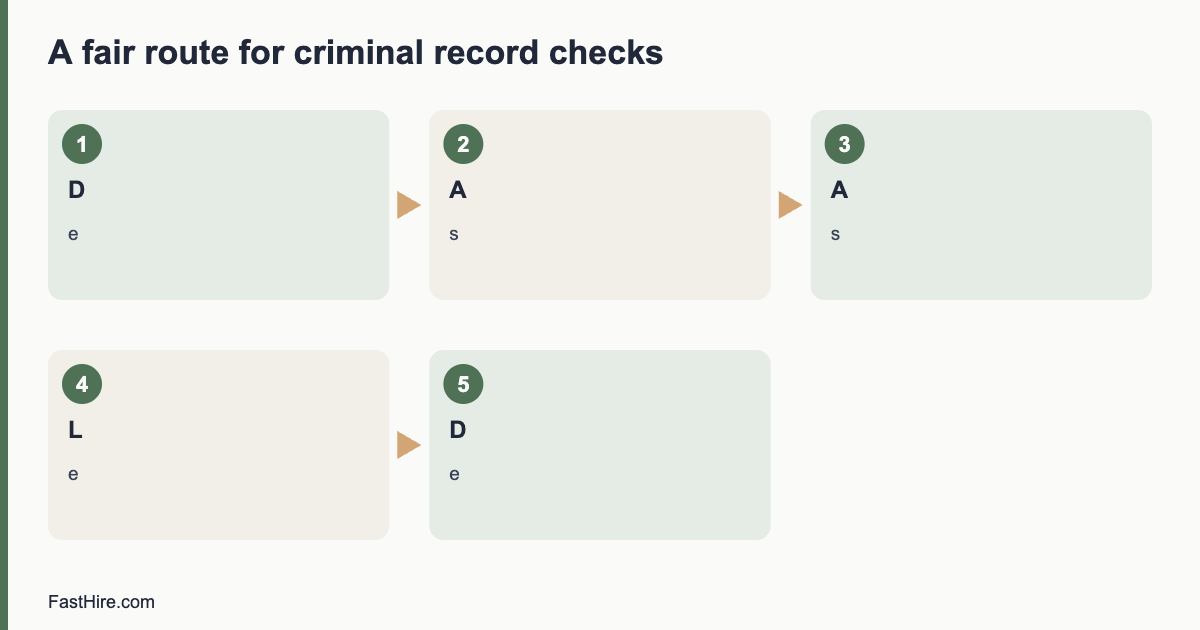
Whether you can ask about criminal records, and when, depends on the country, the state and the job. A fair approach is the same everywhere: check only when the role needs it, ask late in the process, look at how the record relates to the job, let the person explain, and keep a written reason. This guide explains the basics in the US, UK and EU.
Key takeaways
- Rules differ by country, state, city and job. Check the law where the person will work.
- Many places limit when you can ask, which checks you can run and how you can use the result.
- Judge the link between the record and the job, not the label. Consider the type of offence, the time passed and the duties.
- Give the person a chance to explain, and tell them if a result may lead to a rejection.
- Keep records secure and use them only for the purpose you gave.
Why this topic needs care
A criminal record can affect a person chance of work for years. Blanket bans can shut out many capable people, and they can raise discrimination concerns because records are not spread evenly across groups. At the same time, some jobs need checks by law, such as work with children or vulnerable adults, or roles of high financial trust. A fair process protects people, customers and your company.
This article gives general information. Rules change, so confirm them with official sources or an adviser.
Step 1: decide whether the role needs a check
Ask: is a check required by law for this role? If not, is there a real, job-related reason? Write the reason. Examples of reasons might include handling cash, working alone in homes, or access to sensitive data. A job with none of these may not need a check at all.
| Question | If yes | If no |
|---|---|---|
| Is a check required by law or by a regulator for this role? | Run the required check in the way the law states | Go to the next question |
| Does the role involve high trust, safety or sensitive data? | Consider a limited, targeted check, tied to the duties | Do not check |
| Can you reduce the risk in other ways? | Use controls such as supervision or limited access | Consider a check |
| Will you treat everyone in the role the same way? | Proceed with a written policy | Fix the process first |
Step 2: United States
In the US, federal law does not ban all questions about records, but several rules limit how you use them. Title VII of the Civil Rights Act prohibits discrimination, and the EEOC enforces it. If you use a third party to run a background check, the Fair Credit Reporting Act sets steps on notice, consent and what to do before and after taking action. The FTC explains these steps for employers.
Many states and cities have “fair chance” or “ban the box” laws. They may limit when you can ask about a record, require you to consider the link to the job, require written notice before a decision, or ban certain kinds of inquiry. The rules differ widely. Check your state and city labour department for the exact requirements.
Practical points for US employers
- Do not ask about records on the first application form unless the law requires it.
- If you run a check through a provider, follow the notice and consent steps.
- Make an individual assessment: nature of the offence, time passed, and the duties of the job.
- Give the person a chance to respond before you decide, and say what you will do with the information.
- Treat arrests that did not lead to a conviction with great care. Local law may ban their use.
- Apply the same policy to everyone in the same role.
Step 3: United Kingdom
In the UK, the Rehabilitation of Offenders Act lets many convictions become “spent” after a period of time. For many jobs, a person does not need to disclose a spent conviction and you cannot treat it as a reason to refuse. Some roles are exempt and allow questions about spent convictions. The Rehabilitation of Offenders Act is on legislation.gov.uk.
The Disclosure and Barring Service provides criminal record checks at different levels for eligible roles. The GOV.UK guidance for employers on DBS checks explains which checks apply to which roles. You may only request a check if the role is eligible for that level. Data protection rules also apply to how you use and store the information.
Practical points for UK employers
- Find out whether the role is eligible for a basic, standard or enhanced check, or none.
- Ask about unspent convictions only where the law allows it, and ask about spent ones only for exempt roles.
- Ask late in the process, once you have decided to make a conditional offer.
- Write a policy on how you assess a record, and share it with candidates.
- Use the ICO guidance on recruitment and selection for data protection.
Step 4: European Union
In the EU, data about criminal convictions is subject to extra protection under GDPR. Article 10 allows processing only under the control of official authority or when authorised by EU or member state law, with safeguards. You can read the text on EUR-Lex. Each country has its own rules on what employers may ask, which certificate is allowed, and for which jobs. In some countries, employers can ask for an official certificate of good conduct for certain roles. In others, they cannot.
Practical points for EU employers
- Check national law and the guidance of the data protection authority where the person will work.
- Do not collect or store records unless the law allows it for that job.
- If a certificate is allowed, ask for the official one, not a detailed account of the past.
- Collect only what is needed, keep it for as short a time as possible, and delete it.
- Explain the purpose in your privacy notice. See applicant privacy notice template.
See also GDPR for job applicants.
Comparison table
| Topic | US | UK | EU |
|---|---|---|---|
| Is there a general ban on asking? | No single federal ban; state and city laws vary | Depends on spent or unspent status and the role | Strict data rules; depends on national law |
| Official check system | Varies; third party reports covered by FCRA | DBS checks for eligible roles | Varies by country |
| When to ask | Late, if the law requires | After a conditional offer, where permitted | Only where the law allows |
| Assessment required? | Individual assessment recommended | Risk assessment recommended | Proportionality is required by data rules |
Step 5: assess the record fairly
If a record appears, do not decide at once. Use a short, written assessment.
| Question | Why it matters |
|---|---|
| What was the offence and how does it relate to the duties? | A fraud conviction matters for a finance role more than for a gardening role |
| How long ago did it happen? | Time passed shows risk may be lower |
| What has the person done since? | Work, study, training and references show change |
| Can the risk be managed? | Supervision, limited access or training may reduce the risk |
| What does the law require? | Some roles are barred by law |
Involve HR or an adviser in difficult cases. Make the decision with at least two people, and write the reason. Link it to the duties of the job, not to a general view of the person.
Step 6: let the person respond
Before a rejection, tell the person what you found and ask for their view. They may correct an error, give context or show that the record does not relate to the job. A short conversation is fair, and it reduces errors. If you use a third party report, the law in some places requires you to share the report and allow time to respond.
Step 7: keep records and privacy
- Store results securely and limit access to those who need them.
- Keep them only as long as needed. Delete when the retention period ends.
- Do not share the information with others unless the law requires it.
- Keep your policy and reasons in writing.
See how long to keep rejected applicant data.
Wording for forms and messages
| Situation | Wording to adapt |
|---|---|
| Job ad | This role requires a [type of] check, as required by law. We consider each case individually. |
| Application form | We do not ask about criminal records at this stage. |
| Conditional offer | This offer is conditional on a [type of] check, where the law allows. We will tell you about any issue and give you a chance to respond. |
| Policy statement | We assess records fairly, by the link to the job. A record does not automatically bar anyone, except where the law requires it. |
Common mistakes
- Asking about records on the first form for every job.
- Applying a blanket ban with no assessment.
- Running a higher level of check than the role allows.
- Using internet search results or rumour as if they were official records.
- Not telling the person the reason for a rejection that relates to a check.
- Keeping records too long.
Fair processes also protect your company from claims. Our guides on reducing bias in resume screening and how to check references show other ways to base decisions on evidence.
Worked example (fictional)
A building firm hires a site administrator who will handle supplier payments. HR decides that a limited check for fraud-related convictions is relevant, and writes the reason. The ad says that the offer is conditional on a check where the law allows it. After a conditional offer, the check shows an old conviction unrelated to money. HR assesses the offence, the time passed and the duties, and invites the person to discuss it. The person explains the circumstances and provides a reference from a later employer. HR and the manager decide the record does not relate to the role, record the reasons, and confirm the offer.
Roles that usually need checks by law
Some jobs are covered by specific rules. Examples include work with children, work with vulnerable adults, some financial roles and security-regulated jobs. The rules differ by country, and they may require a particular check or certificate. Do not guess. Look up the rule for the role and place, and use only the check that applies. If you are unsure, ask the regulator or an adviser before you ask the candidate.
Using third party providers
Many employers use a provider to run checks. You remain responsible for the result. Choose a provider that explains its sources and methods, follows the law in the place of work and supports corrections. Ask how long it keeps data, how it secures it, and how a person can dispute an error. Never accept a report that is a blend of unverified web searches. Keep your contract with the provider on file.
Fairness checks for your policy
- Do you apply the same policy to every candidate in the same role?
- Does the policy explain which offences matter for which duties?
- Does the process allow a response from the candidate?
- Do you review outcomes by group to see whether the policy has an unfair effect?
- Is the policy short, written in plain words and available to candidates?
Review the policy once a year, and when the law changes. Use official sources, and ask an adviser to check it. A short policy that you follow is better than a long one that you do not.
Frequently asked questions
Can I ask about criminal records on an application form?
In many places the law limits this, or advises against it. Ask late in the process, and only if the role needs it and the law allows it.
Do I have to run a criminal record check?
Only if the law or a regulator requires it for the role. Otherwise it is your choice, and the check should be proportionate.
Can I reject someone because of a conviction?
Sometimes, if it relates to the job and the law allows it. Make an individual assessment and record the reason. Some laws protect people with spent convictions.
What if the person did not tell me about a record?
Check what the law and the form asked. Ask the person to explain. Treat it as a matter of honesty only if the question was proper and clear.
Related guides
This is general information, not legal advice.