Author: fhai

  • What to do when too many people apply: a method for 200 applications

    What to do when too many people apply: a method for 200 applications

    You posted one job and 200 people applied. You have a business to run, and reading every resume takes days you do not have. The fix is a short method: set limits, write down the must-haves, sort by evidence, and keep a person in charge of every decision.

    This guide gives you that method in plain steps, with a time plan, a table you can copy and fair-hiring checks for the US, UK and EU. It works for 50 applications and for 500.

    Key takeaways

    • Decide how many people you can interview before you read a single resume.
    • Write three to five must-haves from the job, and judge each one by evidence in the resume.
    • Do not use rules that exclude people for reasons unrelated to the job, such as gaps or school names.
    • Time-box the work. Two focused sessions beat one long, tired read.
    • Reply to everyone, even with a short message.

    Why too many applications is a problem you can plan for

    A good job ad on a busy board brings many replies. That is normal. The danger is not the number. The danger is what a tired reader does with it: skim for the first thing that feels right, favour people who look like the last hire, or drop everyone after the first 30. None of these is fair, and none finds the best person.

    A method fixes this. It gives you the same questions for every resume, so the pile shrinks for good reasons that you can explain later. If you want to know more about what fair screening rules look like, read how to write fair knock-out criteria.

    Step 1: set your limits first

    Before you open any resume, decide four numbers. Write them down.

    LimitExample (fictional)Why it helps
    Interviews you can run6 first-round callsKeeps the pile from growing without end
    Hours you can spend screening4 hours over two daysKeeps the work in a box
    Minutes per resume3 minutesMakes the screen consistent
    Reply dateWithin 10 working daysKeeps candidates informed

    If you can only interview six people, you do not need to rank 200. You need to find six who clearly show what the role needs. That is a smaller, easier job.

    Step 2: write the must-haves

    Take the job description and pull out three to five must-haves. A must-have is something the person needs on day one, not something you can teach in a month. Write each as a plain sentence.

    Example for a bookkeeper role (fictional): “Has prepared monthly accounts in an accounting package.” “Has handled supplier invoices and payments.” “Can explain a figure to a non-finance colleague.”

    Then list two or three nice-to-haves. Use them only to choose between people who already meet all the must-haves. Do not use them to cut anyone.

    Avoid rules that cut people for the wrong reasons

    • Do not cut people for a gap in work history. A gap does not show lack of skill.
    • Do not cut people for the school they attended or the brand of their last employer.
    • Do not set years-of-experience numbers unless the job truly needs them. They can exclude older or younger people without reason.
    • Do not assume that a long commute, a name or a photo says anything about fit.
    • Do not treat a typo as proof of poor skill unless writing is a core part of the job.

    In the US, the EEOC guidance on employment tests and selection procedures explains that a rule can be unlawful if it excludes a protected group and is not job-related. In the UK and EU, similar principles apply under equality law, so keep your reasons tied to the job.

    Step 3: sort by evidence, not by feeling

    Make a simple sheet with one row per candidate and one column per must-have. For each cell, write one of three marks: clear evidence, some evidence, or no evidence found. Add a short note that quotes or points to the resume line.

    Do the first pass in two sessions of about 90 minutes. Take a break between them. Tired readers become harsher and less fair as the pile grows. Read in a different order in the second session, so that the people at the bottom of the pile get the same fresh eyes.

    CandidateMust-have 1Must-have 2Must-have 3Note
    A (fictional)ClearClearSomeRan month-end close at a 12-person firm
    B (fictional)ClearNo evidenceSomeStrong on invoices, no accounting package named
    C (fictional)SomeClearClearPart-time role; ask about the package

    The point of the sheet is that you can explain every cut. “No evidence of must-have 2 in the resume” is a reason you can write in a note. “Did not feel right” is not.

    Step 4: keep people in charge

    Software can help you read faster, but a person should decide who moves forward. Any tool that ranks, scores or rejects on its own raises legal and fairness risks. In the EU, the GDPR gives people rights around decisions made only by automated means, and the UK has similar rules. See the ICO guidance on recruitment and selection for the UK view.

    FastHire is coming soon. It will show you each job requirement next to the exact CV passage that supports it, so you can check the evidence yourself in seconds. People make every decision. FastHire does not rank, score or reject automatically.

    Step 5: shortlist, reply and record

    Take everyone with clear evidence on all must-haves. If that gives you more than your interview limit, break ties with the nice-to-haves, and write down that you did so. If fewer, review those with “some evidence” on one must-have and ask a short screening question.

    Then reply to everyone. A short message is fine. Send it within your reply date. You will find a template in our guide to how to turn down a candidate kindly.

    Keep your sheet and notes. If a candidate asks why they were not chosen, or complains, you will have an answer. See how to document hiring decisions.

    What if you still have too many?

    • Add one short, job-related screening question to your application form and use it as a must-have.
    • Close the ad early once you have enough strong replies. Say so in the ad.
    • Run a short phone call with the top group before deciding who moves to a full interview.
    • Use a work sample that takes 20 minutes, and apply it the same way to everyone.
    • Hold the rest in a pool, with consent, for a later role. Check how long to keep applicant data.

    Checklist: 200 applications

    • Interview limit and time budget written down
    • Three to five must-haves in plain sentences
    • Rules checked for fairness (no gap, school or brand cuts)
    • Evidence sheet set up
    • Two screening sessions booked
    • Shortlist chosen by a person
    • Reply sent to everyone
    • Notes saved for later

    A worked example: 200 applications, one bookkeeper (fictional)

    Maria runs a small design studio with eight staff. She posts a bookkeeper job on a popular board and gets 212 replies in four days. She has one afternoon a week for hiring.

    She starts with her limits. She can run six first calls and two second interviews. She gives herself four hours of screening, split over two mornings. She writes three must-haves, as in the example above, and two nice-to-haves: experience with her accounting package and comfort with a part-time schedule.

    In the first session she reads 110 resumes at about two minutes each. She fills in her sheet and marks each must-have. About 60 people show clear evidence on all three. About 40 show clear evidence on two. The rest show little. In the second session she reads the other 102 in a different order. At the end she has 92 people with clear evidence on all three must-haves.

    That is still too many for six calls. So she adds one job-related screening question to an email: “Describe how you handled a month-end close that went wrong.” She sends it to the 92 and gives a five-day window. 41 reply. She reads the replies in a random order and finds 11 strong, specific answers. She picks six for calls and tells the other five they are on a short reserve list. She writes this down, along with the reason: “Chosen on strength of screening answer, same question to all.”

    Every other applicant gets a short reply within ten working days. The whole process took Maria about seven hours across two weeks. Nobody was cut for a gap, a school or a name, and she can show why each person did or did not move forward.

    Common mistakes with large pools

    MistakeWhat happensBetter move
    Reading in the same order every timeEarly resumes get fresh eyes, later ones get tired eyesChange the order in each session
    Cutting by a keyword search aloneGood people who use different words are droppedRead for meaning, then use keywords to help only
    Adding new rules half wayEarly and late candidates are judged differentlyFix the must-haves before you start
    Telling no one anythingCandidates chase you and your name suffersSend a date and a short reply to all
    Keeping every resume foreverData risk and legal exposureSet a retention period and delete on schedule

    Using a second reader

    If you can, ask a colleague to read a sample. Give them the same must-haves and the same sheet. Pick 20 resumes at random and compare marks. If you agree on most, your method is clear. If you differ a lot, the must-haves are vague. Rewrite them in plainer words and try again.

    A second reader also catches bias you may not see. If one of you always marks people from a certain school higher, that shows up quickly. This takes about an hour and is worth it for any role you will hold for years.

    Rules for large pools in the US, UK and EU

    In the US, keep your records. The EEOC recordkeeping rules cover hiring records, and the page says what to keep. Check it for the current period. In the UK, the ICO recruitment guidance asks you to be open with candidates about what you do with their data and not to keep it longer than needed. In the EU, the GDPR applies in the same way, so tell candidates how you use their data, collect only what you need and set a deletion date. The text is in Regulation (EU) 2016/679.

    If you hire across borders, apply the strictest practice to everyone. It keeps your process simple and fair.

    How to keep the work light next time

    Save your sheet, your must-have wording and your reply templates as a starter kit. Next time, you will copy them and change only the role details. The first run takes the most time. The second takes half as long, and the third takes less again.

    After each round, note how many people applied, how many met all must-haves, how many you interviewed and how long you spent. After three rounds you will see a pattern. You can then set your limits with confidence, and you will know when to close an ad early or ask one more screening question at the start.

    Last, ask the person you hire how they found the ad and what they thought of the process. A short answer from a new hire tells you more about your process than any guess. Use it to fix the ad, shorten the form or clear up the must-haves. Small changes made after each round add up to a process that handles a large pool with little stress.

    Frequently asked questions

    How long should I spend on each resume?

    Three minutes is enough for a first pass if you have written your must-haves. Spend longer only on the borderline group.

    Is it fair to reject people for typos?

    Only if writing accuracy is a core part of the job. Otherwise a typo says little about skill, and it can unfairly hit people writing in a second language or with dyslexia.

    Do I have to reply to every applicant?

    No law in most places requires it, but it is good practice and protects your name. A short automated or templated reply is fine.

    Can I use software to cut the pile?

    You can use tools to help you read, but a person should make the decision. Avoid tools that rank, score or reject on their own, and check your local rules on automated decisions.

    What if a candidate asks why they were not shortlisted?

    Give a short, honest, job-related reason from your sheet. In the UK and EU they may also ask for their personal data.
    Related guides

  • How to respond to a discrimination complaint from an applicant

    How to respond to a discrimination complaint from an applicant

    A candidate writes to say your hiring process was unfair. They think they were turned down because of their age, race, sex, religion, disability or another protected trait. What you do in the first few days matters more than most employers expect.

    The short answer: acknowledge the complaint quickly, keep every record, have someone who was not involved review the facts against the written requirements, and reply in writing in plain words. Do not argue, do not delete anything, and do not punish the candidate for complaining.

    Key takeaways

    • Reply within a few working days, even if you cannot give a full answer yet.
    • Preserve all records for that hiring round before anyone cleans up.
    • Ask someone who was not in the process to review it.
    • Never treat the candidate worse because they complained.
    • Use your written requirements and notes as the evidence base.

    Why a calm first response matters

    Most applicant complaints do not become legal claims. Many come from a candidate who got a short rejection and no reason. A prompt, respectful reply often ends the matter. A slow or defensive reply can make a small problem larger.

    A complaint can also show you a real gap. Maybe a job ad used biased wording. Maybe a screening question was unclear. Maybe one interviewer asked something they should not have. Treat the complaint as free information about your process, as well as a risk to manage.

    The first 48 hours: step by step

    1. Log the complaint. Write down the date, how it arrived, who received it and what it says. Save the original message.
    2. Send a short acknowledgement. Thank the person, say you take it seriously, and say who will review it and when they can expect a reply.
    3. Tell the people involved to keep everything. That includes the job ad, resumes, notes, scorecards, emails and messages in your hiring tool.
    4. Pick a reviewer who was not part of the decision. In a small business this may be the owner, a trusted adviser or an outside HR consultant.
    5. Do not contact the candidate again from the hiring team until the reviewer has looked at the facts.

    Keep the acknowledgement short. You are not yet saying the complaint is right or wrong. A good example (fictional): “Thank you for your message. We take this seriously. Sam Ortiz from our HR team will review how we handled your application and reply in writing within five working days.”

    What not to do

    • Do not delete or edit old notes. If you add anything, date it and mark it as added later.
    • Do not tell the candidate they are wrong before you have checked.
    • Do not discuss the complaint in open team chats.
    • Do not warn, threaten or ignore the candidate. Treating someone badly because they complained is a separate problem in most countries.
    • Do not offer money or promise a job in the first reply. Speak to a lawyer first if that is on the table.

    What to preserve

    Make a folder for the hiring round and add everything. This is the evidence both for and against you, so collect it all.

    RecordWhy it matters
    Job ad and job descriptionShows the stated requirements and the wording used
    Candidate resume or CV and cover letterShows what the candidate actually submitted
    Screening notes and scorecardsShows how each requirement was judged
    Interview notesShows what was asked and what was said
    Emails and messages with the candidateShows tone, timing and what was promised
    List of other candidates and outcomesShows whether the same criteria were applied to all
    Decision recordShows who decided and why, with dates

    If you already keep decision records, this step is quick. If you do not, read how to document hiring decisions and start with your next round. Good notes are the best protection for both sides.

    Review the facts against the requirements

    The reviewer should answer five plain questions. Write the answers down.

    1. What were the written requirements for the role?
    2. Did the candidate meet each one, based on the resume and any interview evidence?
    3. Were the same requirements used for every candidate?
    4. Is there any comment, question or wording that refers to a personal trait unrelated to the job?
    5. Who made the decision, and did they record a reason linked to the requirements?

    If the record shows a clear, job-related reason applied to everyone, you can say so calmly. If the record is thin or shows a problem, say that to yourself first. It is better to know now than to find out later.

    Be careful with knock-out rules. A rule that looks neutral can still exclude one group more than others. For example, a strict rule about continuous work history can hurt people who took time out for caring. Our guide to fair knock-out criteria explains how to check this.

    How legal routes differ in the US, UK and EU

    You do not need to be a lawyer to respond well, but you should know the general shape of the routes the candidate could take. The details change by country and by type of complaint, so use the official pages linked here as your starting point.

    United States

    Federal law bans discrimination in hiring on several grounds. The EEOC list of prohibited practices shows the main ones. A candidate can usually file a charge with the EEOC or a state or local agency, and there are time limits. Check the EEOC site for how a charge works. Employers must also keep hiring records. The EEOC recordkeeping page says what to keep and, in general, that records should be kept once a charge is filed until the matter is resolved. Read the page for the exact rule.

    United Kingdom

    In Great Britain, the Equality Act 2010 protects job applicants from discrimination on protected characteristics. Acas recruitment guidance gives practical help for employers, and Acas also runs early conciliation services. Northern Ireland has its own equality laws, so check local guidance if you hire there. A candidate may also ask for their personal data. See how to handle a candidate data access request.
    European Union

    EU directives set a baseline against discrimination at work, including Directive 2000/78/EC on religion, disability, age and sexual orientation, and Directive 2000/43/EC on racial and ethnic origin. Each member state turns these into its own law, so the route a candidate takes depends on the country. It may be a labour court, an equality body or another national body. Ask local counsel or your national equality body which route applies where you hire.

    Write the reply

    Your reply should be short, clear and in plain words. It should do four things: thank the candidate, explain what you checked, say what you found, and say what happens next.

    Here is a simple structure to adapt.

    1. Thank them for raising it and confirm it was reviewed by someone not involved in the decision.
    2. Say what you looked at: the written requirements, their resume, the notes and the way all candidates were assessed.
    3. Give the outcome in neutral words. For example: “The decision was based on the requirement for X, which the role needs.” Or: “We found that one question should not have been asked, and we are changing our process.”
    4. Say what you are changing, if anything.
    5. Give a contact for follow-up, and tell them they may seek independent advice.

    Do not copy long passages of internal notes into the reply. Do not name other candidates. Do not guess at motives. Keep to facts that link to the requirements.

    When you find a problem

    Sometimes the review shows that the candidate was treated unfairly. In that case, say so in neutral words, and speak to a lawyer before you offer any remedy. Common fixes include inviting the person to a fresh interview with a different panel, correcting the record, and changing the process for everyone. Do not promise a job or payment before you have legal advice.

    Fix the process

    Whatever the outcome, use the complaint to improve. Hold a short review within two weeks and ask four questions. Where did the process lack a clear rule? Where did the notes fall short? Was any wording in the ad or screening open to a biased reading? What one change would make the next round safer?

    Common fixes are small. Add a requirement-by-requirement scorecard. Add a line to the interview guide listing topics to avoid. Run an inclusive job ad check before posting. Train interviewers in a short session. Check the interview notes template.

    Where FastHire fits: FastHire is coming soon. It will show you each job requirement next to the exact CV passage that supports it, so your notes can point to evidence. People make every decision. FastHire does not rank, score or reject automatically.

    Checklist: applicant complaint

    • Complaint logged with date and original message saved
    • Acknowledgement sent within a few working days
    • Hold placed on all records for the hiring round
    • Reviewer chosen who was not in the decision
    • Facts checked against written requirements
    • Reply written in plain words and sent
    • No negative treatment of the candidate for complaining
    • Process change agreed and recorded
    • Lawyer consulted if the facts look serious or a formal claim is made

    Talking to the people involved

    The interviewers and the hiring manager will feel defensive. That is normal. Meet each of them alone, for about twenty minutes, and keep to the same short list of questions. What did you ask? What did you write down? Why did you decide as you did? Did anything come up that was not about the job?

    Take notes of what they say. Do not suggest answers. Do not tell one person what another said. The aim is to learn the facts, not to find someone to blame. If an interviewer admits to a bad question, thank them for being open and record it. A team that expects to be punished for honesty will hide problems next time.

    Remind everyone that the complaint is confidential. Share details only with people who need them to do their part. Remind them also that the candidate must not be treated worse because they complained. That includes informal comments, jokes and notes in a talent pool.

    If the candidate escalates

    Some candidates will not accept your reply and will go to a regulator, an equality body or a lawyer. If this happens, do not panic and do not change the story. Give your lawyer the full record folder, the timeline and your written reply. Answer official requests on time and keep to the facts.

    Keep one named person in charge of all contact. Mixed messages from several managers cause harm. Tell the hiring team to send any contact from the candidate, a regulator or a lawyer to that person without replying themselves.

    Check any insurance or legal support your business has. Some small businesses have cover that includes employment claims, and the policy may require quick notice. Look at this early, since delay can cause problems with cover.

    A short timeline you can copy

    WhenActionOwner
    Day 0Log the complaint, save the message, send acknowledgementHR or owner
    Day 1Tell the team to keep all records, assign a reviewerHR or owner
    Days 2-3Collect records, talk to interviewers one by oneReviewer
    Days 4-5Check facts against the requirements, draft the replyReviewer
    Day 5-7Send the written reply, agree process fixesHR or owner
    Within 2 weeksHold a short review and update templatesHR and hiring manager

    These timings are a practical guide, not a legal rule. Adjust them to your size. A founder hiring alone can do the whole list in two days. A larger team may need two weeks. What matters is that each step happens, is dated and is written down.

    Frequently asked questions

    How fast should I reply to an applicant who says they were discriminated against?

    Send an acknowledgement within a few working days and give a date for the full reply. There is no single legal deadline for the first reply, but a fast, polite response lowers tension and shows you take it seriously.

    Should I involve a lawyer?

    Speak to a lawyer if the candidate mentions a lawyer, a regulator, a tribunal or court, or if your own review finds a real problem. For a simple misunderstanding, a clear reply from HR is often enough.

    Can I keep the records of a rejected candidate who complains?

    Yes, and you should keep them for that hiring round until the matter is resolved. Do not delete records because of a complaint. Check retention rules for your country and read how long to keep rejected applicant data.

    Can the candidate see my interview notes?

    In the UK and EU, a candidate can ask for their personal data, which may include notes about them. In the US, access rights vary by state and context. Write notes that you would be comfortable showing the person.

    What if the complaint is wrong?

    Say so politely, based on the facts and the written requirements. Do not accuse the candidate of lying. Offer a contact for follow-up and keep the records.

    Related guides

    This is general information, not legal advice.

  • How to document hiring decisions so they stand up to review

    How to document hiring decisions so they stand up to review

    Document a hiring decision by recording the requirements and weights before you start, the evidence and score for each candidate against each requirement, the reasons for the final choice in terms of those requirements, and the dates and people involved. Keep it factual, store it securely, and delete it on schedule. Good records protect candidates, managers and the company.

    Key takeaways

    • Write the requirements and weights before screening, and keep them unchanged unless you change them for everyone.
    • Record evidence and a score per requirement, not general impressions.
    • State the reasons for the decision in terms of the requirements. Record any dissent.
    • Write notes that you would be happy for the candidate to read. Avoid comments on personal traits.
    • Keep records for the period the law and your policy require, protect them, and delete them on time.

    Why documentation matters

    Records serve three purposes. They help you make a better decision, because writing forces you to link choices to evidence. They help you explain the decision to candidates and to your team. And they help you respond if someone challenges the process, whether a candidate, a regulator or a court. In many places, an employer who cannot show the reason for a decision finds it hard to rebut a claim of unfair treatment.

    Records are also personal data. In the UK and EU, candidates have rights to see their data. In the US, some states give applicants rights, and federal rules require some records to be kept. See candidate data access requests and applicant data retention. Write with these points in mind.

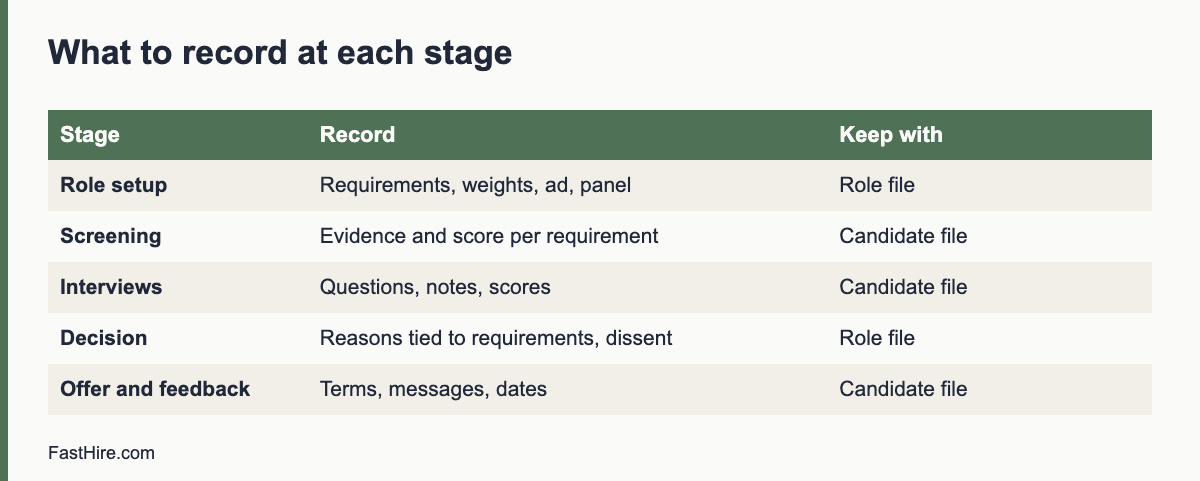
    What to record, stage by stage

    Role setup

    • The role brief and the reason for the vacancy.
    • Requirements (must-haves and nice-to-haves) and their weights.
    • The ad as published, with date and channels.
    • The panel and each person role.
    • The scorecard template and scoring scale.
    • The process steps and timeline.
    • Any adjustment offers and legal checks planned.

    Screening

    • For each applicant: the evidence found for each must-have and the score.
    • The reason for each decision to move forward or not, linked to the requirements.
    • Any knock-out rule used, and the reason. See fair knock-out criteria.
    • The date of each decision.

    Interviews

    • The questions asked (the same core set for all).
    • Short notes of what the candidate said, as evidence, per question.
    • The score per requirement, given before the debrief.
    • Any adjustments provided, without medical detail.
    • The date, the format and the interviewers.

    Decision

    • The grid of scores and the final decision.
    • The three or so main reasons, linked to requirements.
    • Any dissent or concern, and how it was resolved.
    • The tie-break rule used, if any.
    • Who made the decision, and the date.

    Offer and feedback

    • The offer terms, with the pay range and how the number was set.
    • Notes of the offer conversation and the answers given.
    • Messages to successful and unsuccessful candidates, and the feedback given.
    • Checks done (references, right to work) and their results, stored separately as needed.
    x

    How to write notes that stand up

    Good notes are short, factual and job-related. Compare these examples.

    Weak noteStrong note
    Seemed nervous, not very confident.Gave one example of leading a project. Did not give the result when asked.
    Not a good fit.Scored 1 on handling escalations: described general approach, no example.
    Too old for this job.(Never write this. Record only job-related evidence.)
    Great energy, I liked her.Explained supplier negotiation clearly with two examples (scored 3 on supplier work).
    Has kids so may be unreliable.(Never write this. Ask about availability for the real schedule instead.)

    Write notes during or right after the interview. See how to take interview notes. Never record protected traits, health details, family situation, religion or similar matters unless a specific lawful need exists, such as an adjustment, and then record only what is needed.

    A decision record template

    FieldEntry
    Role and reference
    Date of decision
    Panel members and roles
    Requirements and weights (attach)
    Candidates considered (IDs)
    Decision (who is offered / not progressed)
    Main reasons (3 bullet points tied to requirements)
    Concerns or dissent and how resolved
    Tie-break rule used (if any)
    Adjustments offered (yes/no)
    Checks required before start
    Feedback to candidates sent on
    Retention date
    Recorded by / reviewed by

    Who can see the records

    • The hiring manager, the recruiter, HR and the panel can see what they need for their role.
    • Share scores and notes on a need-to-know basis.
    • Keep sensitive data (such as adjustment details or monitoring data) apart from scoring records, with tighter access.
    • Do not share candidate records with people outside the hiring process.
    • Keep an access log for sensitive files where possible.

    Legal and regulatory points

    In the US, EEOC rules require employers to keep personnel and employment records for a period, and longer if a charge is filed; see the EEOC recordkeeping requirements. In the UK and EU, data protection rules require you to keep data no longer than necessary and to be able to justify your period; see the ICO guidance on recruitment and selection. Discrimination laws apply to the process; see GOV.UK employing people. Take local advice for your setting.

    Pause deletion when a dispute is possible

    If a candidate complains, a claim is made or a regulator asks questions, pause deletion of related records and tell HR. Do not alter notes after the fact. If you must correct an error, add a dated correction and keep the original. Deleting or changing records during a dispute can cause serious trouble.

    Using tools to help with records

    Applicant tracking systems can store scores, notes and messages in a structured way. Check that the tool allows export, access control and deletion on schedule. If a tool suggests a ranking or a decision, record what the person decided and why, and do not simply copy the suggestion. Keep people responsible for decisions. See choose recruiting software and ATS compliance checklist. FastHire is coming soon and is designed to keep evidence next to each requirement, with people making every decision.

    Common mistakes

    • Writing notes after the decision to justify it.
    • Recording opinions about personal traits.
    • Keeping scores in personal notebooks that no one can find.
    • Changing requirements or weights after seeing candidates.
    • Keeping records for ever, or deleting them too early.
    • Failing to record why a candidate was rejected at screening.
    • Storing sensitive data with scoring data.

    Checklist

    • Requirements and weights were written before screening.
    • Each candidate has evidence and a score per requirement.
    • Interview questions and notes are saved.
    • The decision record states reasons and dissent.
    • Feedback and offer messages are saved.
    • Sensitive data is stored apart with limited access.
    • A retention date is set and deletion is scheduled.
    • Records are paused from deletion if a dispute is possible.

    Worked example (fictional)

    A hiring manager chooses between two finalists for an operations role. Before the process, she recorded four requirements with weights. During interviews, each panelist scored alone and wrote one line of evidence per requirement. At the debrief, the grid showed a difference on supplier work. The panel agreed the evidence and scored accordingly. The decision record states: offered to Candidate B, because of stronger evidence on supplier negotiation (weight high) and on planning (weight high), while A was stronger on reporting (weight medium). One panelist noted a concern about team coaching for B, to be handled in the 90-day plan. The record is saved, and months later, when A asks for feedback, the manager has clear, fair points to share.

    Records for hiring across the US, UK and EU

    If you hire in more than one country, keep one core record format and add a short local note. The core record is the same everywhere: the requirements, the evidence, the decision and the reason. The local note covers who may see the record, how long you keep it and where it is stored.

    In the US, the EEOC recordkeeping rules set minimum retention for hiring records. Check the current period on that page and use it as your floor. In the UK, there is no single fixed period for hiring records. The ICO guidance on recruitment and selection asks you to keep personal data only as long as you need it, and to be able to explain your choice. In the EU, the GDPR sets the same storage limitation principle, and national rules can add detail. Read Regulation (EU) 2016/679 and check the rules in each country where you hire.

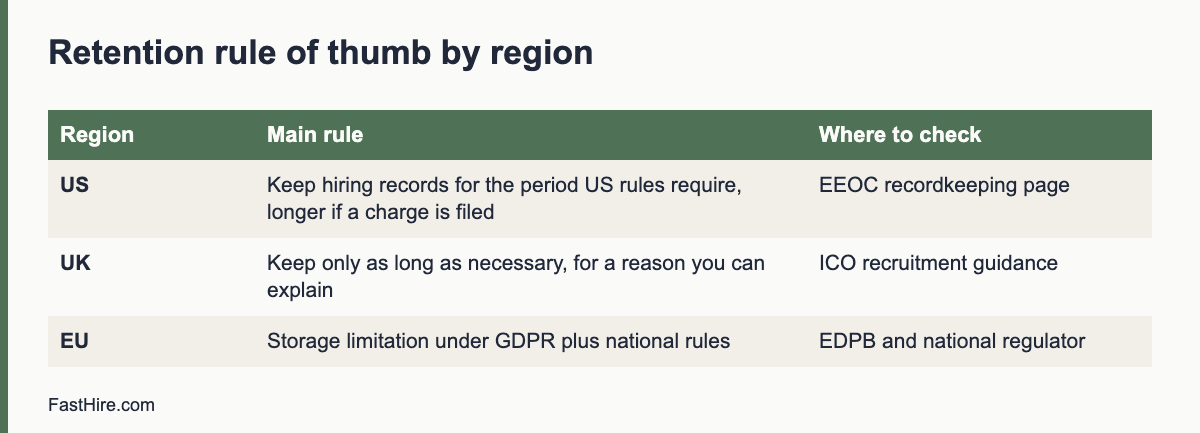
    Set the period once per country, write it in your retention schedule, and apply it the same way to every candidate. For a longer look at this, see how long to keep applicant data in the US, UK and EU.

    Who should review the records

    A record nobody reads is only a file. Pick one person to check a small sample each quarter. This should not be the hiring manager who wrote the notes. A recruiter, an HR partner or a second manager works well.

    Ask the reviewer to look for four things. First, does each decision point to at least one requirement from the job description? Second, is each reason based on evidence the candidate gave you, such as a resume line or an interview answer? Third, are the same criteria used for every candidate in the same hiring round? Fourth, are there any comments about age, health, family, religion, origin or other personal traits that have no link to the job?

    If the reviewer finds a gap, fix the process, not the person. Add a line to the template, run a ten-minute briefing, or add a reminder to the scorecard. Small changes work better than long policy documents that managers do not read.

    A simple sampling plan

    • Pick five closed hiring rounds each quarter, across different teams.
    • From each round, read the decision record for the person hired and for two people who were not.
    • Mark each record as complete, partly complete or missing key parts.
    • Share the pattern with managers in plain terms. Name the most common gap and the fix.
    • Track the share of complete records over time so you can see whether training helps.

    How to train managers to write good notes

    Most managers do not skip notes because they are careless. They skip them because it feels like extra work after a long day of interviews. Make the task short and give them a format they can fill in within five minutes.

    Use a three-line habit. Line one: the requirement being tested. Line two: what the candidate said or showed. Line three: how that compares with what the role needs. That is enough. Long paragraphs are not needed, and neither are guesses about personality.

    Show two short examples in training. One weak note and one strong note, both about the same fictional candidate (fictional). The weak note says, “Not a good fit, did not seem keen.” The strong note says, “Requirement: manage a budget. Candidate described running a small team budget in her last role and named how she tracked spend. Meets the requirement.” The difference is clear in a few seconds.

    Also tell managers what to leave out. Do not record guesses about health, family plans, age, accent or background. If something like this comes up in conversation, do not write it down, and tell HR. Our guide to pregnancy and gender interview questions shows how these topics creep into interviews and what to do.

    What to do when a record is missing or weak

    Sometimes you find a gap after the decision. A manager did not write notes, or the notes only say “good chat”. Do not rewrite history. Never add notes later and date them as if they were written at the time. Instead, add a dated note that says what you found and what you did to fix it.

    If the candidate has not yet been told the outcome, ask the interviewers to write down what they remember about the evidence, mark the note as written after the event, and check the decision again against the requirements. If the decision no longer holds up, change it before you tell the candidate. A late note is better than none, as long as it is honest about when it was written.

    Then fix the cause. Was the template too long? Did the manager not know it was required? Did the tool make the notes hard to find? One fix at the source saves many gaps later.

    Frequently asked questions

    What should a hiring decision record include?

    The requirements and weights, evidence and scores per requirement, the reasons for the decision, dissent, the people involved and the dates.

    Can candidates see my notes?

    In the UK and EU, a candidate can usually ask for their personal data, which may include notes. Some US states give similar rights. Write notes that are fair to read.

    How long should I keep hiring records?

    It depends on the law and your policy. In the US, federal rules require a period for employment records. In the UK and EU, keep data only as long as necessary. See our retention guide.

    Is it enough to keep only the final decision?

    No. Keep the evidence and the reasons, or you cannot show how you reached it.

    Related guides

    This is general information, not legal advice.

  • Fair hiring for older workers and career returners

    Fair hiring for older workers and career returners

    Hire career returners and older workers fairly by removing barriers in the ad and the process, assessing current skills with evidence rather than assumptions about age or time away, using the same scorecard as for every candidate, and offering a supported start. This widens your pool, protects you from age discrimination claims, and often brings strong, reliable people into the team.

    Key takeaways

    • Assess skills and evidence, not age, time away or job titles.
    • Remove barriers: age-linked ad wording, long experience caps, rigid hours and hard forms.
    • Offer ways to show current skills: a short work sample, a structured interview, or a returner programme.
    • Use the same scorecard and process as for all candidates.
    • Support the first months with a plan, a buddy and honest feedback.

    Who we mean

    Career returners are people coming back to work after a break, often for care, health, study, travel or relocation. Older workers are people later in their careers, who may be changing roles, returning after retirement or looking for flexible work. The groups overlap, but they are not the same, and neither group is uniform. Treat each person as an individual with skills to show.

    Both groups can face assumptions: that skills are out of date, that they will not fit, that they will cost more, or that they will leave soon. Assumptions are not evidence. The aim is to replace them with checks that apply to everyone. See age discrimination in hiring and career gaps and job hopping.

    The legal background in brief

    • US: the Age Discrimination in Employment Act protects applicants and employees aged 40 and over. See the EEOC age discrimination page. Disability, sex and other laws may also apply to a returner who took leave for related reasons.
    • UK: the Equality Act 2010 protects against age discrimination at any age, and also covers disability, sex, pregnancy and maternity. See GOV.UK employing people.
    • EU: the Employment Equality Directive prohibits age discrimination in employment, applied by national law. See EUR-Lex and the EU equal treatment guide.

    Barriers to remove

    BarrierWhere it shows upFix
    Age-linked wordingAd: “digital native”, “young team”, “recent graduate”Skills-based wording. See inclusive job ad check
    Experience caps“Up to five years of experience”State the skill level needed instead
    Rigid hoursFixed start with no flexibilityState flexibility honestly; offer part-time or phased starts where the job allows
    Hard application formLong forms, no mobile optionShort, accessible form. See accessible job applications
    Gap penaltyScreening filter on employment gapsRemove; ask about skills
    PedigreeRecent employer brand or schoolFocus on tasks and results
    Assumptions in interviews“Will you cope with a younger manager?”Use structured questions and a scorecard
    x

    Assess current skills with evidence

    The real question behind most worries is “Can this person do the job now?” Answer it with evidence.

    • A structured interview with behavioural questions, scored on a fixed scale. See structured interviews.
    • A short, job-related work sample, scored on a fixed scale and given to all finalists. See work sample tests.
    • A look at recent learning: courses, volunteering, projects, freelance work, self-study.
    • A reference from any recent work or project, paid or unpaid.

    Avoid asking for proof only from returners and older workers. Ask all candidates for evidence of current skills. If you create a special route, such as a returner programme, say clearly that it is open to everyone who meets the criteria, and describe the benefits.

    Returner programmes: how to run one

    Some employers run returner programmes, sometimes called returnships. They are paid, time-limited roles with support, aimed at people who have been out of work for a period. They can be a good way to bring strong people back and to assess fit in practice. Design them with care.

    1. Be clear on the purpose: a route to a permanent role, a training placement, or both.
    2. Pay fairly, and follow the minimum wage and employment status rules where you operate. Do not use unpaid placements to avoid pay duties. See employee or contractor.
    3. Open the programme to anyone who meets stated criteria, not only to people of one sex or age. Take advice before you target a group, because rules on positive action differ by country.
    4. Give a clear plan for the placement, using a version of the 30-60-90 day plan.
    5. Assign a buddy and a manager who understand the aim.
    6. Review progress at set points and decide on a permanent role on evidence.

    Interview practice for returners and older workers

    AvoidAsk instead
    How do you feel about reporting to someone younger?Describe how you work with a manager whose style differs from yours.
    Will you be able to keep up with new technology?Tell me about a time you learned a new tool or process for work. What did you do?
    Why did you take so long away from work?Tell me about anything you have done since your last role that relates to this job. (Offer this to all candidates with a gap, and accept if they say it is private.)
    How many more years do you plan to work?Not asked
    Are you overqualified for this job?What attracts you to this role at this stage of your career?
    Do you have young children at home?Not asked. Say what the schedule needs and ask if they can meet it.

    See interview questions you cannot ask.

    Pay, level and offers

    Set the offer by the job and the range. Do not offer less because the person has been away, or because you think they will accept less. Do not offer more to match a past salary without reason. Explain how you set the number. Review the offer against others in similar roles to avoid unexplained gaps. See how to set a fair salary and pay transparency in hiring.

    Flexible work and adjustments

    Returners and older workers may ask about part-time hours, phased starts, remote days or adjustments for health. Treat requests as normal planning, based on what the job needs. Where a health condition or disability is involved, adjustments may be a legal duty. See reasonable adjustments in interviews and ADA and hiring. Keep health information private and share it only as needed to arrange support.

    Support in the first months

    • A clear plan with a few goals and review dates.
    • A buddy who can answer small questions.
    • Time to learn systems, with training if needed.
    • Honest feedback early, so that problems are fixed when they are small.
    • A check-in at 30, 60 and 90 days on how the person feels and what they need.

    See first 30 days onboarding.

    Measure and improve

    Track applications, interviews, offers and retention for returners and older workers, where the law and privacy allow. Compare with other groups. If a stage shows a gap, review the wording, criteria and scoring there. Ask returners and older hires for feedback on the process. Share what you learn with managers. Improve one thing at a time.

    Checklist

    • The ad uses skills-based, age-neutral wording and welcomes returners.
    • The form is short and accessible.
    • Screening ignores age signals and gaps; it scores evidence.
    • Interviews are structured, with the same questions for all.
    • A work sample or other evidence of current skills is offered to all finalists.
    • Pay is set by the job and the range.
    • Flexibility and adjustments are discussed openly.
    • A support plan is ready for the start.
    • Outcomes are reviewed.

    Worked example (fictional)

    A software firm wants to hire a project coordinator. It posts the role with skills-based wording and a line that says people returning to work are welcome to apply. One applicant has been out of paid work for six years, after caring for a relative, and has run a volunteer fundraising project. The panel scores all finalists using the same scorecard and a short scenario task. The returner scores highest on planning and communication and receives the offer. The manager sets a 30-60-90 day plan and pairs her with a buddy. At 90 days, the team reports that she has taken over the project calendar, and the manager shares the process with other teams.

    Myths and what to do instead

    MythWhat to do instead
    Older workers will not learn new tools.Ask every candidate for an example of learning a new tool. Score the example.
    Returners have lost their skills.Use a work sample and structured questions for all finalists.
    Older workers cost too much.Pay follows the job and range, not the age. Compare total cost with the value of the skills.
    They will retire soon.Do not ask. People of all ages leave jobs, and plans change.
    Younger staff will not accept them.Set team norms based on roles and respect, and support the transition.
    A break shows lack of commitment.Look at the reason only if it is relevant and offered, and judge the evidence.

    The point is not to give anyone an advantage. It is to remove untested assumptions that block capable people. Use the same evidence for everyone and let the best match win.

    How managers can prepare

    Managers set the tone in the first weeks. Brief them before a returner or an older worker joins. Explain the plan, the support and the aim. Ask them to give regular feedback, to avoid jokes about age or time away, and to treat the person as a full member of the team from the start. Ask them to watch for signs that the person is not getting the same chances as others: left out of meetings, given only simple tasks, or not offered training. Give them a way to raise questions with HR. A short briefing and a check-in at 30 days are enough to avoid most problems.

    Mentoring in both directions

    Returners and older workers often bring deep knowledge of customers, process or industry. Newer colleagues may bring recent tools and methods. Set up learning in both directions. Pair people for short projects, or ask each to share one skill with the team. This lifts everyone, avoids a sense of one group being a charity case and builds respect across ages. Make it a normal part of work, not a special scheme.

    Knowledge, succession and planning

    If you rely on older workers for key knowledge, plan for it. Capture knowledge in writing and in training, and share it widely. Do not push anyone out or ask about retirement plans to do so. Offer phased or flexible work if people want it and the job allows. Treat requests about hours or roles fairly and in writing. Seek advice on pension and benefits rules in your country, because some rules are tied to age and differ by place.

    End with a simple promise to yourself: every time you feel doubt about a candidate who has been away or who is older, write down the doubt, turn it into a question about the job, and test it with evidence. Often the doubt fades. Sometimes it points to a real gap that you can address with training or support. Either way, the decision rests on facts, which is fairer to the candidate and better for your business.

    Frequently asked questions

    Is it legal to run a returner programme?

    Yes, in many forms, if it is open on fair criteria and follows pay and employment rules. Take advice before targeting a particular group.

    Can I ask why a person has a gap?

    You can ask a neutral open question if it is relevant to the job, but you must accept that they may keep it private. Do not ask about health, family plans or other protected topics.

    How do I check that skills are current?

    Use a structured interview and a short work sample for all finalists, and look at recent learning and projects.

    Is it age discrimination to prefer younger candidates?

    Preferring candidates because of age is unlawful in most circumstances. Judge skills and evidence, not age.

    Related guides

    This is general information, not legal advice.

  • How to write fair knock-out criteria

    How to write fair knock-out criteria

    Knock-out criteria are yes or no questions that end an application if the answer is no, such as “Do you have the right to work in this country?” or “Do you hold a valid driving licence?” Use them only for requirements that the job truly needs, that you can check objectively, and that you apply to everyone in the same way. Keep them few, and let a person review the results.

    Key takeaways

    • A knock-out must be a real, legal or practical must-have for the job, not a preference.
    • Make it objective and checkable, with a fair way to answer and a route for adjustments.
    • Apply the same knock-outs to all applicants, in the same order.
    • Avoid proxies for protected traits, such as “years since graduation” for age or “native speaker” for origin.
    • Keep a person in charge. Review rejected applications, and check outcomes by group where the law allows.

    What knock-out criteria are

    Many application forms and tracking systems include screening questions that filter people out. Some are fair and useful. Others are blunt tools that remove capable people for no good reason, or that fall harder on some groups. Because knock-outs act before anyone reads the application, their effect can be large. A bad rule affects many people quickly.

    In some places, automated rejection is also regulated. Under GDPR Article 22, people have rights when a decision is made solely by automated means with legal or similarly significant effects; see automated decisions about applicants under GDPR Article 22. In the US, rules on automated tools vary by place, such as New York City Local Law 144. Keep a person responsible for outcomes.

    The fairness test: five questions

    1. Is it needed? Would the job be impossible or unlawful to do without it? If not, make it a nice-to-have.
    2. Is it objective? Can the answer be checked with a fact, not a feeling?
    3. Is it applied to everyone? Same question, same order, same rule for all.
    4. Is there a fair way to answer? Can people with different needs and routes answer it? Is there an adjustment route?
    5. Can a person review it? Is there a human check for borderline cases and complaints?

    If a criterion fails any one of these, change it or remove it.

    x

    Examples of acceptable knock-outs

    CriterionWhy it can be acceptableHow to word it
    Right to work in the countryLegal duty (checked in a lawful way)Are you legally able to work in [country]? (Ask in the way local law allows; check documents after the offer.)
    Required licence or registrationLegal or regulatory dutyDo you hold [named licence], or can you obtain it before the start date?
    Availability for fixed shiftsOperational needThe role requires work on [shift pattern]. Can you work this pattern?
    Location or travelOperational needThis role is based in [place] and requires travel [frequency]. Can you meet this?
    Minimum age set by law for the taskLegal limit for the workCheck age only where the law sets a limit and after a conditional offer, if possible.
    Essential certification for safetyLegal or safety dutyDo you hold [named certification] or an equivalent?

    Even these can be framed fairly. For example, “or equivalent” shows openness to other routes, and “or can obtain before the start date” avoids shutting out capable people who are in the process.

    Examples of risky knock-outs and better choices

    Risky knock-outWhy it is riskyBetter choice
    Degree required (for a job that does not need it)Excludes people with other routes; may have unequal effectsAsk for skills evidence; make a degree a nice-to-have
    At least X years of experienceMay exclude capable people and can act as an age proxyAsk for specific tasks done and results
    Graduated within the last X yearsDirect age proxyRemove
    Native English speakerOrigin proxyCan write clear emails and speak with customers in English
    Currently employedPenalises people who lost jobs, are returning or changing fieldsRemove
    No gaps in employmentPenalises carers, people with health needs and othersRemove. Ask about skills
    Salary expectation within rangeCan exclude people for the wrong reasons if used as a hard filterShow the pay range in the ad. Let candidates decide
    Willing to work any shift, any timeMay exclude carers, students and people with health needsAsk for the actual shift pattern needed
    Clean criminal recordOften unlawful or restricted; see rules in each countryUse only checks the law allows, late in the process

    See criminal record checks in hiring, age discrimination in hiring and career gaps and job hopping.

    The legal background in brief

    Selection rules that disadvantage a group without a job-related reason can be unlawful. In the US, the Uniform Guidelines on Employee Selection Procedures describe how to treat selection tools, and the EEOC page on employment tests and selection procedures explains the idea of job-relatedness. The current federal enforcement position on disparate impact has changed, but intentional discrimination remains unlawful, and state laws may add duties. In the UK, indirect discrimination under the Equality Act requires a rule to be a proportionate means of achieving a legitimate aim; see GOV.UK employing people. In the EU, national law applying the equal treatment directives has similar tests. Our guides on disparate treatment and disparate impact and the four-fifths rule explain related ideas.

    How to write the question

    • Ask about the requirement, not the person: “Can you work this shift pattern?” not “Do you have children?”
    • Keep to yes or no questions with an optional comment box for context or adjustments.
    • Offer “or equivalent” where other routes can meet the need.
    • Add a line: “If you need an adjustment to apply, contact [name].”
    • Explain why you ask, in one line, so applicants understand.
    • Never ask for protected traits as a knock-out.

    Build a review step

    Do not let a rule reject people without any human check. At least review a sample of rejected applications each week. Ask: did the rule act as intended? Did it reject anyone who clearly could do the job? Did anything look odd? Allow people to challenge a rejection: a contact address, a short route for review. For high-volume roles, review a sample large enough to spot patterns. Record what you check and what you change.

    Monitor the effect

    Track the pass rate of each knock-out by stage. If one rule rejects far more people than expected, check the wording and whether the requirement is truly needed. Where the law allows, compare pass rates by group, using optional monitoring data kept apart from the hiring team. If a rule has an unequal effect, look for a fairer way to meet the same need. Keep records of what you did.

    Knock-outs and tools

    If your tracking system applies knock-outs automatically, ask the supplier how they work: which fields are used, whether they use any inferred data, and whether the system shows you rejected applications. Switch off any automatic rejection you cannot explain. If you cannot review rejected applications, you cannot check fairness. See choose recruiting software and the ATS compliance checklist. FastHire is coming soon, and it is designed to show evidence next to each requirement, with people making every decision and no automatic rejection.

    Checklist

    • Each knock-out passes the five-question fairness test.
    • Wording is neutral and offers “or equivalent” where possible.
    • The same knock-outs apply to all applicants.
    • An adjustment route and contact are given.
    • Rejected applications are sampled and reviewed by a person.
    • Pass rates are tracked by stage and, where lawful, by group.
    • The list is reviewed each time the role changes.

    Worked example (fictional)

    A care provider hires support workers. Its form had five knock-outs: a degree, two years of care experience, a driving licence, “open availability” and “no gaps in employment”. The recruiter runs the fairness test. The degree is not needed, so she removes it. Experience becomes a nice-to-have with a question about tasks done. The driving licence stays for roles with home visits, with an “or can travel by another reliable means” option. “Open availability” becomes the actual rota pattern. “No gaps” is removed. She adds a review step: each week she reads a sample of applications that did not pass. After a month, the share of applicants reaching interview rises, and the manager finds the quality of hires is as high as before.

    Knock-outs versus scoring: which to use when

    Not every requirement should be a knock-out. A knock-out is a hard gate. A scored requirement allows a candidate to be strong in some areas and weaker in others. Use knock-outs for conditions that are legally or practically unavoidable: a licence, a shift pattern, a location. Use scoring for skills and experience where there are degrees of strength. If you turn a skill into a knock-out, you risk losing capable people who could learn the missing part quickly. If you leave a legal must-have as a score, you may waste time on people who cannot start. Ask of each requirement: if a person fails this, can they still do the job within a reasonable time with support? If yes, score it.

    How to explain knock-outs to candidates

    Be open. Put the knock-out questions in the ad as well as on the form, so that people can decide before they apply. Say why each one matters: “This role requires a licence because we use company vehicles.” If a candidate does not pass, send a clear message that names the requirement and thanks them. Where you can, suggest a way forward: “If you obtain the licence, please apply again.” This protects your reputation and treats candidates with respect. See how to turn down a candidate kindly.

    Adjustments and exceptions

    Some people cannot meet a knock-out in the usual way because of a disability or health need, but can do the job with an adjustment. For example, a person who cannot drive because of a medical condition may do a role with a driving duty if the driving is only a small part and can be covered another way. Allow applicants to ask. Review each request with HR. Where the requirement is essential and cannot be met by an adjustment, record the reason. See reasonable adjustments in interviews and ADA and hiring.

    Keep a rule register

    RuleReasonSource of requirementOwnerLast reviewed
    Valid driving licenceHome visits by carRole analysisRecruiterDate
    Shift patternOperational rotaManagerManagerDate

    A register shows that each rule has a reason and an owner. Review it at least once a year or when the role changes. Delete rules that no longer have a reason. This also makes it easy to answer questions from candidates, auditors and regulators.

    Training the team that sets the rules

    Rules are often set by whoever builds the form. Give recruiters and managers a short guide on knock-outs: the five-question test, the examples above and the review step. Ask them to bring any proposed new knock-out to a quick check by HR before it goes live. Share two or three cases from your own hiring where a rule was changed after review, and what happened. The aim is a team habit of asking whether each filter is needed, objective and fair, before it touches a real candidate. That habit does more for fairness and for the quality of your shortlist than any single tool.

    Finally, remember that every filter has a cost. Each time you remove a person at the first step, you lose the chance to learn what they could do. Use knock-outs sparingly, explain them honestly and check their results. Where in doubt, move the question into the scored part of your process, where a person can weigh the evidence.

    Frequently asked questions

    What are knock-out questions?

    Screening questions that end an application if the answer is no. Use them only for real must-haves such as a legal licence or a fixed shift.

    Are knock-out questions legal?

    They can be, if job-related, objective and applied fairly. Rules that act as proxies for protected traits, or that have unequal effects without a good reason, can be unlawful.

    Can software reject applicants automatically?

    In some places, rules limit solely automated decisions. Keep a person in charge and review results. Check local law.

    How many knock-outs should I use?

    As few as possible, ideally only for legal or practical must-haves.

    Related guides

    This is general information, not legal advice.

  • How to run an inclusive job ad check

    How to run an inclusive job ad check

    To check a job ad for bias, read it in four passes: the title and tone, the requirements, the conditions and pay, and the way people apply. Replace words that signal age, sex, race, disability or background with plain descriptions of the work. Cut requirements that are not needed. Show pay and hours. Make applying easy and open to adjustments.

    Key takeaways

    • Describe the work and the skills, not the type of person you imagine.
    • Cut or soften requirements that are not needed in the first months. Long lists put off capable applicants.
    • State pay, hours, place and flexibility clearly, as the law and good practice require.
    • Avoid words that signal age, sex, race, religion, disability or class, even when meant as praise.
    • Make the application short, accessible and open to adjustments, and test it on a phone.

    Why the ad matters

    The ad is often the first thing a candidate sees. It tells them whether they belong, whether the job fits and whether the process will be fair. A biased ad does not only risk a claim. It also narrows your pool, because capable people who read the ad as “not for me” simply do not apply. You will never see them in your data. Checking the ad is a cheap way to widen reach and lower legal risk.

    The law applies to ads. In the US, the EEOC lists discriminatory practices, including in job advertisements. In the UK, the Equality Act covers advertising and recruitment; see GOV.UK employing people. In the EU, equal treatment rules apply under national law. See our guides on age discrimination, sex, gender and pregnancy, race and religion.

    Pass 1: the title and tone

    • Is the title a standard one that people search for, such as “Customer Service Assistant”?
    • Does it avoid gendered endings (salesman, chairman) and slang (ninja, rockstar, guru)?
    • Is the tone friendly and plain, not aggressive or elitist?
    • Does it avoid phrases such as “work hard, play hard”, “digital native”, “young team” or “mature candidate”?
    • Does it use “you” or “the post holder” rather than “he” for the person?
    PhraseWhy it can put people offPlain alternative
    Rockstar, ninja, guruSignals a narrow style and cultureSpecialist, skilled, experienced
    Digital nativeSignals ageComfortable using digital tools
    Aggressive, dominantCan signal a gendered styleConfident, proactive
    High-energy, always onCan signal age or ability biasBusy, with changing priorities. Describe actual peaks.
    Native speakerCan signal national originCan write clear emails and speak fluently with customers
    Clean-shaven, well-groomed (unless justified)Can exclude religious or cultural practicesFollows the dress rules listed, with adjustments where needed
    x

    Pass 2: the requirements

    Requirements are the biggest source of unintended bias. A long list can deter people who meet most of the needs, and some groups are less likely to apply unless they meet all. Cut the list to what is truly needed, in the first six months. Separate must-haves from nice-to-haves. See must-haves vs nice-to-haves and checkable job requirements.

    • Does each requirement relate to a task in the job?
    • Is a degree or a number of years needed, or can skills be shown another way?
    • Are language requirements stated as tasks, not as “native speaker”?
    • Are physical requirements stated as tasks, with a note that adjustments are available?
    • Do you ask for qualifications that are a legal requirement, and say so?
    • Do you avoid pedigree signals such as “top university” or “leading firm”?

    Pass 3: pay, hours, place and conditions

    People decide quickly. If your ad hides pay, hours or place, many will skip it. Some places require pay information; see salary in job ads. Say the hours, the shift pattern, the place and any travel. State what flexibility exists, and be honest about what does not. List benefits that are real. Mention the start date if it is fixed.

    ItemCheck
    Pay or rangeShown, accurate, matches what you will offer
    Hours and shiftsClear, with flexibility stated honestly
    Place and travelClear; remote or hybrid rules stated
    Contract type and lengthClear
    BenefitsReal, not vague
    Start date and closing dateStated

    Pass 4: how to apply

    • Can people apply on a phone in a few minutes?
    • Does the form avoid unnecessary questions such as age, photo or marital status?
    • Does it work with a screen reader and a keyboard? See accessible job applications.
    • Is there a plain way to ask for adjustments, with a named contact?
    • Is an alternative route offered, such as email or phone?
    • Do you tell people what happens next and when?
    • Do you explain how their data is used? See applicant privacy notice template.

    Images, layout and the careers page

    Images and layout speak too. Use real photos of your team, showing the range of people who work for you. Avoid stock images that show only one type of person. Use readable fonts, good contrast and clear headings. Add text alternatives to images. Test with a screen reader if you can, and with a phone. Check that the ad is not a locked PDF that people cannot read with assistive tools.

    The equal opportunity statement

    A short statement helps: “We welcome applications from everyone. We assess all candidates on the skills and evidence needed for the role. If you need an adjustment in the process, tell us and we will arrange it.” Write it in your own voice, and make sure the process matches the promise. A statement that is not backed by action can harm trust.

    Before and after example

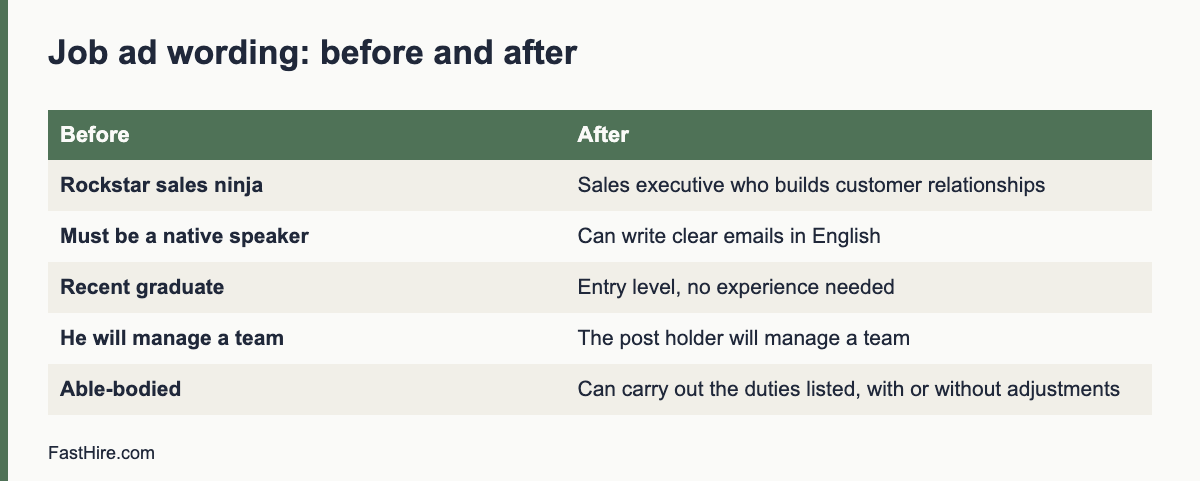
    Before (fictional): “We are looking for a young, energetic digital native to join our dynamic sales team as a sales ninja. He must be a native English speaker with at least five years of experience at a leading firm. Hectic environment. Competitive salary.”

    After (fictional): “We are looking for a sales executive to build relationships with business customers. You will plan calls, follow up leads and report weekly. You can write clear emails and speak with customers confidently in English. You have sales or customer experience, shown by examples of your work. The salary range is [range], full time, hybrid with two days in the office. We welcome applications from everyone. If you need adjustments in the process, tell us.”

    Tools that check wording

    Some tools flag biased words. They can help, but they have limits. They may miss context, miss non-obvious signals or flag harmless words. Use them as a second pair of eyes after your own check. Do not rely on a score. Keep a person responsible for the final wording. If a tool is built into your system, check how it stores and uses your text and candidate data.

    A team routine

    1. The recruiter drafts the ad from the role brief.
    2. A second person, ideally from a different team, checks it with the four passes.
    3. The hiring manager confirms that the requirements match the real work.
    4. HR checks the legal points: pay information, statements and local rules.
    5. The ad is tested on a phone and with an accessibility check.
    6. The final version is saved with the date, for the record.
    7. After the round, review whether the applicant mix changed, and what to improve.

    Common mistakes

    • Copying an old ad without review.
    • Adding more requirements every time the role changes.
    • Using “culture” language that signals a narrow type.
    • Hiding pay, then wondering why good candidates drop out.
    • Making the form so long that only the very motivated finish.
    • Leaving out any route to ask for adjustments.

    Checklist

    • Title is standard and free of slang and gendered terms.
    • Tone is plain and welcoming.
    • Requirements are few, real and checkable.
    • Pay, hours, place and conditions are clear.
    • The application works on a phone and with assistive tools.
    • An adjustment route and a contact are shown.
    • A second person has checked the ad.
    • The saved version is dated.

    Worked example (fictional)

    A retailer posts a store supervisor role and gets mostly male applicants over a few years. The recruiter runs the four-pass check. She finds the title “Store Boss”, the phrase “we need someone tough and dominant”, a requirement for a degree that the job does not use, pay not shown, and a PDF form that does not work with screen readers. She rewrites the ad: “Store Supervisor”, a description of the daily tasks, three must-haves, a pay range, a plain online form that works on a phone, and a line on adjustments. Within two rounds, the applicant pool is broader, with more women and older applicants, and the manager reports that the shortlist quality is as strong as before.

    Why people self-select out, and how to invite them back

    Many capable people read an ad and decide quietly that it is not for them. They may think that they must meet every point, that the tone is aimed at someone else, or that the employer will not welcome their needs. You cannot see these people in your data, because they never apply. You can reduce the effect with small, honest changes. State that you welcome applications from people who meet most of the requirements. Say which requirements are essential and which can be learned. Give a name and an email for questions. Show real people and real work. These steps tell readers that you want a wide range of applicants and that the process is open.

    Be careful not to promise what you cannot deliver. If you say that adjustments are available, make sure the process can provide them. If you say that flexibility is possible, describe what it means in practice. A match between words and actions is what builds trust. Candidates who join an employer that kept its promises become the best source of referrals and good reviews.

    Checking ads for different roles

    Entry level and apprenticeship roles

    Avoid asking for experience that the role is meant to give. Describe the training. State whether a qualification is needed or whether people can show potential in other ways, such as a short task. Avoid age limits unless the law sets one for a clear reason, such as rules for young workers, and state the reason.

    Shift and hourly roles

    State the shift patterns and flexibility clearly. Avoid asking for “open availability” if you do not need it. Offer a way for people with caring duties or study to apply with partial availability. Make the form short and mobile friendly.

    Senior and specialist roles

    Avoid pedigree language and ask for evidence of results. Describe the scope and authority of the role. State pay or range. Avoid terms such as “seasoned” or “battle-tested”, which can signal age or a narrow style. Offer a conversation before applying, for all, not only for those with a link to your network.

    Remote and international roles

    Say where the person can be based, the time zones that matter and the languages needed. Explain how pay is set across locations. Check pay and data rules for each place. See how to manage hiring across the US, UK and EU.

    Review the final ad one more time by reading it aloud, as if you were a capable person who is new to your field. Would you feel invited to apply? Would you know what the work is, what it pays and what happens next? If the answer to any of these is no, change the ad before it goes live.

    Frequently asked questions

    What counts as biased wording in a job ad?

    Words that signal or prefer an age, sex, race, religion, disability, class or background, and requirements not linked to the job. Examples include “young”, “digital native”, “native speaker” and gendered job titles.

    Is it a problem to say “energetic”?

    It can signal youth to some readers. Describe the actual demands of the job instead, such as “on your feet most of the day”.

    Do I need an equal opportunities statement?

    It is good practice and helps candidates, but the process must match it. Some places have rules or guidance on statements.

    Should I show pay in every ad?

    Some places require it, and it helps candidates in any case. Check the rules where you hire.

    Related guides

    This is general information, not legal advice.

  • How to work with agencies: a briefing and fee checklist

    How to work with agencies: a briefing and fee checklist

    Use a recruitment agency when you need reach, speed or a specialist network that you cannot build yourself, and brief it as you would a colleague: with checkable requirements, a pay range, a timeline and a fair process. Agree fees, guarantee and exclusivity in writing. Review shortlists on evidence, and measure results so that you know whether to renew.

    Key takeaways

    • Use an agency for a clear reason: hard-to-fill roles, urgent volume, a niche market or no internal capacity.
    • Give a written brief: requirements, pay range, process, timeline and fairness rules.
    • Agree the fee basis, the guarantee period, exclusivity and ownership of candidate data in writing.
    • Review shortlists against the same scorecard you use for any candidate.
    • You remain responsible for fair treatment and for candidate data, even when an agency does the sourcing.

    When an agency makes sense

    SituationAgency can helpAlternative
    Hard-to-fill specialist roleAccess to a niche networkTargeted sourcing by your own team
    Urgent volume hiringExtra capacityHiring day and batch screening. See hiring in volume
    New market or countryLocal knowledgeLocal adviser plus your own process
    Confidential searchDiscretionInternal confidential process
    No internal recruiterProcess supportTemplate process and a part-time recruiter
    Easy-to-fill roleRarely worth the feeFree and low-cost channels. See post jobs for free

    Compare the cost with other options. Our guide on the cost to hire an employee lists the items to include, and how to source candidates shows what you can do in-house.

    Types of agency and how they differ

    • Contingency: you pay only when you hire a person the agency submitted. Quick to start, but several agencies may compete.
    • Retained: you pay an up-front part and the rest on stages. Suited to senior or hard searches, with more effort from the agency.
    • Temp or staffing: the agency employs the worker and places them with you. Pay, tax and some duties differ. Check the rules where you operate.
    • Executive search: a retained model with deep research for senior roles.
    • RPO (recruitment process outsourcing): an outside team runs part or all of your process.

    In the UK, agencies and employment businesses have legal duties, explained on GOV.UK employment agencies and businesses. In the US and EU, rules vary by state and country. Ask the agency to explain which apply.

    x

    Step 1: write a brief that works

    A weak brief wastes both sides time. Give the agency what you would give an internal recruiter.

    ItemWhat to include
    Role and levelTitle, team, reporting line
    Must-havesCheckable requirements, few and real. See checkable job requirements
    Nice-to-havesClearly marked as such
    Pay and packageThe range and main benefits, agreed internally first
    ProcessStages, interviewers, the scorecard and the timeline
    Fairness rulesOpen recruitment, no questions on protected topics, accommodations welcome
    Sell pointsHonest description of the work, team and challenges
    Data rulesWhat data they may collect and how; privacy notice; retention
    Contact and feedbackWho gives feedback and how fast

    Hold a short intake meeting with the agency and the hiring manager. Ask the agency to repeat the brief back to you in their words.

    Step 2: agree fees and terms in writing

    Terms vary widely. Read them carefully and ask questions before you sign. Below is a checklist of points to settle. Do not copy a number from a general guide; ask each agency and compare.

    TermQuestions to ask
    Fee basisPercentage of first-year pay, fixed fee, or hourly mark-up for temps? What pay figure counts (base only, or bonus too)?
    Payment stagesWhen is each part due? On shortlist, on offer, on start?
    Guarantee periodIf the hire leaves, what do you get: refund, replacement, or credit? For how long? What conditions apply?
    ExclusivityIs the search exclusive? For how long? Can you use other channels? What happens to a candidate you already know?
    Candidate ownershipIf a candidate was submitted, how long does the agency claim a fee if you hire them later, by another route?
    Temp-to-permWhat fee applies if you convert a temp to a permanent role?
    DataWho is the controller of candidate data? How is consent obtained? How are requests handled?
    Fair practiceDoes the agency commit to equal treatment and no discriminatory questions or ads?
    TerminationHow can you end the agreement, and what notice applies?

    Ask a lawyer to review a long or exclusive agreement. Keep a copy, and diarise the dates of any exclusivity or ownership periods.

    Step 3: set the process and the rules

    • Share your scorecard and ask the agency to present candidates with evidence against each requirement.
    • Ask for the candidate resume or CV as it was supplied, plus a short, factual summary. Avoid vague words such as “great” or “a star”.
    • Agree what the agency may say to candidates about pay and process. Candidates should hear the same story from you and the agency.
    • Agree the timeline: when you give feedback, how many interviews, when the offer.
    • Agree rules on contact: the agency should not push candidates, and should not share your confidential information.

    Step 4: review shortlists on evidence

    Treat agency candidates like any other candidates. Score them on the same scale, against the same requirements, using the same questions. Do not give extra weight because an agency recommended someone, and do not drop someone because of an agency summary. Ask for clarity where a summary is unclear. Run a shortlist review with the manager, and give prompt feedback to the agency so that it can improve.

    Step 5: fairness, law and data

    • You are responsible for fair treatment, even when an agency does the work. Include equal treatment duties in the contract. See the EEOC and GOV.UK employing people.
    • Check that the agency does not discriminate in ads or screening. Review a sample of their ads.
    • Agree who sends privacy notices. See applicant privacy notice template.
    • Make sure the agency follows your retention rules for your candidates. See applicant data retention.
    • Check right to work duties. Agree who does the check and keeps the record. See how to check the right to work.
    • If the agency uses automated tools, ask how, and keep people in charge of decisions.

    Step 6: measure quality and decide whether to renew

    MeasureWhat it tells you
    Share of submitted candidates who meet all must-havesQuality of screening
    Time from brief to first shortlistSpeed
    Interview-to-offer rateFit with your needs
    Offer acceptance rateQuality of candidate management
    Retention at 90 days and six monthsLong-term fit
    Candidate feedbackExperience and fairness
    Total cost per hire including all feesValue for money

    Review these after each search. Share the results with the agency. Renew or end the relationship based on facts. Add the numbers to your hiring dashboard.

    Managing several agencies

    Using more than one agency can widen reach but creates risks: duplicate submissions, mixed messages and disputes over who introduced a candidate. Set a rule: the first agency to submit a candidate with a date-stamped record owns that introduction. Ask all agencies to follow the same brief. Hold a shared update each week. Consider a preferred supplier list, with agreed terms and regular review.

    Common mistakes

    • A vague brief, then blaming the agency for poor shortlists.
    • Signing exclusivity without a clear reason or end date.
    • Not reading the candidate ownership clause.
    • Changing the requirements mid-search without telling the agency.
    • Skipping your own scorecard for agency candidates.
    • Not checking the agency ads for fair wording.
    • Giving slow feedback, so that good candidates drop out.

    Checklist

    • Reason for using an agency is written.
    • Brief is written and shared in a meeting.
    • Fees, guarantee, exclusivity and ownership are in the contract.
    • Fairness and data duties are in the contract.
    • Shortlists are scored on your scorecard.
    • Feedback is given within one or two days.
    • Results are measured and reviewed.

    Worked example (fictional)

    A software company needs a rare data engineer. The recruiter has no network in this niche, so she briefs a specialist agency. She writes the requirements, the pay range, the process and the fairness rules, and holds a call with the agency and the manager. The contract sets a percentage fee payable on start, a guarantee period with a replacement, a non-exclusive search and a twelve-month ownership clause. The agency submits four candidates with resume or CV and a short summary. The manager scores them on the standard scorecard, and gives feedback in two days. One candidate receives an offer. After the hire, the recruiter records the cost, the time and the retention at 90 days, and decides to add the agency to a preferred list for similar roles.

    How to run the first call with an agency

    The first call sets the tone. Prepare a one-page brief and send it a day ahead. On the call, ask the agency to describe how it will search: which channels, which networks, how many people it expects to reach, how it screens, how long it will take to the first shortlist. Ask for examples of similar roles it has filled, and for the typical reasons candidates drop out. Ask how it handles requests for adjustments, how it records consent and how it treats candidate data. A good agency answers clearly and asks questions about your business. A weak one promises speed and quality without detail.

    Ask for references from other clients, and call at least one. Ask the client whether the shortlists matched the brief, how quickly feedback was handled and whether any fee disputes arose. Check that the agency has the right registrations or licences where they are required, using official sources such as GOV.UK in the UK. Agree on one named contact on each side.

    What to do when an agency submits candidates you already know

    This causes many disputes. Before the search, give the agency a list of candidates already in your pipeline, or tell it how you will handle duplicates. If an agency submits a person you already have, tell it within a day, in writing, and record the date. Check the contract for how ownership is decided. If you hire a person who was submitted by an agency months ago through another route, check whether a fee claim applies. Clear records and a short written rule avoid arguments.

    Keeping candidates safe and well treated

    Candidates often meet the agency before they meet you. Their experience of the agency becomes their experience of your brand. Agree standards: the agency replies to candidates within a working day, tells them the truth about pay and the process, does not push them, and does not share their details without consent. Ask the agency to send feedback from you promptly and kindly. Read how to give useful feedback to rejected candidates and share it with the agency. Ask candidates how the agency treated them, and act on what you hear.

    Ending the relationship well

    If an agency does not deliver, say so early and clearly. Share the evidence: the shortlists, the feedback, the dates. Give it a chance to fix the problem. If it does not improve, end the agreement according to the notice terms, confirm in writing what happens to candidates in process and thank the agency. Keep the door open if the issue was fit rather than integrity. Record what you learned, so that your next brief and contract are stronger.

    Keep a short agency file for each supplier: the contract, the brief for each search, the dates and the results. Review the file before each renewal. Over time it shows which agencies deliver value for which roles, and it gives you facts to use when you negotiate terms. A small amount of structure turns agency work from a series of one-off favours into a managed part of your hiring, with clear costs, clear duties and clear results.

    Frequently asked questions

    When should I use a recruitment agency?

    When the role is hard to fill, urgent or in a niche, or when you lack capacity. For easy roles, other channels may be cheaper.

    What is a normal agency fee?

    It varies by market, role and agency. Ask each agency, compare in writing, and check what pay figure the fee is based on.

    Do I still need my own scorecard?

    Yes. Score agency candidates against the same requirements as every other candidate.

    Who is responsible for fair treatment if an agency screens candidates?

    You are, as the employer. Put equal treatment duties in the contract, and review the agency ads and process.

    Related guides

    This is general information, not legal advice.

  • How to run an inclusive sourcing process

    How to run an inclusive sourcing process

    Inclusive sourcing means finding candidates from a wider range of places and backgrounds, then judging them all by the same job-related criteria. You can lawfully widen outreach, use more channels, remove barriers and welcome applications from under-represented groups. You cannot lawfully pick people on a protected trait in most places. This guide shows what to do and how to measure it.

    Key takeaways

    • Widen the pool, then judge everyone by the same criteria. Outreach can be broad; selection must be fair.
    • Define the role by skills and outcomes, not by background or pedigree.
    • Use more channels: open boards, community organisations, colleges, employment services, returners programmes and referrals with rules.
    • Write outreach and ads in plain, open language that avoids signals of age, sex, race or other traits.
    • Measure each stage by group where the law allows, and fix the stage with the gap.

    What inclusive sourcing is, and what it is not

    Inclusive sourcing is about reach. It asks: who can see our job, who feels able to apply, and who do we never reach? It does not mean lowering standards or picking someone because of a trait. In most places, selection that favours or excludes a person because of race, sex, age, religion, disability or other protected traits is unlawful. Outreach that welcomes more people to apply is lawful and good practice.

    The law differs by country. In the US, Title VII and other laws prohibit discrimination in hiring, and the EEOC explains the rules. In the UK, the Equality Act allows limited positive action in some cases, such as encouraging applications from under-represented groups or choosing between equally qualified candidates, but it does not allow quotas or automatic preference; check GOV.UK employing people and take advice. In the EU, equal treatment directives apply through national law, with some positive action allowed. See our EU equal treatment guide.

    Usually lawfulUsually unlawful or risky
    Advertising widely, including in communities that are under-representedStating that only people of one sex, race or age may apply, without a lawful exception
    Removing barriers: plain language, flexible hours, accessible formsSetting different standards for different groups
    Offering mentoring or training open to all, or encouraging applications from under-represented groupsQuotas or automatic preference in selection (in most places)
    Using blind screening and structured interviewsAsking for protected traits in screening
    Measuring outcomes by group (where lawful) to find gapsUsing the data to pick individuals by trait

    Step 1: define the role by skills

    Pedigree requirements shut doors without telling you about ability. Replace “degree from a top university” with the skills the job needs. Replace “five years in the same sector” with outcomes: “has managed a supplier relationship from start to finish”. Use checkable job requirements and keep the list short. See must-haves vs nice-to-haves.

    Step 2: widen the channels

    ChannelWho it can reachTip
    Open job boards and your siteActive job seekersClear title, pay and plain language
    Community organisations and networksPeople who may not see mainstream boardsBuild relationships, not one-off posts
    Colleges, apprenticeships and training providersEarly career and career changersShare real tasks, not just logos
    Employment services and returners programmesPeople returning to work or changing fieldDescribe support and flexibility
    Disability employment servicesPeople with disabilitiesOffer adjustments in the ad and process
    Veterans and service leaver programmesService leaversTranslate roles into civilian terms
    ReferralsQuality and speedAsk staff to share the open ad; same process for all
    Past applicants (with consent)Warm leadsContact only those who agreed

    See how to source candidates and how to post jobs for free. Track which channels bring suitable applicants and stay with the ones that work.

    x

    Step 3: write open outreach and ads

    • Use plain words and short sentences.
    • Describe the work and the support available, not the “ideal” person.
    • Avoid gendered or age-linked words. See age discrimination in hiring.
    • Say that you welcome applications from people of all backgrounds, and that adjustments are available.
    • Show pay or the range where required or helpful. See salary in job ads.
    • Use real images of your team. Avoid stock photos that show a narrow group.
    • Make the application short and accessible. See accessible job applications.

    Outreach message example

    “Hello [name], I am hiring for a [role] at [company]. The work involves [two or three tasks]. You do not need a specific degree. We look for [skills]. The salary range is [range], and the role is [hours, place]. If you are interested, you can apply here [link], or reply with any questions. If you need adjustments for the process, tell me and we will arrange them.”

    Step 4: keep selection fair

    Once people apply, treat them all the same. Use the same questions, the same scale and the same reviewers. Hide names and personal details in screening. Use a scorecard. See blind CV screening, structured interviews and how to reduce interview bias. Do not add steps for some applicants or skip steps for others.

    Step 5: remove barriers in the process

    • Offer flexible interview times, including early or late slots.
    • Offer video or phone options.
    • Tell candidates what to expect, and who will be there.
    • Invite requests for adjustments and answer them quickly. See reasonable adjustments in interviews.
    • Pay reasonable travel costs for in-person stages where you can.
    • Avoid unpaid long tasks. Keep any exercise short and tied to the job.

    Step 6: measure and improve

    Track the funnel by stage: reach, applications, screens, interviews, offers and hires. Where the law allows, collect optional monitoring data in a form that the hiring team does not see. Look for a stage where one group drops out far more than others. Then check the criteria, wording, questions and scoring at that stage. Fix one thing, and measure again. The four-fifths rule guide explains one simple check used in the US, with its limits.

    StageMeasureWhat a gap may mean
    ReachViews and clicks by channelChannel does not reach the group
    ApplyStarts versus completionsForm or wording is a barrier
    ScreenPass rate by groupCriteria or screening method is unequal
    InterviewScore distributionQuestions or panel may be unequal
    OfferAcceptance and pay by groupOffer terms or process may be unequal

    Keep the data safe and use it only to improve the process. See GDPR for job applicants for the rules on special category data in the UK and EU.

    Referrals and networks: handle with care

    Referrals are efficient and often produce good hires, but they can repeat the shape of your current team. Balance them. Ask staff to share the open ad widely, not to name individuals. Give referred candidates no advantage in scoring. Track the mix of referred and other candidates through the funnel. If referrals dominate and the pool is narrow, add other channels.

    Tools and AI in sourcing

    Sourcing tools can search large databases. Check what data they use and how they rank. Avoid tools that filter by traits you cannot lawfully use, such as age or sex, even indirectly through proxies. Keep a person in charge of the decisions. Check local rules for automated tools, such as NYC Local Law 144 and GDPR Article 22. FastHire is coming soon and is designed to show evidence from CVs against each requirement, with people making every decision.

    Common mistakes

    • Treating inclusion as a campaign, not a change in process.
    • Posting once in a community group and expecting results.
    • Using words that signal a narrow profile.
    • Making promises about preference in selection that the law does not allow.
    • Not measuring, so no one knows what works.
    • Collecting monitoring data without a notice or a safe store.

    Checklist

    • The role is defined by skills and outcomes.
    • At least three channels are used, including some new ones.
    • Ads and outreach use open, plain language.
    • Selection uses blind screening, structured interviews and scorecards.
    • Adjustments are offered and easy to request.
    • Outcomes are measured by stage and group, where lawful.
    • Findings lead to one change at a time.
    • Records are kept safely and deleted on schedule.

    Worked example (fictional)

    A logistics company wants more applicants for warehouse supervisor roles. The recruiter rewrites the ad to list skills and outcomes, removes a degree requirement, and adds a line on flexible shifts and adjustments. She posts on open boards, shares the ad with a local employment service, a college training programme and a returners network, and asks staff to share it widely. Screening hides names and uses a scorecard. After two rounds, the funnel shows more completed applications, and a drop in the share of interviews offered to older applicants. She reviews the interview questions and finds one that asked about “energy”. She replaces it with a question about handling busy shifts, and the gap narrows in the next round.

    Building relationships with communities, not just posting jobs

    A single post in a community group rarely changes who applies. Relationships do. Contact organisations that serve the groups you want to reach, such as training providers, local employment services, professional networks and charities. Explain the roles, the support and the process. Ask how you can make your process easier for their members. Offer a short information session or an open day. Keep in touch even when you have no job open, so that you are known when one appears. Be clear that you cannot promise jobs, and that everyone is assessed on the same criteria.

    Treat these partners as advisers. Ask them to read your ad and tell you what would put their members off. Ask what barriers they see: transport, childcare, language, a hard form, an unwelcoming website. Then fix what you can and tell them what you changed. This feedback loop is one of the most effective ways to improve both reach and fairness, and it costs only time and attention.

    Returners, career changers and non-traditional routes

    Many capable people reach a role by a path your ad did not imagine: after a break for care, after military service, from another field, through self-study or from a different country. Make it clear that you welcome these routes. Ask for evidence of skills in a way that suits them: a short work sample, a project description or a structured interview, rather than a long list of past titles. See work sample tests and career gaps and job hopping for how to read these histories fairly.

    Support after the offer

    Inclusive sourcing only works if people stay and thrive. Plan the first weeks with care: a buddy, a clear plan, honest feedback and a manager who has been briefed. Use the 30-60-90 day plan guide and first 30 days guide. Ask new hires how the process felt, and what you can do better. Feed the answers back into your sourcing and your interview design.

    Finally, tell the story of your progress honestly. Share what you changed, what you measured and what you are still working on. Do not claim more than the data shows. Candidates and staff notice when words and actions differ, and trust grows when you are open about both progress and gaps. A modest, steady and honest approach to reaching more people will do more for your hiring than a loud campaign, and it keeps you on the right side of the law while you build a team that reflects the wider community you serve.

    Frequently asked questions

    Is it legal to target outreach at under-represented groups?

    Broad outreach and encouragement to apply is generally lawful in the US, UK and EU. Selection must still be based on job-related criteria. Take advice before using preferences.

    Can I set diversity quotas?

    In most places, quotas or automatic preference in hiring are unlawful. Some narrow exceptions exist. Take advice.

    How do I measure inclusion without collecting sensitive data?

    Use optional, anonymous monitoring forms where the law allows, and check process points such as wording, criteria and drop-off by stage.

    What is the first step?

    Rewrite your next job ad in plain language by skills, add two new channels, and measure the funnel.

    Related guides

    This is general information, not legal advice.

  • How long can you keep applicant data? US, UK and EU

    How long can you keep applicant data? US, UK and EU

    There is no single answer to how long you can keep a resume or applicant record. In the US, federal rules require employers to keep personnel and employment records for at least a year, and longer in some cases. In the UK and EU, data protection law says you may keep personal data only as long as you need it for a stated purpose. Set a written schedule, tell candidates, and delete on time.

    Key takeaways

    • US: federal EEOC rules require employers to keep personnel or employment records for one year, longer if a charge or claim exists, and some payroll records for longer.
    • UK and EU: no single fixed period. You must keep data no longer than necessary and be able to justify your period.
    • Different records have different periods: applications, notes, scorecards, offers, background checks and talent pool data.
    • Tell candidates how long you keep their data, and delete or anonymise on schedule.
    • Pause deletion if a claim, complaint or investigation is open, and take advice.

    Why retention matters in recruitment

    Two opposite risks sit side by side. If you delete too early, you may break record rules or lose evidence that your process was fair. If you keep too long, you may break data protection rules, increase the damage of a data breach and keep information you no longer need. A clear schedule balances the two, and it saves time, because everyone knows what to do.

    United States

    The EEOC states that its regulations require employers to keep all personnel or employment records for one year, whether or not a charge has been filed, and to keep records longer once a charge exists, until it is resolved. Payroll records must be kept for longer under other rules: for example, the EEOC page notes three years for payroll records under the Age Discrimination in Employment Act. Read the EEOC recordkeeping requirements for the current text. Government contractors may have longer duties, and states may add rules. Ask your adviser what applies to you.

    • Treat resumes, applications, scorecards, interview notes and offer records as employment records for the period your rules require.
    • Keep records for the same period for every applicant for the same role, so that you do not treat people differently.
    • If a charge, complaint or claim is raised, keep all related records until it is resolved.
    • Some state privacy laws give applicants rights to know, access and delete data. Check which apply.

    United Kingdom

    The UK GDPR requires that you keep personal data no longer than is necessary for the purpose. There is no fixed period for unsuccessful applicants. You decide the period, base it on a clear reason, record it and apply it. The ICO guidance on recruitment and selection explains the data protection points. Think about the time you might need the records to respond to a claim, and balance that against the burden of holding data. Many employers set a short period for unsuccessful applicants, and a longer period for the file of a person who is hired, which becomes part of the employment record.

    European Union

    GDPR includes a storage limitation principle: personal data must be kept in a form that identifies people for no longer than necessary. See the text on EUR-Lex. National laws and regulators may set specific periods or give guidance for recruitment data, and some countries are strict. Check the guidance of the data protection authority in the country where you hire, and the EDPB for cross-border points.

    x

    Build a retention schedule

    A schedule lists each type of record, the reason you hold it, the period and the action at the end. Use the following as a template, and fill in your own periods after checking local rules with an adviser. The periods are for you to set; do not copy them from another business.

    RecordReasonPeriod (set after local advice)End action
    Application and resume of unsuccessful candidateFair process records and possible claims[period]Delete or anonymise
    Interview notes and scorecardsEvidence of fair decisions[period]Delete
    Talent pool data (with consent)Future roles[period, with periodic renewal]Delete or ask for renewal
    Offer letters and hire recordsEmployment recordAs employment recordsMove to the employee file
    Right to work evidenceLegal dutyAs the law statesFollow the official guidance
    Background check resultsSpecific purposeShortest neededDelete
    Diversity monitoring data (if any)StatisticsAnonymise soon after collectionAnonymise
    Access request logsEvidence of compliance[period]Delete

    For talent pool data, you need clear consent and a reason to keep it. See how to build a talent pool with consent.

    Tell candidates

    Say in your privacy notice how long you keep data and why. If you hold data for a talent pool, say so and offer a way to opt out. Our applicant privacy notice template and GDPR guide show wording. A rejection message is a good place to repeat the period.

    Delete safely and on time

    1. List all places data sits: tracker, email, drives, chat, spreadsheets, backups and supplier systems.
    2. Set automated deletion in the tracker where possible, based on the date of the decision.
    3. Run a monthly check for records past their date. Delete or anonymise them.
    4. Ask suppliers to delete data from their systems and confirm in writing.
    5. Handle backups according to a rule: they expire on a cycle, or data is overwritten. Document the rule.
    6. Keep a simple deletion log: date, record type, method and who did it.
    7. Check that the deletion is real, not just hiding the record.

    When to pause deletion

    If someone raises a complaint, a claim, a regulator inquiry or a request that may lead to one, pause the deletion of related records. Tell the data lead and HR. Keep the records safe and restricted. Take advice on how long to keep them and when to resume deletion. This is called a legal hold in some places. Without it, deleting records during a dispute can cause serious problems.

    Common mistakes

    • No schedule at all, so records are kept forever by default.
    • Different periods for different applicants for the same role.
    • Deleting from the tracker but not from email or spreadsheets.
    • Forgetting data held by suppliers and agencies.
    • Keeping resumes for a talent pool without consent.
    • Keeping interview notes with personal opinions that should never have been written.
    • Deleting records after a complaint arrives.

    Checklist

    • A written schedule exists and was checked by an adviser.
    • The privacy notice states the period.
    • Deletion is automated or checked monthly.
    • Suppliers are covered by contract.
    • A legal hold process exists.
    • Staff are trained on notes and records.
    • The schedule is reviewed each year.

    Worked example (fictional)

    A company hires in the US, UK and Germany. The data lead builds a retention table with one row per record type and a separate column for each region, after asking an adviser in each place. For US applicants, the period respects the federal minimum and is applied to all applicants. For UK and German applicants, shorter periods apply, with the reason written next to each. The tracker is set to flag records for deletion on the date set. Each month the recruiter checks the flag list, deletes the records, asks the video interview supplier to delete its copies and writes a line in the deletion log. When a former applicant raises a complaint, the data lead places a hold on the related records and tells the team.

    How to choose a period you can defend

    Where the law leaves the period to you, ask three questions. What is the purpose of keeping the record? What is the shortest period that serves it? What would you say if a candidate, a regulator or a court asked why you kept it? Write the answers in the schedule. For unsuccessful applicants, the purpose is usually to show that your process was fair if a claim is made, and to deal with questions from candidates. The time you need depends on how long claims can be brought in your country, so ask your adviser, and write the reason down.

    For talent pool data, the purpose is future contact, and the period should be short enough that the data stays relevant, such as a year, with a prompt to renew consent. For records of people you hire, the purpose changes to employment administration, and the employment record rules take over. Keep the two sets of rules clear in your schedule.

    Minimising what you keep

    The best way to cut retention risk is to collect and keep less. Do not ask for data you do not need at the application stage, such as date of birth, photos or a copy of identity documents. Ask for those only from the person you hire, and only when the law requires. Store scores and notes in a structured form, not in free text full of opinions. Keep personal sensitive data, such as health information for adjustments, separate from scoring data and delete it as soon as the adjustment is in place. See reasonable adjustments in interviews for the process.

    Anonymise instead of delete, when you need statistics

    You may want to keep statistics about your hiring, such as the number of applicants by stage and source, to improve your process. You can do this without keeping personal data by anonymising: removing names and anything that could identify a person, alone or when combined. True anonymisation is hard. Aggregate counts are safer than lists of individual records. If you keep diversity monitoring data, aggregate it soon after collection and delete the individual responses. Check with your adviser that your method is enough.

    Records about the process itself

    Some records are about your process, not about individuals: the role brief, the ad, the question list, the scorecard template and the policy. These contain no personal data and can be kept as long as they are useful. Keeping them shows how you designed a fair process, which can help if your decisions are questioned. Date each version and store them with the schedule, so you can show what was in use for each hire.

    Retention and automated tools

    If you use an applicant tracking system or an AI-based tool, check its settings. Many tools keep data by default for as long as the account exists. Set a retention period in the tool, switch on automatic deletion, and check that deleted records are removed from exports and backups on a defined cycle. Ask the supplier whether it uses applicant data to train its own models, and if so, whether you can switch this off. Record the answer. If a tool helps with screening, keep logs only as long as you need them to explain decisions, and apply the same schedule to those logs. See ATS compliance checklist for questions to ask suppliers.

    Review the schedule at least once a year, and when you add a new tool, hire in a new country or when the law changes. A short review, with the data lead, HR and the recruiter, keeps the schedule real. Note the date of the review and any changes, and tell the team. A retention policy that is tested, lived and updated protects both candidates and the business much better than a long document that sits unread on a shared drive.

    Frequently asked questions

    How long should I keep resumes of people I did not hire?

    It depends on the law where you hire and your reasons. In the US, federal rules require at least a year for personnel records. In the UK and EU, keep data only as long as necessary and be able to justify it.

    Can I keep resumes for future roles?

    Only with a clear purpose and, in many places, the candidate consent. Tell them how long you will keep it and let them opt out.

    What should I do with data when a claim is possible?

    Pause deletion of related records and take advice.

    Do backups count?

    Yes. Set a rule so that backups expire on a cycle, and document it.

    Related guides

    This is general information, not legal advice.

  • How to handle candidate data requests under GDPR

    How to handle candidate data requests under GDPR

    When a candidate asks what personal data you hold about them, the UK and EU GDPR give them a right of access. Log the request the day it arrives, confirm who is asking, search every place the data may sit, remove other people data, and reply within the time the law allows with a copy and the information the law requires. This guide gives the steps and a reply template.

    Key takeaways

    • A request can arrive in any form, to anyone in the company. Train recruiters to pass it to the data lead at once.
    • The standard time to reply under GDPR is one month, with a possible extension for complex requests. Check the current ICO or national guidance for your country.
    • Search all systems: the tracker, email, calendars, chat, spreadsheets, interview notes and shared drives.
    • Remove or redact other people personal data, such as interviewer names where needed, unless an exception applies. Do not hide the candidate own data without a lawful reason.
    • Reply clearly, keep a record, and delete data on schedule afterwards.

    What the right of access is

    Under the GDPR in the EU and the UK GDPR, a person can ask an organisation whether it processes their personal data, and if so, can ask for a copy and for information such as why you hold it, who you share it with and how long you keep it. The request is often called a data subject access request, or DSAR. Candidates can use it to see what you recorded about them in the hiring process, including notes and scores. The official guidance of the UK regulator is the ICO right of access guidance. The European Data Protection Board publishes guidelines at edpb.europa.eu. The legal text is in Regulation (EU) 2016/679.

    In the US, there is no general federal right of access, but some state privacy laws give job applicants rights to know and access their data, and other laws give access to certain records. Ask your adviser which apply to you. Treat requests from US candidates seriously and consistently.

    Why recruiters should care

    Hiring files contain opinions, scores and notes. If you write them carelessly, the candidate may read them. A clear process protects you and reminds your team to write facts that relate to the job. It also protects the candidate right to know how their data was used. See GDPR for job applicants for the wider rules.

    Step 1: recognise and log the request

    A request does not have to use the words “subject access request” or come through a form. An email saying “please send me everything you have about me” counts. It might arrive at a recruiter, a hiring manager or general email address. Train everyone to pass it on within a day. Log the date it arrived, who sent it, what they asked for, and who is handling it. The clock starts when you receive the request.

    FieldExample entry
    Date received
    Channel (email, post, phone)
    Requester
    Scope (all data or specific)
    Identity check needed? Done on
    Owner
    Reply due date
    Extension used? Reason
    Reply sent on

    Step 2: confirm identity, only as needed

    Check that the person is who they say they are, so that you do not give data to the wrong person. Ask for the minimum proof needed. If you know the person from the application email and the request comes from that address, you may already have enough. Do not ask for more documents than needed, and delete any ID copies once the check is done.

    Step 3: search every place

    • Applicant tracking system: profile, notes, scores, stage history, messages.
    • Email: with recruiters, hiring managers and the candidate.
    • Calendars and scheduling tools.
    • Chat and messaging tools.
    • Spreadsheets and trackers, including personal copies.
    • Interview notes on paper and in notebooks.
    • Assessment tools, video interview platforms and background check providers.
    • Shared drives and backups, as far as reasonable.
    • Data held by processors, such as agencies and software suppliers.

    Ask your suppliers to search their systems too, under your data processing agreements. Note the places you searched, in case you need to explain later.

    x

    Step 4: review and redact

    The candidate is entitled to their own personal data, not to everything in a document. A page of interview notes may mix the candidate data with data about interviewers or other candidates. Review each item.

    ItemWhat to do
    Candidate own data (application, scores, notes about them)Include
    Names and details of other candidatesRemove or redact
    Interviewer names and opinionsConsider the rules on other people data and whether an exemption or consent applies. Take advice on how to handle it
    Legal advice or privileged materialCheck whether an exemption applies
    Information that would harm a lawful ongoing processCheck the exceptions with your adviser
    Duplicate or unrelated emailsInclude only if they contain the candidate personal data

    The ICO guidance covers exemptions and third-party data in detail. Take advice if you plan to withhold anything, and tell the person that something has been withheld, and why, where the law requires it.

    Step 5: reply on time

    Under GDPR the usual time limit is one month from receipt, and it can be extended in certain complex cases. The UK has updated parts of its data rules in recent years, so check the current ICO guidance for the exact rules on timing and on searches. Reply in a secure way: a protected file, a secure link or a password sent by a separate route. Do not send personal data in an open email attachment. Provide a copy in a clear format.

    In your reply, include the information the law lists: the purposes of processing, the categories of data, recipients, how long you keep it, the source of the data if not from the candidate, their rights to correct or delete, and their right to complain to the regulator. A cover letter that covers these points saves follow-up questions.

    Reply template

    “Dear [name], thank you for your request dated [date] for a copy of the personal data we hold about you in connection with your application for [role]. We have confirmed your identity and searched our systems. Enclosed is a copy of your personal data, sent through a secure link. We hold your data for the purpose of managing your application, on the basis of [lawful basis], and we keep it for [period]. We have shared it with [recipients]. Some information has been removed because it relates to other people [or: because an exemption applies]. You have the right to ask us to correct inaccurate data, to ask for deletion in some circumstances and to complain to [regulator]. If you have questions, please contact [name, email].”

    What if the request is unclear, large or repeated

    • If you cannot tell what is asked, ask for clarification promptly, but do not use this to delay without reason. Check the guidance on when the clock pauses.
    • If the request is very large, ask whether the person wants specific items first, while you continue to search the rest.
    • If requests are repeated or clearly abusive, take advice. The law allows limits in narrow cases, but you must be able to justify them.

    Related rights

    A candidate may ask for more than a copy: correction of wrong data, deletion, or an end to certain uses. Handle each request on its own terms and in the time allowed. If they object to automated decisions, see GDPR Article 22. If they ask you to delete their data, check whether you have a lawful reason to keep it, such as a legal duty or a claim, and explain your decision. See how long to keep rejected applicant data.

    Writing notes with the access request in mind

    Write every note as if the candidate will read it. Record facts and evidence tied to the requirements. Avoid jokes, speculation, comments on appearance, age, health, family or other protected traits, and remarks about personality. This is good practice for fairness and makes access requests simple. Train interviewers on it, and review a sample of notes each quarter. See how to take interview notes.

    Checklist

    • Everyone knows to pass requests to the data lead within a day.
    • A log and a template reply are ready.
    • A list of systems and owners is current.
    • Suppliers have agreed to help with searches.
    • Redaction guidance is written and tested.
    • Replies go through a secure route.
    • Notes are written in a way that is fair to read.
    • Data is deleted on schedule afterwards.

    Worked example (fictional)

    A candidate who was not selected emails the recruiter: “Please send me all the data you hold about me.” The recruiter logs the request and forwards it to the data lead the same day. The data lead confirms identity through the email address on the application, then searches the tracker, the email accounts of the two interviewers, the scheduling tool and the video interview platform. She finds the application, two scorecards and a set of emails. She removes the names of two other candidates mentioned in one email, and sends the rest through a secure link with a cover letter, within the month. The candidate thanks her and asks for one wrong date to be corrected, which she does. The data lead notes the request, the dates and the actions in the log.

    Training your team

    Most delays in access requests come from people not knowing what to do. Hold a short session for recruiters, hiring managers and administrators. Show them an example request, the log, and the reply template. Explain that any email asking for personal data may be a request, and that they must pass it on at once. Explain that notes are readable by the candidate and should be written in a fair, factual way. Remind them not to delete anything once a request has arrived, because that can create legal trouble. Repeat the session each year and when new staff join.

    Working with suppliers and agencies

    If an agency, a job board or a software supplier holds candidate data on your behalf, your contract should say how they help with access requests. Check that the agreement names the time they have to respond to you, for example a few working days, so that you can meet your own deadline. If an agency collects the data for its own purposes, it may be a separate controller, and the candidate may need to ask the agency directly. Make sure your privacy notice explains who holds what.

    Keeping the record after the reply

    Keep a copy of the reply and the log for as long as you need them to show that you complied. Limit access to them, since they contain personal data. After the retention period, delete them. If the candidate complains to the regulator, the log, the search list and the reply are your evidence of good faith. Review each request afterwards: what slowed you down, what the candidate asked about, and what you can do to make the next one easier. Update the template and the system list when you learn something new.

    If you are unsure about any part of a request, ask your data protection officer or a qualified adviser early, not on the last day. A short call at the start of the month is far better than a rushed reply at the end, and it keeps the candidate trust in your hiring process intact.

    Frequently asked questions

    How long do I have to reply to a candidate access request?

    Under GDPR the usual limit is one month, with extensions allowed for complex requests. Check the current guidance of your regulator.

    Can I charge a fee?

    Generally no, unless the request is manifestly unfounded or excessive and the law allows a fee or refusal in that case. Take advice.

    Do candidates have the right to see interview notes?

    Notes that contain their personal data are usually in scope, subject to exceptions for other people data and other exemptions.

    What if the candidate lives in the US?

    Some US state laws give applicants access rights. Check which apply to you and treat the request with care.

    Related guides

    This is general information, not legal advice.