
Religion and belief are protected in hiring in the US, UK and EU. In practice this means three things: do not ask about a candidate religion, do not make assumptions from dress or names, and be ready to adjust interview times, dress rules or schedules when a candidate asks, unless there is a strong, job-related reason you cannot. This guide gives rules, examples and wording by region.
Key takeaways
- Do not ask about religion or belief, and do not guess it from names, dress or appearance.
- Be ready for requests: interview times that avoid prayer or holy days, religious dress, and time off for festivals.
- In the US, employers must reasonably accommodate religious practices unless it causes undue hardship. In the UK and EU, indirect discrimination rules apply.
- Look for a practical solution first. Record the request, the options and the decision.
- Apply rules on dress and schedules to everyone, and justify any rule that has an unequal effect.
Why this topic matters in recruitment
Candidates often face a choice: hide a part of their identity or risk a lost chance. Questions about faith, comments about dress and rigid interview times can all deter capable people. A fair process welcomes questions about practical needs and gives clear, calm answers. Most requests are small and easy to meet.
United States
Title VII of the Civil Rights Act prohibits religious discrimination in hiring and requires employers to reasonably accommodate an applicant or employee religious beliefs and practices, unless this would cause undue hardship on the business. The EEOC explains religious discrimination, including dress and grooming and scheduling. Some states add protection. The US Supreme Court has said that undue hardship means a substantial burden in the overall context of the business, so do not assume a request is too costly without checking the facts.
- Do not ask about religion in interviews.
- If a candidate asks for an adjustment, treat it as a request for accommodation. Ask what would help.
- Do not refuse to hire a person because their religious dress does not fit your image or customer preference.
- Avoid asking “can you work Saturdays?” as a trick. If the job needs weekend work, say so, and then discuss any request.
United Kingdom
The Equality Act 2010 protects religion or belief, including lack of belief. There is no direct duty like the US accommodation rule, but a rule that puts people of a faith at a disadvantage, such as a ban on head coverings or a fixed schedule on a day of worship, may be indirect discrimination unless it is a proportionate way of reaching a legitimate aim. The Act is on legislation.gov.uk, and general guidance is on GOV.UK employing people. See also our UK Equality Act recruitment guide.
European Union
The Employment Equality Directive prohibits discrimination in employment based on religion or belief. See EUR-Lex. How far an employer may restrict visible religious signs, such as a headscarf, has been tested in the Court of Justice of the EU, and national laws and courts differ. Do not assume a neutrality rule is lawful. Take advice for your country before you adopt one, and apply any rule in a consistent and justified way. See our EU equal treatment guide.
Interview scheduling and holy days
Offering a choice of interview slots solves most issues. If a candidate says that a slot clashes with prayer, a fast, a holy day or a Sabbath, move the interview or offer another time without asking for proof or explanation. A single polite sentence is enough: “Of course, here are other times.” Do not hold the request against the person, and do not mention it in notes.
| Request | Good response | Poor response |
|---|---|---|
| Interview on a holy day | Offer other slots at once | Say that the day was fixed and cannot change |
| Time for prayer during a long assessment | Plan a short break and a quiet space | Say that breaks are not allowed |
| Fasting during an assessment | Offer water, breaks or a different time, as the person prefers | Make comments about the fast |
| Request to avoid handshakes | Greet in another way, such as a nod and a smile | Treat the refusal as rude |
Our guide to scheduling interviews faster shows how to offer slots that make this simple.
Religious dress and appearance
Dress rules need a real reason. Safety, hygiene and security needs can be valid. A look, brand image or customer preference is rarely enough on its own. If your role requires protective gear, explain what is needed and why, and check whether a design that fits both exists, such as a hijab-compatible helmet liner or a turban-compatible safety solution where available. Ask the candidate how they would work safely, and listen.
- Check your dress code against real job needs.
- Apply the same code to everyone.
- Allow religious dress and symbols unless there is a justified safety, hygiene or legal reason.
- Write the reason into the policy.
- Never comment on a candidate dress in notes or feedback.
Time off for festivals and observance
Candidates may ask in the process whether they can take time off for festivals. Answer honestly about the leave policy, and say how requests are handled. Do not treat a request as a sign of low commitment. If the job has fixed peak times, tell all candidates about them and discuss options for swaps. In the US, a request may fall under the accommodation duty. In the UK, a blanket refusal that disadvantages a faith group needs a good reason.
Questions to avoid and better alternatives
| Avoid | Better alternative |
|---|---|
| What is your religion? | Not asked |
| Do you go to church, mosque, temple or synagogue? | Not asked |
| Will your religion prevent you doing any part of the job? | This job includes X, Y and Z. Are you able to do these, with or without adjustments? |
| Why do you wear that? | Not asked |
| Which holidays do you celebrate? | The role has these fixed peak periods. Can you meet them? |
| Can you work weekends? (used to filter by faith) | The role requires weekend work on a rota. Can you meet this requirement? |
See also interview questions you cannot ask.
Faith-based organisations and exceptions
Some laws allow religious organisations to prefer people of their own faith for certain roles, and some roles may have genuine occupational requirements. These exceptions are narrow and differ by country. If you think one applies, take legal advice, record the reason and apply it only to the roles it covers.
Job ads and sourcing
- Do not state a religion or belief unless a lawful exception applies.
- State fixed working times and dress requirements clearly, with the reason.
- Say that you welcome requests for adjustments.
- Share the ad where different communities will see it.
Handling a request in practice
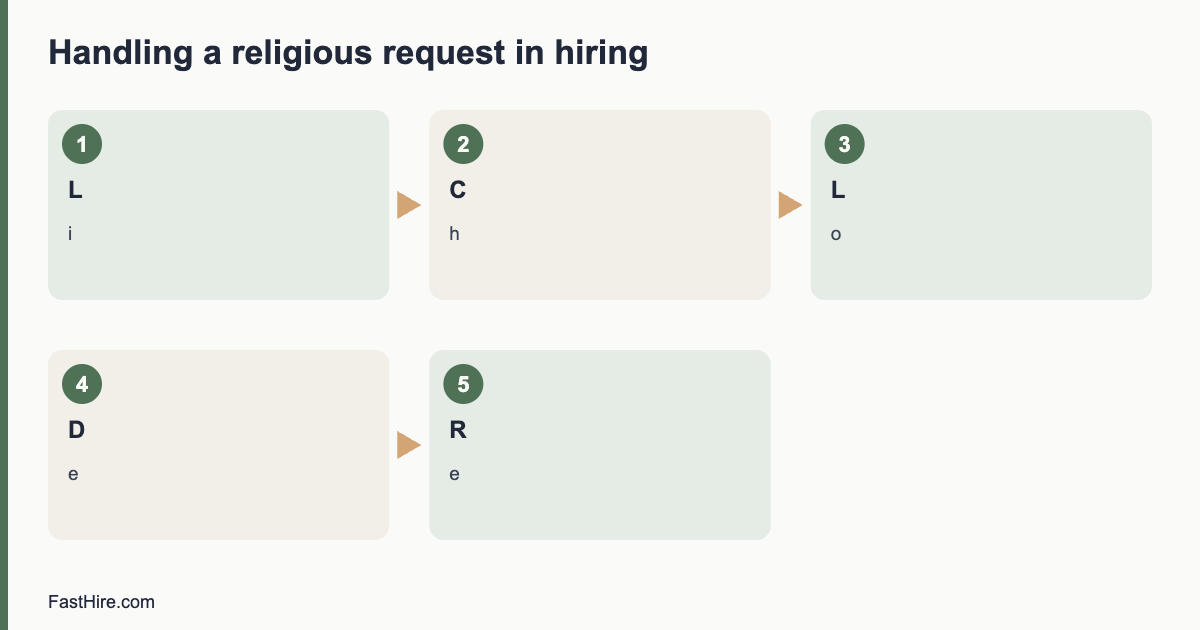
- Thank the candidate and say you will find a solution.
- Ask what would help, without asking about the faith itself.
- Check what the job needs: what is fixed, what can change.
- Offer the options you can, and discuss them.
- Confirm the outcome in writing.
- Record the request and the decision in a separate note, away from scores.
Training your team
Short training can prevent most issues. Teach interviewers three habits: do not ask or guess, offer flexibility on timing, and keep the focus on job-related evidence. Practise a reply: “Thank you for telling me. Let me see what we can arrange.” Give them a contact in HR for hard cases. Review your process once a year. See also how to reduce interview bias.
Worked example (fictional)
A retail chain invites a candidate to an interview at 17:30 on a Friday. The candidate writes that this is before sunset on the Sabbath and asks for another time. The recruiter replies the same hour with three other slots and thanks the candidate. At the interview, the candidate asks whether the store allows a head covering. The manager explains that the uniform policy allows religious headwear, subject to safety rules in the stockroom, and shows the safe options. The panel scores the interview on the fixed questions and the candidate receives an offer. The manager notes the shift pattern and agrees the Friday rota with the candidate before the start.
Scenarios from real practice (fictional)
A candidate declines a handshake
The interviewer extends a hand and the candidate places a hand on the chest and nods. Respond in kind, smile and carry on. Do not comment or record it. The handshake has no link to the job, and the interview should focus on the evidence.
A candidate asks for a prayer room
Say that a quiet room is available if you have one, or find a simple option such as a meeting room for a few minutes. If there is none, say so honestly and ask what would help. Do not suggest that the request reflects poorly on the person.
A manager worries about customer reaction to religious dress
Customer preference is not a valid reason to refuse a candidate. Explain that the decision must rest on the requirements and evidence, and that the law does not allow the exclusion of people on the basis of what others might think. Offer to support the manager in handling any concerns that do arise.
Two candidates ask for the same holiday
Treat requests by the same rules, regardless of faith. Use a fair method, such as the order of request or a swap system, and apply it to all staff. If one request is a religious festival with a fixed date, give it proper weight under the law that applies to you.
Records and privacy
Information about religion or belief is special category data under GDPR and sensitive in other laws. Collect it only if you must, for example to arrange an adjustment, and then keep only what is needed. Store it apart from scoring notes, limit access, and delete it when no longer needed. See GDPR for job applicants and applicant privacy notice template.
Checklist
- The ad does not refer to religion or belief unless an exception applies.
- Interviewers know not to ask or guess.
- Interview slots are flexible and breaks are possible.
- Dress rules are tied to safety or hygiene needs, and are explained.
- Requests for adjustments have a clear route to HR.
- Notes are job-related and free of comments on faith.
- You review your policies once a year with an adviser.
Keep one idea in mind through all of this: your aim is to learn whether the person can do the job, and to give them a fair chance to show it. Faith, dress and festivals are part of who people are, not part of how well they work. When a candidate raises a practical need, treat it as a normal planning question and solve it with the same care you give to any other part of the process. That response protects the candidate, treats your team fairly and keeps you on the right side of the law in each country where you hire.
If you are in doubt about a request, ask a simple question: what is the real need of the job here, and is there another way to meet it? That question solves most cases before they grow, and it shows candidates that your process is fair, calm and practical.
Frequently asked questions
Can I ask a candidate about their religion?
No. Do not ask, and do not guess from names or dress. If a candidate raises a practical need, discuss it.
Must I change an interview time for a religious reason?
In most cases you should if you can. It is usually easy, and in the US it can be part of the duty to accommodate.
Can I ban religious dress at work?
Only with a real and justified reason, such as safety, and with care. Laws differ by country, so take advice before adopting a rule.
What if a request would cause real difficulty?
Look at alternatives first. Document the reason and the options you considered. Take advice if you plan to refuse.
Related guides
This is general information, not legal advice.