
In Great Britain, the Equality Act 2010 makes it unlawful to discriminate in recruitment because of nine protected characteristics: age, disability, gender reassignment, marriage and civil partnership, pregnancy and maternity, race, religion or belief, sex and sexual orientation. Direct discrimination is less favourable treatment because of a characteristic. Indirect discrimination is a neutral rule that puts a group at a particular disadvantage and cannot be justified.
Key takeaways
- The Equality Act 2010 covers England, Scotland and Wales. Northern Ireland has separate equality laws.
- Nine protected characteristics apply. Discrimination can be direct or indirect, and harassment and victimisation are also covered.
- Employers must consider reasonable adjustments for disabled applicants.
- Asking about health or disability before a job offer is restricted, with limited exceptions.
- Positive action is allowed in limited ways. It is not the same as picking someone because of a characteristic.
Who and what the law covers
The Equality Act 2010 applies to employers in England, Scotland and Wales. It covers every stage of recruitment: the job ad, the application, shortlisting, interviews, tests, the offer and the terms offered. The Act protects applicants, not only employees. Northern Ireland has its own equality laws, so employers there should check local guidance. The official text is on legislation.gov.uk. Acas gives a plain guide to fair recruitment on its page about recruitment, and GOV.UK explains checks employers can make on job applicants.
The nine protected characteristics
| Characteristic | Examples in recruitment |
|---|---|
| Age | An ad asking for “recent graduates” only, or “up to 10 years of experience” with no reason |
| Disability | Refusing to consider adjustments for an interview; asking about health too early |
| Gender reassignment | Rejecting an applicant because they are transgender or are proposing to undergo or have undergone gender reassignment |
| Marriage and civil partnership | Preferring single applicants. This protection applies to being married or in a civil partnership |
| Pregnancy and maternity | Not shortlisting someone because they are pregnant |
| Race | Treating applicants differently by colour, nationality, ethnic or national origins |
| Religion or belief | Rejecting someone because of their faith or lack of belief |
| Sex | Different questions or pay for men and women for the same role |
| Sexual orientation | Rejecting an applicant because they are gay, lesbian, bisexual or heterosexual |
Protection also covers discrimination by association (for example, a person who cares for a disabled relative) and discrimination by perception (when you wrongly think a person has a characteristic).
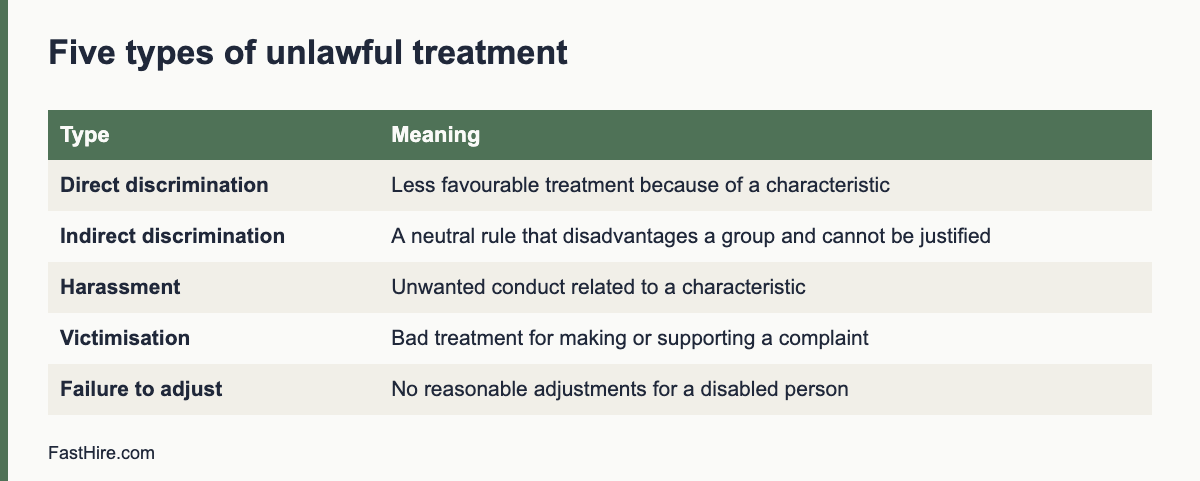
Types of unlawful treatment
| Type | Meaning | Recruitment example (fictional) |
|---|---|---|
| Direct discrimination | Treating someone less favourably because of a protected characteristic | A manager rejects a strong applicant because “she may have children soon” |
| Indirect discrimination | A provision, criterion or practice that applies to everyone but puts people with a characteristic at a particular disadvantage, and cannot be shown to be a proportionate means of achieving a legitimate aim | A rule that all staff must be able to work every Friday evening, with no business need, which disadvantages applicants who observe a religious practice on Fridays |
| Harassment | Unwanted conduct related to a characteristic that violates dignity or creates an intimidating, hostile or offensive environment | Jokes about an applicant’s accent in an interview |
| Victimisation | Treating someone badly because they made or supported a complaint under the Act | Refusing to interview a person who earlier complained about discrimination |
| Failure to make reasonable adjustments | Not taking reasonable steps to remove disadvantage for a disabled person | Refusing to send questions in advance to an applicant who needs them |
Indirect discrimination can be defended if the employer shows that the practice is a proportionate means of achieving a legitimate aim. That requires a real aim, such as health and safety, and evidence that the rule is needed and that less harmful options were considered. A habit or a convenience is usually not enough. For similar ideas in the US, see disparate treatment vs disparate impact.
Reasonable adjustments in recruitment
Employers must take reasonable steps to remove disadvantages for disabled applicants. In recruitment this can mean changing the process, the place or the format, or giving extra help. Examples:
- Sending interview questions in advance
- Allowing extra time for a test
- Offering a different format for an application, such as a phone call instead of a form
- Holding an interview in an accessible room
- Providing a sign language interpreter or captions
- Allowing a support person to attend
Tell applicants how to ask for adjustments in the job ad and the invitation. Respond quickly, and record what you agreed. What is reasonable depends on cost, size, practicability and the effect of the change. Take advice if you are unsure. See our upcoming guide on UK reasonable adjustments in recruitment for more detail.
Health and disability questions before an offer
The Act limits questions about health or disability before you make a job offer or include a person in a pool of preferred candidates. The main exceptions are to find out whether the person can take part in a recruitment assessment with adjustments, to monitor diversity, to support positive action, or where a health requirement is intrinsic to the job. GOV.UK explains these limits in its page about checks employers can make on job applicants. After a conditional offer, you may ask health questions that relate to the job, in line with the law and data protection rules. Do not ask all applicants to complete a general health questionnaire at the application stage.
Job ads, shortlisting and interviews
| Stage | Risk | Good practice |
|---|---|---|
| Job ad | Wording or channels that exclude groups | Plain language, job-related requirements, open channels, an adjustments line |
| Application form | Questions on protected characteristics | Collect only what you need; keep monitoring data separate |
| Shortlisting | Assumptions from names, ages or gaps | Written criteria, evidence sheet, two reviewers on a sample. See structured screening |
| Interview | Unplanned questions on family, health or origin | Question list, scorecard. See questions you cannot ask |
| Tests | Tests that disadvantage a group | Validate tests; offer adjustments |
| Offer | Different pay for similar roles | Pay ranges, consistent offers, reasons recorded |
Positive action
The Act allows certain positive action steps. Employers may take proportionate steps to encourage people with a characteristic to apply if they are under-represented or face disadvantage, such as outreach and training. In a recruitment tie-break, where two candidates are equally qualified, an employer may choose the candidate from an under-represented group, subject to conditions. This is different from positive discrimination, which is generally unlawful, such as setting quotas or choosing a candidate who is less qualified because of a characteristic. Take advice before you use a tie-break. The Equality and Human Rights Commission provides guidance on its website at equalityhumanrights.com.
Data protection and records
Keep records of your criteria, scores and reasons. They show that you acted fairly. Data protection law applies to these records. Information about protected characteristics may be special category data, which has extra conditions. See the ICO employment guidance. Tell applicants what you collect and why, and delete data when you no longer need it.
A worked example (fictional)
This example is invented. A small retailer in England hires a store assistant. The manager wants “energetic, young” people. The owner rewrites the ad to describe tasks (“lift boxes up to 10 kilograms with aids provided; work Saturdays”) and adds “Tell us if you need any adjustment to apply”. She asks all applicants the same questions. One applicant mentions a medical condition in the interview. The manager does not follow up on the condition and focuses on whether the applicant can do the tasks, with or without adjustments, and asks what would help. The applicant says a stool at the till would help. The owner notes the answer and scores the applicant on the criteria. The applicant is offered the job and the stool is provided. The process left a record that supports the decision.
Checklist for UK employers
- Job ad is task-based, avoids age or sex signals and invites adjustment requests.
- Criteria are written and linked to the job.
- Shortlisting uses an evidence sheet and a second reviewer on a sample.
- Interview questions are fixed and exclude protected topics.
- Health questions are held until after an offer, unless an exception applies.
- Adjustments are offered and recorded.
- Monitoring data, if collected, is kept separate and used lawfully.
- Reasons for decisions are recorded and stored securely.
Questions to ask before you finalise a requirement
Use these five questions each time you add a requirement to an ad or a shortlist rule. They help you spot indirect discrimination early.
- Does this requirement apply to every applicant in the same way?
- Is it needed for the job? Which task depends on it?
- Could it put people with a protected characteristic at a particular disadvantage? For example, rigid working hours, a long continuous service requirement, a physical test, a particular qualification or a language level.
- What is the legitimate aim, such as safety or customer service, and is this rule a proportionate way to reach it?
- Is there a less restrictive way, such as a trial period, training, equipment or a different test?
Write the answers next to the requirement in your role brief. If you cannot answer, remove the requirement or change it. See how to write checkable job requirements.
What to do if an applicant complains
Treat the complaint seriously and calmly. Acknowledge it in writing, say who will look into it, and give a date for a reply. Collect the documents: the ad, the criteria, the scorecards, the messages and the notes. Ask someone who was not involved in the decision to review. Do not discourage the applicant from complaining and do not treat them worse for complaining, because that can be victimisation. If the matter may lead to a tribunal claim, take legal advice. Acas offers guidance and early conciliation services for employment disputes, and you can find them on the Acas website.
Where to read next
This guide covers recruitment in Great Britain. For the EU rules, read our article on EU equal treatment in hiring. For the way UK data protection law affects applicants, see our guides on GDPR for applicants. For a practical step-by-step on fair screening, read how to reduce bias in resume screening. For the cost of an unfair process, remember that legal risk is only one part: unfair hiring also loses you good people and damages your reputation.
Pay, offers and the terms you offer
The Act covers the terms on which you offer a job, not only whether you offer it. Offering a lower salary to a woman than to a man for the same role, or less favourable terms to a person of a particular race, can be unlawful. Keep pay ranges for each role and make offers within the range, based on job-related factors such as experience relevant to the tasks. Record the reason when you offer above or below the middle of the range. Reviewing offers across roles each year helps you find unexplained gaps. Equal pay law is a separate topic with its own rules, so take advice if you find a gap.
Be careful with salary history questions and with negotiation. Candidates who negotiate more may be rewarded in ways that disadvantage those who negotiate less, and this can reproduce earlier inequality. A clear range and a consistent process help.
Frequently asked questions
Does the Equality Act apply to job applicants?
Yes. It covers recruitment, including ads, shortlisting, interviews, tests and offers.
What are the nine protected characteristics?
Age, disability, gender reassignment, marriage and civil partnership, pregnancy and maternity, race, religion or belief, sex and sexual orientation.
Can I ask about health before offering a job?
Generally not, with limited exceptions such as adjustments for the recruitment process. See GOV.UK guidance.
Does the Act apply in Northern Ireland?
Northern Ireland has separate equality laws. Check local guidance.
What is the difference between direct and indirect discrimination?
Direct is less favourable treatment because of a characteristic. Indirect is a neutral rule that puts a group at a particular disadvantage and cannot be justified.
Related guides
- Hiring guides for fair and compliant hiring
- Disparate treatment vs disparate impact in hiring
- What you can and cannot ask in a job interview: US, UK and EU
- Structured screening: how to compare every applicant on the same evidence
- All hiring guides for employers
- EU equal treatment rules in hiring: what employers should know
- UK reasonable adjustments in recruitment
- Pay transparency in hiring: EU, UK and US
- Age discrimination in hiring: wording, screening and examples
- Sex, gender and pregnancy: rules for interview questions
- Religion and belief in recruitment: dress, holidays and interviews
- Fair hiring for older workers and career returners
This is general information, not legal advice.