
No, you should not ask about pregnancy, plans for children, marital status or similar topics in an interview. In the US, UK and EU, sex and pregnancy are protected, and questions on these topics can be used as evidence of discrimination. Ask about the real requirements of the job, such as hours, travel and dates, in the same way for every candidate.
Key takeaways
- Do not ask about pregnancy, fertility, plans for children, marital status or childcare.
- Ask all candidates the same questions about the job: hours, travel, tasks, start date.
- Treat gender, sex and gender identity as protected. Use the name and pronouns the person gives, and do not ask for details that the job does not need.
- If a candidate mentions pregnancy or family, do not use it in the decision. Move back to the job requirements.
- Keep records of questions, scores and reasons, and train interviewers.
Why these questions cause trouble
Questions about family plans often come from good intentions, such as wanting to be fair to the team or to plan cover. But they put the burden on one group, usually women, and they signal that the answer will affect the decision. Even if it does not, the candidate cannot know that. In a claim, the question itself can be used as evidence.
There is a simple fix. Describe the real needs of the job and ask everyone whether they can meet them. That gives you the information you need and treats everyone alike.
United States
Title VII of the Civil Rights Act prohibits discrimination because of sex, including pregnancy, childbirth and related conditions. The EEOC explains pregnancy discrimination and the rules on accommodation for pregnancy-related limits. The Pregnant Workers Fairness Act requires reasonable accommodations for known limitations related to pregnancy, childbirth or related conditions for covered employers. Title VII also covers sex stereotyping, and the EEOC treats discrimination because of gender identity and sexual orientation as sex discrimination under its guidance; the legal position is changing, so check current EEOC pages and your state law. See the Title VII page.
United Kingdom
The Equality Act 2010 protects against discrimination because of sex, pregnancy and maternity, and gender reassignment. Pregnancy and maternity discrimination covers the time of pregnancy and maternity leave. Marriage and civil partnership are also protected. Read the Act at legislation.gov.uk and see GOV.UK employing people. Our UK Equality Act recruitment guide gives more.
European Union
EU law requires equal treatment of men and women in employment. The recast directive on equal opportunities and equal treatment covers access to employment, and there are separate EU rules protecting pregnant workers. Member states apply these rules through national law, and many give more protection. Check the law where you hire. See also the EU equal treatment guide.
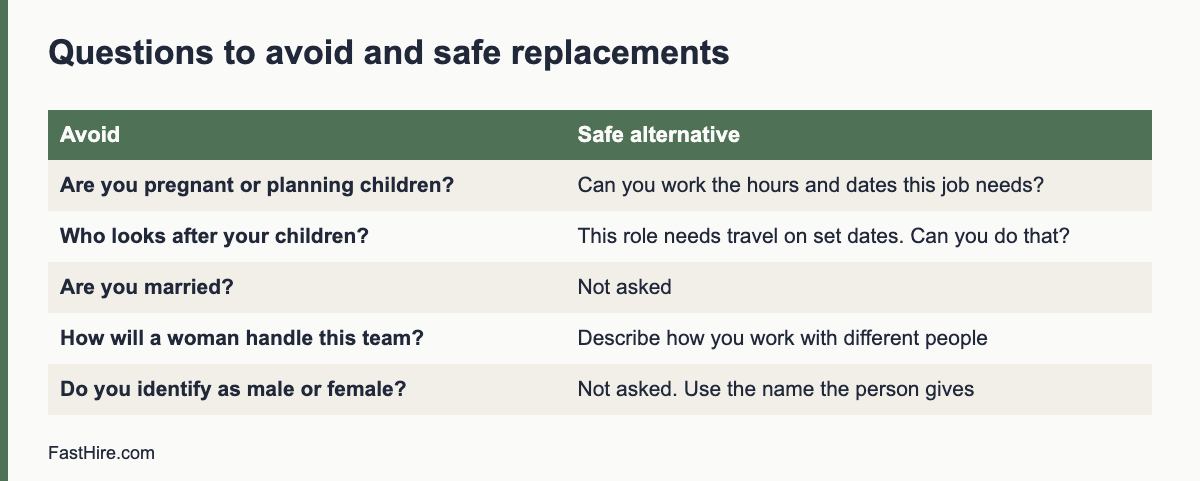
Questions to avoid and what to ask instead
| Avoid | Why | Ask instead |
|---|---|---|
| Are you pregnant? Do you plan to have children? | Protected topic; can be used as evidence of discrimination | This job needs X hours and Y dates. Can you work these? |
| Who will look after your children? | Assumes caring duties, usually of women | Can you meet the schedule and travel needs of this role? |
| Are you married? Do you have a partner? | Marital status can be protected and is not job-related | Not asked |
| Do you think a woman can lead this team? | Sex stereotype | Describe a time you led a team and what happened |
| Are you a man or a woman? What are your pronouns? | Not needed to judge ability; can expose a protected status | Not asked. Use the name and pronouns the person gives you after hire |
| How long do you plan to stay with us? | Can be used to screen out women of child-bearing age | What are you looking for from this role in the next year or two? |
| Will you be able to cope with long hours? | Phrased as a guess about the person | This role includes some evening work on set dates. Can you do that? |
More examples are in interview questions you cannot ask. A structured interview with fixed questions removes the temptation to improvise.
If a candidate raises pregnancy, family or gender identity
Sometimes the candidate brings up the topic. Do not ask follow-up questions, and do not let it affect the decision. Say something neutral such as “Thank you for telling me. We will assess every candidate on the requirements of the role.” Then return to the job. If the person asks about leave, benefits or adjustments, answer the question or refer them to HR. Do not record the information in interview notes unless the law requires it or it is needed to provide an adjustment.
Pregnant candidates and adjustments
A person does not need to tell you about pregnancy before they are hired. If they do, you cannot refuse them because of it. Once hired, they may need adjustments, such as changes to tasks, hours or breaks. Ask what would help and follow the legal rules in your country. For health and safety, take advice on the risk assessment for pregnant workers. Keep information confidential and share it only with people who need it to arrange support.
Gender identity, names and respect
Use the name a candidate gives you. If they ask to be addressed in a particular way, do so. Do not ask about medical history, surgery or sex at birth. If a background check or right to work document shows a different name or sex marker from the one the person uses, handle it in a private, respectful way with HR, and share it only if needed for legal compliance. Make sure forms allow a preferred name and do not force a choice that does not fit. Read the national guidance on gender reassignment and gender identity where you hire.
Job ads and screening: gender-neutral practice
- Use gender-neutral job titles, such as “salesperson” rather than “salesman”.
- Avoid words that signal a gender, such as “he” for the successful candidate, or “ambitious young man”.
- Review the must-haves for real need. A requirement to lift weights or work at night should be tied to the duties.
- Remove names, photos and gender signals from resumes or CVs before screening, if your process allows.
- Compare outcomes by sex or gender, where lawful, to look for patterns.
See how to reduce bias in resume screening, blind CV screening and how to write a job ad.
Pay, flexible work and fairness
Mothers and fathers, carers and people with different needs all benefit from clear, fair rules on hours and flexible work. Say in the ad what flexibility the job offers, and apply the rules in the same way for everyone. Do not assume that a woman wants fewer hours or that a man does not need flexibility. Pay should follow the job and the skills. For equal pay rules, see the US Equal Pay Act, the UK gender pay gap guidance and pay transparency in hiring.
Training interviewers
- Give each interviewer a list of questions to avoid and a list to use.
- Run a practice interview where someone raises a family topic, and rehearse a neutral reply.
- Ask interviewers to take notes on job-related evidence only.
- Review a sample of notes each quarter for protected topics.
- Tell interviewers how to refer a sensitive question to HR.
Worked example (fictional)
A hiring manager is interviewing for a field sales role that needs travel on some weekdays. In the past, a colleague asked candidates whether they had young children. HR replaces that with a statement in the ad and in every interview: “This role includes travel on up to two weekdays a week, with overnight stays on some. Can you meet this requirement?” Candidates answer yes or no and can ask about support. During one interview, a candidate mentions that she is pregnant. The interviewer replies, “Thank you. We assess everyone on the requirements, so let us go back to the travel needs,” and records only the job-related answers. She scores highest on the requirements and receives the offer. Once hired, HR meets her to discuss any adjustments she wants.
Practical scenarios and what to do
The candidate asks whether the job is family friendly
Answer the question about the job: the hours, the flexibility, the leave policy and the benefits. Do not ask why they ask. Give the same information to every candidate who asks, and put the main facts in the ad so everyone sees them.
A manager says a woman candidate may not stay long
Challenge the assumption with the written criteria. Say that the decision must rest on the requirements and the evidence, and that guesses about future plans are not a lawful or reliable basis. Add the comment to your records, and offer the manager refresher training.
A candidate with a visible pregnancy is late to an interview
Treat the delay as you would for any candidate. Ask whether anything would help, such as a seat or a water break. Offer a short rest if the person looks tired. Score the interview on the answers. Do not add any note about the pregnancy.
A transgender candidate has documents in a different name
Use the name the person gives. For right to work or background checks, ask HR to handle the documents privately, follow the law, and share only what is needed. See how to check the right to work. Do not ask about medical history.
Monitoring and data
To see whether your process treats groups fairly, collect data on sex or gender at each stage, where the law allows it. Use an optional form that is separate from the application and not seen by the hiring team. Compare the shares of applicants, interviewees, offers and hires. A large gap at one stage deserves a review of the criteria, the questions and the scoring. The four-fifths rule is one simple check used in the US and explained with its limits in our guide. In the UK, larger employers must report gender pay gaps, as explained on GOV.UK. Use the findings to improve, not to blame individuals.
Policy wording you can adapt
| Section | Wording |
|---|---|
| Purpose | We hire on skills and evidence. We do not use sex, gender, pregnancy or family status in decisions. |
| Interviews | Interviewers use a fixed list of questions. They do not ask about pregnancy, family plans, marital status or childcare. |
| If raised | If a candidate raises such a topic, the interviewer does not use it and returns to the requirements. |
| Adjustments | We provide adjustments as the law requires, once a person asks or we know of a need. |
| Records | Notes are job-related. We review a sample of notes each quarter. |
A final point on culture. Rules on paper do not change behaviour alone. Leaders set the tone by how they talk about parents, carers and people of every gender. When a manager praises a colleague for working late or jokes about who will “go on leave next”, the team learns what is rewarded. Treat caring duties as normal, support flexible work where the job allows, and speak up when you hear a stereotype. This builds a workplace where capable people of every gender want to apply and to stay, and it makes lawful, fair hiring much easier to sustain.
Frequently asked questions
Can I ask a candidate if she is pregnant?
No. Do not ask, and do not base a decision on it. Ask about the dates and hours the job needs, the same way for all candidates.
Can I ask about childcare to check availability?
Ask about availability for the real schedule, not about childcare. Say what the job needs, and ask if the candidate can meet it.
What if a candidate tells me they are pregnant?
Do not use it in your decision. Return to the requirements. After hire, offer support and adjustments as the law requires.
Can I ask for a candidate gender on a form?
Only if there is a lawful reason, such as monitoring, and then in a separate optional form that does not go to the hiring team.
Related guides
This is general information, not legal advice.