
EU equal treatment rules for hiring come from several directives that each member state turns into national law. They ban discrimination in access to employment, including recruitment, on grounds of racial or ethnic origin, religion or belief, disability, age, sexual orientation and sex. Because national laws differ in detail, employers must check the law of each country where they hire.
Key takeaways
- EU directives set minimum rules. Each country adds its own law, so details differ.
- Protected grounds in employment: racial or ethnic origin, religion or belief, disability, age, sexual orientation, and sex.
- Direct and indirect discrimination, harassment and instructions to discriminate are covered.
- Employers must provide reasonable accommodation for disabled people, unless it creates a disproportionate burden.
- When a person shows facts that suggest discrimination, the burden of proof can shift to the employer.
How EU law works for employers
The European Union does not have one employment law that applies directly to every employer. Instead, it issues directives. A directive sets a goal, and each member state writes national laws to meet it. Member states can set higher protection. That is why an employer in Ireland, Germany, Spain and Poland may face different details on the same topic. Always read the national law and guidance for the country where the job is based, and where the employer is established.
This guide gives an overview. It is general information, not legal advice. For official summaries, see the Your Europe page on hiring and managing staff.
The main directives
| Directive | What it covers | Official text |
|---|---|---|
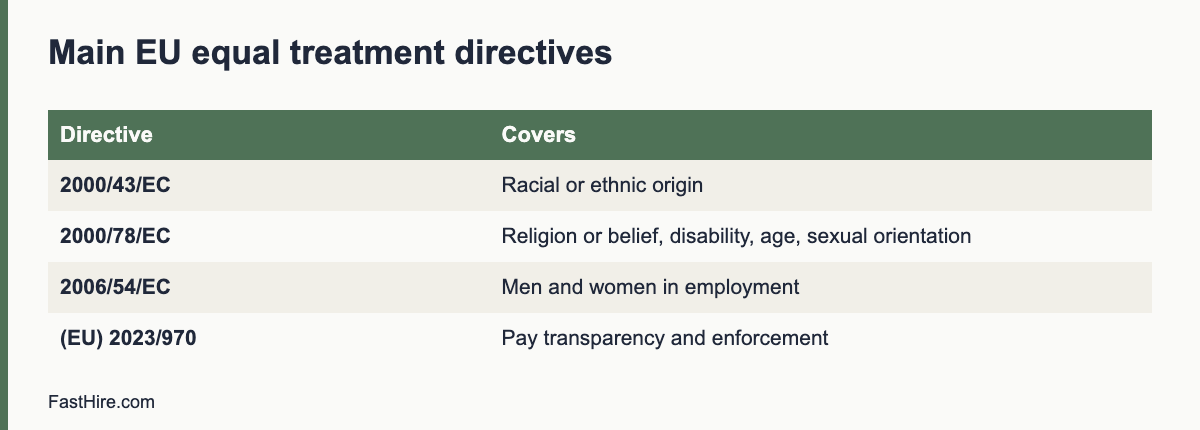
| Directive 2000/43/EC (Racial Equality Directive) | Equal treatment irrespective of racial or ethnic origin, including access to employment, in the public and private sectors | EUR-Lex |
| Directive 2000/78/EC (Employment Equality Directive) | Equal treatment in employment and occupation on grounds of religion or belief, disability, age and sexual orientation | EUR-Lex |
| Directive 2006/54/EC (Recast Directive) | Equal opportunities and equal treatment of men and women in matters of employment and occupation | EUR-Lex |
| Directive (EU) 2023/970 (Pay Transparency Directive) | Pay transparency and enforcement mechanisms, with duties that include information for job applicants about pay. Member states must apply it through national law | EUR-Lex |
The EU Charter of Fundamental Rights also includes a ban on discrimination. Member states and EU institutions must respect it when applying EU law. For the application date of national pay transparency rules, check the official national implementation and the EUR-Lex record, because dates and details may vary by country. We do not give a date here.
What counts as discrimination
| Concept | Meaning | Recruitment example (fictional) |
|---|---|---|
| Direct discrimination | A person is treated less favourably than another in a comparable situation because of a protected ground | An ad that says “no applicants over 40” |
| Indirect discrimination | An apparently neutral provision, criterion or practice puts people with a protected ground at a particular disadvantage, unless it is objectively justified by a legitimate aim and the means are appropriate and necessary | A rule that all staff must work on a day of religious observance, with no need |
| Harassment | Unwanted conduct related to a protected ground that violates dignity and creates an intimidating, hostile, degrading, humiliating or offensive environment | Insulting comments in an interview |
| Instruction to discriminate | Telling someone to discriminate | A manager telling a recruiter to remove applicants of a certain origin |
| Victimisation | Adverse treatment for complaining or supporting a complaint | Refusing to hire a person who earlier made a complaint |
These definitions are paraphrased from the directives. Read the directive and your national law for exact wording. The tests for justification differ between grounds and countries.
Reasonable accommodation for disabled people
Under Directive 2000/78/EC, employers must take appropriate measures, where needed in a particular case, to enable a person with a disability to have access to employment, to take part in it, to advance, or to undergo training, unless the measures would impose a disproportionate burden. In recruitment, this can mean accessible application formats, adjusted tests, extra time, accessible premises, assistive technology or a modified interview format. State how applicants can ask for adjustments in the job ad and the invitation. Respond quickly and record what you agree. National law may define “disability” and “disproportionate burden” in detail. See our UK guide on reasonable adjustments for a comparison.
Exceptions: genuine occupational requirements
The directives allow limited exceptions. A difference of treatment based on a characteristic related to a protected ground may be lawful where, because of the nature of the occupational activities or the context, the characteristic is a genuine and determining occupational requirement, the objective is legitimate, and the requirement is proportionate. Churches and organisations with an ethic based on religion or belief have some defined flexibility under Directive 2000/78/EC, within limits set by national law. Age differences can be justified in some cases, such as set minimum age for safety-critical work, if objectively and reasonably justified by a legitimate aim. These exceptions are narrow. Do not rely on them without advice.
Burden of proof and enforcement
The directives require that when a person shows facts from which discrimination may be presumed, the respondent must prove that there was no breach of the principle of equal treatment. This is called the shifting of the burden of proof. It does not mean a complaint wins automatically. It means that you must be able to show job-related reasons. Written criteria, scorecards and records make this possible.
Member states must provide ways to enforce the rules, including judicial or administrative procedures, and penalties that are effective, proportionate and dissuasive. Many countries have an equality body that gives advice and support to people who think they were discriminated against. The remedies and procedures differ between countries.
What to do in recruitment, step by step
- Identify the countries. List where the job is based and where you are established.
- Find national guidance. Look for the equality body, the labour ministry and the data protection authority for each country.
- Write job-related criteria. Link each requirement to a task. See must-haves vs nice-to-haves.
- Use neutral ads. Avoid wording that signals age, sex, origin or religion without a genuine need.
- Use structured screening and interviews. Same criteria, same questions. See structured screening.
- Offer accommodations. Invite applicants to ask for them.
- Keep records. Store scorecards and reasons securely and delete them on schedule.
- Check data rules. Monitoring data about protected grounds is special category data under GDPR, with extra rules. See the GDPR text and your national authority, or the European Data Protection Board.
Differences across countries: what to check
| Topic | Why it varies | What to check |
|---|---|---|
| List of protected grounds | Many countries add grounds such as language, family status, social origin or political opinion | The national equality act and guidance |
| Age rules | Minimum ages, retirement rules and justifications differ | National labour law |
| Questions about criminal records | Rules differ widely | National law and data protection authority |
| Health questions | Strict in many countries | National law on pre-employment medical questions |
| Photos and personal details on CVs | Customs differ; some countries discourage or restrict them | National guidance |
| Monitoring and diversity data | Special category data; some countries restrict collecting it | Data protection authority |
| Collective agreements | May add duties in some sectors | Sector agreements |
When you recruit across several countries, build a short country sheet for each: protected grounds, key rules, who to contact and the process notes. Update it once a year. See our guide to managing hiring across the US, UK and EU for an approach to multi-country work.
A worked example (fictional)
This example is invented. A company based in one EU country opens a role in another member state. The HR lead assumes that the same ad and interview questions apply. She checks national guidance for the second country. She finds that the local equality body discourages questions about marital status and that photos on CVs are not required. She removes a line about “native speaker” from the ad and replaces it with “fluent written and spoken French at a level for client calls”, which she can test in a call. She adds an adjustments line in the local language. She tells the interviewers which topics are not allowed. The process is the same in structure as in the home country and different in details. She keeps a one-page note of what she checked, with sources and the date.
Job ads under EU equal treatment rules
The job ad is the first place where discrimination can occur. Many countries ban ads that exclude people on a protected ground unless there is a genuine occupational requirement. Use this short check before you publish.
| Check | Example of a risk | Better wording |
|---|---|---|
| Age | “Young and dynamic team”; “recent graduate” with no need | “Team that values learning”; “entry-level; training provided” |
| Sex | “Salesman wanted”; “waitress” | “Sales representative”; “server” |
| Origin | “Native speaker” | “Fluent written and spoken [language] (level B2 or equal)” |
| Religion | “Must be available on all religious holidays” | State the real schedule |
| Disability | “Must be fit and healthy” | “This role includes [tasks]. Tell us if you need adjustments.” |
| Family | “No family commitments” | State the hours and the place |
The language level scale in the table (B2) refers to the Common European Framework of Reference for Languages, which many employers use. State the level only if the job needs it.
Working across several member states
If you run one process for several countries, keep a shared core and adapt local details. The core can be the criteria, the scorecard and the evidence sheet. The local details are the ad wording, the legal checks, the data rules and the questions you must avoid. Appoint a local contact, such as an HR adviser or a lawyer, for each country. Ask them to review your template once a year and when laws change. Share a short summary with all interviewers, in the local language where possible.
Be careful with tools and vendors. If you use software for screening or testing, ask where data is stored, how long it is kept and whether the tool was tested for unfair effects. In the EU, rules on automated decisions and on the use of AI in hiring may also apply. Check the official EU sources and your national authority. This is general information, not legal advice.
Records that help you in a dispute
Because the burden of proof can shift, records matter. Keep the role brief and criteria, the ad as published, the question list, the scorecards, the notes, the decision record and the messages sent to candidates. Store them securely, limit access and set a deletion date that follows national law and data protection rules. If a complaint arrives, do not delete or change records. Keep them, tell your legal adviser and respond within the time that applies.
A short, written explanation for each hiring decision, linked to the criteria, is often the strongest evidence of fair treatment. It also improves your own decisions, because writing the reason forces you to check it. Make this habit part of your debrief. See how to run a debrief meeting for a template of a decision record.
Frequently asked questions
Which grounds does EU law protect in employment?
Racial or ethnic origin, religion or belief, disability, age, sexual orientation and sex. National laws often add more.
Do EU directives apply directly to employers?
They are implemented through national law. Employers follow the national law of the country where they hire.
Do I have to provide reasonable accommodation?
Yes, for disabled applicants and employees, unless it would impose a disproportionate burden. National law sets the details.
What does a shifting burden of proof mean?
If a person shows facts that suggest discrimination, the employer must prove it did not breach equal treatment. Records help you do that.
Where can I find the national rules?
Start with the Your Europe pages, then the equality body, labour ministry and data protection authority of the country concerned.
Related guides
- Hiring guides for fair and compliant hiring
- UK Equality Act: direct and indirect discrimination in recruitment
- Disparate treatment vs disparate impact in hiring
- What you can and cannot ask in a job interview
- All hiring guides for employers
- Pay transparency in hiring: EU, UK and US
- Race, ethnicity and national origin in hiring: what the law says
This is general information, not legal advice.