

To hire an employee in another country, first confirm why the role must be in that country, then choose a legal route: hire directly through a local company, use an employer of record, or engage a contractor if the facts support it. Check local employment law, tax and social contributions, right to work, data protection and company registration rules with a local adviser before you make an offer.
Key takeaways
- Employment law, tax and social contributions follow the place where the person works, and often where they live. Your home rules do not travel with the job.
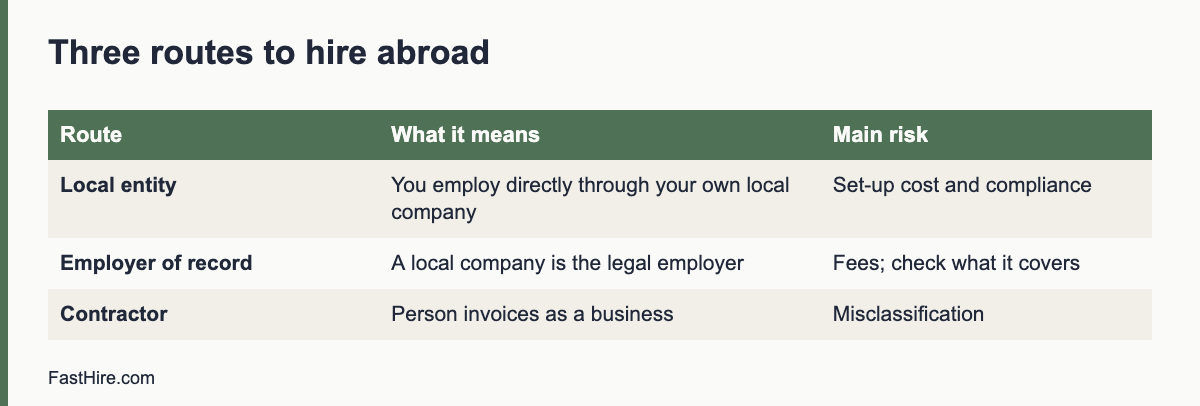
- There are three main routes: your own local entity, an employer of record, or a contractor. Each has costs and risks.
- A person working for you in another country can create tax and legal duties for your company, even with no office.
- Check right to work, data protection and pay rules before you recruit, not after.
- Take advice from a local employment lawyer and accountant for the first hire.
Start with the reason and the facts
Hiring abroad is more complex than hiring at home. Before you start, write down why. Reasons may include access to skills, serving customers in that market, time-zone cover or a person you already know who is moving. Then collect the facts: the country, the city or region, the job, the hours, whether the person will work remotely or on site, the expected length, and whether the person already has the right to work there.
These facts decide which rules apply. Hiring a person who lives in Germany and works remotely for a US company is a different case from hiring a person in Poland to work in your Polish office. Always check the country-specific rules, because EU countries differ from each other as well. For an overview of EU staff rules, see Your Europe: hiring and managing staff.
Three routes, compared
| Route | What it means | Fits when | Main risks |
|---|---|---|---|
| 1. Your own local entity | You register a company or branch in the country, run local payroll and employ the person directly | You plan several hires or a long-term presence | Set-up time and cost; local compliance; accounting and legal fees |
| 2. Employer of record (EOR) | A local company becomes the legal employer and runs payroll and compliance; you direct the daily work | You want one or a few hires without setting up a company | Fees; the contract with the provider matters; check what the provider does and does not cover; some tax risks may remain with you |
| 3. Contractor | The person works as a self-employed business and invoices you | The work is a defined project and the person is independent in fact | Misclassification: if the person works like an employee, authorities may treat them as one. See employee or contractor |
Do not choose a route only on price. A cheaper route that breaks the law costs more later. Ask a local adviser which route is lawful for your facts. In some countries, a remote employee can create a taxable presence, called a permanent establishment, for the employer. This is a tax question, and tax advisers can assess it.
The seven checks before you recruit
| Check | Question | Where to look |
|---|---|---|
| 1. Employment law | What minimum terms apply: notice, probation, working time, holiday, sick pay, termination rules? | National labour law and official portals; a local lawyer |
| 2. Contract | Does the contract need to be in the local language, follow a standard form, or include specific clauses? | Local lawyer |
| 3. Tax and social contributions | What payroll tax and social contributions apply to the employer and employee? Who registers and files? | National tax and social security authorities; an accountant |
| 4. Right to work | Does the person have the right to work in that country? If not, can you sponsor them? | National immigration authority. See right to work basics |
| 5. Data protection | Where will you store applicant and employee data? Are transfers across borders allowed? | Data protection authority. In the EU, see the GDPR text and the EDPB |
| 6. Pay rules | Is there a legal minimum wage or collective agreement that sets minimum pay in the sector? | National ministry of labour; sector agreements |
| 7. Insurance and benefits | Which benefits are legally required, and which are common? | Local adviser |
Many countries require pay transparency in job ads or have rules on how you can ask about salary history. Check these before you write the ad. See also our guide on what you can and cannot ask and note that rules differ by country.
Step by step: your first international hire
Step 1: Write the role brief
Use the one-page role brief. Add: the country, the working hours and time-zone overlap, the language level needed and why, and the plan for supervision.
Step 2: Choose the route and the advisers
Ask a local employment lawyer and an accountant for a short written opinion on the three routes for your facts. Ask: what are the legal minimums, what will the first-year cost be, and which risks remain with us? If you use an EOR, ask for the contract, the fee structure, the data protection terms and a list of what the provider handles.
Step 3: Estimate the full cost
Use the cost worksheet, with local figures from official sources. Add: employer taxes and contributions, local benefits, advisor fees, EOR or entity fees, equipment, travel and currency costs. Do not copy rates from another country.
Step 4: Write the ad in the local context
Use plain language, the correct local job title, pay information where required, and the local language if the job needs it. Check local rules on ads and the words you must avoid. Post on local channels as well as global ones. See where to post a job when you have no budget. The EU job portal EURES supports cross-border job search in the European Economic Area.
Step 5: Run a fair process
Use the same structured process for all candidates: written criteria, structured interviews, a scorecard and references. Offer interviews at fair times across time zones and offer adjustments. Remember that questions allowed in one country may be restricted in another. Use the stricter standard when unsure.
Step 6: Make a local-law offer
Issue the offer and the contract in line with local law. Include: the legal employer, job title, place of work, pay, hours, notice, probation if allowed, holiday and benefits. Have the local lawyer review the contract. See how to make a job offer for the structure.
Step 7: Onboard with the local rules in mind
Complete required registrations before day one. Provide equipment and safety information for the place of work, even if remote. Plan regular check-ins and clear working hours. See the onboarding plan and add time-zone and culture notes.
Common mistakes
| Mistake | Risk | Fix |
|---|---|---|
| Paying a person abroad as a contractor when they work like an employee | Penalties, back taxes, claims | Get a local opinion; use EOR or local employment where needed |
| Using your home contract template | Terms may be unlawful or void | Use local counsel |
| Ignoring social contributions | Debt and penalties | Register and pay as required |
| Forgetting time off rules and public holidays | Disputes | Learn local holidays and leave |
| Sending personal data across borders without a basis | Data protection breach | Check transfer rules |
| Assuming the person can work in the country | Illegal employment | Check the right to work first |
A worked example (fictional)
This example is invented. A UK software company wants to hire a customer support lead who lives in Spain and works remotely. The founder writes a role brief and asks a Spanish employment lawyer and an accountant for advice. The advisers explain that a contractor arrangement is risky because the role is full-time, directed and long-term. They compare setting up a Spanish branch with using an employer of record. The company chooses an employer of record for the first hire, because it plans only one hire in Spain in the next year. The founder checks the provider’s contract and data protection terms. The company advertises in Spanish and English, runs the usual structured interview, and offers adjustments. The lawyer reviews the contract and the notice and probation terms. The founder tracks the real cost in the first year and compares it with the estimate. After a year, the company decides whether to keep the EOR or open a branch if it plans more hires.
This example shows the method. The right route depends on the country and the facts. It is not advice for any real case.
Questions to ask an employer of record or adviser
- Which entity is the legal employer, and where is it registered?
- What exactly do you handle: payroll, tax filing, social contributions, benefits, insurance, termination?
- What is the fee structure, and what happens to the fee if the person leaves?
- Who owns the employee’s work and how are intellectual property terms handled?
- How do you handle data protection, and where is personal data stored?
- How is the contract written, and in which language?
- What happens if the employee needs a visa, a leave of absence or a termination?
- What parts of tax and compliance risk remain with us?
- Can we see an example contract and a list of references from customers in this country?
- What is the notice period to end our agreement, and how do you hand over the employee?
Keep the answers in a file. If the answers are vague, ask again or choose another adviser. A good provider explains clearly what it does not cover.
Culture, language and working time
Legal rules are the first layer. The second is how people work together across borders. Agree on a core overlap of working hours, written communication standards, who decides what, and how you handle public holidays and leave in the person’s country. Learn the local rules on working time, rest periods and the right to disconnect where they exist. Do not assume your home practices apply. Meet the person on video regularly, and plan an in-person visit if the budget allows. Clear expectations in writing prevent most misunderstandings.
Ending the relationship
Many countries have strict rules on dismissal, notice, severance and consultation. Termination that is easy in one country can be unlawful in another. Before you hire, ask your adviser how the relationship can end, what notice or pay applies, and what a fair process looks like. Document performance fairly and early, follow the local procedure and do not rely on your home rules. If you use an employer of record, check how they handle termination and who bears the cost. This is general information, not legal advice.
If your plan changes and you decide to hire more people in the same country, revisit the route. What was efficient for one hire may be costly for five. Set a review point, for example after the first year or after the third hire, and compare the cost and control of each route again with current quotes and advice.
Frequently asked questions
Can I hire someone abroad as a contractor?
Only if the person is genuinely independent under local law. If they work like an employee, they may be treated as one. Get a local opinion.
What is an employer of record?
A company that becomes the legal employer in the country, handles payroll and compliance, while you direct the work. Check what the provider covers and what remains with you.
Do I need a company in the other country?
Not always. It depends on the route you choose, how many people you hire and local law. A local adviser can tell you.
Which law applies to the contract?
Usually the law of the country where the person works, even if the contract names another law. Local rules often cannot be waived.
How long does it take?
It varies. Allow time for advice, contracts, registrations and right-to-work checks before the start date.
Related guides
- Hiring guides for small businesses and founders
- Employee or contractor? How to choose for your first role
- How much does it cost to hire an employee? A cost worksheet
- How to make your first hire: a step-by-step plan
- All hiring guides for employers
- How to check the right to work: US, UK and EU basics
- How to manage hiring across the US, UK and EU
This is general information, not legal advice.