
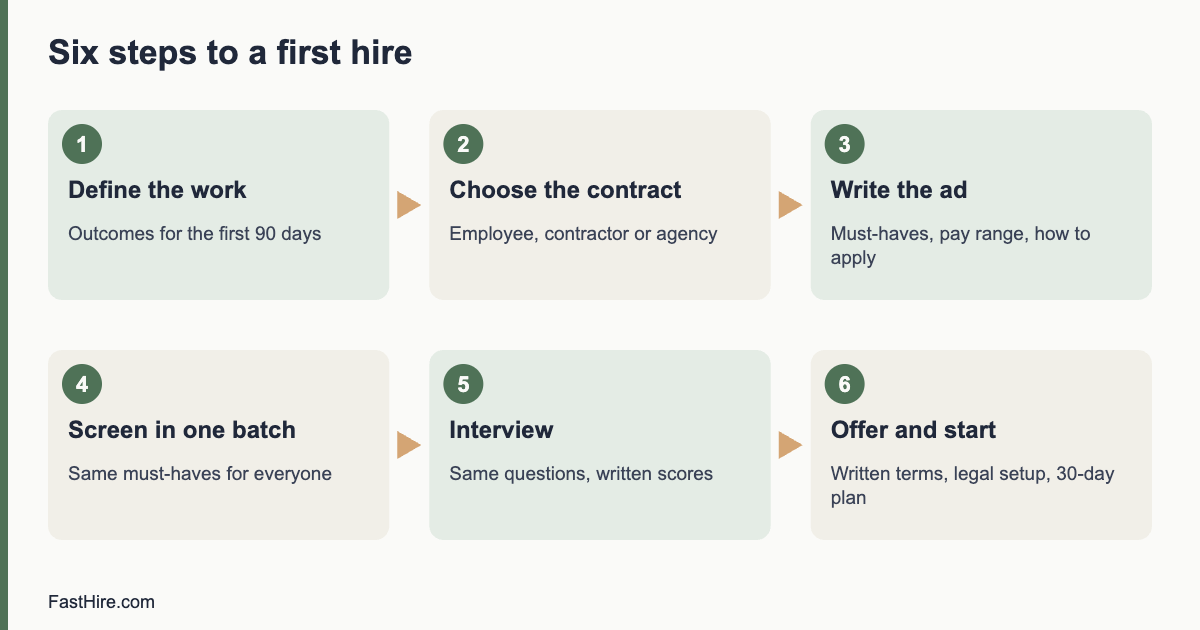
To make your first hire, start with the work, not the person. Write down what the role must achieve in 90 days, choose the right contract type, publish a clear job ad, compare every applicant against the same must-haves, interview with the same questions, and confirm the offer in writing. This guide walks through each step for founders in the US, the UK and the EU.
Key takeaways
- Define the outcomes first. A role you cannot describe in five sentences is not ready to advertise.
- Decide employee, contractor or agency before you write the ad. The choice changes the law that applies.
- Set three to five must-haves and judge every applicant against the same list.
- Use the same interview questions for every candidate and write down evidence, not impressions.
- Check right to work, give written terms and register as an employer before day one.
Step 1: Decide whether you really need to hire
A first hire is a long commitment. Before you advertise, check that the work is regular, that it will not disappear in three months and that you can pay for it. Ask three questions.
- What outcome is missing today? Describe it as a result, for example “customer emails answered within one working day”, not as a job title.
- Could a tool, a process change or a short contract cover it? If yes, try that first.
- Can you pay the full cost for at least a year? Salary is only part of the cost. Add employer taxes, insurance, equipment, software and your own time to train the person.
If the answers point to a permanent role, continue. If the need is short or uncertain, read the section on contractors below.
Step 2: Define the role in one page
Most weak hires start with a vague role. Write a one-page brief before you write any ad. It should contain four parts.
- Purpose: one sentence on why the role exists.
- Outcomes: three to five results the person should deliver in the first 90 days.
- Tasks: the regular work, in order of time spent.
- Working conditions: location, hours, pay range and who the person reports to.
Here is a short before-and-after example for a small online shop.
| Weak version | Stronger version |
|---|---|
| Customer service star wanted | Answer customer emails and chats within one working day, resolve returns, and report the three most common complaints each month |
| Must be a fast learner and a team player | Must have 1 year or more of customer support work, paid or unpaid, and be able to write clear replies in English |
| Competitive salary | Salary range: [your range] per year, 4 days in the office, 1 day remote |
The stronger version tells candidates what the job is. It also gives you something to check each application against. For more on separating essential skills from preferences, see Must-haves vs nice-to-haves: cutting your applicant pile without unfair filters and How to write job requirements candidates can actually check themselves against.
Step 3: Choose the contract: employee, contractor or agency
The contract type decides your legal duties, so decide before you advertise. The table gives a first view. It is not a test, because the rules differ by country and by the facts of each case.
| Option | Best when | Main risk |
|---|---|---|
| Employee | The work is regular, you direct how and when it is done, and you want a long-term relationship | Full employer duties: payroll, insurance, notice and dismissal rules |
| Independent contractor or freelancer | The work is a defined project and the person runs their own business | Misclassification: if the facts look like employment, authorities can treat the person as an employee |
| Agency or temporary worker | You need short-term cover or a fast start | Higher cost per hour and less control over who arrives |
Each country looks at the real working relationship, not the label in the contract. In the US, the Department of Labor explains how it tells employees from independent contractors in its guidance on misclassification. In the UK, GOV.UK sets out the main employment statuses: worker, employee and self-employed or contractor. In the EU, rules sit mainly at national level, so check the law of the country where the person will work.
Step 4: Set the budget and the pay range
Work out the full cost before you promise a number. Use a simple sheet with these lines: base pay, employer taxes and social contributions, pension or retirement contribution where required, insurance, equipment, software, recruitment costs and training time. Tax and contribution rates change, so take them from your tax authority for the current year.
Set a pay range and show it in the ad. Some US states and some countries require pay information in job ads or on request, and more rules are coming in the EU. Publishing a range also saves time, because applicants who cannot accept it do not apply. Check the rules in the place where the person will work.
Step 5: Write a clear job ad
A good ad answers the questions a candidate has before they apply: what will I do, what do I need, what do I get, and how do I apply. Keep it under 500 words. Here is a short sample you can adapt.
Customer Support Assistant, Greenfield Home Goods (small online shop, 6 people)
What you will do: answer customer emails and chats within one working day, process returns, and tell us each month what customers ask about most.
What you need: at least 1 year of customer support work (paid, unpaid or volunteer), clear written English, and comfort learning new software.
Nice to have: experience with a shop platform.
What we offer: [pay range] per year, 25 days of holiday, 4 days in our office and 1 day from home.
How to apply: send your resume or CV and a few lines on a time you solved a customer problem. We reply to every application within 10 working days.
Avoid wording that points to a protected group, such as “young and energetic” or “native speaker”. The US Equal Employment Opportunity Commission explains that job ads must not favour or discourage people because of protected traits, on its page about prohibited employment policies and practices. In the UK, Acas has practical advice on recruiting fairly, including advertising a job.
Step 6: Find candidates
You do not need a large budget. Start with channels where your kind of candidate already looks.
- Your own website and social accounts. Ask friends and customers to share the ad.
- One or two job boards that fit your sector and country.
- Public employment services. In the UK, Jobcentre Plus help for recruiters is listed on the GOV.UK recruiting and hiring page.
- Referrals. They are quick, but they tend to bring people who look like your current team, so also advertise openly.
Tell people when the ad closes and when they will hear from you. A closing date lets you screen in one batch, which is faster than reading each application on the day it arrives.
Step 7: Screen applications in one batch
Screening means comparing each application with your must-haves. It does not mean looking for reasons to reject. Use a simple three-column sheet: the must-have, what the resume or CV shows, and a yes, no or unclear.
- Read each application once against the must-haves only. Mark each as yes, no or unclear.
- Note the line in the CV that supports each yes. If you cannot point to a line, mark it unclear.
- Invite everyone with all yes marks. For unclear marks, send one short question by email.
- Keep the sheet. It is your record of why you made each decision.
Do not reject people for things that are not requirements, such as a gap in work history, an unusual career path or a degree you listed only as “nice to have”. FastHire is being built around this idea: show each requirement next to the exact CV passage that supports it, so a person can check the evidence quickly. FastHire is coming soon. It does not rank, score or reject candidates. People make every decision.
Step 8: Interview with the same questions for everyone
A structured interview means each candidate gets the same questions in the same order, and you score the answers against the same scale. It is fairer and easier to compare than a free conversation. Prepare six to eight questions tied to the outcomes in your brief. A sample set:
- Tell me about a time you had to learn a new tool quickly. What did you do first?
- Describe a customer or colleague who was unhappy. What did you say and what happened?
- How do you decide what to do first when three tasks are urgent?
- What would you want to know in your first week?
- Give an example of a mistake you made at work. What did you change afterwards?
Score each answer from 1 to 4 using notes you write straight after the interview: what the person said they did, not how they made you feel. Do not ask about age, family plans, health, religion or similar topics. If a candidate raises a health need or a disability, ask only what adjustment would help them do the interview or the job.
Step 9: Check references and right to work
Ask permission before you contact a referee. Ask each referee the same questions, for example: “What was this person responsible for? How did they handle pressure? Would you work with them again?”
Right to work checks are a legal duty in every country, and the method differs.
- US: complete Form I-9 for every new employee. The IRS page on hiring employees covers Form I-9 and the Form W-4.
- UK: check the applicant’s right to work before they start, following the steps in the GOV.UK guide: an online share code or original documents, with copies and the date of the check kept.
- EU: rules are national. Check with the labour ministry or employer authority in the country of employment.
Step 10: Make the offer and set up the legal basics
Make the offer by phone first, then confirm it in writing. Include the job title, start date, pay, working hours, location, notice period and any probation period. Give a date by which you need an answer.
Then complete the basic setup for your country.
| Country | What to do before or on day one |
|---|---|
| US | Get an Employer Identification Number if you do not have one, collect the Form W-4 and complete Form I-9. See the SBA guide to hiring and managing employees. Check your state for extra rules, such as new-hire reporting and workers’ compensation insurance. |
| UK | Register as an employer with HMRC before the first payday, using the GOV.UK registration page. Give a written statement of employment particulars. The core statement is due on the first day and the wider statement within two months, according to GOV.UK. Arrange employers’ liability insurance. |
| EU | Give the employee written information about the main terms of work. Directive (EU) 2019/1152 sets minimum rules on transparent and predictable working conditions, and each member state applies it through national law. Register the employee with the national tax and social security bodies. |
Step 11: Plan the first 30 days
The start of the job is where a good hire is made or lost. Prepare before day one: equipment, accounts, a named buddy and a plan for week one. A simple structure works.
- Day one: welcome, tools, introductions and the one-page brief.
- Week one: shadow the work, finish a first small task and hold a short end-of-week check-in.
- Day 30: review against the outcomes in the brief. Agree what to do in the next 60 days.
Use the brief you wrote in step 2. If you wrote clear outcomes, the review is a conversation, not a guess.
Common mistakes in a first hire
- Hiring someone like yourself. Choose for the work that is missing, not for a similar personality.
- Making the ad a wish list. A long list of requirements discourages good applicants and makes screening harder.
- Skipping written notes. Memory is unreliable, especially after five interviews.
- Waiting for the perfect candidate. A candidate who meets all the must-haves is a strong candidate.
- Ignoring local law. The rules about contracts, probation and notice differ by country and even by state.
A simple timeline
For a small team, plan roughly three to six weeks from advertising to offer if you move steadily. That is two weeks to advertise and collect applications, one week to screen, one to two weeks to interview, and a few days for references and the offer. The notice period of the person you choose may add more weeks before they start. Your market and the role will change these numbers, so treat them as a planning aid and not a benchmark.
Frequently asked questions
How long does it take to make a first hire?
Plan for several weeks from the ad to the offer, and add the notice period of the person you choose. A closing date and batch screening shorten the process more than posting in more places.
Should my first hire be an employee or a contractor?
Choose an employee when the work is regular and you direct how it is done. Choose a contractor for a defined project where the person runs their own business. Classification depends on the real relationship, so check your country’s rules.
Do I need an HR person to make a first hire?
No. You need a clear role, a fair and consistent process and the legal basics for your country. Written notes and the same questions for every candidate give you most of what an HR team would add.
What should I include in a first job ad?
Include what the person will do, the must-haves, the pay range, the location and working pattern, and how and when to apply. Leave out wording that points to age, sex, race or other protected traits.
Can I use AI tools to screen applicants?
Some tools help you read applications faster. The decision should stay with a person, and local rules may apply, so check the law where you hire.
Related guides
- Hiring guides for small businesses and founders
- Must-haves vs nice-to-haves: cutting your applicant pile without unfair filters
- How to write job requirements candidates can actually check themselves against
- All hiring guides for employers
- How to hire without an HR team: a simple process that works
- How to write a job ad that attracts the right applicants
- How to screen applications quickly: a 20-minute method for small teams
- What a bad hire really costs, and how to lower the risk
- Structured interviews: what they are and how to run one
- Behavioural interview questions with a scoring guide
- How much does it cost to hire an employee? A cost worksheet
- Employee or contractor? How to choose for your first role
- Where to post a job when you have no budget
- How to run a first interview for a small business: questions and scorecard
- How to check references without breaking rules or trust
- How to make a job offer: a letter template and what to include
- A small business onboarding plan for the first 30 days
- How long should hiring take? A realistic timeline for small teams
- How to hire your first salesperson without a sales manager
- How to hire an assistant or office manager: role, ad and interview
- How to hire your first developer when you are not technical
- How to hire in another country: a first guide for small employers
- How to check the right to work: US, UK and EU basics
This is general information, not legal advice.