Category: Small businesses and founders

Practical guides for first hires, job ads and quick screening, written for teams without an HR department.

  • What to do when too many people apply: a method for 200 applications

    What to do when too many people apply: a method for 200 applications

    You posted one job and 200 people applied. You have a business to run, and reading every resume takes days you do not have. The fix is a short method: set limits, write down the must-haves, sort by evidence, and keep a person in charge of every decision.

    This guide gives you that method in plain steps, with a time plan, a table you can copy and fair-hiring checks for the US, UK and EU. It works for 50 applications and for 500.

    Key takeaways

    • Decide how many people you can interview before you read a single resume.
    • Write three to five must-haves from the job, and judge each one by evidence in the resume.
    • Do not use rules that exclude people for reasons unrelated to the job, such as gaps or school names.
    • Time-box the work. Two focused sessions beat one long, tired read.
    • Reply to everyone, even with a short message.

    Why too many applications is a problem you can plan for

    A good job ad on a busy board brings many replies. That is normal. The danger is not the number. The danger is what a tired reader does with it: skim for the first thing that feels right, favour people who look like the last hire, or drop everyone after the first 30. None of these is fair, and none finds the best person.

    A method fixes this. It gives you the same questions for every resume, so the pile shrinks for good reasons that you can explain later. If you want to know more about what fair screening rules look like, read how to write fair knock-out criteria.

    Step 1: set your limits first

    Before you open any resume, decide four numbers. Write them down.

    LimitExample (fictional)Why it helps
    Interviews you can run6 first-round callsKeeps the pile from growing without end
    Hours you can spend screening4 hours over two daysKeeps the work in a box
    Minutes per resume3 minutesMakes the screen consistent
    Reply dateWithin 10 working daysKeeps candidates informed

    If you can only interview six people, you do not need to rank 200. You need to find six who clearly show what the role needs. That is a smaller, easier job.

    Step 2: write the must-haves

    Take the job description and pull out three to five must-haves. A must-have is something the person needs on day one, not something you can teach in a month. Write each as a plain sentence.

    Example for a bookkeeper role (fictional): “Has prepared monthly accounts in an accounting package.” “Has handled supplier invoices and payments.” “Can explain a figure to a non-finance colleague.”

    Then list two or three nice-to-haves. Use them only to choose between people who already meet all the must-haves. Do not use them to cut anyone.

    Avoid rules that cut people for the wrong reasons

    • Do not cut people for a gap in work history. A gap does not show lack of skill.
    • Do not cut people for the school they attended or the brand of their last employer.
    • Do not set years-of-experience numbers unless the job truly needs them. They can exclude older or younger people without reason.
    • Do not assume that a long commute, a name or a photo says anything about fit.
    • Do not treat a typo as proof of poor skill unless writing is a core part of the job.

    In the US, the EEOC guidance on employment tests and selection procedures explains that a rule can be unlawful if it excludes a protected group and is not job-related. In the UK and EU, similar principles apply under equality law, so keep your reasons tied to the job.

    Step 3: sort by evidence, not by feeling

    Make a simple sheet with one row per candidate and one column per must-have. For each cell, write one of three marks: clear evidence, some evidence, or no evidence found. Add a short note that quotes or points to the resume line.

    Do the first pass in two sessions of about 90 minutes. Take a break between them. Tired readers become harsher and less fair as the pile grows. Read in a different order in the second session, so that the people at the bottom of the pile get the same fresh eyes.

    CandidateMust-have 1Must-have 2Must-have 3Note
    A (fictional)ClearClearSomeRan month-end close at a 12-person firm
    B (fictional)ClearNo evidenceSomeStrong on invoices, no accounting package named
    C (fictional)SomeClearClearPart-time role; ask about the package

    The point of the sheet is that you can explain every cut. “No evidence of must-have 2 in the resume” is a reason you can write in a note. “Did not feel right” is not.

    Step 4: keep people in charge

    Software can help you read faster, but a person should decide who moves forward. Any tool that ranks, scores or rejects on its own raises legal and fairness risks. In the EU, the GDPR gives people rights around decisions made only by automated means, and the UK has similar rules. See the ICO guidance on recruitment and selection for the UK view.

    FastHire is coming soon. It will show you each job requirement next to the exact CV passage that supports it, so you can check the evidence yourself in seconds. People make every decision. FastHire does not rank, score or reject automatically.

    Step 5: shortlist, reply and record

    Take everyone with clear evidence on all must-haves. If that gives you more than your interview limit, break ties with the nice-to-haves, and write down that you did so. If fewer, review those with “some evidence” on one must-have and ask a short screening question.

    Then reply to everyone. A short message is fine. Send it within your reply date. You will find a template in our guide to how to turn down a candidate kindly.

    Keep your sheet and notes. If a candidate asks why they were not chosen, or complains, you will have an answer. See how to document hiring decisions.

    What if you still have too many?

    • Add one short, job-related screening question to your application form and use it as a must-have.
    • Close the ad early once you have enough strong replies. Say so in the ad.
    • Run a short phone call with the top group before deciding who moves to a full interview.
    • Use a work sample that takes 20 minutes, and apply it the same way to everyone.
    • Hold the rest in a pool, with consent, for a later role. Check how long to keep applicant data.

    Checklist: 200 applications

    • Interview limit and time budget written down
    • Three to five must-haves in plain sentences
    • Rules checked for fairness (no gap, school or brand cuts)
    • Evidence sheet set up
    • Two screening sessions booked
    • Shortlist chosen by a person
    • Reply sent to everyone
    • Notes saved for later

    A worked example: 200 applications, one bookkeeper (fictional)

    Maria runs a small design studio with eight staff. She posts a bookkeeper job on a popular board and gets 212 replies in four days. She has one afternoon a week for hiring.

    She starts with her limits. She can run six first calls and two second interviews. She gives herself four hours of screening, split over two mornings. She writes three must-haves, as in the example above, and two nice-to-haves: experience with her accounting package and comfort with a part-time schedule.

    In the first session she reads 110 resumes at about two minutes each. She fills in her sheet and marks each must-have. About 60 people show clear evidence on all three. About 40 show clear evidence on two. The rest show little. In the second session she reads the other 102 in a different order. At the end she has 92 people with clear evidence on all three must-haves.

    That is still too many for six calls. So she adds one job-related screening question to an email: “Describe how you handled a month-end close that went wrong.” She sends it to the 92 and gives a five-day window. 41 reply. She reads the replies in a random order and finds 11 strong, specific answers. She picks six for calls and tells the other five they are on a short reserve list. She writes this down, along with the reason: “Chosen on strength of screening answer, same question to all.”

    Every other applicant gets a short reply within ten working days. The whole process took Maria about seven hours across two weeks. Nobody was cut for a gap, a school or a name, and she can show why each person did or did not move forward.

    Common mistakes with large pools

    MistakeWhat happensBetter move
    Reading in the same order every timeEarly resumes get fresh eyes, later ones get tired eyesChange the order in each session
    Cutting by a keyword search aloneGood people who use different words are droppedRead for meaning, then use keywords to help only
    Adding new rules half wayEarly and late candidates are judged differentlyFix the must-haves before you start
    Telling no one anythingCandidates chase you and your name suffersSend a date and a short reply to all
    Keeping every resume foreverData risk and legal exposureSet a retention period and delete on schedule

    Using a second reader

    If you can, ask a colleague to read a sample. Give them the same must-haves and the same sheet. Pick 20 resumes at random and compare marks. If you agree on most, your method is clear. If you differ a lot, the must-haves are vague. Rewrite them in plainer words and try again.

    A second reader also catches bias you may not see. If one of you always marks people from a certain school higher, that shows up quickly. This takes about an hour and is worth it for any role you will hold for years.

    Rules for large pools in the US, UK and EU

    In the US, keep your records. The EEOC recordkeeping rules cover hiring records, and the page says what to keep. Check it for the current period. In the UK, the ICO recruitment guidance asks you to be open with candidates about what you do with their data and not to keep it longer than needed. In the EU, the GDPR applies in the same way, so tell candidates how you use their data, collect only what you need and set a deletion date. The text is in Regulation (EU) 2016/679.

    If you hire across borders, apply the strictest practice to everyone. It keeps your process simple and fair.

    How to keep the work light next time

    Save your sheet, your must-have wording and your reply templates as a starter kit. Next time, you will copy them and change only the role details. The first run takes the most time. The second takes half as long, and the third takes less again.

    After each round, note how many people applied, how many met all must-haves, how many you interviewed and how long you spent. After three rounds you will see a pattern. You can then set your limits with confidence, and you will know when to close an ad early or ask one more screening question at the start.

    Last, ask the person you hire how they found the ad and what they thought of the process. A short answer from a new hire tells you more about your process than any guess. Use it to fix the ad, shorten the form or clear up the must-haves. Small changes made after each round add up to a process that handles a large pool with little stress.

    Frequently asked questions

    How long should I spend on each resume?

    Three minutes is enough for a first pass if you have written your must-haves. Spend longer only on the borderline group.

    Is it fair to reject people for typos?

    Only if writing accuracy is a core part of the job. Otherwise a typo says little about skill, and it can unfairly hit people writing in a second language or with dyslexia.

    Do I have to reply to every applicant?

    No law in most places requires it, but it is good practice and protects your name. A short automated or templated reply is fine.

    Can I use software to cut the pile?

    You can use tools to help you read, but a person should make the decision. Avoid tools that rank, score or reject on their own, and check your local rules on automated decisions.

    What if a candidate asks why they were not shortlisted?

    Give a short, honest, job-related reason from your sheet. In the UK and EU they may also ask for their personal data.
    Related guides

  • What to do when no one applies: a checklist for slow hiring

    What to do when no one applies: a checklist for slow hiring

    When no one applies, find where people drop out: do they see the ad, click it, start the form, finish it, or fit the role? Fix the biggest gap first. The usual causes are low pay compared with the market, a vague or unrealistic ad, poor channels, a hard application, or a location and hours that few people can meet. This checklist helps you test each in turn.

    Key takeaways

    • Measure the funnel: views, clicks, started applications, completed applications, suitable applicants.
    • Check pay against official data for your area and role. A low range is the most common cause.
    • Make the ad clear: pay, place, hours, must-haves, and how to apply. Cut anything that is not needed.
    • Use more than one channel, and ask your network to share the real ad.
    • Change one thing at a time and measure for a week.

    Step 1: find where the problem is

    Different symptoms point to different causes. Check the numbers on your job board or site, if available.

    SymptomLikely causeFirst fix
    Few viewsPoor channel, weak title, wrong location tagBetter title; add channels; check the location
    Views but few clicks to applyTitle or pay not attractive; ad looks unclearRewrite the top of the ad; show pay
    Clicks but few started applicationsSign-in required, hard formShorten the form; allow mobile
    Started but not finishedForm too long or brokenCut questions; test on a phone
    Many applicants, none suitableAd attracts the wrong peopleClarify must-haves and daily tasks
    No response to messagesSlow reply, unclear next stepReply within a day; say what happens next

    If your tool does not give numbers, count the applications and try the process yourself on a phone. You will often find the problem in five minutes.

    Step 2: check the pay

    Compare your pay with the market. Use official data: the US Bureau of Labor Statistics occupational data, the UK Office for National Statistics earnings data, and Eurostat or your national statistics office in the EU. Look at your area and the role level. If your pay is well below the typical range, expect few applicants, or only those with weaker fits. Our guide to setting a fair salary explains the method.

    If you cannot raise pay, offer something else of value that is real: flexible hours, a four-day week, training, a clear route to a better role. Say it in the ad. Do not hide a low rate. In many places you must show pay anyway: see salary in job ads.

    Step 3: check the ad

    • Is the title the one people search for? Use “Customer Service Assistant”, not “Customer Happiness Hero”.
    • Do the first three lines say the role, place, hours and pay?
    • Are the must-haves few, real and checkable? Long lists scare off good people. See how to write a job ad.
    • Do you describe daily tasks in plain words?
    • Is the ad free of age-linked or exclusive wording?
    • Is it easy to see how to apply?
    x

    Test the ad by showing it to two people in the role you want. Ask: would you apply? What would put you off? Their answers are worth more than guesses.

    Step 4: check the requirements

    Many ads ask for too much: five years of experience for an entry role, a degree that is not needed, ten tools. Review each requirement and ask: can someone do the first six months without this? If yes, move it to nice-to-have or remove it. Our guide on must-haves vs nice-to-haves shows how. Wider requirements, honestly stated, widen your pool without lowering your standards, as long as you can teach what is missing.

    Step 5: check the location, hours and conditions

    Some jobs are hard to fill because of where or when people must work: night shifts, split shifts, no transport, an area with few people in the field. Ask whether anything can change: flexible start times, remote days, help with travel, shift swaps. Even small changes can open the role to new groups, such as carers, students or older workers. If the work must be on site at fixed hours, say so clearly and look for people who need exactly that.

    Step 6: widen your channels

    ChannelGood forTip
    Job boardsActive job seekersPay and clear title matter most
    Your website and social pagesPeople who know youPin the ad; ask followers to share
    Local groups and collegesEntry level and local rolesAsk for an introduction, not a favour
    Employment servicesMany types of rolesLearn how to list vacancies with them
    ReferralsQuality and speedAsk staff to share the ad; keep the same process for all
    Former applicantsWarm leadsContact only those who agreed to hear from you

    See how to post jobs for free and how to source candidates. Track which channel gives suitable applicants, and put your time there.

    Step 7: check the application process

    • Can people apply on a phone in under five minutes?
    • Do you ask for a login or an account? Remove it if you can.
    • Do you ask only what you need at this stage?
    • Does the form work with a screen reader? See accessible job applications.
    • Do applicants get a confirmation message?
    • Do you reply within a few days?

    Step 8: look at your reputation

    Candidates look you up. Check how your business looks online: reviews, photos, your careers page. If a past employee wrote a bad review, answer calmly and factually. Show your team, your work and your values. Be honest. A real photo of your workplace does more than a stock image.

    Step 9: consider the market

    Sometimes the market is tight. Few people have the skill, or many roles compete for the same people. Use official labour data to see the trend for your area. If supply is low, consider training someone with the right attitude and some of the skills. Our first hire plan and onboarding guide help you plan this. Consider part-time or job-share arrangements, a contractor for the short term (see employee or contractor), or a changed job design.

    Step 10: fix one thing and measure

    Change one thing at a time so you can see what worked: the pay line, the title, the form, the channel. Give each change a week, and count views, starts and finishes. Keep a simple log. When the numbers move, keep the change and move to the next issue.

    DateChange madeViewsStartedFinishedSuitableNotes

    Fairness and legal points

    As you rewrite your ad, keep it fair and lawful. Do not state preferences for age, sex, race, religion or other protected traits. Follow local pay-in-ad rules. Treat all applicants in the same way. See the EEOC and GOV.UK employing people, and read hire without HR for the wider process.

    Master checklist

    • I know my funnel numbers or have tested the process myself.
    • My pay is checked against official data, and shown.
    • The ad starts with role, place, hours and pay, in plain words.
    • Must-haves are few and real.
    • Location, hours and conditions are as flexible as the job allows.
    • I use at least three channels.
    • The form is short and works on a phone.
    • I reply to applicants within a few days.
    • I change one thing at a time and measure.

    Worked example (fictional)

    A plumber posts a job for an apprentice and gets no replies in two weeks. He checks: the ad is long, lists five required certificates and does not show pay. He rewrites it to show the pay, say that training is provided, and list two must-haves: a driving licence and a willingness to learn. He cuts the form to four questions and posts it on a local college board and his own page. Within a week he has eight applicants, three of whom are suitable. He keeps the log and uses the same ad for the next hire.

    Talking to people who did not apply

    The fastest way to learn why people do not apply is to ask. Talk to three people who could do the job but did not apply: a neighbour, a former colleague, a student at a local college. Show them the ad. Ask what they notice, what puzzles them and what would make them apply. You will often hear the same two or three points. Fix those first. This costs nothing and gives better insight than a long guess in a quiet office.

    Ask your current staff too. They know what it is like to work for you and what drew them in. They also know what puts people off. Ask them to read the ad and to say what is missing or wrong. Thank them for their honesty, and act on what they say.

    Short-term options while you fix the cause

    • Split the work: move some tasks to other staff, or pause low-value tasks.
    • Use a temporary worker or a contractor for a defined period. Check the legal status, as in employee or contractor.
    • Offer overtime fairly and within the law, if staff want it.
    • Hire part-time, then grow the hours.
    • Train someone who has the attitude and some of the skills, with a clear plan.

    Each option has costs. Do not let a short-term fix become a long-term problem. Set a date to review, and record what you decided and why.

    When to ask for outside help

    If you have tried the steps and still get no suitable applicants, consider outside help: a local employment service, a trade body, an agency or an adviser. Ask what they charge, what they promise and what data they will give you. Compare with the cost of leaving the role empty. Do not sign a long contract before you test a short one. Keep the same fairness rules, and remember that you are responsible for the process even if someone else runs part of it.

    Keeping a record of what you try

    Write a short note each time you change something: what you changed, why, the date and the result after a week. Over a few hires you will build a picture of what works in your area for your type of role. You will know which channels bring suitable people, what pay range gets replies and which wording helps. This turns each hard search into an asset for the next one. It also helps you explain to a partner, a manager or an adviser what has been done, so that decisions about pay, hours or the job design rest on facts.

    If you work with others, share the note. A hire that fails to attract applicants is not a personal failing. It is a signal about the market, the ad or the process, and each signal can be read and answered. Treat the work as a series of small tests, stay calm and keep your standards for fairness and quality. The right person usually appears once the ad, the pay and the process match what the market expects.

    One more check is worth making before you give up on a role: ask whether the job itself is the problem. If you are asking one person to do the work of two, or mixing tasks that rarely sit together, few people will fit. Splitting the role into two smaller jobs, or removing a rarely used task, can double the pool of people who can apply. Talk to the person who does the work today, if there is one, and map what really happens each week.

    Frequently asked questions

    Why am I getting no applicants?

    The usual causes are low or hidden pay, an unclear or demanding ad, poor channels, a hard application or a hard location. Check the funnel to find which.

    How long should I wait before changing the ad?

    Check numbers after a few days. If views are low, change channels. If views are fine but applications are low, change the ad or pay. Give each change a week.

    Should I lower my requirements?

    Review them. Remove those that are not needed in the first months. Keep those that are required by law or safety.

    Is it worth paying for a job ad?

    Sometimes. Test one paid channel against free ones and compare suitable applicants per cost.

    Related guides

    This is general information, not legal advice.

  • How to hire for culture without hiring clones

    How to hire for culture without hiring clones

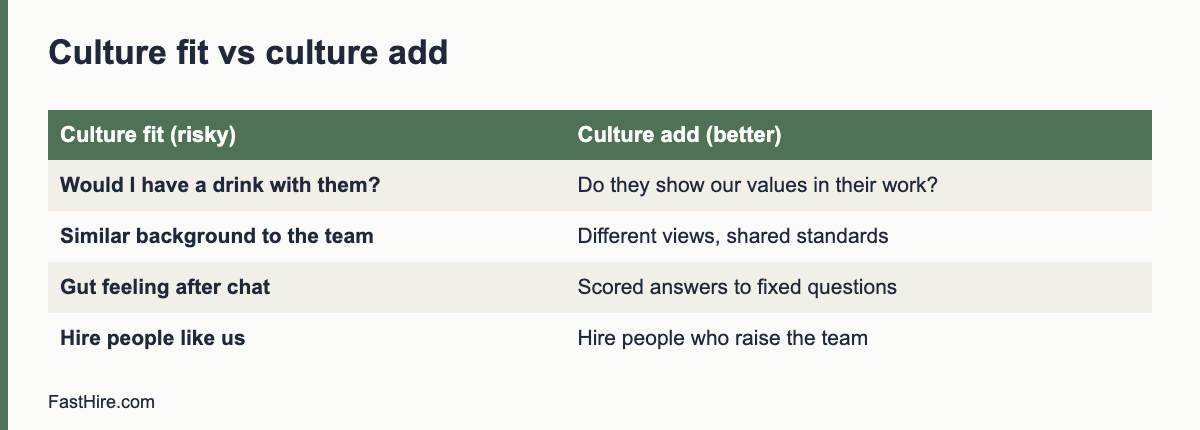
    Hire for culture by turning your values into behaviours you can observe, asking every candidate the same questions about those behaviours, and scoring the answers. Avoid “culture fit” as a gut feeling, because it often means “similar to us”, which narrows your talent pool and can lead to unfair decisions. Aim for culture add: people who share your standards and bring something new.

    Key takeaways

    • Define each value as two or three observable behaviours, with examples of what good looks like.
    • Ask the same behaviour-based questions of every candidate and score the answers on a fixed scale.
    • Separate shared standards (honesty, quality, safety) from personal style (humour, hobbies, background).
    • Watch for bias: similarity, likeability and small talk are not evidence of ability.
    • Review your team mix and your hiring results, and adjust.

    What goes wrong with “culture fit”

    Culture is real. A team with shared standards works better. The trouble comes when “fit” is judged by feel. A friendly chat, a shared hobby or a similar background makes an interviewer feel at ease, and that feeling is mistaken for evidence of ability. Over time, the team becomes more alike. Fewer ideas are tested, fewer mistakes are challenged, and some groups are quietly left out.

    This also has a legal side. If “fit” is a loose label, it can hide decisions based on age, sex, race, religion, disability or other protected traits. It is hard to defend a rejection that rests on “not a good fit” with no evidence. The fairness guides in this blog, such as how to reduce interview bias and UK Equality Act in recruitment, explain why.

    Step 1: define your values as behaviours

    Most small businesses can name three to five values: honesty, care for customers, quality, curiosity, teamwork. Words alone do not help an interviewer. Turn each into behaviours that someone can show.

    ValueObservable behavioursQuestion to test it
    HonestyAdmits mistakes early; shares bad newsTell me about a mistake you made at work and what you did.
    Care for customersListens before solving; follows upDescribe a time you handled an upset customer. What happened?
    QualityChecks work; asks for reviewGive an example of how you check your own work before you hand it over.
    CuriosityAsks questions; learns new toolsTell me about something you learned recently for work and how.
    TeamworkShares credit; helps othersDescribe a time you helped a colleague meet a deadline.

    Write the behaviours for your own values, with a sentence on what a strong answer looks like. Keep the list short. Share it with the team, so that they recognise it.

    x

    Step 2: separate standards from style

    A shared standard is something the work needs: honesty with customers, safety rules, respect for colleagues. Style is how people differ: loud or quiet, formal or relaxed, early bird or night owl, sporty or not. Hire for standards. Welcome different styles. If someone is quiet but careful, they may be a better colleague than a charming person who cuts corners.

    Ask yourself: if a candidate was different from me in this way, would it affect the work? If not, it is style, and it should not count against them.

    Step 3: use fixed questions and a scorecard

    Choose one question per value and ask every candidate the same ones, in the same order. Use a scale from zero to three, with a clear description at each level. Take notes on what the person said, not on how you felt. Our guides on structured interviews, behavioural interview questions and the interview scorecard have templates.

    ScoreMeaning for a values question
    0No relevant example, or an example that goes against the value
    1A weak or vague example
    2A clear example with the person own actions and a result
    3A strong, recent example with scope, action, result and learning

    Step 4: watch for bias

    • Similarity bias: favouring people who share your background or interests.
    • Affinity: scoring higher because the chat was easy.
    • Halo effect: letting one strong trait colour everything.
    • Stereotypes about age, sex, race, religion or disability.
    • First impressions: deciding in five minutes and looking for reasons after.

    Counter these by scoring each answer on its own, using a second interviewer, and holding a short debrief where each person gives evidence before opinions. See interview debrief meeting. If a decision comes down to “I just liked them”, ask for the evidence.

    In the US, the EEOC lists prohibited practices; in the UK, GOV.UK employing people and the Equality Act apply; in the EU, national equal treatment law applies. Fixed questions and written reasons protect candidates and your business.

    Step 5: look at your team as a whole

    Ask what the team lacks. A team of five who all think alike may need someone who asks the awkward question. A team with no experience of a key area may need a specialist. Culture add means looking for a skill, view or habit that raises the team while sharing the core standards. State it in the role brief. The role brief guide shows how.

    Questions that help and questions that harm

    HelpsHarms
    Tell me about a time you disagreed with a colleague. What did you do?What do you do in your spare time?
    How do you prefer to receive feedback, and what helps you learn?Would you fit in with a young team?
    What kind of working environment helps you do your best work?Where did you go to school? (as a status signal)
    Describe how you work with people who have a different view from yours.Are you married? Do you have children?

    See interview questions you cannot ask.

    Culture in small teams: special risks

    In a small business, one hire changes the culture. Owners often hire people like themselves, or friends of friends. This is natural, but it is risky. Add a second reviewer from outside the immediate team, set the questions in advance, and write your reasons. Be open to candidates whose route to the job was different from yours. Consider a short paid trial or work sample to see how a person works in practice, as in work sample tests.

    After the hire: build culture on purpose

    Hiring is only part of culture. Model the behaviours you want, name them in feedback, and show new hires what good looks like. Use the first 30 days to teach standards and give examples. Ask new people what they notice with fresh eyes, and listen. Check in at 90 days on how they feel about the team. See onboarding in the first 30 days.

    Checklist

    • Values are written as behaviours.
    • Standards and style are separate.
    • Every candidate gets the same values questions.
    • Answers are scored on a fixed scale, with notes on evidence.
    • A second reviewer reads the notes.
    • Questions about protected traits are avoided.
    • The team mix is reviewed before each hire.

    Worked example (fictional)

    A five-person marketing studio wants “a good fit”. The owner writes three values: clear communication, care for detail and willingness to help. For each, she writes two behaviours and one question. In interviews, a candidate with a quiet manner gives strong examples of checking work and helping a colleague meet a deadline. Another candidate, very chatty and close to the owner in style, gives vague examples. The scores favour the quieter candidate, and the owner hires her. Six months later the team finds the new hire raises the standard of proofreading, and the owner keeps the scorecard for the next role.

    How to talk about culture in your job ad

    Your ad is the first signal of your culture. Say what the work is like in plain terms: the pace, the way decisions are made, how the team communicates, how feedback is given. Avoid empty phrases such as “work hard, play hard” or “we are like a family”. They can put off capable people who do not see themselves in those words, and they say little about what you expect. Replace them with facts: “We hold a 15 minute team meeting each morning. We review each other work before it goes to a client. We close at five.”

    Invite a range of people to apply. Say that you welcome different backgrounds and routes into the job, and mention adjustments if needed. Use the guidance in how to write a job ad. Candidates who read an honest description can judge for themselves whether the place suits them, which is better than you guessing from a short interview.

    Giving candidates a chance to see the culture

    Culture fit works both ways. A candidate also needs to know whether your workplace suits them. Offer a short visit, a conversation with a future colleague, or a look at how a normal day runs. Be honest about hard parts. Candidates who know the real picture and still want the job are more likely to stay. Those who find out later feel misled, and the cost of an early exit, described in the cost of a bad hire, falls on both sides.

    What to do when the team pushes back on a different candidate

    Sometimes the team likes the familiar candidate and doubts the one who is different. Listen to the concern and turn it into a question about the work. If the worry is “they might not get our humour”, that is style. If it is “they might not follow our safety rules”, that is a standard, and you can test it. Ask the team to point to evidence from the interview for each worry. If there is none, the concern is a feeling, and the scores should decide. Then support the new hire: introduce them, set a buddy and share the norms openly.

    Culture and remote or hybrid teams

    In remote teams, culture is shown through writing, response times, meeting habits and how people give credit. Define the behaviours in those terms: “answers messages within a working day”, “writes decisions down”, “asks for help early”. Test them with a short written task or scenario. Be careful with time zones and with different working styles. Do not read quiet cameras or short messages as a lack of commitment. Ask about the person preferred way of working and share yours.

    Measuring whether your approach works

    • Compare the scores of hires with their review at 90 days. Do the values scores predict how they do?
    • Ask new hires after 30 days how well the interview matched the reality.
    • Review the mix of your hires over a year by background and route, where lawful and private. Does the pool of interviewees look broader than before?
    • Count how often “fit” is used in debriefs without evidence, and coach the team to replace it.
    • Keep notes so that you can show the reason for each hiring decision.

    A last practical step: write a one-page culture note for your hiring file. List the values, the behaviours, the questions and the scoring guide, and keep it with the role brief. Share it with every person who interviews. When a new interviewer joins, spend ten minutes walking through it. This turns culture from a private feeling in one person head into a shared, checkable standard that anyone can use fairly. It also gives you something to improve each year, as the business grows and the team changes, without losing the people and habits that make it work well today.

    Frequently asked questions

    Is it wrong to hire for culture?

    No. Shared standards matter. The risk is using gut feel and sameness. Define values as behaviours and test them fairly.

    What is culture add?

    Hiring people who share your core standards but bring a skill, view or habit that the team lacks.

    Can I reject someone for not fitting in?

    Only if you can point to a job-related behaviour that falls below a clear standard, with evidence. A vague feeling is not enough and can hide bias.

    How do I test values in an interview?

    Ask the same behaviour-based questions of every candidate, take notes on what they say, and score against a written scale.

    Related guides

    This is general information, not legal advice.

  • How to handle a counter-offer from a candidate’s employer

    How to handle a counter-offer from a candidate’s employer

    A counter-offer happens when a candidate who has received your job offer tells you that their current employer has offered more to keep them. Stay calm. Ask what is behind the decision, check your pay range and limits, respond once with your best honest answer, and be ready to accept a no. Keep a backup candidate in mind from the start.

    Key takeaways

    • Ask early. A short question at the offer stage reveals whether the candidate is likely to receive a counter-offer.
    • Do not argue, pressure or insult the current employer. Thank the candidate and ask what matters most to them.
    • Decide your limits before you make the offer: range, extras and walk-away point.
    • Respond once, clearly and in writing. Do not bid against a stranger repeatedly.
    • Keep your second choice warm and honest, and know your plan B.

    Why counter-offers happen

    A counter-offer is a retention tool. An employer learns that a valued person is leaving and tries to keep them with money, a title or a promise. For small businesses, this can feel like losing a race you cannot win. But a counter-offer is not always a defeat. Many people decide to leave for reasons that money does not solve: growth, the type of work, the manager, flexibility or the culture. Others stay for a while and leave later. Your task is to understand what this candidate really wants and to be honest about what you can give.

    Counter-offers are less likely in a business with a poor relationship between the candidate and their current boss, and more likely when the person is hard to replace. You cannot control either, but you can prepare.

    Step 1: ask early, and ask in a respectful way

    Before you make an offer, ask three questions in a calm tone. Why are you looking to move? What would need to be true for you to say yes to our offer? If your current employer asked you to stay, how would you respond? You are not testing loyalty. You are learning what drives the decision.

    Listen for reasons other than money. If the candidate says “I want to learn more” or “I have no path to lead a team,” a raise may not fix it. If they say “I am underpaid,” a counter-offer might. Use the answers to shape your offer and your message. See how to keep your best candidate warm for ways to stay connected.

    Step 2: know your limits before you make the offer

    Set a pay range using the method in how to set a fair salary. Decide the top of your range, and the non-pay extras you can offer: flexible hours, training budget, a review at six months, a clear growth path. Decide your walk-away point. Write them down. A written limit protects you from making a hasty promise under pressure.

    ItemYour answer before the offer
    Top of pay range
    Extras you can offer (flexibility, training, review date)
    Start date flexibility
    Walk-away point
    Backup candidate
    Who decides, and how fast
    x

    Also check fairness. If you raise the offer for one person because of a counter-offer, think about the effect on others in similar roles. A pay gap that cannot be explained by skills or scope can cause trouble later. See pay transparency in hiring and salary in job ads.

    Step 3: when the candidate tells you about the counter-offer

    1. Thank them for being open. It is a sign of trust.
    2. Ask what the counter-offer includes, and what matters most to them.
    3. Do not criticise the current employer or the person.
    4. Ask what they would need from you to say yes, and tell them what you can and cannot do.
    5. Give yourself a short time to check, such as one working day.
    6. Respond in writing, once, with your best honest position.

    Example reply: “Thank you for telling me. I understand the offer is attractive. Here is what I can do: [pay within your range, the extras]. I cannot go beyond that. I would like to work with you, and I hope you will choose us. Please let me know by [date].”

    Step 4: avoid pressure tactics

    It is tempting to use pressure: a short deadline, a hint that other candidates are waiting, or a claim that the counter-offer is a trick. Do not. Pressure damages trust before the first day. If the person says yes under pressure, they may leave early or start with resentment. If they say no, they remember how you treated them. Treat the candidate as an adult making a big choice.

    Be honest about the facts. If the deadline is real, say so and why. If you have other candidates, you can say that you must plan, without naming them or making threats.

    Step 5: decide on a rule for bidding

    Decide in advance how many times you will adjust. A common rule: you make one best offer, you may adjust once if the candidate gives a clear and fair reason, and you hold that line. Endless bidding against a current employer can push you above your range and create unfairness. It also puts the candidate in the position of using you for leverage. A single, honest best offer respects both sides.

    What research and experience suggest, and what they do not

    You will see claims online that people who accept counter-offers usually leave within a year. Treat such claims with care. Unless you can see the source and method, do not rely on them or repeat them to a candidate. The honest advice is that a counter-offer changes the pay, but may not change the reasons the person wanted to leave. Encourage the candidate to think about those reasons.

    If the candidate accepts the counter-offer

    Thank them for their time and decision, and keep the door open. Send a kind message, and ask if they want you to keep in touch. Do not guilt them or comment on the current employer. Then move to your backup candidate quickly and honestly. Our guide to turning down a candidate kindly shows how to speak to candidates you decide not to continue with, and the same warmth applies here.

    If the candidate accepts yours

    • Confirm the terms in writing the same day, using the offer letter template.
    • Agree the notice period and start date with the candidate, in line with their current contract.
    • Check references and the right to work as planned. See how to check the right to work.
    • Keep in touch during the notice period, as the candidate may receive further pressure.
    • Plan the first weeks, using the first 30 days guide.

    Legal and fairness points

    • Do not ask the candidate to break their current contract, for example by taking confidential information or approaching clients in a way the contract forbids. Check the notice period and any restrictions.
    • Make offers on job-related grounds, and treat similar candidates in similar ways. Equal pay rules apply in the US, UK and EU.
    • Keep candidate data private and use it only for hiring.

    For general employer duties, see GOV.UK employing people and the US SBA guide to hiring.

    Plan B: build your backup from day one

    The best defence against a counter-offer is a strong second choice. Keep the second finalist informed in an honest way. Do not promise an offer. Say that you are finishing a few steps and will reply by a date. If your first choice declines, move at once. If you have no backup, see the checklist in what to do when no one applies.

    Worked example (fictional)

    A small engineering firm offers a role to a candidate from a larger company. Before the offer, the owner asks why she is leaving, and she says she wants to lead a small team. The firm offers a pay rise within its range and a team lead role after six months. Two days later she says her employer has offered more money. The owner thanks her, asks if the offer includes a path to lead a team, and learns that it does not. He replies once in writing, restating the team lead path and a six-month review, and says he cannot match the new pay. He asks for a decision by Friday. She accepts, and the owner thanks the second finalist honestly.

    How to talk about growth when you cannot match the money

    Small businesses often lose on pay but can win on other things. Be specific and honest. Instead of saying “we offer great growth”, say what the person will actually do and learn: “In the first six months you will run the supplier relationships for two product lines. At the review we will look at a lead role for the team of three.” Concrete detail is easier to believe than slogans.

    Talk about the daily reality. Who will the person work with? How much freedom will they have? How are decisions made? How quickly can they see the result of their work? For some candidates, these things matter more than a modest pay gap. Do not oversell. If you cannot promise a title or a raise, do not hint at one. Candidates remember promises, and a broken promise in the first year is a common reason for leaving.

    Questions to ask yourself before you bid again

    • Is the new number inside my pay range, and fair to people in similar roles?
    • Can the business afford it for the full year, not only for the first month?
    • Does the candidate want money, or something else that I can offer?
    • Would I be comfortable if my team knew the offer?
    • What happens if I say no? Do I have a backup, and can I wait?

    If the answers are not clear, take a day. A short delay is better than a rushed promise. Tell the candidate you need a day, and keep your word.

    Keeping the relationship after a no

    Many candidates who decline come back later. A warm, professional ending leaves the door open. Thank the person, say that you wish them well, and ask if they would like to stay in touch. If they agree, note it and set a date to reach out, perhaps in six months. Respect their choice and their data: tell them how you will use their details and when you will delete them. See GDPR for job applicants and how to build a talent pool with consent.

    A message to send when you decide not to bid

    “Hello [name], thank you for telling me about the offer from your current employer, and for being open with me. I understand that it is a good one. I have reviewed what we can do, and I cannot go further than the offer I made. I respect your decision either way. If you choose to stay, I wish you every success. If you choose us, we will be glad to have you. Please tell me by [date], so that I can plan.”

    This message is honest, brief and kind. It sets a clear date, makes no threats and does not criticise anyone. If the candidate declines, send a short thank-you the same day and keep the door open. If they accept, send the written offer and begin the plan for the first weeks. In every case, record the decision and the reasons in your tracker, so that you can learn what worked and improve the next offer.

    One more habit helps: after each hire, note whether the candidate received a counter-offer, how you responded and what the result was. Over time you will see patterns in the roles and sources where counter-offers are common, and you can adjust your pay range, your timeline and your plan B accordingly, without relying on guesses or rumour.

    Frequently asked questions

    Should I match a counter-offer?

    Only if it is within your range and fair to others in similar roles. Think about what the candidate really wants, and do not bid against a stranger without limits.

    Is it rude to ask if a candidate expects a counter-offer?

    No, if you ask politely. It helps you plan. Ask about their reasons and what would make them say yes.

    What if the candidate uses my offer to get a raise?

    It happens. Decide your limits first, make one best offer, and be ready to accept a no.

    How do I keep a backup candidate?

    Be honest, give dates, and send updates. Do not say they are second choice.

    Related guides

    This is general information, not legal advice.

  • How to keep your best candidate warm while you decide

    How to keep your best candidate warm while you decide

    To keep a strong candidate interested while you decide, tell them when they will hear from you, update them on a set rhythm even when there is no news, answer questions quickly, and be honest if the date moves. Do not make false promises or pressure them. Most good candidates stay if they feel informed and respected.

    Key takeaways

    • Give a date for the next step at the end of every conversation.
    • Send a short update every few days, even if the news is “no change”.
    • Answer questions within one working day.
    • Be honest about competing candidates, timing and limits. Do not invent urgency.
    • Prepare the offer in advance, so you can move fast when you decide.

    Why good candidates go cold

    Strong candidates are rarely on one shortlist. While you wait for a manager to return from leave or for a budget to be signed, they hear from other employers. Silence tells them you are not interested, or that you are disorganised. The longer the gap, the more likely they will accept something else, or lose enthusiasm.

    Small businesses can be at an advantage here. You can reply the same day, speak to the decision maker directly and make a fast offer. Use that speed. See how long hiring takes for typical stages and where delays arise.

    Step 1: set expectations at each stage

    At the end of every call or interview, say what happens next and when. “We are interviewing until Friday. I will email you by Tuesday with news, either way.” Then do it. If you do not know the date, give a range and a promise to update: “I expect a decision by the end of next week. I will write on Wednesday to update you, even if the date has not changed.”

    MomentWhat to say
    End of screening callThe steps left, how many people you will see and when you will reply
    End of interviewThe date of the decision and who decides
    After final interviewWhen the offer will come, and what you still need to check (references, budget)
    If delayedThe new date and the reason, in one sentence

    Step 2: update on a rhythm

    Choose a rhythm that fits your timeline: for example, a short message every three to four working days while the process is open. Keep each message to two or three sentences. Silence is the problem, not the lack of news.

    x

    See the candidate update email cadence guide for a schedule, and how to avoid ghosting candidates for why it matters.

    Step 3: message templates

    Waiting for the decision

    “Hello [name], a quick update. We are still finishing interviews and expect to decide by [date]. You remain a strong candidate, and I will write again on [day]. If you have any questions or another deadline, please tell me.”

    Delay

    “Hello [name], I wanted to tell you personally that our decision will take a few more days because [short, true reason]. The new date is [date]. I am sorry for the wait, and I will write by [day] with an update.”

    After a verbal yes, before the written offer

    “Hello [name], I am glad to tell you we would like to offer you the role. The written offer will reach you by [day]. The main terms are: [pay, start date, hours]. Please tell me if you have questions in the meantime.”

    Step 4: handle competing offers honestly

    If the candidate tells you they have another offer, ask for the date. Do not panic, and do not invent a rival to create pressure. If you can move your date, do. If you cannot, say so and let them choose. A candidate who joins because of pressure may leave early. A candidate who chooses you freely is more likely to stay.

    If you must hurry, prepare the offer in advance. The job offer letter template helps, and so does a clear pay range from how to set a fair salary.

    Step 5: keep the candidate connected to the business

    • Send one useful thing: a short note about the team, a date for a visit, or a link to a recent project.
    • Offer a second conversation with a future colleague, if it helps them decide.
    • Invite them to ask any question about the role, pay, hours or growth.
    • Be honest about difficult parts of the job. It builds trust.

    Do not use these touches as filler. If you have nothing useful to add, a short status message is better than an empty pitch.

    What not to do

    • Do not promise an offer before you have approval.
    • Do not ask the candidate to turn down other offers before you make yours.
    • Do not hint at pay or terms that you may not give.
    • Do not ask personal questions about their family or other plans to judge their commitment.
    • Do not use the process to gather a free idea or work product beyond what you agreed.

    Fairness and legal points

    Treat all finalists in the same way. If you give one candidate extra calls, offer the same chance to others. Keep to the same questions, and do not let a friendly relationship replace evidence. Discrimination law applies to the whole process, including how you treat people while they wait. See GOV.UK employing people and the EEOC. Store messages securely, and use the candidate data only for hiring. See GDPR for job applicants.

    Plan B: a backup

    Even a well-managed process can fail. The candidate may decline. Keep your second choice in the loop, honestly. Do not say “you are my second choice”; instead say “we are finishing a few steps and I will write by [date]”. When you do move to them, treat them with the same respect and speed. If your second choice has gone, see what to do when no one applies for ways to restart.

    Checklist

    • Every conversation ends with a date for the next step.
    • A message is sent at least every three to four working days.
    • Questions are answered within one working day.
    • The offer letter, pay range and approvals are ready before the final interview.
    • Delays are explained honestly.
    • Competing offers are handled calmly, without pressure.
    • All finalists are treated in the same way.

    Worked example (fictional)

    A two-person design studio finishes final interviews on a Thursday. The owner tells the lead candidate that she will hear by Wednesday. On Monday, the owner learns that her business partner is away until the following Monday and must approve the pay. She writes to the candidate that day: the decision will move to next Tuesday because of the approval, here is the reason, and she will write again on Friday. On Friday she sends a short note with the date unchanged. The candidate, who had another interview, replies that she appreciates the updates and will wait. The offer goes out on Tuesday and is accepted the same day.

    What candidates want to know while they wait

    Think about the questions in the mind of a candidate who has done well in an interview. Am I still in the running? When will I hear? What is the pay and the start date? Who will I work with? What are the downsides? You cannot answer all of them in a message, but you can answer the ones within your control. Share the timeline. Share the range for pay if it is agreed. Share the name and role of the person they will report to. Tell them the practical steps that remain, such as references or checks, so that nothing surprises them later.

    Honesty is more useful than polish. If the job has long hours at certain times of year, say it. If the team is small and everyone covers for each other, say it. Candidates who know the real picture and still want the job are far more likely to stay once hired. Those who find out later feel misled. You also reduce the cost of a bad fit, as explained in the cost of a bad hire.

    Using a second conversation well

    A second, informal conversation can help both sides. Offer a call or coffee with a future colleague or with you. Use it to answer questions, not to test the candidate again. Prepare the topics: a day in the life, how decisions are made, how feedback works, what the first months look like. Ask the candidate what they would like to know. Keep notes brief and job-related, and do not use the chat to ask about protected topics such as family plans or health.

    When the candidate asks for more time

    Candidates sometimes ask for time to decide on your offer. A short extension is reasonable, especially for a big move. Agree a date and keep it. If they need more time than you can give, explain the limit and why. Do not use short deadlines as a tactic to push people, and do not leave your own deadline vague. A clear, fair deadline helps both sides plan.

    SituationGood response
    Candidate asks for a few daysAgree a date, put it in writing, and keep other finalists informed honestly
    Candidate waits for another offerAsk for the date, tell them what you can do, and let them decide
    Candidate asks to negotiateCheck your range, explain what can move, and respond within a day
    Candidate goes quietWrite once, then call, then close politely with a final date

    Keeping other finalists warm too

    While you wait on your first choice, other finalists wait too. They deserve honest updates. Say that you are finishing the process and give a date. Do not say they are second choice. Do not leave them with no news for weeks. If your first choice accepts, tell the others quickly and kindly, using the templates in how to turn down a candidate kindly. If your first choice declines, move to the next one without delay and with a real offer.

    What to do when you cannot decide

    Sometimes two candidates score close. Return to the written requirements and the scores. Ask a trusted second person to read the notes. If needed, add one more structured step, such as a short work sample, as in work sample tests, and give both candidates the same task and deadline. Do not draw out the process without telling them why. If the delay will exceed a week, say so and give the new date.

    A simple tracker for finalists

    CandidateLast contactNext contact dueOpen questionsOther offers (as told by candidate)
    Finalist 1
    Finalist 2
    Finalist 3

    Check the tracker each morning while the process is open. If a next contact date has passed, write that day. The tracker takes two minutes to update and prevents the quiet slips that lose good people. It also gives you a record of when you contacted each finalist, which supports fairness if anyone asks later.

    A final thought: the way you treat people during the wait is a preview of what it is like to work for you. Reliable, clear and kind communication shows that you keep your word. That is a strong reason for a good candidate to say yes, and it is entirely within your control, whatever the size of your business or the budget you have to offer.

    Frequently asked questions

    How often should I contact a candidate while I decide?

    Every few working days is a good rhythm. Short updates are better than long silences.

    Should I tell a candidate they are my top choice?

    Only when you are ready to make an offer. Until then, say that they remain a strong candidate, and give a date.

    What if I need more time than I said?

    Tell them as soon as you know, give a new date and the reason, and keep to it.

    Is it fair to give one candidate more updates?

    Give all finalists the same rhythm of contact. Extra calls to one person can look unfair and may cause problems.

    Related guides

    This is general information, not legal advice.

  • How to turn down a candidate kindly and clearly: templates

    How to turn down a candidate kindly and clearly: templates

    To turn down a candidate kindly, tell them quickly, say the decision in the first sentence, thank them for their time, give one honest and job-related reason if they reached an interview, and wish them well. Keep the message short and keep a copy. This guide gives templates for each stage and the rules to follow.

    Key takeaways

    • Send the message within a few working days of the decision. Silence is the worst reply.
    • Put the decision in the first line, then thank the person.
    • For people who interviewed, add one or two true, job-related points. Never mention personal traits.
    • Do not promise to keep their details unless they agreed, and tell them how long you will keep data.
    • Use a template, then change the name, the role and one personal detail.

    Why a small business should bother

    In a small business, your name is your brand. Candidates are customers, neighbours and future colleagues. A kind, clear message takes five minutes and costs nothing. A missing reply leaves people waiting and guessing, and they tell others. It also helps you: a clear close lets you move on, and a good message can keep a strong person open to applying again.

    For a deeper guide on feedback, see how to give useful feedback to rejected candidates. For longer templates, see rejection emails that respect candidates. This article is the short version for owners who do the hiring alone.

    Principles

    1. Be prompt. Aim to reply within a few working days of the decision.
    2. Be clear. Do not say “we will keep your CV” if you will not.
    3. Be kind but not vague. Avoid false hope.
    4. Be honest. Never invent a reason.
    5. Be brief. Four to seven sentences are enough.
    6. Be consistent. Treat every candidate at the same stage in the same way.
    7. Be careful. Do not mention age, health, family, religion, race or other protected traits.

    Timing by stage

    StageWhen to replyWhat to include
    Applied, not shortlistedWhen you close the shortlist, or within two weeks of applyingThanks, the decision, good wishes
    Phone or video screenWithin two or three working daysThanks for their time, the decision
    First interviewWithin three working days of the decisionThanks, the decision, one or two job-related points if possible
    Final interviewA phone call, then a short emailThanks, the decision, specific feedback, an invitation to ask questions
    Offer declined by you after trialSame day if possible, by phoneClear, calm, thanks
    x

    Templates you can copy

    After an application

    Subject: Your application for [role]

    “Hello [name], thank you for applying for the [role] at [company]. We have reviewed all applications against the requirements in the ad, and we will not take your application further this time. We know applying takes effort, and we appreciate your interest in [company]. We wish you well in your search.”

    After a phone or video screen

    “Hello [name], thank you for speaking with me about the [role]. We have decided to continue with other candidates whose experience is closer to what we need for this role. I enjoyed our conversation, and I wish you success in your search.”

    After a first interview

    “Hello [name], thank you for the time you gave us for the interview for the [role]. We have decided to offer the role to another candidate. The role needed strong experience in [requirement], and in the interview we heard more about [other area]. You explained [strength] very clearly. We wish you well, and you are welcome to apply for future roles.”

    After a final interview (call script)

    “Hello [name], thank you for coming through every stage. I wanted to tell you myself that we have chosen another candidate. It was a close decision. The deciding factor was [requirement]. What stood out about you was [strength]. If you would like to ask me anything about it, please do. I would be glad to hear from you again about future roles.”

    If you want to keep them in mind

    Only say this if you mean it, and ask first: “If you would like us to keep your details for future roles, please reply yes. We will keep them for [period] and then delete them. You can ask us to remove them at any time.”

    What to avoid

    • Vague lines such as “you were not the right fit”.
    • False hope: “we will be in touch” when you will not.
    • Reasons that mention personal traits or guesses, such as “we want someone younger” or “you seemed nervous”.
    • Comparing the person with others by name.
    • Long explanations that invite an argument.
    • Sending the message at night after a hard day. Wait and re-read.

    Privacy and records

    A rejection message is a good time to say how long you will keep a person data. Keep the application, the notes and the message for as long as your local rules say, then delete them. In the UK and EU, people can ask to see their data. The ICO guidance on recruitment and selection explains your duties, and our guides on GDPR for job applicants and how long to keep rejected applicant data give practical steps.

    Acas also offers advice on fair recruitment at acas.org.uk/recruitment.

    If the person replies upset or asks why

    Stay calm and kind. Thank them for replying. If they ask for feedback and you have clear notes, give two or three job-related points. If you have no notes, say what the role needed and what you saw in general, honestly. If they say the decision was unfair, do not argue. Say you will review the notes, and do so. If they raise discrimination, write down what they said and take advice. Do not delete anything.

    Template for a short reply to a request for feedback

    “Thank you for asking. The role needed [requirement 1] and [requirement 2]. In the interview, we heard strong examples about [area], and less about [requirement]. I hope that helps, and I wish you well.”

    Keeping a log

    CandidateStageDecision dateMessage sentData delete date
    Name or IDApplied
    Name or IDFirst interview

    A simple log helps you keep to your own promises, and shows you the delays. Add a delete date when you send the message, and clear old records every few months. The first hire plan and how to hire without HR include similar steps.

    Mistakes to avoid

    • Waiting until you have a signed offer from your first choice. Tell others once the choice is made, or say there is a delay.
    • Using a message that reads as if no person wrote it.
    • Sending the same message to someone who spent three hours with you and to someone who sent a CV.
    • Giving a reason you cannot support with notes.
    • Leaving people without news for weeks.

    Worked example (fictional)

    A bakery owner interviews four people for a counter role. After the decisions, she sends the three unsuccessful candidates a message the same day. She uses her template, adds the name, and for each adds one true point from her notes: one had strong experience with tills but less with customers; another explained opening hours clearly; the third was friendly but could not work the weekends needed. She does not mention age, family or anything personal. One candidate replies with thanks and applies again for a later role, and gets it.

    How the law shapes your message

    You are not usually required to give reasons for a rejection, but what you write can be used if a candidate later claims unfair treatment. That is why short, factual, job-related messages are best. Do not write anything that you would not want a stranger to read. In the US, the EEOC lists the practices that are prohibited. In the UK, see GOV.UK employing people. In the EU, national equal treatment rules apply.

    If you used any third party check, such as a background report, some places require extra steps before you reject a person because of it. Read the guidance for your country before you send the message. If you are unsure, take advice. See criminal record checks in hiring.

    Handling the hardest cases

    A friend or contact applied

    Be even more careful. Use the same template and the same timing as for others. Offer to talk by phone if you wish, and keep the reasons job-related. Our guide to hiring friends and family gives more advice.

    The person was your second choice

    If you might need them if the first choice declines, be honest: “You were a strong candidate. We have made an offer to someone else, and we will let you know quickly if the situation changes.” Do not use this line to keep a person waiting for weeks. Set a date and tell them.

    A current employee applied for the job

    Speak in person first, then send a short note. Give clear feedback and a path for growth. The internal candidate will remain in the team, so the way you handle this shapes morale. See internal vs external hiring.

    The candidate has a disability and asked for adjustments

    Do not mention the disability in your reason. Give only job-related points. Make sure the process was fair, with the adjustments made, and that your notes show the evidence on the requirements.

    Setting up a simple system

    1. Write four templates: after application, after screen, after interview, after final interview.
    2. Save them in your email as drafts or in a document.
    3. Add a column to your tracker for “message sent” and “delete date”.
    4. Set a weekly time to send messages, such as Friday morning.
    5. Once a quarter, review your templates and update them.

    A small system keeps you consistent, which is both fairer and faster. It also shows candidates that your business is organised and respectful, which helps with referrals and future applications.

    Tone: examples of warm and cold wording

    ColdWarm and clear
    Unfortunately you have been unsuccessful.Thank you for applying. We have decided not to take your application further this time.
    We received many strong applicants.We chose another candidate whose experience was closer to the requirements for this role.
    Your profile does not match.The role needed hands-on experience with [skill], which we did not see in your examples.
    Do not contact us for feedback.If you would like feedback, reply to this email and I will share the main points.

    Read your message aloud before you send it. If it sounds like something you would be glad to receive, send it. If it sounds like a form letter, add one personal line that is true. Candidates remember the tone of a rejection long after they forget the details of the interview. A warm, honest and brief message costs you five minutes, and it protects the reputation of your business in the community where you hire.

    Keep a short folder of replies from candidates. Over time, you will see which phrases people appreciate and which cause questions. Adjust the templates, and share them with anyone else in your business who helps with hiring, so that every candidate hears the same respectful voice.

    Finally, remember that candidates are people who hoped for a yes. A sentence that acknowledges the effort they made, such as the time spent preparing for the interview, shows respect. Keep it short and true, avoid clichés, and let the message stand on its own without long apologies.

    Frequently asked questions

    How soon should I reply to a rejected candidate?

    Within a few working days of the decision. Quick replies are kind, and they help you keep a good name.

    Do I have to give a reason?

    Usually not by law, but a short honest reason helps people who spent time on interviews. Keep it job-related.

    Should I keep the CV on file?

    Only if the person agrees or you have another lawful reason. Tell them how long you will keep it, and delete it when the time ends.

    What if I never got a reply from the candidate?

    Send your message anyway. Closure is part of good practice, even when the person has gone quiet.

    Related guides

    This is general information, not legal advice.

  • How to avoid hiring friends and family by mistake

    How to avoid hiring friends and family by mistake

    Hiring a friend or relative is not illegal in itself, and it can work well. The risk is hiring someone because you know them, not because they are the best fit, and then finding it hard to manage, review or let them go. This guide shows how to spot the trap, how to run a fair process, and what rules to set if you decide to go ahead.

    Key takeaways

    • The problem is not the person. It is skipping the process that you would use for a stranger.
    • Closed, word-of-mouth hiring can shut out other good candidates and can raise fairness and discrimination concerns.
    • Use the same job criteria, questions and scoring for everyone, including people you know.
    • Bring in an independent reviewer when you are close to a candidate.
    • Write down the rules for working together before the first day, including reporting lines and pay.

    Why small businesses end up hiring people they know

    When you are busy and short of money, the fastest route to a new hire is someone you already trust. A friend of a friend, a cousin, a former classmate. It feels safe and quick. The cost shows up later, when the person is not quite right for the role, and you cannot give honest feedback without damaging a relationship.

    It also happens by mistake. You post the job only on your personal page. The first three replies are from people you know. You interview them first, enjoy the talk, and make an offer before the wider pool has arrived. Nobody did anything wrong on purpose, but the result is the same as hiring by favour.

    The main risks

    RiskWhat it looks likeWhy it matters
    Weak fitThe person is liked but lacks a key skillThe work suffers and others cover for them
    Hard feedbackYou avoid honest talks to protect the bondProblems grow and fairness to others is lost
    Team trustStaff see the person as protectedMorale and retention suffer
    Fairness claimsOther candidates were never given a chancePossible discrimination or equal treatment complaints
    Personal falloutA hard end to the job harms the friendshipYou lose both a worker and a friend

    The fairness risk deserves a closer look. If you recruit only through personal networks, your team can end up looking like you and your friends. That can exclude people by race, sex, age or other protected traits without anyone intending it. In the US, the EEOC lists prohibited employment practices. In the UK, the Equality Act guidance on GOV.UK and Acas give practical steps. In the EU, equal treatment rules apply under national law, as our EU equal treatment guide explains.

    How to spot it before you decide

    Ask yourself these questions when you feel drawn to a person you know.

    • Would I hire this person if I had met them today in an open pool?
    • Have I looked at at least three other candidates against the same criteria?
    • Can I explain in writing why this person is the best fit for each requirement?
    • Could I give this person a hard performance review?
    • Would I be comfortable if my team saw my notes?

    If you answer no to two or more, slow down and run a fuller process.

    x

    A fair process when you know a candidate

    1. Post the job openly, with the same ad on public channels, not only on your personal page.
    2. Write the requirements before you see any applications. Our guide to checkable job requirements shows how.
    3. Review every application against the same list, not against your feelings.
    4. Interview with the same questions in the same order. Use the structured interview approach.
    5. Ask an independent person to score, or to sit in, when you know a candidate well.
    6. Record the reasons for your choice in a short note for each finalist.
    7. Make the offer in the normal way, with the normal letter and terms.

    Using an independent reviewer

    An independent reviewer is someone with no personal link to any candidate, such as a trusted adviser, a manager from another team, or a colleague. Their job is to read the notes, check that the same criteria were used, and challenge anything that looks like favour. In a very small firm, this can be an outside adviser for one hour.

    Give the reviewer a one-page scorecard, so their feedback is clear. Our interview scorecard guide has a template you can copy.

    If you still want to hire someone you know

    This is a legitimate choice if the person is the best fit and the process was fair. Add safeguards.

    Set the rules in writing

    • Who will manage the person, and who is not allowed to manage them?
    • How will pay be set? Use the same range as for any other hire.
    • How will performance be reviewed? Use the same form and dates as for everyone.
    • What happens if it does not work? Include the usual probation and notice terms.
    • How will you separate work talk from personal talk?

    Avoid direct reporting lines between relatives

    A person should not manage, pay or review a close relative if you can avoid it. If you cannot avoid it in a tiny firm, ask a third party, such as an adviser or board member, to take part in key decisions about pay and performance.

    Be open with the team

    Tell your team how the decision was made. You do not need to share private details, but you should show that the role was open and the process was fair. Silence invites rumours.

    Conflict of interest policy: a short template

    SectionWording you can adapt
    PurposeWe hire on merit. This policy keeps hiring fair when personal ties exist.
    DisclosureAnyone involved in hiring must tell the owner if they know a candidate personally.
    ProcessA person who knows a candidate does not score that candidate alone. A second reviewer is added.
    Reporting linesRelatives and close partners do not manage or approve pay for each other.
    RecordsReasons for each hiring decision are written down and kept.

    Alternatives that keep the trust and lower the risk

    • Ask your network to share the open job, not to supply names. Everyone can apply.
    • Offer a referral bonus only if it follows a fair process, and tell referrers that a referral gives no advantage in scoring.
    • Use a short paid trial or work sample for all finalists, as explained in our work samples guide.
    • Offer friends and family help in other ways, such as an introduction or advice, without creating a job for them.

    Common mistakes

    • Posting the job only on a personal page.
    • Skipping reference checks because you already know the person.
    • Setting a pay level above what other hires would receive.
    • Skipping the probation period or the review dates.
    • Not planning for how to end the job if it fails.

    Our reference checking guide shows that even a well-known person deserves the same checks as anyone else.

    Worked example (fictional)

    A café owner needs a weekend supervisor. A close friend asks for the job, and the owner wants to say yes. Instead, the owner posts the job on the café window and two job boards, writes four requirements, and invites five people to a short trial shift. A colleague from a nearby shop sits in as an independent scorer. The friend does well but a second candidate scores higher on the requirement to open and close the till alone. The owner offers the job to the second candidate, and gives the friend honest feedback and a part-time shift. The friendship stays intact, and the café has the stronger supervisor.

    Referrals: a safer way to use your network

    Your network is a strong source of candidates. The question is how you use it. A fair referral process asks the network to spread the word, and then treats every applicant in the same way. Tell people: “We are hiring a supervisor. Here is the ad and the requirements. Please share it with anyone who might fit.” This widens the pool instead of narrowing it.

    If you offer a referral bonus, write the rules. The bonus is paid after the new hire has passed probation, the referral gives no extra points in scoring, and the referrer has no say in the decision. This keeps the incentive from turning into pressure.

    What to say to staff who bring in friends

    Staff will often suggest friends. Thank them, and explain the process in two sentences: “We would love to see their application. They will go through the same steps as everyone, and you will not be part of the scoring.” Put this in the staff handbook so the answer is the same each time.

    Signs the hire is not working

    • You find yourself fixing their work in private rather than giving feedback.
    • Other staff no longer raise problems about this person with you.
    • You have given them tasks that do not match the role, to avoid a hard talk.
    • Pay or hours have been set outside the normal range.
    • You avoid review meetings that you hold for everyone else.

    If you see two or more of these signs, hold a formal review in the normal way. Use the same form as for any employee. Keep your tone kind and direct. If the fit is poor, follow your local process for ending the job, and ask an adviser if you are unsure. The earlier you act, the better the chance of keeping the personal bond.

    Separating work and friendship

    Agree a few habits that protect both. Hold work talks at work, during work hours. Put decisions in writing. Treat a review as a normal event, not as a personal verdict. If a disagreement grows, ask a third person to help. These habits feel formal at first, but they keep small issues from becoming personal ones.

    What about family businesses?

    In a family firm, hiring relatives is common and often the point of the business. The same risks apply, with extra weight. Staff who are not family may wonder whether they have a fair path to promotion. Write down the roles, the pay bands and the criteria for promotion, and apply them to relatives and non-relatives alike. Consider an outside adviser or board member for decisions about family pay and progress.

    Set out what happens if a family member leaves, and how any shares or rights are handled. This is a legal matter, so take advice early. A clear plan protects both the business and the relationships.

    A one-page checklist before you make the offer

    • The job was posted in at least two public places for a fair time.
    • The requirements were written before any applications were read.
    • Every finalist answered the same questions and was scored on the same sheet.
    • An independent person reviewed the scores for any candidate you know personally.
    • The pay offered sits inside the range set for the role.
    • References were checked for every finalist, including the person you know.
    • The reasons for the decision are written down and saved.
    • The reporting line avoids relatives managing relatives.
    • The offer letter, probation terms and review dates are the same as for any other hire.

    Print this list and tick it at the end of the process. If you cannot tick every line, pause and fix the gap before you make the offer. The extra day is small compared with the cost of an unfair or unsuitable hire, and it gives you a record you can share if anyone questions the decision later.

    Frequently asked questions

    Is it illegal to hire a relative?

    Usually not, but rules can apply in public bodies and in some company policies. Discrimination law still applies to how you treat other candidates. Check the rules for your sector.

    Can I hire a friend if they are the best candidate?

    Yes, if the process was fair and you can show the reasons. Add the safeguards in this guide.

    What if my staff refer people they know?

    Referrals can be a good source. Make sure referred candidates go through the same steps as everyone else.

    How do I say no to a friend?

    Be kind and clear. Say the process was open, thank them, and give one or two honest pieces of feedback if they ask.

    Related guides

    This is general information, not legal advice.

  • Pay transparency laws: what small employers must put in a job ad

    Pay transparency laws: what small employers must put in a job ad

    Whether you must put a salary in a job ad depends on where the job is and where you advertise. A growing number of US states and cities require a pay range. The EU has adopted a directive on pay transparency that member states must apply through national law. The UK has no single rule that covers every ad, but equal pay law still applies. This guide shows what to check and gives wording you can reuse.

    Key takeaways

    • Check the rules for the place where the worker will be based, not only where your office is.
    • Many US states and cities require a pay range in ads. Rules differ on size of employer, remote jobs and the form of the range.
    • The EU directive on pay transparency gives applicants a right to pay information before the interview. Check how your country applies it.
    • In the UK, there is no general duty to publish salary in an ad, but posting a range helps fairness and reduces gaps.
    • When in doubt, post a good-faith range. It is cheaper than a complaint.

    Why this question matters for small employers

    Large companies have lawyers who track these rules. A small employer usually does not, yet the rules often apply to small employers too. A rule may exist only for firms above a size threshold, or it may apply to all. Remote jobs add another layer: some rules apply if the worker could be based in the place, even if you are not.

    The benefit of posting pay goes beyond avoiding a fine. A range filters out people who cannot accept the pay, saves interviews, and signals that you treat people fairly. Candidates often skip ads with no pay information. Our guide to setting a fair salary shows how to build the range you will post.

    United States: state and city rules

    There is no single federal rule requiring salary ranges in job ads for private employers. Instead, a growing number of states and cities have their own rules. They differ on several points, so check the law for each place where you hire.

    QuestionWhat laws often say
    Who is covered?Some apply to all employers, others only above a headcount threshold
    What must be shown?A pay range, sometimes also benefits or bonus information
    Which jobs?Jobs based in the place, sometimes also remote jobs that could be done there
    How precise?A good-faith range, the one you really expect to pay
    What about pay history?Many places also ban asking about past pay

    To find the rule for a state, search the website of the state labour department, or use the US Department of Labor as a starting point to find your state office. For New York City, the city also publishes rules for its hiring-tool law, covered in our NYC Local Law 144 guide, which is a separate topic from pay ranges.

    Practical rules for US employers

    • Post a range that you really expect to pay. A very wide range such as “from nothing to anything” is a poor-faith range.
    • If a rule covers remote jobs, check each place where the person could live.
    • If you use a job board, check whether it adds a pay field and fill it in.
    • Keep a copy of every ad, with the date, so you can show what you posted.
    • Do not ask about pay history where it is banned. Ask about expectations after you share the range.
    x

    European Union: the pay transparency directive

    The EU adopted a directive on pay transparency. Among other things, it gives job applicants the right to receive information about the starting pay or range for the job, and it limits questions about pay history. It also covers job titles and ads, which should be gender neutral. The directive is not a direct law for employers. Each member state applies it through national law, so the exact rules and timing depend on the country. Read the text on EUR-Lex and check what your national government has published.

    What EU employers can do now

    • Prepare a pay range for each role, based on objective, gender-neutral criteria.
    • Write job titles and ads in a neutral way.
    • Be ready to share pay information with applicants before the interview, in the way your national law requires.
    • Do not ask about pay history. Ask about expectations after you share the range.
    • Check collective agreements that may already set pay for your sector.

    Our article on pay transparency in hiring covers the EU, UK and US in more depth.

    United Kingdom: practice and equal pay

    UK law does not require every employer to post pay in every ad, but equal pay law applies to all, and larger employers must report on gender pay. See the GOV.UK gender pay gap reporting guidance. Posting a range is good practice and helps close gaps, because it removes room for unfair bargaining. Acas also gives practical advice on fair recruitment at acas.org.uk/recruitment. If you advertise jobs that could be based in the EU, check the national rules there too.

    What to put in the ad

    A good pay line is short, clear and honest. Place it near the top, with the location and hours, so people see it early.

    PartExample wording (fictional)
    RangeThe salary range for this role is X to Y per year.
    What decides where you sitPay within the range depends on skills and experience that match the requirements.
    Other payThis role also includes a yearly bonus of up to Z, based on the plan shared at interview.
    Hours and placeFull time, based in the city office, with two days from home.
    BenefitsPaid holiday, pension and training budget.

    Replace X, Y and Z with your real numbers. Do not use a figure you do not plan to pay.

    Pitfalls in the pay line

    • A range that is so wide it says nothing.
    • Words such as “competitive” with no number, where a number is required.
    • A different range in the ad and in the offer.
    • Leaving bonuses or commission vague, when they are a large part of pay.
    • Ignoring the legal minimum wage for the role.

    A short routine for every job ad

    1. Decide where the worker can be based, including remote options.
    2. Check the pay rules for each place. Use the official sources above.
    3. Build a range using the method in our salary guide.
    4. Check the range against current staff for equal pay.
    5. Write the pay line, using the table above.
    6. Save a copy of the ad with the date.
    7. Review the rule once a year, or when you hire in a new place.

    Link the ad to the rest of your hiring

    The ad is the start of the process. If you promise a range, keep to it in the offer. If you ask about pay later in the process, wait until you have shared the range. When you write the ad as a whole, follow our job ad guide. When you make the offer, use the offer letter template. If you run a trial period afterwards, see how probation works.

    Questions to ask your adviser

    • Which places do our rules cover for this job, including remote?
    • Is a range enough, or do we also need to list benefits or bonuses?
    • How do we show commission-based pay in an ad?
    • What do we do if the job is posted on a board that cannot show the range?
    • Are there fines or private claims if we get it wrong?

    Worked example (fictional)

    A ten-person design studio in one US state wants to hire a designer who can work from anywhere in the country. The owner checks the rules for the studio state and finds a pay range rule. The owner then reads that a few other states cover remote jobs that could be filled there. The owner decides to post one good-faith range for the role, to add it to the job board field, and to keep a dated copy of the ad. The owner also removes the past pay question from the application form, and asks for expectations after the first call. The whole check takes an afternoon, and the same routine works for the next hire.

    Handling the job board and agency side

    Most small employers do not post only on their own site. Job boards, social networks and agencies each have their own forms. Some have a field for a pay range, and some require it for certain places. Fill in the field when it exists, and use the same numbers everywhere. If a board cannot show a range, put the range in the text of the ad instead.

    If an agency posts for you, give it the range in writing and ask it to confirm that every ad shows it. You remain responsible for what is posted in your name, so ask to see the live ad, and check it again after any edit.

    A quick board checklist

    • Does the board show the range in a clear place?
    • Is the range the same as on your own site?
    • Does the ad name the right location, including remote options?
    • Is there a dated copy of the live ad in your files?
    • Did you remove any question about past pay from the application form?

    Talking about pay at each stage

    The range in the ad is only the first point. A fair process keeps the pay conversation consistent from first contact to offer.

    StageWhat to say about pay
    AdThe range and what decides where in the range a person sits.
    First callConfirm the range still fits the candidate. Do not ask for pay history.
    InterviewsOnly discuss pay if the candidate raises it, and refer back to the range.
    OfferA number inside the range, with the reasons based on skills and scope.
    After offerAnswer questions in writing, so the record is clear.

    If a candidate says the range is too low, thank them, and say whether there is any flexibility. If there is none, say so clearly. It saves time for both sides and it is fair to everyone who applied at that range.

    Keep the records

    Keep the ad, the range worksheet and notes on how you set the offer. If someone later asks why two people in the same role are paid differently, you can show the job-related reasons. If a regulator or court asks about your ad, you can show what was posted and when. Store the records safely and delete them when your retention period ends. See our article on how long to keep rejected applicant data for the privacy side.

    A note on commission and bonus pay

    Where pay includes commission, tips or a bonus, a plain range of base salary may not tell the whole story. Say what the base is, what the variable part is, how it is calculated, and what a typical person earns in a normal year if you can support that figure with your own records. If you cannot support it, do not state it. Avoid examples that suggest a level of earnings you have not paid in the past.

    Check the local rule on whether variable pay must be included in the range you post. Where the law is not clear, include a short line that explains how the variable part works, and keep the written plan that supports it. A candidate who understands the plan is less likely to feel misled, and you are less likely to face a complaint later.

    Finally, tell the hiring team. The person who answers candidate questions should know the range, the rules and the reasons, so everyone gives the same answer from the first day the ad goes live.

    Frequently asked questions

    Do I have to put a salary in every job ad?

    Not everywhere. Some US states and cities require a range, the EU is introducing a right to pay information for applicants, and the UK has no general rule. Check the law for the place of work.

    Is a range enough?

    Where the law requires pay information, a good-faith range is usually the standard. Check the exact wording of your local rule.

    What if I hire remote workers?

    Some rules apply if the job could be done in the place. Check each place you are willing to hire in.

    Can I still negotiate?

    Yes. A range allows negotiation inside it. Keep the reasons job-related and written down.

    Related guides

    This is general information, not legal advice.

  • How to set a fair salary for a small business role

    How to set a fair salary for a small business role

    To set a fair salary, define the job and level first, then compare it with official pay data for your country and region, then build a range with a low, middle and high point. Check the range against what you already pay your team, and be ready to explain how a person moves through it. This guide gives you a method you can finish in an afternoon.

    Key takeaways

    • Price the job, not the person. Start with the role and the level, then place the person in the range.
    • Use official data first: BLS in the US, ONS in the UK, Eurostat and national statistics offices in the EU.
    • Build a range with a low, middle and high point. A single number invites argument.
    • Check your range against current staff for equal pay. Fix gaps before you hire.
    • Pay transparency rules are growing. Plan to share the range even where the law does not yet require it.

    Why a method matters

    Small employers often set pay by gut feel, by what the last person earned, or by what the candidate asks for. Each of these has a cost. Gut feel misses the market. The last salary may have been too low or too high. Asking the candidate first rewards people who negotiate hard and can create unfair gaps between people who do the same work.

    A simple method fixes this. It also makes it easier to write the job ad, to make the offer and to answer questions from staff. The cost to hire an employee article shows the extra costs on top of the salary, which you need for your budget.

    Step 1: define the job and the level

    Write a short description of the work, not a long wish list. Include the main duties, the skills you must have on day one, the skills you can teach, and the scope: does the person manage others, handle money, deal with clients, or work alone? Level matters as much as title. A “marketing manager” in a two-person business may do the work of a coordinator in a larger firm.

    • Entry: needs training, works under close guidance.
    • Experienced: works alone on most tasks, asks for help on hard ones.
    • Senior: owns an area, guides others, makes decisions with little review.
    • Lead: manages people or a function, is accountable for results.

    If you need help with the description, use the job description for a new role guide.

    Step 2: collect official pay data

    Use official sources before you use job boards or word of mouth. They show real data collected on a clear method, and they are free.

    United States

    The US Bureau of Labor Statistics publishes pay data by job and region in the Occupational Outlook Handbook and the Occupational Employment and Wage Statistics tables. Search for the job title, pick your state or metropolitan area, and read the range of pay from the lower to the upper end. Also check your state minimum wage and the federal rules on overtime for non-exempt roles at the Department of Labor.

    United Kingdom

    The Office for National Statistics publishes earnings data on its employment and labour market pages. Look for earnings by occupation and by region. Check the current legal minimum on the GOV.UK national minimum wage page, because it varies by age and changes from time to time.

    European Union

    Eurostat publishes labour data across member states at the Eurostat labour market pages. For a single country, the national statistics office is usually better, and some countries set pay floors through national law or collective agreements. Always check whether a collective agreement applies to your sector.

    x

    Step 3: build a range

    Take the official figures for your region and role, and decide where you want to sit: below, at or above the typical level. Then build three points.

    PointWhat it meansWho sits here
    LowEntry to the job, meets the basic requirementsNew to the level, needs training
    MiddleFully able, does the whole job wellMost people after the first year or so
    HighBeyond the level, with extra scope or rare skillsStrong performers and those with scarce skills

    Keep the range wide enough to allow growth but narrow enough to stay fair. A very wide range hides unfair differences. A very narrow range leaves no room for progress.

    Factors that move a person inside the range

    • Skills and proven results that match the job needs.
    • Relevant experience that the person will use in this role.
    • Scarcity of the skill in your area.
    • Extra responsibility that is written in the job description.

    Avoid factors that are not job-related, such as the pay at a previous job, what the person says they need, or how well they negotiate. In some places you cannot ask about pay history at all. See pay transparency in hiring for the rules.

    Step 4: check against your own team

    Before you hire, put your range next to the pay of people who do the same or similar work. If the new range is much higher than the pay of a current employee, you have a fairness problem to solve, and it is cheaper to solve it now than after a complaint. Equal pay laws exist in the US, UK and EU, and they cover work of equal value, not only identical jobs. The US EEOC page on equal pay and the GOV.UK gender pay gap guidance are good places to start.

    CheckQuestion to ask
    Same job, different payIs there a job-related reason, such as skills or results, written down?
    Similar jobsDo the jobs need similar skill, effort and responsibility?
    Group patternDo women, minorities or older workers cluster at the low end?
    New hire above current staffWill you raise current staff, or can you explain the gap?

    Step 5: decide the total package

    Salary is only part of the offer. List the parts you can give: base pay, bonus, benefits, holiday, flexibility, training and growth. A small business may not match a large firm on base pay but can often win on flexibility, learning and responsibility. Be honest. Do not promise bonuses, equity or raises that you may not be able to give.

    • Base pay: the range from Step 3.
    • Variable pay: only if you can describe the rule and pay it reliably.
    • Benefits: those required by law, plus any you can afford.
    • Time off: the legal minimum plus any extra.
    • Growth: a written plan for review at six and twelve months.

    Step 6: explain the range

    Tell candidates the range in the job ad or early in the process. It saves time for both sides. It also reduces the risk of a person turning down the offer after several interviews. A short sentence is enough: “The salary range for this role is X to Y, depending on skills and experience.” The write a job ad guide shows where to place it.

    When you make the offer, explain how you reached the number, in plain words: “This is where your skills sit in the range, based on the requirements we discussed.” If the person asks for more, ask what skill or scope is not yet priced in. If there is a real reason, you can move within the range. If not, explain what growth looks like.

    Common mistakes

    • Using the last person pay as the only guide.
    • Posting a range that is far from what you can actually pay.
    • Giving a higher offer to the person who negotiates harder, without a job-related reason.
    • Ignoring pay for current staff, then facing complaints.
    • Forgetting taxes, insurance and benefits when you budget.
    • Setting pay below the legal minimum, including for trial work or short placements.

    A one-page salary worksheet

    ItemYour notes
    Job title and level
    Main duties (three to five)
    Official data source and figure
    Range: low / middle / high
    Comparison with current staff
    Total package
    Date reviewed and by whom

    Review the range each year

    Pay data changes. Review each range once a year, and again if you have trouble hiring or losing people. Write down the date and the data you used. A short note is enough, and it protects you if someone asks why a person is paid as they are.

    When to ask for help

    If you pay across several countries, use a payroll provider or adviser who knows local law. If you have a collective agreement or a union, follow its rules. If you are unsure whether a gap between two people is justified, ask an adviser to review it. The aim is a range you can explain in a sentence to any employee.

    Worked example (fictional)

    A five-person landscaping firm needs a crew supervisor. The owner writes the job as: leads a crew of three, plans daily routes, handles customer calls and signs off finished work. That is the experienced to senior level. The owner checks the official wage tables for the region and finds a spread of pay for first-line supervisors. The owner picks a range that sits near the middle of that spread, because the firm can offer a company van, a four-day week in winter and a clear route to manager.

    Next, the owner checks current staff. The longest-serving crew member earns close to the bottom of the new range and has asked about a promotion. The owner decides to post the range, offer the crew member an interview for the supervisor job, and raise that person pay if they do not get it, because the gap could not be explained by skills. The decision is written down on the one-page worksheet. The owner can now explain every number in one sentence.

    Handling a candidate who asks for more

    Expect a request for more at some point. A calm routine keeps the talk fair.

    1. Thank the person and say you want to find a fair answer.
    2. Ask what is behind the request: a skill, scope or market comparison you have not priced in.
    3. Check the range and the worksheet. Is there room for that skill or scope?
    4. If yes, move within the range and tell the person why. If no, say so, and describe what could change the answer later, such as a review at six months.
    5. Never go above the range for one person without checking what it means for the others who do the same work.
    6. Confirm the final number and package in writing.

    If you do raise the offer, note the job-related reason. If the reason is only that the person pushed harder, think again. Over time, that pattern creates gaps that are hard to defend, and they often fall along lines of gender or ethnicity.

    Pay in a small business with little data

    Some roles are rare in your area, and official tables may be thin. In this case, combine three sources: the official figure for the closest occupation, two or three job ads for similar roles that show a range, and a short talk with a local adviser, accountant or trade body. Write down all three and your reasoning. Treat the result as a first range and review it after your first few hires.

    Do not copy a number from a single job ad. Ads can be out of date, can show a range that is not real, or can be for a very different employer. They are a clue, not the answer.

    Remote roles and pay across regions

    If you hire remote staff, decide in advance how you will set pay. You can pay by the location of the person, by one rate for the whole company, or by a mix. Each choice has trade-offs, and each must be applied the same way to everyone in the same role. Write the rule, share it, and check the legal minimum and tax rules for each country. Our guide to hiring in another country covers the other steps you need.

    Frequently asked questions

    How do I set pay when I have no budget data?

    Start with the official figures for your region, choose the low point you can afford, and be clear in the ad about what is not on offer. Add growth steps you can keep.

    Should I ask candidates for their current salary?

    In many places this is restricted or discouraged, and it can carry old pay gaps into the new job. Ask for their expectation after you have shared the range, where the law allows it.

    Do I need to publish the range?

    Some US states, the EU and parts of the UK are moving towards pay transparency. Check the current rule where you hire, and see our article on pay transparency.

    Can I pay different people different amounts for the same job?

    Yes, if the reasons are job-related and written down, such as skills, results or scope. The reason cannot be a protected characteristic.

    Related guides

    This is general information, not legal advice.

  • Do you need a probation period? How it works in each country

    Do you need a probation period? How it works in each country

    A probation period is a set time at the start of a job when you and the new hire check that the fit is right. It is not the same thing in every country. In some places it changes the legal rights of the employee, and in others it is only a management habit. This guide explains the differences and shows you how to run a fair one.

    Key takeaways

    • A probation period is a review period, not a legal switch that removes all rights.
    • In the US, most jobs are at will, so a probation period is mainly a management tool, and anti-discrimination law applies from day one.
    • In the UK, probation is not defined in law, but it can affect notice and how you manage performance. Discrimination law applies from day one.
    • In the EU, many countries limit the length of probation by law, and an EU directive sets a general upper limit.
    • Whatever the country, write down goals, hold reviews and decide with evidence.

    What a probation period is for

    A new hire and a new employer both take a risk. The employer has seen a CV and a few interviews. The employee has seen a job description and a few conversations. A probation period gives both sides a fixed time to see how the work really goes, and a clear point to talk about it.

    It works only when the goals are clear. A probation period with no goals is a worry for the employee and a weak record for the employer. If you have a good role brief and a first 30 days plan, you already have most of what you need.

    The law, country by country

    United States

    Most US jobs are at will, which means either side can end the job at any time, with some exceptions set by law or contract. Because of this, a probation period does not usually change legal rights. It tells the new hire that you will review their work at a set point. You should still follow anti-discrimination and wage laws from the first day. See the US Department of Labor for pay rules and the SBA guide to hiring and managing employees for general steps. Some states, and some written contracts, add limits, so check your own state.

    United Kingdom

    UK law does not define probation. In practice, employers use it to check suitability, and some contracts give a shorter notice period during it. Basic rights such as pay, the minimum wage and protection from discrimination apply from the first day. Rights such as protection from unfair dismissal depend on length of service, and the rules can change, so read the current page on GOV.UK employing people before you set your terms. Whatever the contract says, you must follow a fair process, and the Acas pages on recruitment and managing people are a good place to start.

    European Union

    There is no single EU probation rule that every employer follows in the same way, but there is a common floor. The EU directive on transparent and predictable working conditions sets a general maximum for probation, and many member states set shorter limits, rules for renewal and rules for notice. You can read the text on EUR-Lex. Because national law decides the details, always check the rules of the country where the employee works.

    x
    TopicUSUKEU
    Is probation defined by law?Generally noGenerally noOften yes, set nationally
    Typical lengthManagement choiceOften 3 to 6 months by contractSet or capped by national law
    Discrimination law applies?Yes, from day oneYes, from day oneYes, from day one
    Notice during probationUsually as per contract or at willCheck contract and lawSet by national law
    Main riskPoor recordsUnfair processExceeding legal limits

    How long should a probation period be?

    Pick a length that matches how long it takes to see whether the person can do the job. A role with a short learning curve can use three months. A role with a long learning curve, such as a sales role with a long cycle, may need six months. Do not make it longer than you need, and do not use it to avoid a hard conversation. In countries with legal limits, stay inside them.

    How to run a fair probation period

    1. Write three to five goals for the first three to six months. Make each one something you can see.
    2. Give the goals to the person on the first day, with the date of each review.
    3. Hold a short review in week two, to catch problems early.
    4. Hold a longer review at the midpoint. Use the same form for every employee.
    5. Ask the person how it is going, and what they need from you.
    6. Keep notes of each review. Write what you saw, not what you assume.
    7. Decide before the end date. Confirm, extend if the law and contract allow it, or end the job following your local process.
    8. Tell the person in writing, and say what happens next.

    A review template you can copy

    QuestionNotes
    What were the goals for this period?
    What has the person achieved? Give examples.
    What is behind plan? What help is needed?
    What did the person say about the job so far?
    What is the decision, and why?

    Mistakes small employers make

    • Having no written goals, so the review is based on feelings.
    • Skipping the early review, so the person hears about problems only at the end.
    • Treating probation as a reason to ignore the usual rules on fairness.
    • Letting the date pass with no decision. In some places that changes the legal position.
    • Holding different reviews for different people for no clear reason.

    If the review shows a poor fit, talk to the person early and plainly. Often a small change in training or in the task list fixes the issue. If it does not, follow your local legal process and, if you are unsure, ask a qualified adviser. The cost of a bad hire is real, but so is the cost of a rushed decision.

    What to put in the contract

    • The length of the probation period and how it can be extended, if the law allows.
    • The notice period during probation, if it differs.
    • What happens at the end: confirmation in writing.
    • A line saying that review meetings are part of the process.

    The offer letter template has a place for these terms.

    Worked example (fictional)

    A small design studio hires a junior designer. The owner writes four goals: learn the studio templates in the first month, deliver two client drafts without help by month three, handle one client call alone by month four, and keep files tidy at all times. The probation period is four months. The owner holds a review in week two, month two and month four, using the same form each time.

    At the week two review the designer says the file naming system is confusing. The owner fixes the guide. At month two the drafts are late, so the owner pairs the designer with a senior for one project. At month four both goals are met, and the owner confirms the job in a short letter. No one is surprised at any point, and the record is clear.

    How to give feedback during probation

    Feedback is the main benefit of a probation period. Use short, specific, kind sentences. Say what you saw, what you expected and what to do next time. Avoid labels such as lazy or slow, and avoid comparing the person with others.

    • Name the task and the date: “The client report on the 12th had three missing figures.”
    • Name the standard: “We check every figure against the source.”
    • Name the next step: “Please use the checklist for the next report, and we will review it together on Friday.”
    • Ask a question: “What made it hard to finish?”

    If the same issue appears three times after clear feedback and support, record it and discuss the next step with an adviser. Written notes make the later conversation fair for both sides. For more on this, see how to give fast interview feedback, which uses the same plain approach.

    Fairness and bias in reviews

    Reviews can be unfair when they rely on memory and impression. Protect against this in three ways. First, use the same goals and form for everyone in the same role. Second, write notes soon after events, not at the end. Third, ask a second person to read the notes before a hard decision. If the person has a disability, a health condition or a family duty, consider whether a reasonable adjustment or flexibility would help, and note that you did. Never base a decision on a protected characteristic.

    Be careful with pregnancy, illness, religion and similar topics. If the person raises one, listen, write down only what is needed for the job, and read the official guidance for your country before you act.

    Probation for different kinds of role

    Entry level and trainee roles

    For a first job, give more training time and more frequent check-ins. Set goals that focus on learning, such as mastering a tool or a process, not on output alone. A weekly 20-minute meeting in the first two months is usually enough to catch trouble early.

    Senior and specialist roles

    Senior people need less training but more context. Goals can focus on results, relationships and decisions. Agree two or three outcomes that matter most, and hold a review at a time when the first results should be visible, not at an arbitrary date.

    Part-time and flexible roles

    If the person works fewer days, the same calendar length gives you fewer days of evidence. You may choose a longer period if the law allows it, or you may count working days instead of weeks. Explain the choice in writing, and check that the choice does not treat part-time staff less favourably than full-time staff in a way the law forbids.

    What if the person wants to leave?

    Probation works in both directions. If the employee says the job is not right, treat it as useful information. Ask what is not working, thank them, agree the notice terms from the contract, and plan a handover. A calm end protects your reputation, and the next candidate may hear about it.

    A short script for the end-of-probation meeting

    1. Thank the person for their work so far.
    2. Say the decision at once, in one sentence.
    3. Give two or three examples that explain it.
    4. Ask for their view and listen without interrupting.
    5. Explain the next steps and the date they take effect.
    6. Confirm in writing the same day.

    Checklist for the day probation ends

    • The decision is made at least a week before the end date.
    • The notes of all reviews are in one place.
    • The person is told in a private meeting, then in writing.
    • If the job is confirmed, update payroll, benefits and the contract if needed.
    • If the period is extended, the reason, the new date and the goals are in writing, and the law and contract allow it.
    • If the job ends, follow the local process and the notice terms.

    Keeping the records

    Keep the goals, the review forms, the notes and the final letter in the personnel file. Limit who can see them. Delete what you no longer need once the retention period in your country ends. If the person asks to see their records, check the data access rules where you operate, because in the UK and EU a person can usually ask for a copy of their personal data.

    Frequently asked questions

    Do I have to have a probation period?

    No. In most places it is a choice, though in a few countries it is a normal part of the contract. Check the rules where the employee works.

    Can I fire someone during probation without a reason?

    That depends on the country, the contract and the reason. Discrimination is unlawful from day one in the US, UK and EU. Check local rules before you act.

    Can I extend probation?

    Sometimes. Some countries limit extensions or require agreement from the employee. Look at your contract and local law first.

    Is probation the same as a trial shift or a work sample?

    No. A trial task before the offer is part of selection, while probation happens after the person is hired.

    Related guides

    This is general information, not legal advice.