
Choose an employee when you control how, when and where the work is done and the person works mainly for you. Choose a contractor when the person runs their own business, decides how to do the work, and delivers a defined result for a fee. The label in the contract does not decide it. The facts of the working relationship do, and the tests differ by country.
Key takeaways
- Employee or contractor is decided by the real working relationship, not by the name on the contract.
- Control, independence, who bears financial risk and how long the work lasts are the main questions.
- Wrong labels can lead to back taxes, penalties and claims. Check the official tests in your country.
- A contractor suits a defined project. An employee suits ongoing work that you direct.
- If you are unsure, ask an employment lawyer or accountant before the first day.
The core difference
An employee works inside your business. You set the hours, the tools and the methods, you train the person, and the person usually works for you alone. In return, the employee gets protections: minimum pay, paid leave, notice rules, and in many countries protection from unfair dismissal. You pay employer taxes and contributions and often provide benefits.
A contractor works as a separate business. The contractor decides how to do the job, uses their own tools, can work for other clients, can send a substitute in some cases, and carries financial risk. You pay an invoice. You usually do not pay employer taxes or benefits. The contractor handles their own taxes and insurance.
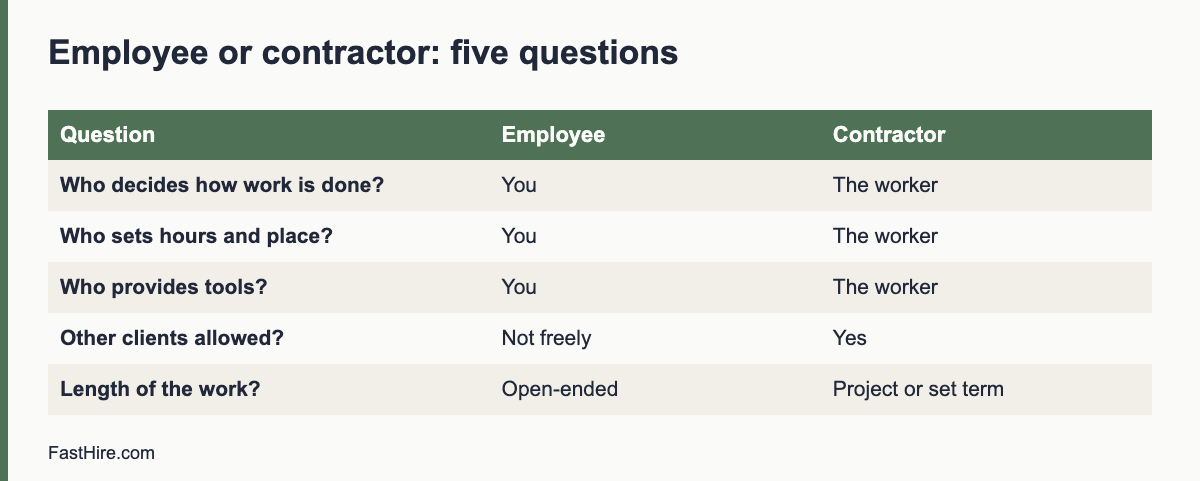
| Question | Points to employee | Points to contractor |
|---|---|---|
| Who decides how the work is done? | You do | The worker does |
| Who sets the hours and the place? | You do | The worker does, within a deadline |
| Who provides tools and equipment? | You do | The worker does |
| Can the person work for other clients? | Not freely | Yes |
| Is there a fixed pay each period? | Yes, wage or salary | No, invoice per job or per day |
| Who bears the loss if the work goes wrong? | You do | The worker does, in part |
| Can the person send someone else in their place? | No | Often yes |
| How long does the relationship run? | Open-ended | A project or a set term |
| Is the person part of your team structure? | Yes, with a manager and a title | No, a supplier outside the team |
No single row decides the question. Authorities look at the overall picture. If most rows point to the left column, treat the person as an employee.
What the official sources say
Each region has its own test. Read the official page, not a summary of a summary.
| Region | How the test works | Official source |
|---|---|---|
| United States | Federal agencies use several tests. The IRS looks at behavioural control, financial control and the type of relationship. The Department of Labor uses an economic reality analysis for wage and overtime law. State tests can be stricter. | IRS: independent contractor or employee and DOL: misclassification |
| United Kingdom | The law uses three groups: employee, worker and self-employed. The group depends on control, obligation to work and personal service. | GOV.UK: employment status |
| European Union | National law decides. Tests and protections differ in each member state. | Your Europe: hiring and managing staff, then your national authority |
In the UK there is a middle group called “worker”. Workers get some rights, such as the minimum wage and paid holiday, but not all employee rights. Check the GOV.UK page if your role does not fit neatly.
A decision guide for your first role
Step 1: Describe the work in one paragraph
Write what the person will do, for how long, and who decides how. If your paragraph includes “will report to me every day”, “will use our systems”, or “will be available during our hours”, you are describing an employee.
Step 2: Score the control questions
Use the table above. Mark each row. Count how many point to each side. Keep this record. It shows you made a reasoned decision.
Step 3: Check the length and type of the work
A defined project with a start, an end and a clear deliverable fits a contractor. A role you will need for years, such as customer support or office management, fits an employee.
Step 4: Price both options
Use the cost worksheet for the employee. For the contractor, use the quoted fee and add any cost of your own time to manage the work. Compare the full costs, not the day rate against the salary.
Step 5: Check the official test and confirm with an advisor
Read the official page for your country. Then ask an accountant or employment lawyer to confirm. One hour of advice before you start is cheap compared with a dispute later.
Examples (fictional)
| Situation | Likely classification | Why |
|---|---|---|
| A founder needs a new website built in 8 weeks. The designer works from their own studio, sets their own hours and invoices at milestones. | Contractor | Defined project, own tools, own methods, own business |
| A shop needs someone to answer customers every weekday, using the shop’s help desk, following the shop’s scripts, with a fixed weekly wage. | Employee | Ongoing, directed work with fixed pay |
| A start-up wants a bookkeeper for 4 hours a month who also serves other clients. | Contractor | Small, independent service with other clients |
| A company calls a person a “freelancer” but requires set hours, a company email address, and a manager to approve their work. They work for no one else. | Likely employee, despite the label | Control and dependence point to employment |
These are examples to explain the method. They are not legal conclusions about any real situation.
Risks of getting it wrong
If an authority decides that a contractor is an employee, the employer may owe back taxes and contributions, pay for missed holiday, and face penalties. The person may also claim rights that apply to employees. In some countries the person who hired also faces fines. The risk is higher if the label was used to avoid costs. Treat the decision as a legal question, not a budget question.
There are risks for the worker too. A contractor does not get paid holiday or sick pay in most countries and carries tax and insurance duties. A worker who accepts the wrong label may lose protections they would have had. Be clear and honest about the arrangement in your ad and in your talks with candidates. Do not describe a job as freelance to avoid costs if you will direct it like a normal job.
How to write the ad for each type
| Item | Employee ad | Contractor ad |
|---|---|---|
| Title | Job title and level | Project or service name |
| Pay | Salary or wage range, hours, benefits | Fee or day rate, project length, payment terms |
| Hours | Working hours or shifts | Deadline and deliverables |
| Tools | Provided by you | Provided by the contractor, or stated in the brief |
| Next step | Application, interviews, offer letter | Proposal or portfolio review, statement of work |
For an employee role, use our guide on how to write a job ad that attracts the right applicants. For a contractor, write a short brief with the goal, the deliverable, the deadline, the review steps and the payment terms. Treat contractor applicants with the same fairness as employee applicants: use written criteria and evidence, and do not use protected traits to choose. Anti-discrimination law may apply to contractors in some places, so do not assume it does not.
A contractor agreement checklist
- Names and legal status of both parties
- Scope of work and deliverables
- Deadline and review steps
- Fee, invoice dates and payment terms
- Who owns the finished work and any intellectual property
- Confidentiality terms
- The contractor provides their own tools and decides how to work
- The contractor is responsible for their own taxes and insurance
- How either side ends the agreement
- Which country’s law applies
Have a lawyer review a template once. Then reuse it. A signed agreement helps, but it does not override the facts of the relationship.
When you can change your mind
Many businesses begin with a contractor and later hire the same person. This is normal when the work grows. Do it openly. End the contractor agreement, offer an employment contract, and set up payroll. Do not keep both arrangements running at once for the same work. If you begin as an employer and then want to move someone to a contractor model, take legal advice first, because this can be seen as an attempt to avoid employee rights.
Red flags that a contractor is really an employee
Review your arrangement every six months. These signs suggest the relationship has moved toward employment.
| Red flag | What it suggests | What to do |
|---|---|---|
| The person works set hours that you choose | You control time | Move to a deadline-based model or hire as an employee |
| You give daily instructions on how to do each task | You control method | Treat as employee work |
| The person uses your email address, title and equipment | They are part of your team | Review the status; take advice |
| The work has run for years with no end date | Ongoing need | Consider an employment contract |
| The person has no other clients | Dependence on you | Review the status; take advice |
| You pay a fixed monthly amount regardless of output | Wage-like pay | Move to milestone or invoice pay, or hire as an employee |
One red flag alone does not prove anything. Several together are a signal to act. Document your review and the reasons for your decision.
Questions to ask a possible contractor
Use the same questions for every contractor you consider. This keeps the process fair and gives you evidence for your choice.
- Describe a similar project you delivered. What was the goal, your method and the result?
- Which tools and software will you use, and who pays for them?
- Who else do you work for, and how will you manage your time between clients?
- What is your fee, what does it cover, and what costs extra?
- How do you handle changes to the scope?
- Can you share a link or file that shows your work?
- What insurance do you hold?
- How do you prefer to report progress?
Score the answers against a short written list, as you would for an employee. A simple guide is in our article on the interview scorecard. Ask each person the same questions, and write down the evidence for each answer.
Switching from contractor to employee: a short plan
- Tell the contractor in writing that you plan to offer employment. Give a date.
- Agree a notice period on the contractor agreement.
- Prepare an offer letter and an employment contract. Take legal advice for the first one.
- Register as an employer and set up payroll before the first day.
- Check right-to-work rules for the person, as for any new employee.
- End the contractor agreement on the day the employment starts.
- Record the change and the reasons.
This plan keeps the change clean and avoids a period in which the person is both. If the person was truly a contractor before, nothing was wrong. If the person worked like an employee for a long time, take advice about any past tax or pay duties.
Frequently asked questions
Can I just call someone a contractor to save money?
No. The real working relationship decides, not the label. If the person works like an employee, authorities can treat them as one and charge back taxes and penalties.
Is a part-time employee the same as a contractor?
No. A part-time employee works fewer hours but is still an employee, with the same rights in proportion to hours. A contractor runs their own business.
What is the difference between a worker and an employee in the UK?
Workers have some rights, such as minimum wage and paid holiday, but fewer than employees. The GOV.UK employment status page explains the three groups.
Do anti-discrimination rules apply to contractors?
In many places the rules reach beyond employees. Do not assume contractors are outside the law. Check the rules for your country.
Who should I ask if I am unsure?
An employment lawyer or an accountant who knows your country. Bring your description of the work and the table from this guide.
Related guides
- Hiring guides for small businesses and founders
- How to make your first hire: a step-by-step plan
- How much does it cost to hire an employee? A cost worksheet
- How to hire without an HR team
- All hiring guides for employers
- How to hire your first developer when you are not technical
- Part-time, seasonal or temporary staff: how to hire fast and fairly
- How to hire in another country: a first guide for small employers
This is general information, not legal advice.