
An interview scorecard is a one-page form where each interviewer rates every candidate on the same criteria, with a short note of evidence for each rating. Build it from the role brief: list the must-haves and four to six competencies, define a rating scale with anchors, score alone straight after each interview and compare scores in the debrief. A scorecard turns a feeling into something you can discuss and check.
Key takeaways
- Build the scorecard from the role brief, not from a generic template.
- Separate must-haves (pass or not yet shown) from competencies (rated 1 to 4 or 1 to 5).
- Add a line of evidence for every score. A score with no evidence does not count.
- Score alone, immediately after the interview and before any discussion.
- Use scores to structure the decision, not to replace judgement. A person decides.
What a good scorecard does
A scorecard has four jobs. It reminds interviewers what to look for, so that they do not drift into talk about hobbies and shared friends. It gives each candidate the same measuring stick. It records the reasons for a decision. And it makes the debrief shorter, because the first ten minutes of argument are replaced by a table.
A scorecard does not make a decision for you. Scores are a summary of what people noticed. If the scores say one thing and your reading of the evidence says another, ask why, and write the answer down. In some places, using automated scoring tools triggers specific legal duties, so keep the scorecard a human tool, completed and understood by the interviewer.
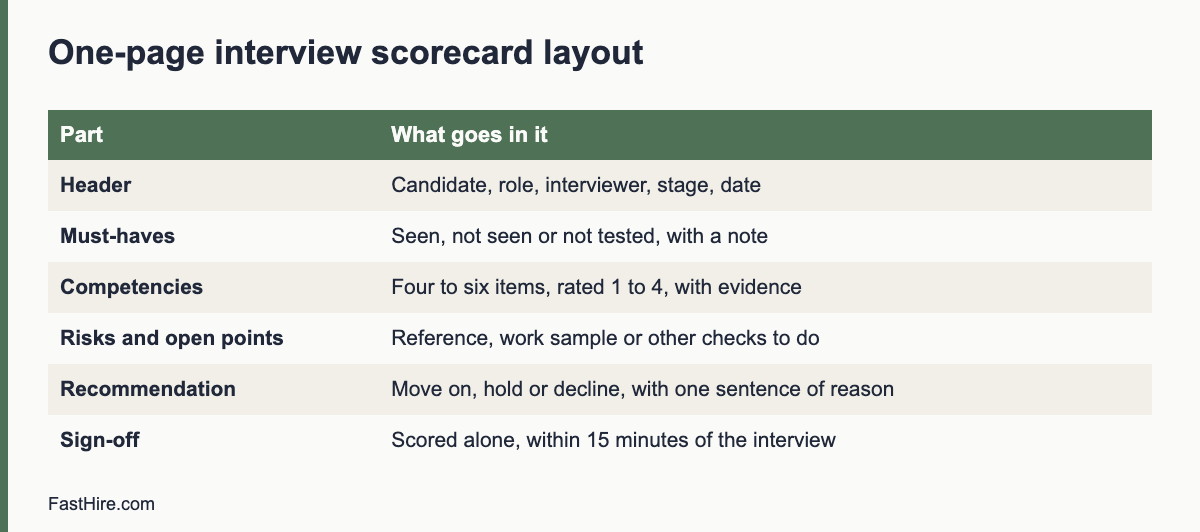
The layout of a one-page scorecard
| Part | What goes in it | Why |
|---|---|---|
| Header | Candidate, role, interviewer, date, interview stage | Traceability |
| Must-haves | Each must-have from the brief with “seen”, “not seen” or “not tested” and a note | Keeps the decision tied to the requirements |
| Competencies | Four to six competencies, each rated 1 to 4 with a line of evidence | Compares candidates on skills the interview tested |
| Risks and open points | Anything to check, for example a reference or a work sample | Makes the next step clear |
| Recommendation | Move on, hold or decline, with one sentence of reason | Forces a position |
| Sign-off | Interviewer name and time of scoring | Shows that the score was made alone and promptly |
Step 1: Choose what to score
Start with the role brief. Copy the must-haves into the top part of the scorecard. These are not rated. They are either seen in the application or interview, not seen, or not yet tested. If a must-have is not seen, the candidate does not move forward unless you have a good reason and write it down.
Then pick four to six competencies that the interview can test. They should be connected to outcomes in the brief. For a project coordinator, these might be planning, communication, problem solving, reliability and working with others. Avoid vague items such as “attitude” or “energy”. If you cannot write an anchor for an item, remove it.
Step 2: Define the rating scale
Use a 1 to 4 scale. It avoids the neutral middle and keeps the form simple. Write a general meaning for each number and then, for each competency, write one line for what a 1 and a 4 look like.
| Score | General meaning |
|---|---|
| 1 | Little or no evidence, or evidence of poor practice |
| 2 | Some evidence, but incomplete or inconsistent |
| 3 | Clear evidence that meets what the role needs |
| 4 | Strong evidence that clearly exceeds what the role needs |
Add one rule: a score of 4 must be backed by a specific example. This reduces score inflation, which is the habit of giving high scores to candidates you like.
Step 3: Add weights only if you can explain them
Not all competencies matter equally. You can give a competency more weight, for example a double weight for the one that matters most for the 90-day outcomes. Do this before the first interview and write the reason in the brief. Do not change weights after you meet candidates. If weights make you uneasy, skip them and compare the profile of scores instead of a total.
A worked example
This example is fictional. It shows how two interviewers might score two candidates for a project coordinator role. The role brief has three must-haves: two years of coordination work, clear written English and working knowledge of a project tool. Five competencies are scored from 1 to 4, and “planning” has a double weight because on-time delivery is the main outcome.
| Competency (weight) | Candidate A: score and evidence | Candidate B: score and evidence |
|---|---|---|
| Planning (x2) | 3: described a 12-week plan with milestones and a weekly check | 4: described adjusting a plan when a supplier failed, with dates and impact |
| Communication (x1) | 4: gave a clear, structured answer to every question | 3: clear, but needed prompts to give detail |
| Problem solving (x1) | 3: solved the example by splitting the task | 3: used a similar approach and added a check |
| Reliability (x1) | 3: gave a specific example of covering for a colleague | 2: example was vague about the outcome |
| Working with others (x1) | 3: described a conflict and how it ended | 3: described a joint deadline with a clear role split |
| Weighted total (max 24) | 3×2 + 4 + 3 + 3 + 3 = 19 | 4×2 + 3 + 3 + 2 + 3 = 19 |
The totals are equal at 19. This is exactly where a scorecard helps. Instead of a vague argument, the panel can see that Candidate A is stronger in communication and reliability, and Candidate B in planning. The panel can ask: which strength matters more for the first 90 days? It can also decide to run a short work sample on planning for Candidate A, or to check a reference on reliability for Candidate B. The scorecard did not decide. It showed where to look.
Step 4: Score alone and promptly
Each interviewer fills in their own scorecard within 15 minutes of the interview, before they talk to anyone else. Memory fades quickly, and the first strong opinion in the room tends to pull everyone with it. Collect the scorecards before the debrief starts. See our guide on structured interviews for question design and anchors.
Step 5: Compare in the debrief
- Put every interviewer’s scores in one table, with the evidence next to each.
- Look first at the must-haves. Is any not seen for a candidate?
- Look at large differences between interviewers. Ask for the evidence behind each. A big gap often means the interviewers saw different things or read the anchors differently.
- Agree the next step, such as a reference check or a short work sample, to settle open points.
- Record the decision and the reason in two sentences.
What to do about common problems
| Problem | What it looks like | Fix |
|---|---|---|
| Score inflation | Almost every candidate gets 3s and 4s | Require an example for every 4. Review the average per interviewer. |
| Halo effect | One strong answer lifts every score | Score one competency at a time, with the evidence in front of you. |
| Similarity bias | Higher scores for people who are like the interviewer | Ask: what is my evidence? Have a second interviewer score. |
| Late scoring | Scores written the next day | Block 15 minutes after each interview in the calendar. |
| Weighting drift | Weights change after meeting candidates | Fix weights before interviews and write them in the brief. |
| Over-reliance on totals | The highest total wins by one point | Read the evidence. Treat small differences as ties. |
Keeping the scorecard fair and lawful
Scorecards help show that you used job-related criteria. They only help if the notes are factual. Write what the candidate said or did. Do not write comments about age, sex, race, religion, disability, family plans or similar topics. The US Equal Employment Opportunity Commission explains the main limits on its page about prohibited employment policies and practices. The Acas page on recruitment explains the position in Great Britain.
Scorecards and notes are personal data. In the UK and the EU, tell candidates how you use their data and delete it when you no longer need it. The Information Commissioner’s Office explains the rules in its guidance on recruitment and selection. A candidate may ask to see notes about them, so write notes that you would be comfortable sharing.
A blank scorecard to copy
Interview scorecard
Candidate: ______ Role: ______ Interviewer: ______ Date and time of scoring: ______
Must-haves (seen / not seen / not tested, with a note)
1. ______
2. ______
3. ______
Competencies (score 1 to 4 and evidence; weight in brackets)
1. ______ (x__): Score __ Evidence: ______
2. ______ (x__): Score __ Evidence: ______
3. ______ (x__): Score __ Evidence: ______
4. ______ (x__): Score __ Evidence: ______
5. ______ (x__): Score __ Evidence: ______
Risks and open points: ______
Recommendation: move on / hold / decline
Reason in one sentence: ______
FastHire is being built so that the evidence behind the must-haves is easy to see. It shows each job requirement next to the exact CV passage that supports it, so the interview can concentrate on what the CV cannot show. FastHire is coming soon. It does not rank, score or reject candidates. People make every decision.
Sample competencies for common roles
Use these as starting points, then change them to match your own role brief. Keep to four to six.
| Role | Possible competencies to score | Evidence to ask for |
|---|---|---|
| Customer support agent | Clear writing, patience under pressure, problem solving, learning new tools, reliability | A real ticket they handled; how they replied; what they learned |
| Sales representative | Listening, planning the week, handling objections, honesty with customers, follow-through | A deal won and a deal lost; what they did differently next time |
| Software developer | Problem solving, code quality, collaboration, learning, communication of trade-offs | A project they built; a decision they changed after feedback |
| Operations coordinator | Planning, accuracy, communication, prioritising, working with suppliers | A schedule they ran; a problem they caught before it grew |
| Team lead | Coaching, fairness, decision making, handling conflict, delivering outcomes | A person they helped improve; a hard decision and the result |
Using scorecards across several rounds
If you run more than one interview, give each round a different focus and its own scorecard, but keep the must-haves the same. For example, round one tests communication and role knowledge, and round two tests planning and working with others. Avoid asking the same question twice, because a repeated question tests memory, not skill. Before the final round, gather all scorecards into one table with the evidence, and look at the whole picture instead of the last interview.
When a candidate does a work sample, score it with the same 1 to 4 scale and the same anchors for every candidate. Ask two people to score it separately, and compare. A short rubric written before the task is set, such as “includes a clear summary”, “numbers are correct” and “next steps are listed”, keeps the scoring objective.
Keep it short enough to use
A scorecard that takes 30 minutes to fill in will be filled in badly or late. Aim for 10 to 15 minutes. If interviewers complain, remove competencies rather than evidence lines. Evidence is what makes the scorecard worth keeping. A short form with real notes is better than a long form with ticks.
Frequently asked questions
What should an interview scorecard include?
The candidate and role, the must-haves, four to six competencies with a rating scale and a line of evidence each, risks and open points, a recommendation and a sign-off with the time of scoring.
Should I use a 1 to 5 or a 1 to 4 scale?
Both work. A 1 to 4 scale avoids the neutral middle score. Choose one scale and use it for every candidate.
Do I need weights?
Not always. Use weights only when one competency clearly matters more for the 90-day outcomes, and set them before the first interview.
Can candidates see my scorecard?
In some countries, candidates can ask for the personal data you hold about them, and notes may be included. Write notes that are factual and that you could explain.
What if two candidates have the same total?
Look at the evidence and at where each is strongest. Decide which strength matters more for the outcomes in the brief, or use a short work sample or reference to settle the difference.
Related guides
- Hiring guides for hiring managers
- Structured interviews: what they are and how to run one
- How to define a role before you hire: a one-page role brief
- Must-haves vs nice-to-haves: cutting your applicant pile without unfair filters
- All hiring guides for employers
- Behavioural interview questions with a scoring guide
- How to run a first interview for a small business: questions and scorecard
- How to check references without breaking rules or trust
- How to run a debrief meeting after interviews
- How to assess skills with a work sample test
- How to take interview notes that help you decide
- What to look for on a resume or CV: a manager guide
- How to compare candidates with different backgrounds
- How to make a hiring decision when the team disagrees
- How to document hiring decisions so they stand up to review
- How to respond to a discrimination complaint from an applicant
This is general information, not legal advice.