
To take interview notes that help you decide, use a prepared sheet with one box per question, write facts and short quotes instead of opinions, mark each note against a must-have, score straight after the interview, and leave out anything about protected traits. Tell the candidate you will take notes, store them securely and keep them only as long as the rules allow.
Key takeaways
- Notes are evidence for the decision. Write what the candidate said and did, not what you felt.
- Use a prepared sheet: question, evidence, score. Link each note to a must-have.
- Record facts and numbers. Avoid labels such as “good fit” or “not senior enough”.
- Never note protected traits or comments on appearance. Remove them if you wrote them.
- Candidates may be able to request their data in some countries. Write notes you could stand behind.
Why notes matter
Memory is unreliable. An hour after an interview you remember the start and the end, strong feelings and the last candidate. Notes preserve the middle. They also protect fairness. A decision based on written evidence for each criterion is easier to explain, check and defend than a decision based on impressions. Notes help the debrief, the feedback to candidates and the reference check. See how to run a debrief meeting and how to give fast interview feedback.
What good notes look like
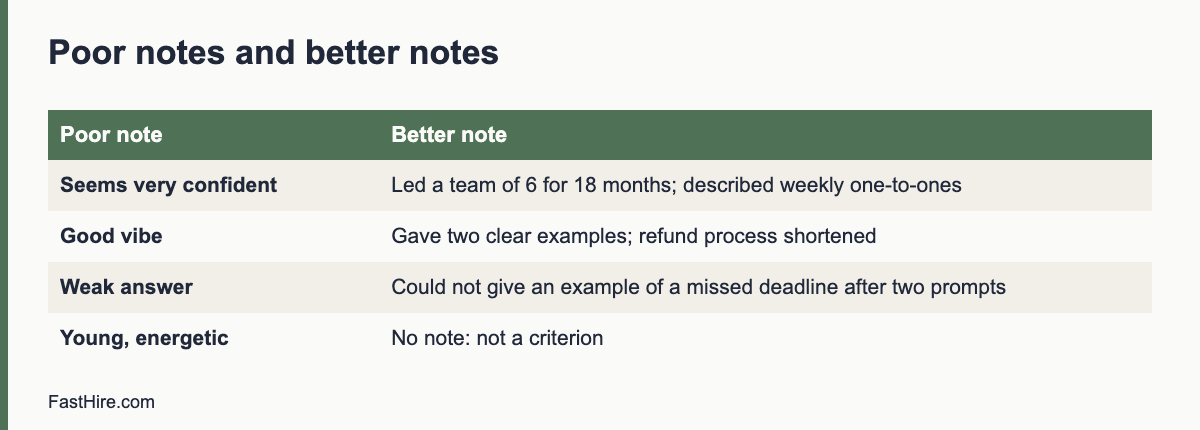
| Poor note | Why it is poor | Better note |
|---|---|---|
| “Seems very confident” | Opinion; style not evidence | “Led a team of 6 for 18 months; described weekly one-to-ones and a hiring plan” |
| “Good vibe” | Feeling; similarity bias | “Gave two clear examples of resolving customer complaints; result: refund process shortened” |
| “Probably will leave soon” | Guess; may relate to age or family | No note. If a retention concern is job-related, ask a question about career plans for this role |
| “Young, energetic” | Age signal | No note |
| “Weak answer” | No evidence | “Could not give an example of handling a missed deadline; said ‘it did not happen’ after two prompts” |
| “Struggled with English” | Vague; may relate to origin | “Answer to question 3 took three attempts to clarify; written test shows clear writing” (only if language level is a stated criterion) |
Good notes quote key phrases, state numbers and name the actions the candidate took. They link to the criterion being tested. They are short enough to write while listening.
A note sheet you can copy
| Question | Criterion | Evidence (facts and quotes) | Score (1 to 4) |
|---|---|---|---|
| 1. Tell me about a time you handled a difficult customer. | Customer skills | ||
| 2. Describe how you plan a week with many deadlines. | Planning | ||
| 3. Tell me about a mistake you made at work. | Learning | ||
| 4. Walk me through your use of [tool]. | Tools | ||
| 5. Availability and notice | Practical fit |
Add a header with the candidate’s name or code, the role, the date, the interviewer and the start and end time. Add a box at the bottom for the three strongest points, the biggest doubt and the overall recommendation. Fill in the last box after you score.
Techniques that work
Write in short forms
Use abbreviations you will understand later, such as “Q2: led proj, 6 ppl, 18 mo, shipped on time”. Replace them with full words if you share the notes. Do not try to write everything. Write the facts that matter for the criteria.
Mark each note against a criterion
Draw a line or use a code (C1, C2, C3) for each criterion. After the interview, you can scan the sheet and see what evidence you have for each must-have.
Use silence
While you write, tell the candidate: “I am noting what you said, please continue.” Pauses are normal. A short silence often leads to more detail.
Capture exact words for key points
Write exact phrases when the wording matters, for example a number, a promise, or a clear statement about what the candidate did themselves. Use quotation marks to show these are exact words.
Separate observation from interpretation
Write observations in one column and interpretation in another, or do the interpretation later in your score. For example: observation, “said ‘the team did most of it’ when asked about the result”; interpretation, “unclear personal contribution; ask follow-up”.
When two people interview together
Split the roles. One person asks the questions and listens; the other takes notes. Switch roles for the second half. Compare notes after scoring alone, not before. Do not share impressions in front of the candidate. See how to run an interview panel well.
What not to write
- Protected traits: age, sex, race, religion, disability, sexual orientation, pregnancy, family status and similar. Remove them if the candidate volunteered them.
- Comments about appearance, accent, voice or clothing, unless a stated and lawful job requirement relates to them.
- Guesses about the reason for a gap, a move or a choice.
- Comparisons with other candidates. Compare in the debrief using scores.
- Insults, jokes or private opinions. Notes can be read later by others.
If you wrote something you should not have, cross it out or delete it before filing and tell the HR contact if it relates to a legal risk. Do not alter records after a complaint has been made. Take advice. See what you can and cannot ask.
Recording and tools
| Method | Pros | Cons and rules |
|---|---|---|
| Paper sheet | Simple, no data risk if stored safely | Hard to share; handwriting; must be stored and destroyed |
| Digital document or form | Searchable, shared | Needs access control and retention rules |
| Applicant tracking system | Central; links to the candidate record | Check retention and access settings |
| Audio or video recording | Complete record | Needs a lawful basis and the candidate’s knowledge; many countries require explicit notice or consent; heavy to store |
| Automatic transcription tools | Fast | Check data protection, accuracy, bias and where data is processed; people must still make the decision |
If you record or transcribe, tell candidates in advance, explain why, how long you keep it and who sees it. In the UK and EU, data protection law applies. See the ICO employment guidance and the GDPR text. In the US, recording laws differ by state, with some requiring all parties to consent. Take local advice. This is general information, not legal advice.
Storing, sharing and deleting notes
- Store notes in one secure place with access only for the hiring team.
- Do not email notes to personal accounts or share in public chat.
- Label them with a code or name, role and date.
- Set a deletion date based on the law and your retention policy. For unsuccessful candidates this is often a limited period. Check the rules for your country.
- Delete or anonymise after the date and record that you did.
- If a candidate asks to see their data, follow the legal process. In the UK and EU, this may be a subject access request.
Write every note as if the candidate might read it, because in some places they may be able to. This is a good test of tone and fairness.
A worked example (fictional)
This example is invented. An interviewer uses a sheet with five questions. For question 1, she writes: “Handled 30-40 tickets a day; used a help desk tool; refund replies; one angry customer: apologised, issued refund in 1 day, customer thanked team in follow-up”. She scores 3. For question 3, the candidate says, “I do not make mistakes.” After a prompt, the candidate gives a minor example. She writes: “First answer: none. After prompt: sent wrong template once; checked tone after; now reads twice before sending”. She scores 2 and notes the need for a follow-up on learning from errors. She does not write about the candidate’s accent or the fact that he mentioned his children in small talk. After the interview she writes three strongest points and one doubt, files the sheet and joins the debrief with her notes ready. The debrief takes 20 minutes because the evidence is clear.
From notes to score: a five-minute routine
- Read your notes for question 1. Underline the facts that relate to the criterion.
- Compare them with the scale anchors. Choose the score that matches the evidence, not the best answer you heard that day.
- Write one line to justify the score.
- Repeat for each question. Do not go back to change a score unless you find a clear error.
- Write the three strongest points, the biggest doubt and the recommendation. Add the time.
The routine takes five to ten minutes after a 45-minute interview. It turns a messy page into clean evidence. If you find that you cannot score a question, note “no evidence” and ask the candidate a follow-up in a later step, such as a reference call or a short written question.
Sharing notes in the debrief
In the debrief, share your scores and the evidence lines, not the full page. Others can ask to see the notes if they need to check. Do not read out personal remarks. If another interviewer’s note includes a protected trait or an opinion without evidence, ask them to remove it or restate it as a fact related to a criterion. A short, polite prompt keeps the record clean for everyone.
Notes for candidates who are not hired
Notes also support feedback. When you decline a late-stage candidate, use your notes to choose two job-related points: one strength and one gap in the evidence. This is faster and more accurate than writing from memory. Keep the language neutral and based on the criteria. See how to give fast interview feedback.
Over time, review a sample of your own notes. Ask whether another person could understand the evidence, whether the notes relate to the criteria and whether any comment would look unfair if read aloud. Adjust your habits. Better notes improve every later step in the hiring process.
Notes on a screen: tips for video interviews
- Place the note sheet on a second screen or on paper, not over the video window, so that you can keep eye contact.
- Tell the candidate if you look down to write, so they do not read it as a lack of interest.
- Do not use the chat window for notes that could be shared by mistake.
- Mute notifications and close other applications.
- Check that your note file is not in a shared folder that others can open by mistake.
Notes on a screen can also be copied or shared more easily than paper. Use a document that is saved in a private location with a clear name, and delete drafts. If you use a tool that records or transcribes, check settings before the interview. Treat every file as personal data that you are responsible for.
A short checklist
- The note sheet matches the question list.
- Each note is linked to a criterion.
- Facts, numbers and quotes are written down.
- No protected traits or appearance comments.
- Scores are written within 15 minutes.
- The file is stored securely and a deletion date is set.
When in doubt, return to the purpose of the notes: they exist so that a decision can be explained with facts. If a note does not help to explain a decision, leave it out. Concise, factual notes are easier to score and to review, and they save time in every later step of the process.
Remember that clear notes are a gift to your future self. A month later, when the new hire asks why they were chosen, or a colleague asks for the evidence behind a decision, you can answer in a minute with facts, instead of reconstructing a conversation from memory.
Frequently asked questions
Should I take notes during an interview?
Yes. Tell the candidate you will, and why. Notes protect fairness and help your decision.
What should I write down?
Facts, numbers, key phrases and actions the candidate took, linked to your criteria. Leave out feelings and protected traits.
Can I record an interview?
Only with a lawful basis and usually with the candidate’s knowledge or consent. Check local rules.
How long should I keep interview notes?
Only as long as needed and as the law allows. Set a deletion date in your retention policy.
Can candidates see my notes?
In some places they can request their personal data, including notes. Write notes you could stand behind.
Related guides
- Hiring guides for hiring managers
- Interview scorecard template with a worked example
- How to run a debrief meeting after interviews
- Structured interviews: what they are and how to run one
- All hiring guides for employers
- How to interview when you are not trained to
- How to document hiring decisions so they stand up to review
- How to respond to a discrimination complaint from an applicant
This is general information, not legal advice.