
Document a hiring decision by recording the requirements and weights before you start, the evidence and score for each candidate against each requirement, the reasons for the final choice in terms of those requirements, and the dates and people involved. Keep it factual, store it securely, and delete it on schedule. Good records protect candidates, managers and the company.
Key takeaways
- Write the requirements and weights before screening, and keep them unchanged unless you change them for everyone.
- Record evidence and a score per requirement, not general impressions.
- State the reasons for the decision in terms of the requirements. Record any dissent.
- Write notes that you would be happy for the candidate to read. Avoid comments on personal traits.
- Keep records for the period the law and your policy require, protect them, and delete them on time.
Why documentation matters
Records serve three purposes. They help you make a better decision, because writing forces you to link choices to evidence. They help you explain the decision to candidates and to your team. And they help you respond if someone challenges the process, whether a candidate, a regulator or a court. In many places, an employer who cannot show the reason for a decision finds it hard to rebut a claim of unfair treatment.
Records are also personal data. In the UK and EU, candidates have rights to see their data. In the US, some states give applicants rights, and federal rules require some records to be kept. See candidate data access requests and applicant data retention. Write with these points in mind.
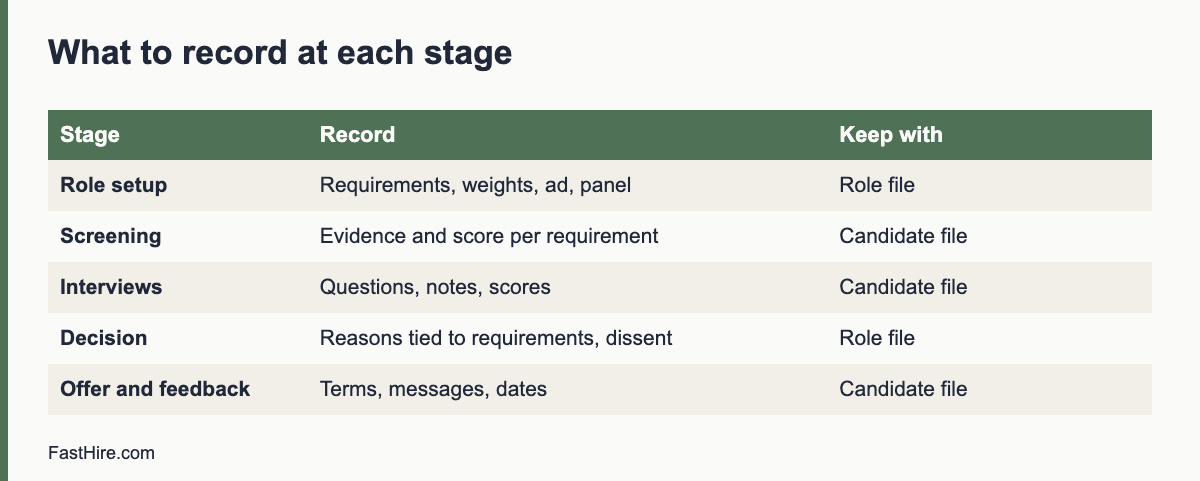
What to record, stage by stage
Role setup
- The role brief and the reason for the vacancy.
- Requirements (must-haves and nice-to-haves) and their weights.
- The ad as published, with date and channels.
- The panel and each person role.
- The scorecard template and scoring scale.
- The process steps and timeline.
- Any adjustment offers and legal checks planned.
Screening
- For each applicant: the evidence found for each must-have and the score.
- The reason for each decision to move forward or not, linked to the requirements.
- Any knock-out rule used, and the reason. See fair knock-out criteria.
- The date of each decision.
Interviews
- The questions asked (the same core set for all).
- Short notes of what the candidate said, as evidence, per question.
- The score per requirement, given before the debrief.
- Any adjustments provided, without medical detail.
- The date, the format and the interviewers.
Decision
- The grid of scores and the final decision.
- The three or so main reasons, linked to requirements.
- Any dissent or concern, and how it was resolved.
- The tie-break rule used, if any.
- Who made the decision, and the date.
Offer and feedback
- The offer terms, with the pay range and how the number was set.
- Notes of the offer conversation and the answers given.
- Messages to successful and unsuccessful candidates, and the feedback given.
- Checks done (references, right to work) and their results, stored separately as needed.
How to write notes that stand up
Good notes are short, factual and job-related. Compare these examples.
| Weak note | Strong note |
|---|---|
| Seemed nervous, not very confident. | Gave one example of leading a project. Did not give the result when asked. |
| Not a good fit. | Scored 1 on handling escalations: described general approach, no example. |
| Too old for this job. | (Never write this. Record only job-related evidence.) |
| Great energy, I liked her. | Explained supplier negotiation clearly with two examples (scored 3 on supplier work). |
| Has kids so may be unreliable. | (Never write this. Ask about availability for the real schedule instead.) |
Write notes during or right after the interview. See how to take interview notes. Never record protected traits, health details, family situation, religion or similar matters unless a specific lawful need exists, such as an adjustment, and then record only what is needed.
A decision record template
| Field | Entry |
|---|---|
| Role and reference | |
| Date of decision | |
| Panel members and roles | |
| Requirements and weights (attach) | |
| Candidates considered (IDs) | |
| Decision (who is offered / not progressed) | |
| Main reasons (3 bullet points tied to requirements) | |
| Concerns or dissent and how resolved | |
| Tie-break rule used (if any) | |
| Adjustments offered (yes/no) | |
| Checks required before start | |
| Feedback to candidates sent on | |
| Retention date | |
| Recorded by / reviewed by |
Who can see the records
- The hiring manager, the recruiter, HR and the panel can see what they need for their role.
- Share scores and notes on a need-to-know basis.
- Keep sensitive data (such as adjustment details or monitoring data) apart from scoring records, with tighter access.
- Do not share candidate records with people outside the hiring process.
- Keep an access log for sensitive files where possible.
Legal and regulatory points
In the US, EEOC rules require employers to keep personnel and employment records for a period, and longer if a charge is filed; see the EEOC recordkeeping requirements. In the UK and EU, data protection rules require you to keep data no longer than necessary and to be able to justify your period; see the ICO guidance on recruitment and selection. Discrimination laws apply to the process; see GOV.UK employing people. Take local advice for your setting.
Pause deletion when a dispute is possible
If a candidate complains, a claim is made or a regulator asks questions, pause deletion of related records and tell HR. Do not alter notes after the fact. If you must correct an error, add a dated correction and keep the original. Deleting or changing records during a dispute can cause serious trouble.
Using tools to help with records
Applicant tracking systems can store scores, notes and messages in a structured way. Check that the tool allows export, access control and deletion on schedule. If a tool suggests a ranking or a decision, record what the person decided and why, and do not simply copy the suggestion. Keep people responsible for decisions. See choose recruiting software and ATS compliance checklist. FastHire is coming soon and is designed to keep evidence next to each requirement, with people making every decision.
Common mistakes
- Writing notes after the decision to justify it.
- Recording opinions about personal traits.
- Keeping scores in personal notebooks that no one can find.
- Changing requirements or weights after seeing candidates.
- Keeping records for ever, or deleting them too early.
- Failing to record why a candidate was rejected at screening.
- Storing sensitive data with scoring data.
Checklist
- Requirements and weights were written before screening.
- Each candidate has evidence and a score per requirement.
- Interview questions and notes are saved.
- The decision record states reasons and dissent.
- Feedback and offer messages are saved.
- Sensitive data is stored apart with limited access.
- A retention date is set and deletion is scheduled.
- Records are paused from deletion if a dispute is possible.
Worked example (fictional)
A hiring manager chooses between two finalists for an operations role. Before the process, she recorded four requirements with weights. During interviews, each panelist scored alone and wrote one line of evidence per requirement. At the debrief, the grid showed a difference on supplier work. The panel agreed the evidence and scored accordingly. The decision record states: offered to Candidate B, because of stronger evidence on supplier negotiation (weight high) and on planning (weight high), while A was stronger on reporting (weight medium). One panelist noted a concern about team coaching for B, to be handled in the 90-day plan. The record is saved, and months later, when A asks for feedback, the manager has clear, fair points to share.
Records for hiring across the US, UK and EU
If you hire in more than one country, keep one core record format and add a short local note. The core record is the same everywhere: the requirements, the evidence, the decision and the reason. The local note covers who may see the record, how long you keep it and where it is stored.
In the US, the EEOC recordkeeping rules set minimum retention for hiring records. Check the current period on that page and use it as your floor. In the UK, there is no single fixed period for hiring records. The ICO guidance on recruitment and selection asks you to keep personal data only as long as you need it, and to be able to explain your choice. In the EU, the GDPR sets the same storage limitation principle, and national rules can add detail. Read Regulation (EU) 2016/679 and check the rules in each country where you hire.
Set the period once per country, write it in your retention schedule, and apply it the same way to every candidate. For a longer look at this, see how long to keep applicant data in the US, UK and EU.
Who should review the records
A record nobody reads is only a file. Pick one person to check a small sample each quarter. This should not be the hiring manager who wrote the notes. A recruiter, an HR partner or a second manager works well.
Ask the reviewer to look for four things. First, does each decision point to at least one requirement from the job description? Second, is each reason based on evidence the candidate gave you, such as a resume line or an interview answer? Third, are the same criteria used for every candidate in the same hiring round? Fourth, are there any comments about age, health, family, religion, origin or other personal traits that have no link to the job?
If the reviewer finds a gap, fix the process, not the person. Add a line to the template, run a ten-minute briefing, or add a reminder to the scorecard. Small changes work better than long policy documents that managers do not read.
A simple sampling plan
- Pick five closed hiring rounds each quarter, across different teams.
- From each round, read the decision record for the person hired and for two people who were not.
- Mark each record as complete, partly complete or missing key parts.
- Share the pattern with managers in plain terms. Name the most common gap and the fix.
- Track the share of complete records over time so you can see whether training helps.
How to train managers to write good notes
Most managers do not skip notes because they are careless. They skip them because it feels like extra work after a long day of interviews. Make the task short and give them a format they can fill in within five minutes.
Use a three-line habit. Line one: the requirement being tested. Line two: what the candidate said or showed. Line three: how that compares with what the role needs. That is enough. Long paragraphs are not needed, and neither are guesses about personality.
Show two short examples in training. One weak note and one strong note, both about the same fictional candidate (fictional). The weak note says, “Not a good fit, did not seem keen.” The strong note says, “Requirement: manage a budget. Candidate described running a small team budget in her last role and named how she tracked spend. Meets the requirement.” The difference is clear in a few seconds.
Also tell managers what to leave out. Do not record guesses about health, family plans, age, accent or background. If something like this comes up in conversation, do not write it down, and tell HR. Our guide to pregnancy and gender interview questions shows how these topics creep into interviews and what to do.
What to do when a record is missing or weak
Sometimes you find a gap after the decision. A manager did not write notes, or the notes only say “good chat”. Do not rewrite history. Never add notes later and date them as if they were written at the time. Instead, add a dated note that says what you found and what you did to fix it.
If the candidate has not yet been told the outcome, ask the interviewers to write down what they remember about the evidence, mark the note as written after the event, and check the decision again against the requirements. If the decision no longer holds up, change it before you tell the candidate. A late note is better than none, as long as it is honest about when it was written.
Then fix the cause. Was the template too long? Did the manager not know it was required? Did the tool make the notes hard to find? One fix at the source saves many gaps later.
Frequently asked questions
What should a hiring decision record include?
The requirements and weights, evidence and scores per requirement, the reasons for the decision, dissent, the people involved and the dates.
Can candidates see my notes?
In the UK and EU, a candidate can usually ask for their personal data, which may include notes. Some US states give similar rights. Write notes that are fair to read.
How long should I keep hiring records?
It depends on the law and your policy. In the US, federal rules require a period for employment records. In the UK and EU, keep data only as long as necessary. See our retention guide.
Is it enough to keep only the final decision?
No. Keep the evidence and the reasons, or you cannot show how you reached it.
Related guides
This is general information, not legal advice.