

Knock-out criteria are yes or no questions that end an application if the answer is no, such as “Do you have the right to work in this country?” or “Do you hold a valid driving licence?” Use them only for requirements that the job truly needs, that you can check objectively, and that you apply to everyone in the same way. Keep them few, and let a person review the results.
Key takeaways
- A knock-out must be a real, legal or practical must-have for the job, not a preference.
- Make it objective and checkable, with a fair way to answer and a route for adjustments.
- Apply the same knock-outs to all applicants, in the same order.
- Avoid proxies for protected traits, such as “years since graduation” for age or “native speaker” for origin.
- Keep a person in charge. Review rejected applications, and check outcomes by group where the law allows.
What knock-out criteria are
Many application forms and tracking systems include screening questions that filter people out. Some are fair and useful. Others are blunt tools that remove capable people for no good reason, or that fall harder on some groups. Because knock-outs act before anyone reads the application, their effect can be large. A bad rule affects many people quickly.
In some places, automated rejection is also regulated. Under GDPR Article 22, people have rights when a decision is made solely by automated means with legal or similarly significant effects; see automated decisions about applicants under GDPR Article 22. In the US, rules on automated tools vary by place, such as New York City Local Law 144. Keep a person responsible for outcomes.
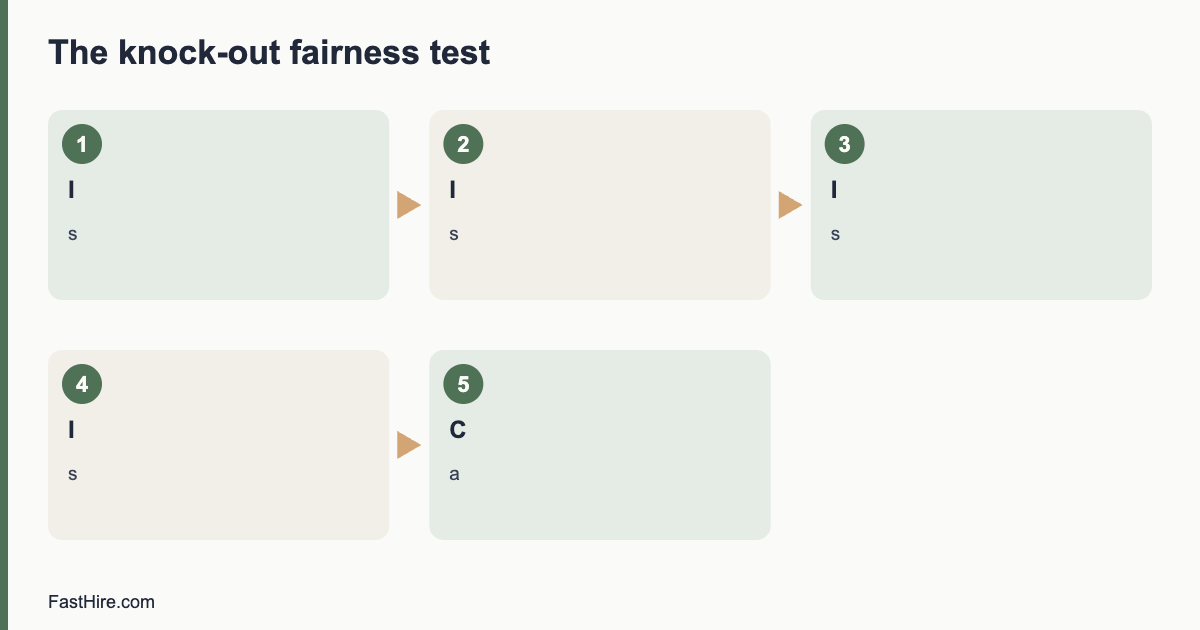
The fairness test: five questions
- Is it needed? Would the job be impossible or unlawful to do without it? If not, make it a nice-to-have.
- Is it objective? Can the answer be checked with a fact, not a feeling?
- Is it applied to everyone? Same question, same order, same rule for all.
- Is there a fair way to answer? Can people with different needs and routes answer it? Is there an adjustment route?
- Can a person review it? Is there a human check for borderline cases and complaints?
If a criterion fails any one of these, change it or remove it.
Examples of acceptable knock-outs
| Criterion | Why it can be acceptable | How to word it |
|---|---|---|
| Right to work in the country | Legal duty (checked in a lawful way) | Are you legally able to work in [country]? (Ask in the way local law allows; check documents after the offer.) |
| Required licence or registration | Legal or regulatory duty | Do you hold [named licence], or can you obtain it before the start date? |
| Availability for fixed shifts | Operational need | The role requires work on [shift pattern]. Can you work this pattern? |
| Location or travel | Operational need | This role is based in [place] and requires travel [frequency]. Can you meet this? |
| Minimum age set by law for the task | Legal limit for the work | Check age only where the law sets a limit and after a conditional offer, if possible. |
| Essential certification for safety | Legal or safety duty | Do you hold [named certification] or an equivalent? |
Even these can be framed fairly. For example, “or equivalent” shows openness to other routes, and “or can obtain before the start date” avoids shutting out capable people who are in the process.
Examples of risky knock-outs and better choices
| Risky knock-out | Why it is risky | Better choice |
|---|---|---|
| Degree required (for a job that does not need it) | Excludes people with other routes; may have unequal effects | Ask for skills evidence; make a degree a nice-to-have |
| At least X years of experience | May exclude capable people and can act as an age proxy | Ask for specific tasks done and results |
| Graduated within the last X years | Direct age proxy | Remove |
| Native English speaker | Origin proxy | Can write clear emails and speak with customers in English |
| Currently employed | Penalises people who lost jobs, are returning or changing fields | Remove |
| No gaps in employment | Penalises carers, people with health needs and others | Remove. Ask about skills |
| Salary expectation within range | Can exclude people for the wrong reasons if used as a hard filter | Show the pay range in the ad. Let candidates decide |
| Willing to work any shift, any time | May exclude carers, students and people with health needs | Ask for the actual shift pattern needed |
| Clean criminal record | Often unlawful or restricted; see rules in each country | Use only checks the law allows, late in the process |
See criminal record checks in hiring, age discrimination in hiring and career gaps and job hopping.
The legal background in brief
Selection rules that disadvantage a group without a job-related reason can be unlawful. In the US, the Uniform Guidelines on Employee Selection Procedures describe how to treat selection tools, and the EEOC page on employment tests and selection procedures explains the idea of job-relatedness. The current federal enforcement position on disparate impact has changed, but intentional discrimination remains unlawful, and state laws may add duties. In the UK, indirect discrimination under the Equality Act requires a rule to be a proportionate means of achieving a legitimate aim; see GOV.UK employing people. In the EU, national law applying the equal treatment directives has similar tests. Our guides on disparate treatment and disparate impact and the four-fifths rule explain related ideas.
How to write the question
- Ask about the requirement, not the person: “Can you work this shift pattern?” not “Do you have children?”
- Keep to yes or no questions with an optional comment box for context or adjustments.
- Offer “or equivalent” where other routes can meet the need.
- Add a line: “If you need an adjustment to apply, contact [name].”
- Explain why you ask, in one line, so applicants understand.
- Never ask for protected traits as a knock-out.
Build a review step
Do not let a rule reject people without any human check. At least review a sample of rejected applications each week. Ask: did the rule act as intended? Did it reject anyone who clearly could do the job? Did anything look odd? Allow people to challenge a rejection: a contact address, a short route for review. For high-volume roles, review a sample large enough to spot patterns. Record what you check and what you change.
Monitor the effect
Track the pass rate of each knock-out by stage. If one rule rejects far more people than expected, check the wording and whether the requirement is truly needed. Where the law allows, compare pass rates by group, using optional monitoring data kept apart from the hiring team. If a rule has an unequal effect, look for a fairer way to meet the same need. Keep records of what you did.
Knock-outs and tools
If your tracking system applies knock-outs automatically, ask the supplier how they work: which fields are used, whether they use any inferred data, and whether the system shows you rejected applications. Switch off any automatic rejection you cannot explain. If you cannot review rejected applications, you cannot check fairness. See choose recruiting software and the ATS compliance checklist. FastHire is coming soon, and it is designed to show evidence next to each requirement, with people making every decision and no automatic rejection.
Checklist
- Each knock-out passes the five-question fairness test.
- Wording is neutral and offers “or equivalent” where possible.
- The same knock-outs apply to all applicants.
- An adjustment route and contact are given.
- Rejected applications are sampled and reviewed by a person.
- Pass rates are tracked by stage and, where lawful, by group.
- The list is reviewed each time the role changes.
Worked example (fictional)
A care provider hires support workers. Its form had five knock-outs: a degree, two years of care experience, a driving licence, “open availability” and “no gaps in employment”. The recruiter runs the fairness test. The degree is not needed, so she removes it. Experience becomes a nice-to-have with a question about tasks done. The driving licence stays for roles with home visits, with an “or can travel by another reliable means” option. “Open availability” becomes the actual rota pattern. “No gaps” is removed. She adds a review step: each week she reads a sample of applications that did not pass. After a month, the share of applicants reaching interview rises, and the manager finds the quality of hires is as high as before.
Knock-outs versus scoring: which to use when
Not every requirement should be a knock-out. A knock-out is a hard gate. A scored requirement allows a candidate to be strong in some areas and weaker in others. Use knock-outs for conditions that are legally or practically unavoidable: a licence, a shift pattern, a location. Use scoring for skills and experience where there are degrees of strength. If you turn a skill into a knock-out, you risk losing capable people who could learn the missing part quickly. If you leave a legal must-have as a score, you may waste time on people who cannot start. Ask of each requirement: if a person fails this, can they still do the job within a reasonable time with support? If yes, score it.
How to explain knock-outs to candidates
Be open. Put the knock-out questions in the ad as well as on the form, so that people can decide before they apply. Say why each one matters: “This role requires a licence because we use company vehicles.” If a candidate does not pass, send a clear message that names the requirement and thanks them. Where you can, suggest a way forward: “If you obtain the licence, please apply again.” This protects your reputation and treats candidates with respect. See how to turn down a candidate kindly.
Adjustments and exceptions
Some people cannot meet a knock-out in the usual way because of a disability or health need, but can do the job with an adjustment. For example, a person who cannot drive because of a medical condition may do a role with a driving duty if the driving is only a small part and can be covered another way. Allow applicants to ask. Review each request with HR. Where the requirement is essential and cannot be met by an adjustment, record the reason. See reasonable adjustments in interviews and ADA and hiring.
Keep a rule register
| Rule | Reason | Source of requirement | Owner | Last reviewed |
|---|---|---|---|---|
| Valid driving licence | Home visits by car | Role analysis | Recruiter | Date |
| Shift pattern | Operational rota | Manager | Manager | Date |
A register shows that each rule has a reason and an owner. Review it at least once a year or when the role changes. Delete rules that no longer have a reason. This also makes it easy to answer questions from candidates, auditors and regulators.
Training the team that sets the rules
Rules are often set by whoever builds the form. Give recruiters and managers a short guide on knock-outs: the five-question test, the examples above and the review step. Ask them to bring any proposed new knock-out to a quick check by HR before it goes live. Share two or three cases from your own hiring where a rule was changed after review, and what happened. The aim is a team habit of asking whether each filter is needed, objective and fair, before it touches a real candidate. That habit does more for fairness and for the quality of your shortlist than any single tool.
Finally, remember that every filter has a cost. Each time you remove a person at the first step, you lose the chance to learn what they could do. Use knock-outs sparingly, explain them honestly and check their results. Where in doubt, move the question into the scored part of your process, where a person can weigh the evidence.
Frequently asked questions
What are knock-out questions?
Screening questions that end an application if the answer is no. Use them only for real must-haves such as a legal licence or a fixed shift.
Are knock-out questions legal?
They can be, if job-related, objective and applied fairly. Rules that act as proxies for protected traits, or that have unequal effects without a good reason, can be unlawful.
Can software reject applicants automatically?
In some places, rules limit solely automated decisions. Keep a person in charge and review results. Check local law.
How many knock-outs should I use?
As few as possible, ideally only for legal or practical must-haves.
Related guides
- Fair hiring hub
- Structured screening
- Employer guides
- What to do when too many people apply: a method for 200 applications
This is general information, not legal advice.