
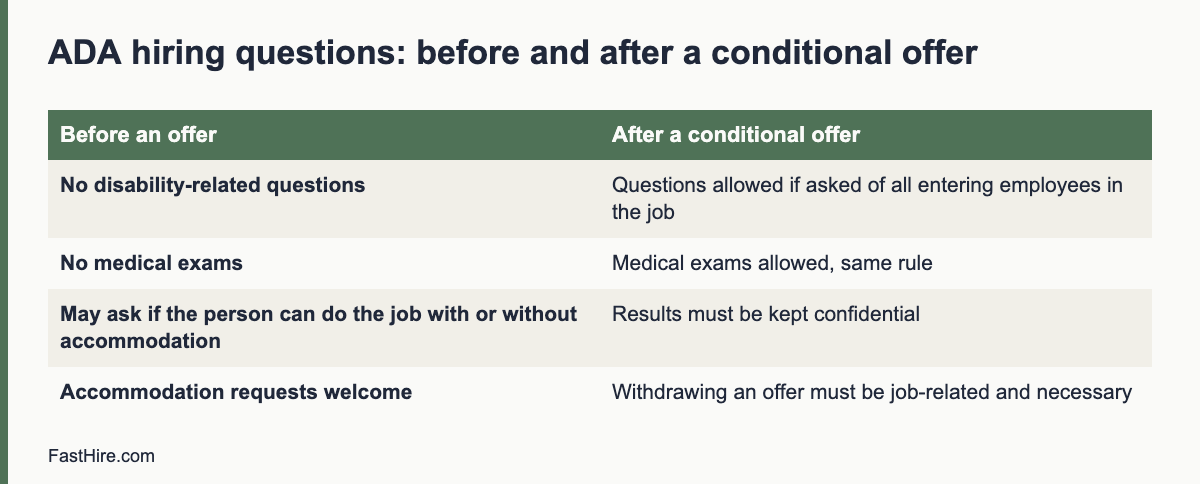
The Americans with Disabilities Act (ADA) bans discrimination against qualified applicants with disabilities and requires covered employers to provide reasonable accommodation in the application process. Before a conditional job offer, you generally cannot ask disability-related questions or require medical exams. After an offer, you can, if you do it for everyone entering the same job and keep the results confidential.
Key takeaways
- The ADA covers qualified applicants. Judge people on whether they can perform the essential functions of the job, with or without accommodation.
- Before an offer, do not ask disability-related questions or require medical exams. You can ask whether the person can perform the job functions.
- After a conditional offer, you may ask and test, if you do it for all entering employees in that job category and keep the information separate and confidential.
- Provide reasonable accommodation in the application process unless it causes undue hardship.
- Coverage and state laws vary. Check the EEOC guidance and ask a specialist about hard cases.
Who and what the ADA covers
Title I of the ADA prohibits discrimination in employment, including hiring, against a qualified individual on the basis of disability. The text is hosted by the EEOC on its page for Titles I and V of the ADA. Coverage depends on the size of the employer, and the EEOC’s small business pages explain how the rules apply; see EEOC guidance for small business. Many state and local laws reach smaller employers or add protections, so do not assume that you are outside the rules.
“Qualified” means that the person can perform the essential functions of the job with or without reasonable accommodation. “Disability” is defined broadly in the ADA as amended, and includes physical or mental impairments that substantially limit one or more major life activities, a record of such an impairment, or being regarded as having one. Employers should not try to decide who “counts”. Focus on the job and on what the person needs to do it.
Before the job offer: what you cannot ask
The EEOC’s guidance on preemployment disability-related questions and medical examinations explains the rules. In outline, before a conditional offer you generally may not ask disability-related questions or require medical examinations. That is true even if you plan to look at the results only after the offer.
| Allowed before an offer | Not allowed before an offer |
|---|---|
| “Can you perform the essential functions of this job, with or without accommodation?” | “Do you have a disability?” “What medications do you take?” |
| Asking about attendance requirements, such as “Can you work the hours listed?” | “How many sick days did you take last year?” |
| Asking about non-medical qualifications and skills | “Have you ever had a workers’ compensation claim?” |
| Asking about current illegal drug use | Asking about past treatment for addiction or mental health conditions |
| Asking a candidate who has an obvious disability, or who has told you about one, whether they need an accommodation and what it would be | Medical exams, including tests that measure physiological responses such as blood pressure |
| Physical agility tests that are not medical, for all applicants in the job | Tests that measure heart rate or other medical responses |
These examples follow the EEOC guidance. Read the guidance for details and edge cases, such as how to describe job functions and how drug and alcohol tests are treated. A drug test for illegal drugs is not a medical exam, but an alcohol test is treated as one.
After a conditional offer
Once you make a conditional offer, you may ask disability-related questions and require medical examinations, and make the offer depend on the results. Three conditions apply. You must do it for all entering employees in the same job category, whether or not they have a disability. You must keep medical information confidential, in files separate from the personnel file. And if you withdraw the offer because of a medical result, you must show that the reason is job-related and consistent with business necessity, and that no reasonable accommodation would let the person do the job.
Reasonable accommodation in the application process
Reasonable accommodation includes changes to the application process, the way a test or interview is given, and the way a job is done. The EEOC’s enforcement guidance on reasonable accommodation and undue hardship covers job applicants and the application process.
| Stage | Examples of accommodation |
|---|---|
| Application form | Accept applications by phone or email; provide an accessible form; give extra time; allow help from another person |
| Online tests | Extra time; a different format; a screen-reader-friendly version; an oral or written alternative |
| Interviews | Sign language interpreter; step-free location; written questions; a quiet room; breaks; a video or phone option |
| Work sample or trial | Adapted equipment; a different way to show the skill; a longer time limit |
| Offer and onboarding | Accessible documents; flexible start arrangements; workplace changes |
The employer and the applicant should talk about the need and the options. A request does not need special words. If a person says that a change would help because of a condition, treat it as a request. You may ask what would help. You may ask for limited documentation only where the disability and the need are not obvious, and take care not to ask for more than you need. Where an accommodation causes undue hardship, you can decline it, but you should look for an alternative that works. Our guide on reasonable adjustments in interviews gives step-by-step handling and scripts, and many of the practices apply in the US.
Essential functions and job descriptions
The ADA looks to the essential functions of the job. Write them down before you advertise. A good description lists the real tasks, the time spent on each, and whether the task could be done in another way. It avoids “must be able to lift 25 kilos” unless lifting is truly a core function. If a task is not essential, it should not be a barrier. Use the same list to build your screening criteria and interview questions. Our guide to writing a job description for a new role and the role brief method help here.
Tests, tools and standards
- Ask whether a test measures a skill the job needs. A timed typing test is relevant to a data entry role, but not necessarily to a role that uses speech software.
- Check that online tools are accessible. They should work with keyboards and screen readers.
- Offer an alternative. Give a clear way to ask for another format.
- Validate selection criteria. The EEOC explains how tests and selection procedures are assessed in its guidance on employment tests and selection procedures.
- Review automated tools. See our guide on US law on AI and hiring.
Confidentiality and records
Information about an applicant’s disability or accommodation request is confidential. Share it only with people who need to know it to carry out the accommodation, and describe the change, not the condition. Keep it out of scorecards and out of general applicant files. Medical information should sit in a separate confidential file. Do not use the information to decide who moves forward. Follow your retention schedule; see our guide on retention of rejected applicant data.
Common mistakes
| Mistake | Fix |
|---|---|
| Asking “Do you have any health problems?” in an interview | Ask whether the person can do the essential functions, with or without accommodation |
| Rejecting a person because an accommodation “might be costly” | Look at the actual accommodation, and at the undue hardship standard in the EEOC guidance. Many accommodations cost little or nothing |
| Telling the hiring team about a candidate’s condition | Tell them only what they need to carry out the change |
| Using a medical form with the application | Remove it. Medical exams come after a conditional offer, for all entering employees in the job |
| Assuming that a person cannot do a task because of a condition | Ask the person how they would do it, and offer a trial where relevant |
| No contact for requests | Name a person and put the contact in every invitation |
FastHire is being built for fair, evidence-based screening. It shows each job requirement next to the exact CV passage that supports it, so decisions rest on skills and not on guesses. FastHire is coming soon. It does not rank, score or reject candidates. People make every decision.
A fictional case: a request during an application
This case is invented to show the reasoning. It is not legal advice. A candidate for an inventory clerk role writes to the contact in the invitation: “I have a visual impairment and use screen magnification. Could I receive the skills test as a file I can enlarge, with extra time?”
| Step | What the employer does |
|---|---|
| 1. Reply fast | Thanks the candidate, confirms the request and asks if the format and time suggested would work |
| 2. Check the test | Asks: does the test measure a skill the job needs? Is speed essential? The job involves counting stock, not speed reading, so extra time is reasonable |
| 3. Provide the change | Sends an accessible file, sets a longer time limit, and confirms in writing |
| 4. Keep it separate | Tells the assessor only that the format and time limit differ, not why |
| 5. Score on the job criteria | Marks the test against the same criteria as all other candidates |
| 6. Keep records | Stores the request and the change in a confidential file for the retention period |
The employer did not ask about the cause, did not ask for medical proof and did not change the standard. It changed how the candidate showed the skill. If the employer had been unsure whether extra time was reasonable, it could have talked with the candidate about alternatives and taken advice.
Training for people who handle requests
The person who first receives an accommodation request is often a recruiter, a coordinator or a hiring manager who has never been trained. A one-hour session helps. Cover these points: what an accommodation is, how to reply in a warm and practical way, who to involve, how to keep information confidential, what not to ask, and what to do if the request seems difficult. Give them a script and a contact in HR or legal for hard cases. Repeat the session once a year and when new people join the hiring team.
Reply template:
Hello [Name], thank you for letting us know. We can [change]. Does that work for you? If you would like something different, please tell us. We will confirm the arrangement in writing and will tell only the people who need to know what is different, not the reason.
Keep the tone matter-of-fact and positive. Candidates who are treated well when they ask for help often become strong employees and good advocates for your company.
Ask for a review each year
Once a year, review how requests were handled. Count the number of requests, the time to reply, the types of change and the results. Remove personal details before you share the review. Ask whether any request was declined and why. Ask a few candidates who used accommodations, if they agree, what worked and what did not. Use the findings to update your templates, your venues and your online tools.
Frequently asked questions
Can I ask a candidate if they have a disability?
Generally not before a conditional job offer. You may ask whether they can perform the essential functions of the job with or without accommodation, and you may invite requests for accommodation.
Can I ask a candidate with a visible disability how they would do the job?
If the disability is obvious, or the person has told you about it, you may ask whether they need an accommodation and what it would be. Keep the questions about the job.
Is a drug test a medical exam?
A test for illegal drugs is not a medical exam under the ADA. A test for alcohol is. Check the EEOC guidance and your state law.
Can I ask for a doctor’s note for an accommodation request?
Only in limited cases, where the need is not obvious, and only what is needed. Ask a specialist first, and do not request medical records at the application stage by default.
Does the ADA apply to remote or online hiring?
Yes. The application process is covered whatever the format.
Related guides
- Hiring guides for fair and compliant hiring
- Reasonable adjustments in interviews: what hiring managers should do
- US law on AI and hiring: what employers should know
- Interview questions you cannot ask
- All hiring guides for employers
- UK reasonable adjustments in recruitment
- Accessible job applications: a checklist for forms and websites
This is general information, not legal advice.