
In the United States, federal anti-discrimination laws apply to hiring decisions made with software in the same way as to decisions made without it. Employers remain responsible for the results of tools they use, including tools bought from vendors. Federal enforcement priorities have shifted since 2025, but the laws have not changed, and states, cities and private plaintiffs can still act.
Key takeaways
- Title VII, the ADA and the ADEA apply to hiring tools. A tool is not a legal shield.
- Employers can be responsible for a vendor’s tool if they use it to make or inform hiring decisions.
- Two risks stand out: unequal results for protected groups (disparate impact) and tools that screen out disabled people who could do the job with an accommodation.
- The EEOC’s earlier AI technical assistance pages were taken down from its site, and federal disparate-impact enforcement was deprioritised by a 2025 executive order. Check current guidance before you rely on any summary.
- State and local rules, such as New York City Local Law 144, may add duties.
What the law covers
The main federal laws on employment discrimination apply regardless of the technology used. Title VII of the Civil Rights Act of 1964 prohibits discrimination based on race, color, religion, sex and national origin. The Americans with Disabilities Act (ADA) protects qualified people with disabilities, and requires reasonable accommodation in the application process. The Age Discrimination in Employment Act (ADEA) protects workers aged 40 and over. The Equal Employment Opportunity Commission (EEOC) enforces these laws, and its page on prohibited employment policies and practices summarises the basics.
None of these laws has an exception for software. If a tool produces results that treat applicants differently because of a protected trait, the employer who uses it can be liable. The same logic applies when the tool is simple, such as a keyword filter, and when it is complex, such as a model trained on past hires.
Two kinds of risk
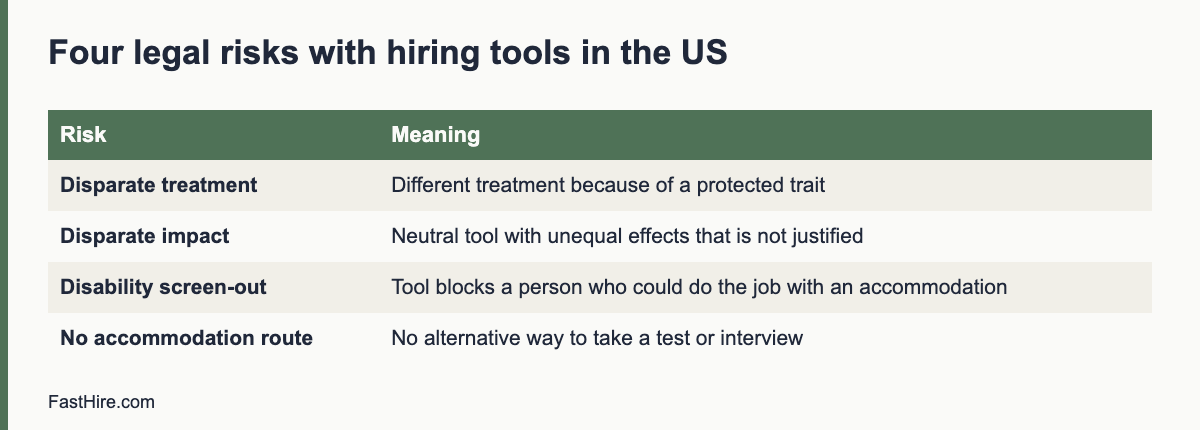
| Risk | What it means | Example (generic) |
|---|---|---|
| Disparate treatment | Treating people differently because of a protected trait, on purpose | A tool is set to filter out applicants over a certain age |
| Disparate impact | A neutral rule or tool that falls more heavily on a protected group and is not job-related and consistent with business necessity, or where a less discriminatory alternative exists | A screening score trained on past hires reproduces a past imbalance in the workforce |
| Disability screen-out | A tool or test that screens out a person because of a disability, when the person could do the job with a reasonable accommodation | A timed online test that a person with a motor or processing difference cannot complete in the usual way |
| Failure to accommodate | Not offering an alternative way to take a test or interview | No route to ask for another format |
Our guides on disparate treatment vs disparate impact and the four-fifths rule explain the first two in more detail. The EEOC explains how selection procedures are judged in its page on employment tests and selection procedures, and the Uniform Guidelines on Employee Selection Procedures are published as 29 CFR Part 1607.
What changed in 2025
Employers should know three developments, and should verify each on official sources. First, the EEOC published technical assistance documents on AI and hiring in 2022 and 2023. Those pages were later removed from the agency’s site, so they should not be treated as current EEOC guidance. Second, an executive order in April 2025 told federal agencies to deprioritise enforcement of disparate impact liability. Third, the statutes, including Title VII’s disparate impact provisions, were not repealed. Private individuals can still bring claims, and state attorneys general and state or local agencies can apply their own laws.
What this means in practice: federal agencies may act less on disparate impact. Lawsuits and state action remain possible, and tools that may cause unequal results are still a business and reputational risk. Intentional discrimination, including by an automated tool, remains unlawful. Rules and priorities keep changing, so check the EEOC site and ask a lawyer for current advice.
Employer responsibilities with vendor tools
Buying a tool does not move legal responsibility to the vendor. In general, if you use a tool to make or inform decisions, you answer for the effects on your applicants. Contract terms can share costs, but they do not remove your duties. So you need to understand the tool and test its effects on your own process.
- List all tools used in hiring. Include resume parsers, chatbots, video tools, assessments and scoring or ranking features.
- Ask each vendor what the tool does. What inputs does it use? What is the output? How was it built and tested?
- Ask for evidence of testing. Has the vendor tested for differences in outcomes between groups? Can you see the summary?
- Review job-relatedness. Does the tool measure something the job needs? Can you explain how?
- Test with your own data. Compare outcomes for applicants by group where the law allows, and use a sample review by people to check for errors.
- Provide accommodations. Offer another way to take an assessment, and a clear contact for requests.
- Keep a person in charge. Make sure a trained person reviews the evidence and makes each decision.
- Keep records. Store what you tested, what you found and what you changed, for the period required by law. See how long to keep rejected applicant data.
Disability and AI tools
Many hiring tools time responses, measure speech or facial expression, track mouse movements or use games. These can disadvantage people with disabilities who could do the job. Practical steps include telling candidates what the tool measures, giving a simple way to ask for an alternative or more time, and training staff to respond to requests. Our guides on reasonable adjustments in interviews and the ADA and hiring cover the process. The EEOC’s enforcement guidance on reasonable accommodation is still available.
State and local rules
| Place | Example | Where to read |
|---|---|---|
| New York City | Local Law 144 requires a bias audit within a year before using covered tools, a public summary and candidate notice | City page and our Local Law 144 guide |
| Illinois | A law on artificial intelligence in video interviews requires notice and consent in covered cases | Check the Illinois General Assembly site for current text |
| Other states | Several have passed or proposed rules on automated decisions or AI in employment | Check state legislature and attorney general sites for each state where you hire |
Because the picture changes, make “check current rules” a standing item in your procurement checklist, as in our guide to choosing recruiting software. The US National Institute of Standards and Technology also publishes a voluntary AI Risk Management Framework that employers can use to structure their own review.
A short policy for AI in hiring
Write a one-page policy and share it with recruiters and hiring managers. It can follow this outline.
| Section | Contents |
|---|---|
| Purpose | Hire fairly and lawfully; keep people responsible for decisions |
| Scope | All tools that sort, score, rank, recommend or screen candidates |
| Rules | No automatic rejection; every decision reviewed by a trained person; no use of protected traits or close proxies |
| Approval | New tools need approval from HR and legal after a review |
| Testing | Outcomes checked by group where lawful; sample review of decisions each quarter |
| Accommodations | A clear route to request alternatives; staff know how to respond |
| Transparency | Candidates are told which tools are used and how to ask questions |
| Records | Keep the review, tests and changes for the required period |
| Review | Reviewed each year and when rules or tools change |
FastHire is being built to help you keep people in charge. It shows each job requirement next to the exact CV passage that supports it. FastHire does not rank, score or reject candidates. People make every decision. FastHire is coming soon.
A vendor review sheet (fictional example)
| Question | Vendor answer (fictional) | Follow-up |
|---|---|---|
| What does the tool output? | A match percentage for each applicant | Is it used to rank? Can we switch it off? |
| What data does it use? | CV text and answers to screening questions | Does it use anything that is a close proxy for a protected trait? |
| How was it tested? | Internal testing, summary available on request | Request the summary; ask who ran the test and when |
| How do applicants ask for an accommodation? | Not built in | We add a contact in the invitation and a manual route |
| Can reviewers see why a result appeared? | A list of matched words | Can they see the CV passage and overrule the result? |
The answers are invented. The structure is the point: each answer leads to a follow-up that either reduces the risk or ends the use of the feature. Keep the completed sheet in your file for the tool.
What to do when a test shows a gap
- Do not ignore it. Document the finding, the date and who reviewed it.
- Check the data. Small groups can show large swings. Look at more data before you conclude anything.
- Look for the cause. Which step or requirement produces the gap? Is it a feature of the tool, a job requirement or the source of applicants?
- Test job-relatedness. Is the requirement or feature necessary for the job? Could a less exclusive method work?
- Change the process. Adjust the requirement, remove or limit the feature, add a human review, or change how the tool is used.
- Re-test. Check again after the change, and note the result.
- Take legal advice. Do this early if the gap is large or affects a legally protected group.
Remember that testing your own tool is a good-faith step toward fair hiring, and it is much better than not looking. Handle the data with care, limit who can see protected-trait data and delete it on schedule.
Talking to candidates about tools
Candidates increasingly ask whether AI is used on their application. Give a plain answer in your careers page and your application confirmation. Say what the tool does, that a person makes the decision, and how to ask for another process or an adjustment. Do not claim that a tool removes bias. Say what you do to test and review. Honest, specific language builds more trust than large claims, and it keeps you consistent with what your vendors really provide.
One more practical point: assign a single owner for hiring tool risk. Without an owner, the vendor relationship sits with whoever signed the contract, the data sits with IT and the fairness question sits with nobody. A named owner, usually in HR with support from legal, keeps the tool list current, collects vendor documents, schedules tests and reports to leadership once a year. Even in a small company, one person with an hour a month for this task makes a difference.
Frequently asked questions
Does the EEOC still have AI guidance?
The EEOC’s earlier technical assistance pages on AI and hiring were removed from its site. The laws they described are still in force. Check the EEOC website for what is current, and ask a lawyer.
Am I liable for a vendor’s tool?
You can be liable for the effects of tools you use in your hiring decisions. Contract terms do not remove your legal duties.
Do small employers need to worry?
Coverage of the federal laws depends on the number of employees, and state laws may reach smaller employers. Tool risk exists at any size.
Is a keyword filter an AI tool?
The law does not care about the label. A simple filter that causes unlawful discrimination is still a problem.
Can I test my own tool for bias?
Often yes, using lawful methods and data. Work with a specialist, and be careful with how you collect and store protected-trait data.
Related guides
- Hiring guides for fair and compliant hiring
- Disparate treatment vs disparate impact
- New York City Local Law 144: bias audits for hiring tools
- EU AI Act and hiring tools
- All hiring guides for employers
- The ADA and hiring: reasonable accommodation for applicants
This is general information, not legal advice.