
The four-fifths rule is a rule of thumb from US federal guidelines. It compares selection rates between groups: if the rate for one group is less than four-fifths (80 percent) of the rate for the group with the highest rate, enforcement agencies will generally regard it as evidence of adverse impact. It is a screening signal, not proof of discrimination and not a legal safe harbour.
Key takeaways
- Adverse impact means a neutral selection step that selects one group at a markedly lower rate than another.
- The four-fifths rule: divide each group’s selection rate by the highest group’s rate. A result below 0.80 is a warning sign.
- Small numbers can make the ratio unstable. Statistical and practical significance also matter.
- Passing the rule does not prove a process is fair. Failing it does not prove unlawful discrimination.
- The rule comes from US guidelines. UK and EU law use different tests. Check current US enforcement priorities, because they have changed.
What adverse impact is
Adverse impact, also called disparate impact, happens when a rule or test that looks neutral selects members of one group at a much lower rate than members of another group. A requirement can look fair on its face, and still exclude more people from a protected group. The question is then whether the requirement is job-related and necessary, and whether a less exclusionary alternative exists.
The US Equal Employment Opportunity Commission describes this in its page on employment tests and selection procedures: neutral tests that disproportionately exclude a protected group can violate federal law unless they are job-related and consistent with business necessity. For the difference between disparate treatment and disparate impact, see our guide on disparate treatment vs disparate impact.
Where the four-fifths rule comes from
The rule appears in the Uniform Guidelines on Employee Selection Procedures, which US federal agencies adopted. The text of 29 CFR 1607.4 says that a selection rate for any race, sex or ethnic group that is less than four-fifths (or 80 percent) of the rate for the group with the highest rate will generally be regarded as evidence of adverse impact. It adds that smaller differences may still constitute adverse impact if they are significant in both statistical and practical terms, and that greater differences may not count where they are based on small numbers and are not statistically significant.
So the rule is a first screen. It tells you where to look. It does not give a verdict.
How to calculate it, step by step
- Choose the step. For example, resume screening, a test, or an interview stage.
- Count applicants and selections by group. Use only data you may lawfully collect and use for monitoring.
- Calculate each group’s selection rate. Rate = number selected divided by number of applicants in the group.
- Find the highest rate.
- Divide each group’s rate by the highest rate. The result is the impact ratio.
- Compare to 0.80. Below 0.80 is a flag for review.
- Check the numbers. If groups are small, results may be unstable. Collect more data or look at several searches together.
A worked example (fictional)
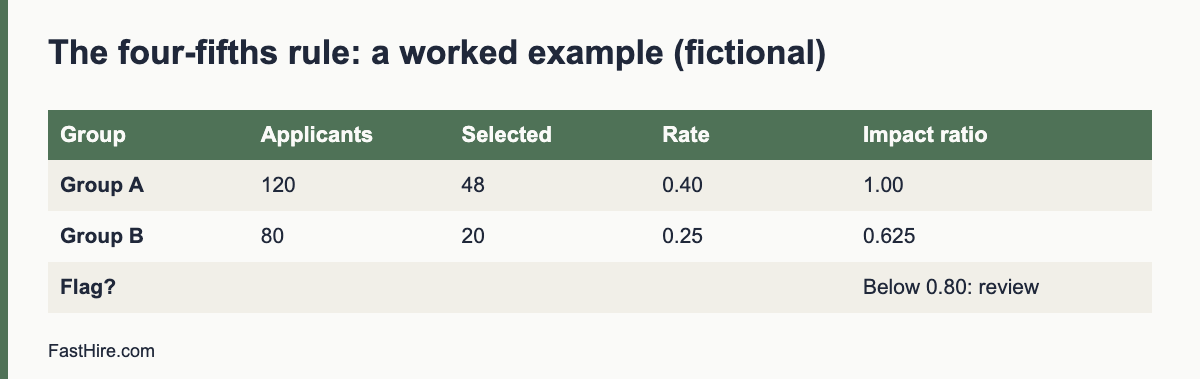
This example is invented. A company screens 200 applicants for a role. The table shows applicants and those who passed the resume screen, by a fictional group split.
| Group | Applicants | Selected | Selection rate | Impact ratio (rate divided by highest rate) |
|---|---|---|---|---|
| Group A | 120 | 48 | 48 / 120 = 0.40 | 0.40 / 0.40 = 1.00 |
| Group B | 80 | 20 | 20 / 80 = 0.25 | 0.25 / 0.40 = 0.625 |
Group A has the highest rate, 0.40. Group B has a rate of 0.25. The impact ratio is 0.25 divided by 0.40, which is 0.625. This is below 0.80, so the result flags a possible adverse impact at the resume screening step. The next step is not to conclude that discrimination happened. It is to look at the criteria used at that step and ask: Which rule produced the gap? Is it job-related? Is there a less exclusive alternative? Are the numbers large enough to trust? A statistician or an employment lawyer can advise on tests of significance.
| Same example, different numbers | Group A | Group B | Impact ratio |
|---|---|---|---|
| Selection rate | 0.40 | 0.34 | 0.34 / 0.40 = 0.85 |
| Result | Above 0.80 | No four-fifths flag, but still check the criteria |
If the selection rates are 0.40 and 0.34, the ratio is 0.85. That is above 0.80 and the rule does not flag it. Yet the guidelines say smaller differences can still matter if they are significant in statistical and practical terms. Treat the rule as one tool.
The limits of the rule
| Limit | What it means | What to do |
|---|---|---|
| Small samples | A change of one person can move the ratio a lot. With 10 applicants in a group, one extra hire changes the rate by 10 points | Pool several searches. Use statistical tests. Take advice |
| Only one measure | It compares rates; it ignores why | Examine the criteria and the evidence |
| Not a safe harbour | Passing does not make a process lawful | Keep criteria job-related and documented |
| US-specific | UK and EU law use different tests | Use local guidance in each country |
| Data availability | Many employers cannot collect group data in all countries | Check what the law allows. Some countries restrict collecting such data |
| Group definitions | Results depend on how groups are defined | Use official categories where required; avoid guessing a person’s group |
What to do if a step is flagged
- Check the data. Look for counting errors and double counts.
- Check the sample. If groups are small, collect more data before you act.
- Find the cause. Which criterion or test separated the groups? A required qualification, a test score, a keyword filter, a location rule?
- Test job-relatedness. Is the criterion needed to do the job? Write why. Show the link to the tasks.
- Look for alternatives. Could another way of checking the same skill select people more evenly without losing quality?
- Change the step if needed. Test the new version on past data where possible.
- Record what you did. Keep notes on the analysis, the reasons and the decision.
- Take advice. Employment lawyers and industrial psychologists can advise on validation and risk.
Common causes of adverse impact include rigid keyword filters, degree requirements that are not needed, strict years-of-experience rules, tests with no validation and location rules. See must-haves vs nice-to-haves for how to separate real requirements from habit.
The current US landscape: check the position
US federal approaches to disparate impact enforcement have shifted. In April 2025 an executive order directed federal agencies to deprioritise enforcement of disparate-impact liability. That order does not change the statute. Title VII still contains the provisions on disparate impact, and private plaintiffs and many state laws can still raise such claims. Because the position is changing, check the current EEOC and Department of Labor guidance, and the law of each state where you hire, before you rely on any summary, including this one. This is general information, not legal advice.
Other countries use different tests
| Region | Concept | Where to read |
|---|---|---|
| United States | Adverse (disparate) impact; the four-fifths rule is a rule of thumb in federal guidelines | 29 CFR 1607; EEOC |
| United Kingdom | Indirect discrimination under the Equality Act 2010: a provision, criterion or practice that puts a group at a particular disadvantage and cannot be justified as a proportionate means of achieving a legitimate aim | Acas: recruitment |
| European Union | Indirect discrimination in the equal treatment directives, applied by national courts | Directive 2000/78/EC; Directive 2000/43/EC |
The UK and the EU do not use the four-fifths rule as a formal test. Employers there can still use selection-rate comparisons as a monitoring tool, provided that data protection rules allow the data to be collected and used.
Using the rule well: a monitoring routine
- Choose the steps to monitor: screening, tests, interviews, offers.
- Decide what group data you may collect and how you will keep it separate from decision records.
- Calculate selection rates every quarter or after each large search.
- Review ratios below 0.80, and also any trend that worries you.
- Pool data across similar roles for stability.
- Record what you did and what you changed.
- Share a summary with leaders: numbers, causes and actions.
Monitoring pairs well with the steps in how to reduce bias in resume screening. If you use software to screen applicants, ask the vendor how the tool was tested for adverse impact, and test it on your own data. People must make the decisions.
Common questions about the calculation
Which group is the comparison group?
Use the group with the highest selection rate at that step as the reference. Do not use a fixed group such as “men” or “majority” unless that group happens to have the highest rate. Compare each other group with the reference group.
Which applicants count in the denominator?
Count the people who actually applied and entered the step. If a step is screening, count all who were screened. If a step is the interview, count all who were invited to an interview. Be consistent. Do not mix counts from different steps.
Can I combine groups?
You can check each protected category on its own, such as sex, or each ethnic group. Very small groups may need to be combined or tracked across several searches. Take statistical advice before you draw a conclusion from small numbers.
What about intersections?
The rule is usually applied to single categories. Real people belong to several. If you have enough data, look at combinations such as sex and age band together. If you do not, note that single-category results may hide issues.
A reporting template
| Field | Entry |
|---|---|
| Step analysed | |
| Period and roles included | |
| Data source and how groups were recorded | |
| Selection rate by group | |
| Impact ratio by group | |
| Sample size note | |
| Possible causes | |
| Job-relatedness of the criterion | |
| Alternatives considered | |
| Action taken and date | |
| Review date |
A one-page report like this helps you show that you looked at the issue and acted. Keep the report and the data secure, and limit access. In the UK and EU, data about protected characteristics is special category data, which needs a lawful basis and extra care. See the ICO employment guidance and the GDPR text.
What the rule does not tell you
The rule does not say why a gap exists. A gap may come from the criteria, from where you advertise, from who applies in the first place, or from a mix. Look at the whole funnel: who sees the ad, who applies, who is screened in, who is interviewed, who is offered and who accepts. A gap at one step may begin at an earlier step. If your ad reaches mainly one group, your selection rates at later steps will look different even if each step is fair. Compare the applicant pool to the working population where you have reliable data, and test the reach of your ad channels.
Finally, a ratio above 0.80 is not a goal. Aim for a process in which every criterion is job-related and every applicant has a fair chance to show their evidence. The rule helps you find places where that is not happening.
Frequently asked questions
What is the four-fifths rule in hiring?
It is a rule of thumb from US federal guidelines. If a group’s selection rate is less than 80 percent of the highest group’s rate, it is generally regarded as evidence of adverse impact.
Does passing the four-fifths rule mean my process is fair?
No. It is only one signal. Smaller differences can still matter, and a process can be unfair in ways the rule does not measure.
Does the rule apply in the UK or the EU?
It is a US federal guideline. UK and EU law use the concept of indirect discrimination, with different tests.
What if my group sizes are small?
Ratios can swing a lot. Pool data across searches and seek statistical advice.
Can I collect group data from applicants?
Often yes, with rules. Keep it separate from decision records and explain the purpose. Rules differ by country, so check the official guidance.
Related guides
- Hiring guides for fair and compliant hiring
- How to reduce bias in resume screening: 15 practical steps
- Must-haves vs nice-to-haves
- Blind CV screening: does it work and how to do it
- All hiring guides for employers
- Disparate treatment vs disparate impact in hiring
- New York City Local Law 144: bias audits for hiring tools
- US law on AI and hiring: what employers should know
This is general information, not legal advice.