

When a role attracts a large number of applications, the temptation is to cut the pile fast. Add a filter, reject anyone missing a keyword, and get down to a number you can read. It works, in the sense that the pile gets smaller. Whether it gets smaller in the right way is another question.
The tool most hiring teams already have for this is the split between must-haves and nice-to-haves. Used well, it lets you narrow a pile quickly and defensibly. Used badly, it quietly turns preferences into hard rules and excludes people who could have done the job. This post is about using it well.
Key takeaways
- A must-have is a requirement where missing it means you would not hire the person, even if everything else is excellent.
- Keep the must-have list to three to five items, each written so that a reviewer can find proof in a CV or an interview.
- Nice-to-haves help you choose between people who already meet the must-haves. Do not use them to reject.
- Test every requirement for fairness: could it exclude a group for reasons unrelated to the work?
- Write the list before you read applications, and keep it the same for everyone.
What makes something a must-have
A must-have is a requirement where, if a candidate does not meet it, you would not hire them even if everything else about them was excellent. That is a high bar, and it should be.
A good way to test each requirement is to imagine the strongest possible applicant who lacks just that one thing. Would you really turn them down?
- A pharmacist without a professional registration: yes, you would have to. Must-have.
- A data analyst who has used every major BI tool except the one you happen to use: probably not. They could learn it. Nice-to-have.
- A delivery driver without a driving licence: yes. Must-have.
- A marketing manager without a marketing degree but with years of running campaigns: almost certainly not. Not even a nice-to-have, perhaps.
Most roles have three to five genuine must-haves. If your list is longer, some of them are preferences wearing a must-have badge.
Common traps
Copying last year’s advert
Requirements accumulate. Each time a role is reopened, someone adds a line about the thing the last hire struggled with, and nothing is ever removed. Before you reuse an advert, go through each requirement and ask whether the current team still needs it.
Must-haves that describe the last person
It is natural to picture whoever did the job before and write down their background. But their exact path is one route into the role, not the only one. “Has worked at a Big Four firm” describes a person. “Has prepared statutory accounts for limited companies” describes the work.
Proxies instead of the real thing
Degrees, years of experience and job titles are often used as stand-ins for skills. They are quick to filter on, which is why they are popular. They are also where unfairness tends to hide. A requirement for a degree can exclude capable people from backgrounds less likely to have gone to university. A requirement for a number of years can disadvantage younger candidates, and sometimes older ones too.
In the UK, the Equality Act 2010 treats a rule that applies to everyone but puts people with a protected characteristic at a particular disadvantage as indirect discrimination, unless the employer can show it is a proportionate means of achieving a legitimate aim. In the Netherlands, the Algemene wet gelijke behandeling and related acts work in a similar way, and the College voor de Rechten van de Mens gives opinions on complaints about recruitment. A must-have that you cannot justify in terms of the work is a risk, not just a missed opportunity.
Language requirements set higher than the job needs
“Native English speaker” or “moedertaal Nederlands” excludes people based on where they grew up rather than how well they speak. If the job needs strong language skills, describe the level and the use instead: “Can write formal letters to customers in Dutch” or “Can present to clients in English”. That is checkable, and it is about the work.
Writing nice-to-haves that help
Nice-to-haves are useful. They tell candidates what would make them stand out and give reviewers a way to tell apart applicants who all meet the must-haves. The trouble is that many candidates, and many reviewers, read them as hidden must-haves.
A few habits make them work better:
- Label them clearly. Put them under a separate heading such as “Useful but not required”. Do not mix them into the main list.
- Say they are optional. A short line like “If you meet the requirements above but not these, we would still like to hear from you” makes a real difference to who applies.
- Keep them short. Three or four is plenty. A long list of extras signals that you expect all of them.
- Never filter on them. Nice-to-haves are for reading and comparing, not for rejecting.
Filtering on must-haves without silent exclusion
Once you have a short list of real must-haves, it is reasonable to use them to narrow the pile. How you do it matters.
Make the filter visible
If a filter removes applications, someone on the hiring team should be able to see how many it removed and why. A filter that silently drops people gives you no way of noticing when it goes wrong. Seeing “this filter hid 40 applications” is a prompt to look at a few of them.
Look at what was filtered out
Read a sample of the applications a filter excluded, especially early on. Keyword filters miss people who describe the same experience in different words. “Managed the books” and “ran bookkeeping” mean the same thing; a filter looking for “accounts” may catch neither. A quick look tells you whether your must-have is doing what you meant.
Let candidates answer factual questions themselves
For must-haves that are facts rather than skills (right to work, a licence, availability to start), ask the candidate directly with a yes/no question. It is more accurate than inferring the answer from a CV, and it respects the candidate’s own account of their situation.
Keep a person responsible for every rejection
Filters can sort and narrow, but someone should own the decision to reject. If a candidate asks why they were not taken forward, a person on your team should be able to answer with reference to a requirement the candidate did not meet. If your process relies on automated decisions with significant effects, UK GDPR and the GDPR in the Netherlands add specific rules on solely automated decision-making. The ICO’s guidance on automated decision-making is a sensible starting point.
A quick checklist
Before you publish an advert or set up a filter, run through these:
- Do I have three to five must-haves, and could I justify each one in terms of the work?
- Have I removed requirements that are proxies (years, degrees, job titles) where the real skill can be stated directly?
- Are language requirements described as a level and use, not as nationality or mother tongue?
- Are nice-to-haves clearly labelled as optional, and am I sure no filter uses them?
- Will I be able to see how many applications a filter excluded, and will I look at some of them?
- Are factual must-haves asked as yes/no questions the candidate answers themselves?
- Is there a person who owns each rejection and could explain it?
The point of the split
Separating must-haves from nice-to-haves is not paperwork. It is how you make your applicant pile smaller for good reasons, while being able to explain those reasons to a candidate, a colleague or a regulator. A short, honest must-have list, applied visibly and checked by a person, is quicker to review and fairer to the people applying. Both of those are worth having.
If you have not yet written your requirements in a way candidates can check, start with how to write job requirements candidates can actually check themselves against.
A 20-minute sorting exercise
Most lists of requirements grow over time. Different people add items, and nobody removes them. A short exercise with the hiring manager can fix this. You need the draft list, a timer and a shared document.
- Write every requirement on its own line. Include skills, experience, qualifications, tools and traits. Aim to get all items on the page in five minutes.
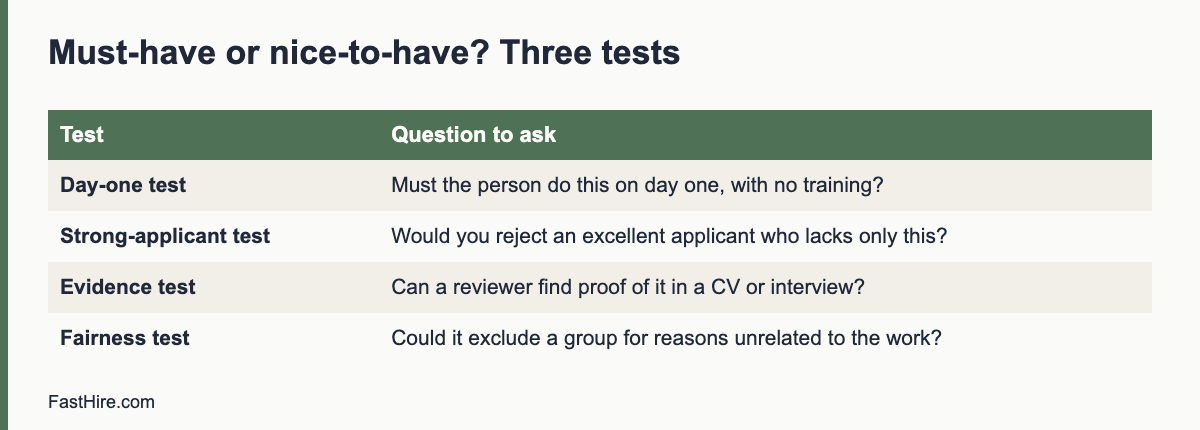
- Apply the day-one test. For each line ask: must the person do this on their first day, without training? If the answer is “they could learn it in three months”, move it to nice-to-have or to the onboarding plan.
- Apply the strong-applicant test. Imagine an excellent applicant who lacks only this item. Would you still decline them? If not, it is not a must-have.
- Apply the evidence test. Write what a reviewer would see in a CV or hear in an interview as proof. If you cannot write it, rewrite the item or drop it.
- Apply the fairness test. Ask whether the item could exclude people because of age, sex, race, religion, disability, family status or nationality, without being needed for the work. Examples of risky items: “recent graduate”, “native speaker”, “no career gaps”. Replace each with a precise skill or task.
- Count. If more than five must-haves remain, vote on the three that matter most and move the rest down.
Save the final list in the role brief and share it with everyone who will review applications.
A fictional example: operations coordinator
This example is invented to show the method. A manager lists eight requirements for an operations coordinator. After the exercise, the list changes as shown.
| Original requirement | Result | Reason |
|---|---|---|
| Degree in business | Dropped | Strong applicants without a degree could do the job; the work needs skills, not the qualification |
| Five years in operations | Rewritten as must-have: “has coordinated schedules or orders for a team, paid or unpaid” | Checks the task, allows different routes |
| Excel expert | Rewritten as must-have: “builds and checks spreadsheets for tracking work” | Describes the task and leaves out vague “expert” |
| Knows our order system | Nice-to-have | Can be learned in the first month |
| Excellent communicator | Rewritten as must-have: “writes clear emails to customers or suppliers” | Observable in a task or CV example |
| Young, energetic team player | Dropped | “Young” signals age; “energetic” is not measurable; teamwork is tested in interviews |
| Own transport | Dropped | Not needed for the work; may exclude people unfairly |
| Fluent in a second language | Nice-to-have | Helpful but not essential |
The final list has three must-haves, each with a way to check it, and two nice-to-haves. The pool grows, and each reviewer knows what to look for.
How must-haves connect to evidence in a CV
A must-have is only useful if you can see it. After you write the list, add an “evidence” column that says what counts. For “writes clear emails to customers or suppliers”, evidence could be a job task that includes customer email, a link to a writing sample, or a description of a project that required written replies. What does not count alone: the phrase “excellent communicator”. Our guide on screening resumes against must-haves with evidence shows how to record a yes, no or unclear mark for each applicant with the CV passage behind it. If a CV does not show a must-have clearly, mark it unclear and ask the same short question of every applicant in that position, instead of rejecting them.
Using nice-to-haves well
- Use them to choose between candidates who all meet the must-haves, never to remove people from the pile.
- Limit them to three to five. More than that creates noise.
- Weigh them in the final decision, not in the first screening.
- Say which ones can be learned. A candidate without a nice-to-have but with strong must-haves may become a strong hire with training.
- Avoid hidden must-haves. If a nice-to-have decides every outcome, it is a must-have and belongs on the list, with a test.
Keep the list stable
Changing requirements after you have read some CVs is a common source of unfairness. People tend to change the list to fit the candidates they like. If a change is needed, write down what changed and why, apply it to everyone, including applicants you already declined, and tell the recruiter. See our guide on how to write checkable job requirements for more on wording.
The official sources on equal treatment give the baseline for fairness. In the US, see the Equal Employment Opportunity Commission page on prohibited employment policies and practices. In Great Britain, see Acas on recruitment. In the EU, see the Employment Equality Directive and your national law.
FastHire is being built around this split. It shows each job requirement next to the exact CV passage that supports it, so you can see which must-haves a CV shows and which are unclear. FastHire is coming soon. It does not rank, score or reject candidates. People make every decision.
Frequently asked questions
How many must-haves should a role have?
Three to five is a good range. A longer list shrinks the pool and often contains items that could be learned.
Is a degree ever a must-have?
Yes, when the law or a regulator requires a qualification, such as for a licensed profession. In other cases, ask whether the skills can be shown in other ways.
What if I get too few applicants who meet all must-haves?
Check whether each must-have passes the day-one test. Move items that can be learned to nice-to-have, and review the advert and pay range.
Can I use keyword filters for must-haves?
Be careful. Keyword filters can miss people who use different words. Use them to find passages, and have a person read before anyone is declined.
Should candidates see the must-haves?
Yes. Put them in the advert in plain words. Candidates can then judge their own fit before they apply.
Related guides
- Hiring guides for hiring managers
- How to write checkable job requirements
- How to write a role brief
- How to screen resumes against must-haves with evidence
- All hiring guides for employers
- What to look for on a resume or CV: a manager guide
This is general information, not legal advice.