

A role brief is a one-page document that says why the role exists, what the person must achieve, what they must be able to do and what the job offers. Write it before you open the vacancy, agree it with the people who will work with the new hire, and use it for the ad, the screen, the interviews and the first 90 days. It takes one to two hours and saves weeks.
Key takeaways
- Start with outcomes, not duties or a copied job description.
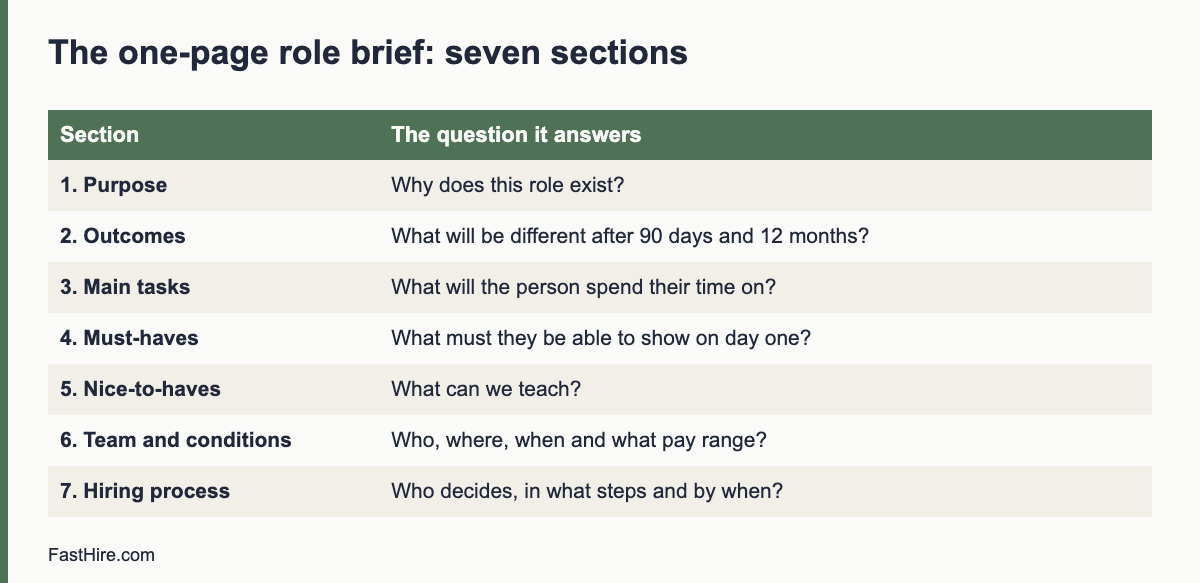
- Use seven sections: purpose, outcomes, tasks, must-haves, nice-to-haves, team and conditions, and the hiring process.
- Keep must-haves to three to five items that a person can check from a resume or CV.
- Agree the brief with your recruiter, your manager and the main colleagues before you advertise.
- Review the brief against five tests before you publish it, and change it only with a written reason.
Why define the role first
Most hiring managers start with an old job description or a list of tasks they want to hand over. The result is a long list that describes the last person, not the next one. Candidates see a vague ad. Recruiters guess. Interviewers ask different questions because nobody agreed what good looks like. The hire may be a fine person who does not do what you needed.
A brief fixes this by forcing three choices early: what changes if this person succeeds, what they need to be able to do on day one and what you can teach. These choices shape every later step. If you skip them, you will make them anyway, but under time pressure and without the people who should have a say.
The seven sections of a one-page role brief
| Section | The question it answers | Example |
|---|---|---|
| 1. Purpose | Why does this role exist? | Keep our five customer teams supplied with accurate weekly reports |
| 2. Outcomes (90 days and 12 months) | What will be different if this person succeeds? | In 90 days: weekly reports sent on time with fewer than two corrections a month |
| 3. Main tasks | What will they spend their time on? | Pull data, check it, write the summary, answer questions from team leads |
| 4. Must-haves | What must they be able to show on day one? | 2 years of reporting work in any setting; advanced spreadsheet skills; clear writing |
| 5. Nice-to-haves and teachable skills | What can they learn here? | Our reporting tool; our sector terms |
| 6. Team and conditions | Who do they work with, where and when? What is the pay range? | Reports to Head of Operations; hybrid; salary range [range] |
| 7. Hiring process | Who decides and by when? | Two interviews, one work sample, decision within 3 working days of the last interview |
Section 1: Purpose
Write one sentence. Use the form “This role exists so that [who] can [do what].” If you need two sentences, the role may be two roles. A clear purpose helps when you have to trade off: which skill matters more, and which duty can stay with someone else?
Section 2: Outcomes
List three to five results you expect in the first 90 days and in the first 12 months. Write them as things you could see or measure: “closes the monthly accounts by the fifth working day”, not “improves finance processes”. Outcomes tell you what to ask in the interview and how to judge the first months.
Section 3: Main tasks
List the regular work, in order of time spent. Five to eight lines is enough. Mark the one or two tasks that are hardest or most important. Tasks are useful for the ad and the onboarding plan, but they should not drive the must-haves. Many tasks can be learned.
Section 4: Must-haves
This is the most important section. A must-have is something a person must already be able to do, because you cannot or will not train it in the first weeks, and because you will reject a candidate who lacks it. Write each one so that a stranger can check it in a resume or CV. For more detail, see Must-haves vs nice-to-haves: cutting your applicant pile without unfair filters and How to write job requirements candidates can actually check themselves against.
A quick test: for each must-have, ask “Would I really turn down an otherwise excellent candidate who lacks this?” If the answer is “probably not”, move it to nice-to-have.
Section 5: Nice-to-haves and teachable skills
List what is helpful but not essential. Add a short note on what you will teach. This makes it clear to candidates and recruiters that missing items are fine, and it reminds you to plan the training.
Section 6: Team and conditions
Name the manager, the main colleagues, the location, the hours and the pay range. If the pay is not agreed, agree it now. Without a range you cannot write an honest ad, and you risk a late-stage surprise. Some places require pay information in job ads or on request, so check the rules where the person will work.
Section 7: Hiring process
Say who will screen, who will interview and who decides. List the steps and the time each takes. Agree how quickly interviewers must give feedback. A process that is clear to you and the recruiter keeps candidates moving. We cover feedback speed in how to give fast interview feedback.
A worked example
This example is fictional and is only meant to show the level of detail.
Role brief: Operations Reporting Analyst
Purpose: This role exists so that our five customer teams can plan each week with accurate numbers.
Outcomes. In 90 days: weekly reports go out every Monday by 10:00 with no more than two corrections a month; the team leads confirm they use them in their planning meetings. In 12 months: the person has replaced two manual reports with a shared dashboard and trained team leads to read it.
Main tasks (most time first): pull and check data from three systems; write the weekly summary; answer team questions; maintain the dashboard; document report definitions.
Must-haves: at least two years of reporting or analysis work, paid or unpaid; advanced spreadsheet skills, shown by an example; clear written English; can work with a team lead to define a report.
Nice-to-haves (we will teach): our reporting tool; our sector terms; basic SQL.
Team and conditions: reports to the Head of Operations; works with five team leads; three days in the office, two from home; salary range [range].
Process: screen by the recruiter and the manager; 45-minute interview with two interviewers; one 45-minute work sample; decision within three working days of the last interview.
Notice what the brief leaves out: a degree requirement, “strong communication skills” and “team player”. If the role truly needs a qualification, say which and why. If it only needs the skill, test for the skill.
How to build the brief with your team in 90 minutes
- Before the meeting (20 minutes). Write a draft of sections 1 and 2. Send it to the recruiter and to two people who work closely with the role.
- Meeting, part one (30 minutes). Review purpose and outcomes. Ask: “If we hired the perfect person, what would you see after three months?” Rewrite until everyone agrees.
- Meeting, part two (30 minutes). List tasks, then pick must-haves. Challenge each one with the “would I turn down an excellent candidate?” test.
- After the meeting (10 minutes). Fill in sections 6 and 7. Send the final one-page brief to everyone. Ask for objections within one working day.
If you work with a recruiter, use the brief as the agenda for your first meeting. Our guide on how to run a kickoff meeting with your recruiter shows how.
Five tests before you publish
| Test | Pass if |
|---|---|
| Clarity | A person outside the team can say what the new hire will do after reading the brief |
| Checkability | Every must-have can be confirmed from a resume or CV or a short, job-related test |
| Fairness | No must-have excludes people for reasons unrelated to the job, such as age, a specific school or a native language |
| Realism | The pay range, the outcomes and the must-haves fit the market, and the person can reach the outcomes in the time given |
| Agreement | The manager, the recruiter and the main colleagues all agree and have said so in writing |
On fairness: use job-related criteria and apply them to everyone. The US Equal Employment Opportunity Commission lists protected traits and practices to avoid on its page about prohibited employment policies and practices. In Great Britain, the Acas page on recruitment explains how the Equality Act applies to hiring decisions. In the EU, equal treatment rules are set in EU and national law, so check the country where you hire.
Common traps
- Copying the last job description. It lists tasks the previous person did, including tasks that no longer matter.
- Title inflation. A senior title with a junior brief attracts the wrong people and creates pay problems later.
- Solution first. “We need a data scientist” may hide the real need, which could be better reports. Define the outcome and then choose the role.
- Everything is a must-have. A list of twelve must-haves describes a person who does not exist.
- Moving the target. If you add a new must-have after interviews begin, you risk treating candidates unequally.
How to use the brief in the rest of the process
Treat the brief as the source for everything else. The ad takes its purpose, tasks, must-haves and pay from sections 1, 3, 4 and 6. The screen uses section 4. The interview questions come from section 2 and section 4. The scorecard uses the must-haves as its rows. The 30-60-90 day plan is section 2 with dates. If a new fact appears, update the brief first and tell everyone.
FastHire is being built around this chain. It shows each job requirement next to the exact CV passage that supports it, and candidates check their fit before applying. FastHire is coming soon. It does not rank, score or reject candidates. People make every decision. A clear brief makes that evidence much easier to read.
Questions that sharpen a weak brief
If your draft feels vague, ask the people closest to the role these ten questions. Write the answers in the brief.
- What is the one thing that goes wrong today because this role is empty?
- Who will rely on the new hire, and what do they need first?
- What would a very good first month look like? What would a poor one look like?
- Which task is the hardest, and what makes it hard?
- Which skills can we teach in four weeks, and which can we not?
- What did the last person do well that we must keep?
- What did we wish they had done differently?
- Who will the person work with most, and how do those people prefer to work?
- What is the lowest and highest pay we can offer, and what is the reason for the gap?
- What will make us say “yes” or “no” at the end of the process, and who will decide?
Collect the answers in a shared document and ask people to comment before the meeting. Disagreement is useful here. It shows what you must settle before candidates arrive. If two senior colleagues give different answers to question one, the role is not ready to advertise.
Turning the brief into an ad in 15 minutes
Copy the purpose into the opening lines. Turn the main tasks into five to seven bullet points. Copy the must-haves as they stand. Add the nice-to-haves with the words “you can still apply without these”. Paste the conditions and the pay range, then list the process steps and dates. Remove internal terms that candidates will not know. Our guide to writing a job ad has a full template and a before-and-after example.
Frequently asked questions
How long should a role brief be?
One page. If it runs longer, the role is probably too broad or the brief contains detail that belongs in the ad or the onboarding plan.
Is a role brief the same as a job description?
No. A job description often lists duties and formal requirements for HR files. A role brief focuses on outcomes, must-haves and the hiring process, and is meant to guide decisions.
Who should approve the brief?
The hiring manager, the recruiter or HR partner, and the person who owns the budget. Ask the main colleagues for comments before you finalise it.
Can I change the brief after interviews start?
Only for a good reason, and write the reason down. Changing requirements midway makes it hard to compare candidates fairly. If you must change it, tell everyone and apply the change to all candidates.
Do I share the brief with candidates?
Share the parts that help candidates decide: purpose, outcomes, tasks, must-haves, conditions and process. Keep internal notes, such as budget limits beyond the range, private.
Related guides
- Hiring guides for hiring managers
- Must-haves vs nice-to-haves: cutting your applicant pile without unfair filters
- How to write job requirements candidates can actually check themselves against
- How to write a job ad that attracts the right applicants
- All hiring guides for employers
- How to run a kickoff meeting with your recruiter
- Structured interviews: what they are and how to run one
- Interview scorecard template with a worked example
- How to source candidates: ten channels and when to use each
- How to write a job description for a role that does not exist yet
- How to write a good interview plan for a new role
- How to hire your replacement when a team member leaves
- How to run an intake meeting with a hiring manager
- How to decide whether to promote internally or hire externally
- How to build a headcount business case
This is general information, not legal advice.