
A recruiter kickoff meeting is a 45 to 60 minute conversation where you and your recruiter agree what the role is, what good looks like, who does what and how fast each step must be. Bring a one-page role brief, agree the must-haves, review three sample profiles together, set response times for both sides and end with a written summary. This meeting is the best chance to save weeks later.
Key takeaways
- Bring a written role brief. Do not start from a blank page in the meeting.
- Agree must-haves, nice-to-haves and pay range, and write them down.
- Review three sample profiles to calibrate: one clear yes, one clear no, one maybe.
- Set response times for both of you, such as feedback on shortlists within one working day.
- Send a written summary within 24 hours and ask the recruiter to confirm it.
Why the kickoff matters
Recruiters work with what you tell them. If the brief is thin, they fill the gaps with guesses, and you spend the next weeks correcting profiles that miss the mark. A good kickoff turns a few vague wishes into a shared definition of success. It also builds a working relationship: the recruiter learns how you decide, and you learn how they work.
The meeting matters whether your recruiter is internal, an agency partner or an HR generalist who also runs hiring. The structure is the same. If you have never written a brief, start with our guide to the one-page role brief.
Before the meeting: what to prepare
- A one-page role brief. Purpose, 90-day outcomes, tasks, must-haves, nice-to-haves, conditions and process.
- Pay range and approval. Confirm the range is approved. A recruiter cannot sell a role with a pay range that may change.
- Three sample profiles. Choose real or anonymised resumes or CVs: one you would hire, one you would reject and one you are unsure about. If you have none, write three short imaginary profiles.
- Your calendar. Block interview slots for the next two weeks, so that you can promise speed.
- The interview panel. Know who will interview and who will decide.
Send the brief and the samples one working day before the meeting, so that the recruiter can come with questions.
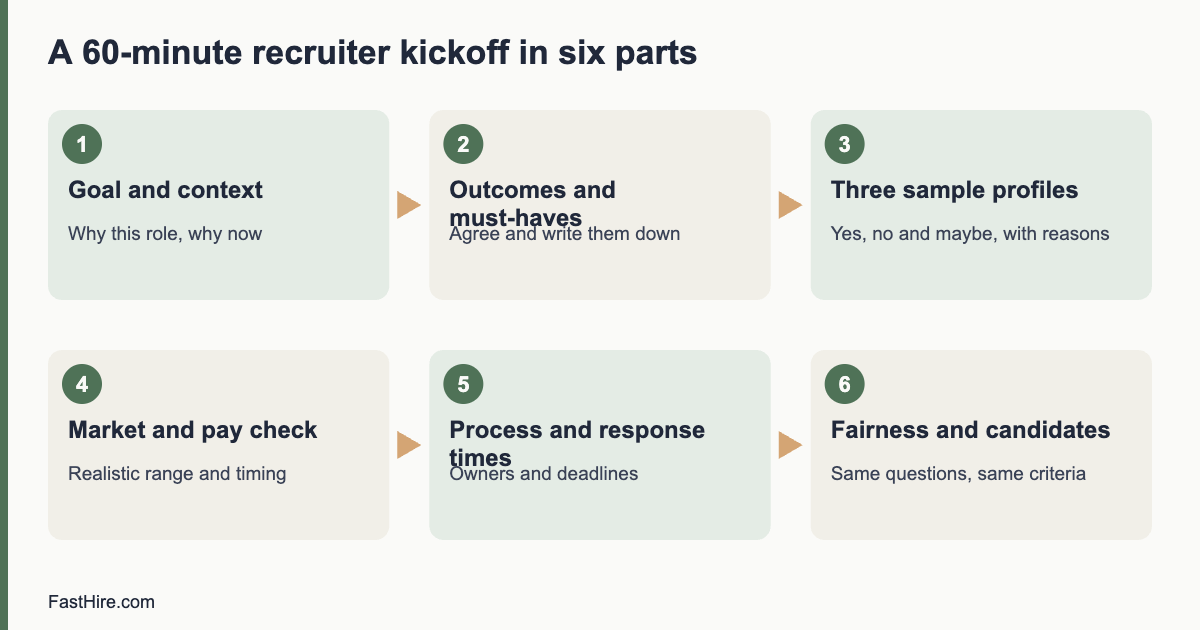
A 60-minute agenda
| Time | Topic | Output |
|---|---|---|
| 0 to 5 min | Goal and context: why this role, why now | Shared purpose |
| 5 to 20 min | Walk through outcomes, tasks and must-haves | Agreed must-haves and nice-to-haves |
| 20 to 30 min | Review three sample profiles | Calibrated view of yes, no and maybe |
| 30 to 40 min | Market and pay check | Realistic range and time estimate |
| 40 to 50 min | Process, roles and response times | Named owners and deadlines |
| 50 to 60 min | Candidate experience and fairness | Agreed message to candidates and how you will avoid bias |
The 15 questions to answer in the meeting
- Why does this role exist now, and what happens if it stays empty for two months?
- What are the three to five outcomes for the first 90 days?
- What are the must-haves? How will we check each one from a resume or CV or a short test?
- What is on the nice-to-have list, and what will you teach?
- What are the pay range, the benefits and the location rules? Which of these can move?
- Who is on the interview panel, and what will each person assess?
- How many interview rounds will there be, and how long will each last?
- Is there a work sample? How long is it, and will candidates be paid for long tasks?
- How fast will you give feedback on each shortlist? What is the recruiter’s promise to candidates?
- Which channels will the recruiter use? Is there a referral or an internal candidate?
- What is the realistic number of candidates you want to interview?
- What is the target date for the offer and for the start?
- What message do we send to candidates who are not selected?
- How will we monitor fairness, for example by using the same questions and the same criteria?
- What will we do if the first two weeks produce no good candidates?
Calibrating with three sample profiles
Calibration is the most underused part of a kickoff. Show the recruiter three profiles and say what you would do with each, and why. The reasons matter more than the verdicts. Use the must-haves as your language.
| Profile | Your decision | Reason to give the recruiter |
|---|---|---|
| A: Two years of reporting work in a shop, strong spreadsheet example | Yes | Meets all four must-haves with evidence |
| B: Recent degree, no work experience, no examples of reporting | No | Does not show the work-experience must-have. Please do not send profiles like this |
| C: One year of reporting plus volunteer finance work, strong writing sample | Maybe, send | Experience is short, but volunteer work counts. Include if other must-haves are met |
Be careful to base each reason on the job. Do not say “he feels senior” or “she looks like a good fit”. If you notice yourself giving vague reasons, return to the brief and turn the reason into a must-have or drop it. This habit also helps avoid unfair filters. The US Equal Employment Opportunity Commission lists practices to avoid on its page about prohibited employment policies and practices.
Agree who does what
| Task | You (hiring manager) | Recruiter | Other |
|---|---|---|---|
| Role brief and must-haves | Own | Challenge and advise | HR approves |
| Job ad | Review and approve | Write and publish | Brand or comms review |
| Sourcing and screening | Review shortlists | Own | Use agreed must-haves |
| Interviews | Own | Schedule and prepare candidates | Panel members |
| Feedback to candidates | Give feedback to the recruiter within one working day | Deliver to candidates | HR checks wording |
| Offer | Decide | Prepare and make the offer | HR and finance approve |
Write the response times next to each step. A small number of agreements, such as “shortlist feedback within one working day” and “candidate updates every five working days”, often matter more than any tool.
Fairness and data points to agree
Say out loud how you will keep the process fair. Agree that every candidate gets the same questions and the same scoring scale, that notes are factual, and that nobody asks about protected characteristics. The Acas page on recruitment explains how discrimination law applies to hiring in Great Britain.
Also agree how candidate data will be handled. If your recruiter is an agency or consultant, ask who is responsible for the data, where it is stored, who can see it and when it will be deleted. In the UK, the Information Commissioner’s Office explains the responsibilities of employers and recruiters in its guidance on recruitment and selection.
The written summary: a template
Subject: Kickoff summary for [role]
Hello [recruiter name],
Thank you for the meeting today. Here is what we agreed.
Purpose and outcomes: [two lines].
Must-haves: [list]. Nice-to-haves: [list].
Pay range and conditions: [range, location, hours].
Process: [steps, panel, timings]. Offer target date: [date].
Sample profiles: A yes, B no, C maybe, for the reasons we discussed.
Response times: shortlist feedback within [one working day]; candidate updates every [five working days].
Open items: [list with owner and date].
Please confirm or correct by [date].
[Your name]
After the kickoff: the first two weeks
- Day 1: receive the written confirmation and the job ad draft. Reply within a working day.
- Day 3 to 5: review the first shortlist. Give feedback in writing, linked to the must-haves, so that the recruiter can adjust.
- Day 7: check progress. If you have fewer candidates than expected, review the brief together. Adjust the sourcing, the pay range or the must-haves, and record why.
- Day 10 to 14: hold the first interviews. Share notes with the recruiter in the format you agreed.
Common kickoff mistakes
- Treating the recruiter as an order taker. Ask them to challenge your brief and to bring market data.
- Leaving the pay range open. It slows the process and harms trust with candidates.
- Listing ten must-haves. The recruiter will read this as “send nothing” or “send everyone”.
- Not blocking interview times. Candidates lose interest in a long gap.
- Giving verbal feedback only. Written feedback is easier to act on and to audit later.
FastHire is being built to help with the evidence that sits behind a shortlist. It shows each job requirement next to the exact CV passage that supports it, so a hiring manager and a recruiter can look at the same evidence. FastHire is coming soon. It does not rank, score or reject candidates. People make every decision.
Adapting the kickoff to your situation
| Situation | What to add to the standard agenda |
|---|---|
| Internal recruiter | Agree how this role ranks against other open roles, and how many hours per week the recruiter can give it. Capacity is the usual hidden constraint. |
| External agency | Agree fees, the guarantee period, exclusivity, how candidates are presented and who owns candidate data. Put the terms in writing before work starts. |
| Urgent hire | Cut the must-haves to the minimum, agree a one-week interview window and decide in advance who can approve an offer. Do not skip the written brief. |
| Hard-to-fill role | Add a market check: how many people have these skills, where they work and what they earn. Agree what you can change if the first two weeks fail, such as pay, location, or the balance of must-haves. |
| Many similar roles | Agree one shared scorecard and one screening method, so that every hiring manager judges candidates the same way. Meet weekly to compare notes. |
| Internal move possible | Agree how internal candidates will be considered, and make sure they go through the same assessment as external ones. |
Weak and strong kickoffs: a short comparison
This comparison is illustrative. It shows how two different kickoffs for the same role can lead to different results.
In the weak kickoff, the manager joins the call for 15 minutes, says “we need someone strong in reporting, ideally with a finance background, quick to start”, and sends last year’s job description. The recruiter sends twelve profiles in a week. The manager rejects eleven with comments such as “not senior enough” and “not quite right”. Nobody can say what the comments mean. The recruiter guesses again. Three weeks pass with no interviews.
In the strong kickoff, the manager sends a one-page brief a day early. The meeting reviews three sample profiles with written reasons: yes because the CV shows two years of reporting work, no because there is no work experience, maybe because the experience is short but the volunteer work counts. The recruiter sends five profiles in three days. The manager replies with a yes or no and one reason per profile, linked to a must-have, the same day. Interviews start in week two. The recruiter can adjust because the feedback is specific.
The difference is not effort, but information. A kickoff turns your preferences into criteria that another person can apply without you.
Frequently asked questions
How long should a recruiter kickoff meeting be?
Aim for 45 to 60 minutes. If you have a written brief and sample profiles, 45 minutes is usually enough.
Who should attend?
The hiring manager and the recruiter at least. For senior roles or unclear roles, add the HR partner and one senior colleague who works closely with the role.
What if I do not have a role brief?
Use the meeting to write one, but plan for 90 minutes and a follow-up. A shorter option is to write sections one to four before the meeting.
How many sample profiles do I need?
Three is enough: one yes, one no and one maybe. Each should come with a reason linked to the must-haves.
What response times are realistic?
Many teams agree on feedback within one working day for shortlists and candidate updates every five working days. Pick times you can meet and put them in writing.
Related guides
- Hiring guides for hiring managers
- How to define a role before you hire: a one-page role brief
- Must-haves vs nice-to-haves: cutting your applicant pile without unfair filters
- How to write a job ad that attracts the right applicants
- All hiring guides for employers
- Structured interviews: what they are and how to run one
- Interview scorecard template with a worked example
- How to source candidates: ten channels and when to use each
- How to run a debrief meeting after interviews
- How to give fast interview feedback without cutting corners
- How to run an intake meeting with a hiring manager
- How to push back on unrealistic hiring manager requests
- How to work with HR on a hiring plan
- How to build a headcount business case
- How to close a candidate: an honest offer conversation
This is general information, not legal advice.