
Sourcing means finding people who could do the job and inviting them to apply, before or alongside advertising. The most reliable method is to define the profile from the role brief, choose three or four channels that fit that profile, contact people with a short honest message, track where every candidate comes from and drop channels that do not produce. This guide covers ten channels and when each one works.
Key takeaways
- Start with a clear profile based on the must-haves in the role brief, not on job titles alone.
- Use three or four channels at a time. Ten channels in parallel create noise and double work.
- Contact people with a short, honest message and a clear next step.
- Treat personal data with care: tell people where you found them and why you are contacting them.
- Record the source of every candidate and review the numbers every two weeks.
What sourcing is, and when you need it
Advertising waits for candidates to find you. Sourcing goes to find them. You need it when a role is hard to fill, when the people you want are not looking, when a market is tight, or when your usual channels bring too few or too similar candidates. Sourcing also helps when you want a wider mix of candidates and your ad alone does not reach them.
Sourcing is not a separate magic skill. It is a repeatable process: define, search, contact, track and review. You can do it with a spreadsheet and a few free channels. Before you start, make sure the role is defined. Our guides to the role brief and the recruiter kickoff meeting show how.
Step 1: Define the profile
Write the profile in terms of what a person can do and has done, not job titles alone. Titles differ widely between companies, and some capable people have never held the title you list. For each of the three to five must-haves, add two or three ways it might appear in a profile.
| Must-have | Ways it might appear in a profile |
|---|---|
| Two years of warehouse planning | “Stock controller”, “inventory planner”, “stock room lead”, volunteer stock management |
| Uses a warehouse system | Names of systems, “WMS”, “barcode scanning”, or training in a similar tool |
| Leads a small team | “Shift lead”, “supervisor”, “trainer”, or running a group of volunteers |
This list becomes your search terms and your checklist for judging profiles later. It also reminds you that skills can come from different paths, which helps fairness.
Step 2: Choose the channels
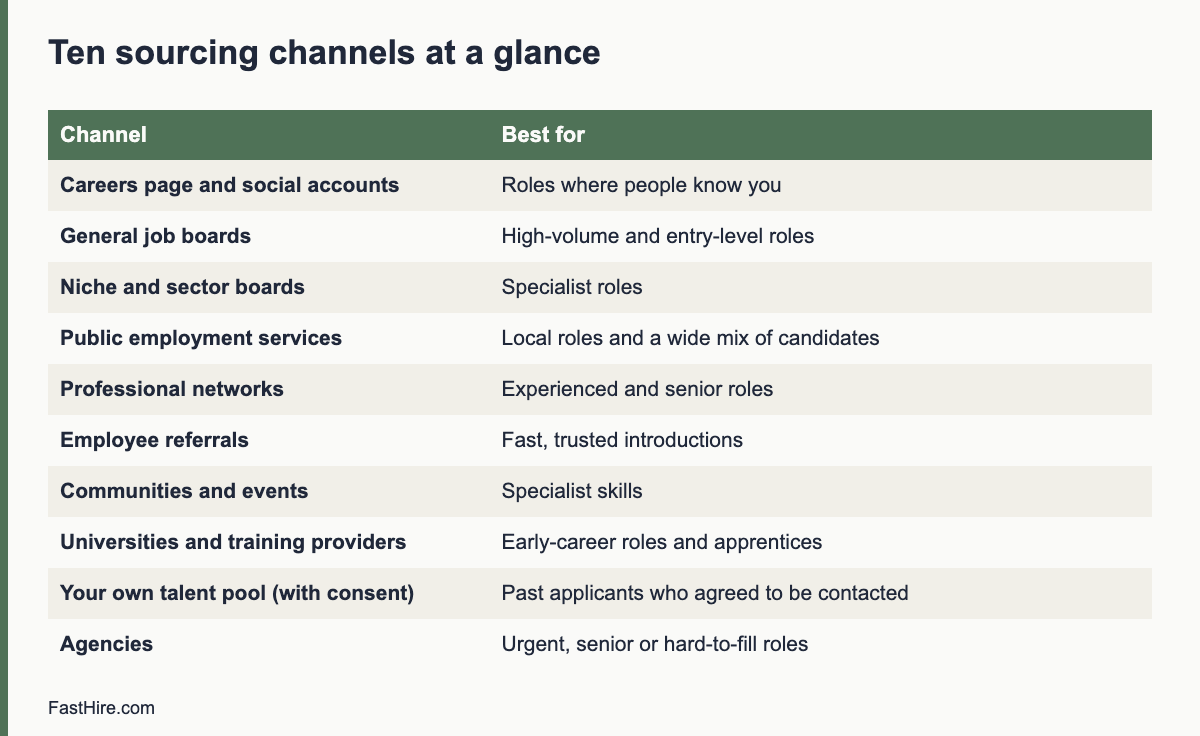
Here are ten channels. Pick the ones that match where your candidates are, the time you have and the budget.
| Channel | Best for | Main limit |
|---|---|---|
| 1. Your own careers page and social accounts | Roles where people already know you | Small reach if your brand is unknown |
| 2. General job boards | High-volume roles, entry-level roles | Many unsuitable applications |
| 3. Niche or sector boards | Specialist roles | Cost and smaller audience |
| 4. Public employment services | Local roles, wide mix of candidates. In the UK, the Find a job service; in the EU, EURES | Coverage varies by country |
| 5. Professional networks | Experienced and senior roles | Needs personal outreach; response rates vary |
| 6. Employee referrals | Fast, trusted introductions | Can repeat the profile of your current team |
| 7. Communities and events | Specialist skills; meetups, forums, alumni groups | Slow to build, needs a real presence |
| 8. Universities and training providers | Early-career roles and apprentices | Seasonal timing |
| 9. Your own talent pool | Past applicants who said yes to being contacted | Must respect consent and retention rules |
| 10. Agencies | Urgent, senior or hard-to-fill roles | Fees; you give up some control of the process |
You do not need all ten. For a customer service role, two job boards, your careers page and referrals may be enough. For a rare engineer, you may add a niche board, two communities and direct outreach.
Step 3: Search and shortlist profiles
When you search networks or databases, use the variations from your profile table, and record the search terms you used. This helps you repeat what works and explain later how you found people. For advanced search syntax, see our guide to Boolean search for recruiters.
Compare each profile against the must-haves only. Write one line of evidence for each yes, as in a normal screen. Do not rank people by how polished their profile looks. People write profiles for different reasons, and many strong candidates keep them short.
Step 4: Contact people with respect
A good message is short. It says who you are, why you are writing to this person, what the role is and what you want them to do next. It tells them where you found their details and makes it easy to say no. For more, see our guide to writing outreach messages that candidates reply to.
Subject: Warehouse planning role at [company]
Hello [name],
I found your profile on [source]. You have worked on stock planning at [company], which is close to what we need for a Warehouse Planner role in [city]. Pay range: [range]. Hybrid, four days on site.
If you would like to hear more, reply with a good time for a 15-minute call. If not, no problem. I will not contact you again unless you ask.
[Your name, company and a way to verify who you are]
Keep personal data lawful
When you find people yourself, you hold personal data about them. In the UK and the EU, data protection law applies, and you should tell people where you obtained their details, why you hold them and how long you will keep them. Use only the data you need, and delete it when you no longer need it. The UK Information Commissioner’s Office explains the duties of employers and recruiters in its guidance on recruitment and selection. In the US, there is no single national law on this, but state privacy laws and platform rules may apply, so check them for the places where you recruit.
Platform terms matter too. Many networks restrict automated collection or mass messaging. Read the rules before you use any tool that copies data.
Fair sourcing
Sourcing can widen your pool or narrow it. If you search only in the same networks or ask only your own team for referrals, you may keep meeting the same kind of people. Add channels that reach different groups. Describe the role in neutral language. Contact people based on skills, not on names, photos or other traits that point to protected characteristics. The US Equal Employment Opportunity Commission lists protected traits and practices to avoid on its page about prohibited employment policies and practices. In Great Britain, the Acas page on recruitment explains how discrimination law applies to hiring.
A two-week sourcing sprint
| Day | What to do |
|---|---|
| Day 1 | Confirm the profile and the search terms with the hiring manager. Agree the channels. |
| Days 2 and 3 | Search and shortlist 30 to 50 profiles against the must-haves. Record the evidence. |
| Day 4 | Send the first 20 messages. Use one template and personalise one line. |
| Day 7 | Send one follow-up to people who did not reply. Do not send more than one. |
| Days 8 to 10 | Hold short calls with interested people. Share two to four strong profiles with the hiring manager. |
| Day 14 | Review: how many contacted, how many replied, how many passed the must-haves and which channel produced them. Change the plan. |
What to measure
Track four numbers per channel: contacts or applications, replies or qualified applicants, interviews and offers. Divide each stage by the one before it. This shows where a channel is weak: low replies mean the message or targeting is off, low qualification means the profile or the ad is unclear. Review every two weeks and drop channels that give nothing.
Common sourcing mistakes
- Searching for job titles only and missing capable people with other titles.
- Sending the same long message to hundreds of people. Short and personal gets more replies and builds a better name for your employer.
- Contacting people repeatedly after they say no.
- Keeping candidate data in private spreadsheets without a deletion date.
- Letting the hiring manager skip the brief and say “send more profiles”. Calibrate first.
FastHire is being built for the step after sourcing, when you have a pile of profiles or applications. It shows each job requirement next to the exact CV passage that supports it, so that people can check the evidence quickly. FastHire is coming soon. It does not rank, score or reject candidates. People make every decision.
A sourcing tracker you can copy
One simple sheet is enough. Add one row per person you contact or who applies.
| Column | What to record |
|---|---|
| Name and contact | As the person gave it or as it appears in the public profile |
| Source and date found | Channel, link and the date you found the profile |
| Basis for contact | Why you contacted this person, for example “stock planning at a retailer, matches must-have 1” |
| Must-haves | Yes, no or unclear for each, with one line of evidence |
| Message sent and reply | Date of first message, follow-up, reply and the outcome |
| Consent and retention | What you told the person, and the date you will delete the record |
| Stage | Contacted, replied, call, shortlisted, interview, offer, closed |
Sourcing in three common situations
| Situation | What works | What to watch |
|---|---|---|
| Senior or specialist role, few candidates | Direct outreach, referrals and communities. A personal note that shows you read the profile. Offer a short, low-pressure call. | Do not overstate the role or the pay. Be clear about the process and the timeline. |
| High-volume role, many candidates needed | Job boards, public employment services and a short application. Screen in batches against must-haves. | A long application loses people. Keep the first step to a few minutes. |
| Early-career role | Universities, training providers and community groups. Describe what you will teach. | Do not require experience that only some people can get, such as unpaid internships. |
A worked example: warehouse planner
This example is fictional. A regional distributor needs a warehouse planner. The hiring manager and the recruiter use the profile table above. They choose four channels: the company careers page, one logistics job board, the local public employment service and employee referrals. They ask the team for referrals with a short message that explains the must-haves and says that referred people go through the same process as everyone else.
In week one, the recruiter finds 40 profiles and contacts 20 of them. Eight reply and six agree to a call. Applications arrive from the careers page and the public employment service. The recruiter reviews all of them against the same four must-haves, writes one line of evidence for each yes and sends the hiring manager five strong candidates. The numbers in this example are invented to show the flow. They are not benchmarks.
At the two-week review, the recruiter sees that the job board produced many applications but few that met the must-haves, while referrals and the public service produced fewer but better matches. The recruiter keeps the two stronger channels, adds one community, and pauses the board. The process improved because every candidate had a recorded source and the same screen.
Frequently asked questions
What is the difference between sourcing and recruiting?
Recruiting is the whole process from role definition to offer. Sourcing is the part that finds and contacts potential candidates, often people who are not actively applying.
How many sourcing channels should I use?
Use three or four at a time and review them every two weeks. Drop those that give nothing and test a new one.
Is it legal to contact people I find online?
It can be, but data protection rules apply, especially in the UK and the EU. Tell people where you found their details, why you are contacting them and how they can object. Check platform rules too.
How do I find candidates who are not looking?
Use professional networks, communities and referrals, and write a short message that explains why you contacted them and what is in it for them. Respect a no.
How do I avoid sourcing only people like my current team?
Add channels that reach different groups, use skill-based search terms and apply the same must-haves to every profile.
Related guides
- Hiring guides for recruiters and HR teams
- How to define a role before you hire: a one-page role brief
- How to run a kickoff meeting with your recruiter
- How to write a job ad that attracts the right applicants
- All hiring guides for employers
- Boolean search for recruiters: examples you can copy
- How to write outreach messages candidates reply to
- Screening at volume: a process for 500 applications
- Time-to-hire vs time-to-fill: definitions and how to measure
- How to run an inclusive sourcing process
- How to work with agencies: a briefing and fee checklist
This is general information, not legal advice.