

Inclusive sourcing means finding candidates from a wider range of places and backgrounds, then judging them all by the same job-related criteria. You can lawfully widen outreach, use more channels, remove barriers and welcome applications from under-represented groups. You cannot lawfully pick people on a protected trait in most places. This guide shows what to do and how to measure it.
Key takeaways
- Widen the pool, then judge everyone by the same criteria. Outreach can be broad; selection must be fair.
- Define the role by skills and outcomes, not by background or pedigree.
- Use more channels: open boards, community organisations, colleges, employment services, returners programmes and referrals with rules.
- Write outreach and ads in plain, open language that avoids signals of age, sex, race or other traits.
- Measure each stage by group where the law allows, and fix the stage with the gap.
What inclusive sourcing is, and what it is not
Inclusive sourcing is about reach. It asks: who can see our job, who feels able to apply, and who do we never reach? It does not mean lowering standards or picking someone because of a trait. In most places, selection that favours or excludes a person because of race, sex, age, religion, disability or other protected traits is unlawful. Outreach that welcomes more people to apply is lawful and good practice.
The law differs by country. In the US, Title VII and other laws prohibit discrimination in hiring, and the EEOC explains the rules. In the UK, the Equality Act allows limited positive action in some cases, such as encouraging applications from under-represented groups or choosing between equally qualified candidates, but it does not allow quotas or automatic preference; check GOV.UK employing people and take advice. In the EU, equal treatment directives apply through national law, with some positive action allowed. See our EU equal treatment guide.
| Usually lawful | Usually unlawful or risky |
|---|---|
| Advertising widely, including in communities that are under-represented | Stating that only people of one sex, race or age may apply, without a lawful exception |
| Removing barriers: plain language, flexible hours, accessible forms | Setting different standards for different groups |
| Offering mentoring or training open to all, or encouraging applications from under-represented groups | Quotas or automatic preference in selection (in most places) |
| Using blind screening and structured interviews | Asking for protected traits in screening |
| Measuring outcomes by group (where lawful) to find gaps | Using the data to pick individuals by trait |
Step 1: define the role by skills
Pedigree requirements shut doors without telling you about ability. Replace “degree from a top university” with the skills the job needs. Replace “five years in the same sector” with outcomes: “has managed a supplier relationship from start to finish”. Use checkable job requirements and keep the list short. See must-haves vs nice-to-haves.
Step 2: widen the channels
| Channel | Who it can reach | Tip |
|---|---|---|
| Open job boards and your site | Active job seekers | Clear title, pay and plain language |
| Community organisations and networks | People who may not see mainstream boards | Build relationships, not one-off posts |
| Colleges, apprenticeships and training providers | Early career and career changers | Share real tasks, not just logos |
| Employment services and returners programmes | People returning to work or changing field | Describe support and flexibility |
| Disability employment services | People with disabilities | Offer adjustments in the ad and process |
| Veterans and service leaver programmes | Service leavers | Translate roles into civilian terms |
| Referrals | Quality and speed | Ask staff to share the open ad; same process for all |
| Past applicants (with consent) | Warm leads | Contact only those who agreed |
See how to source candidates and how to post jobs for free. Track which channels bring suitable applicants and stay with the ones that work.
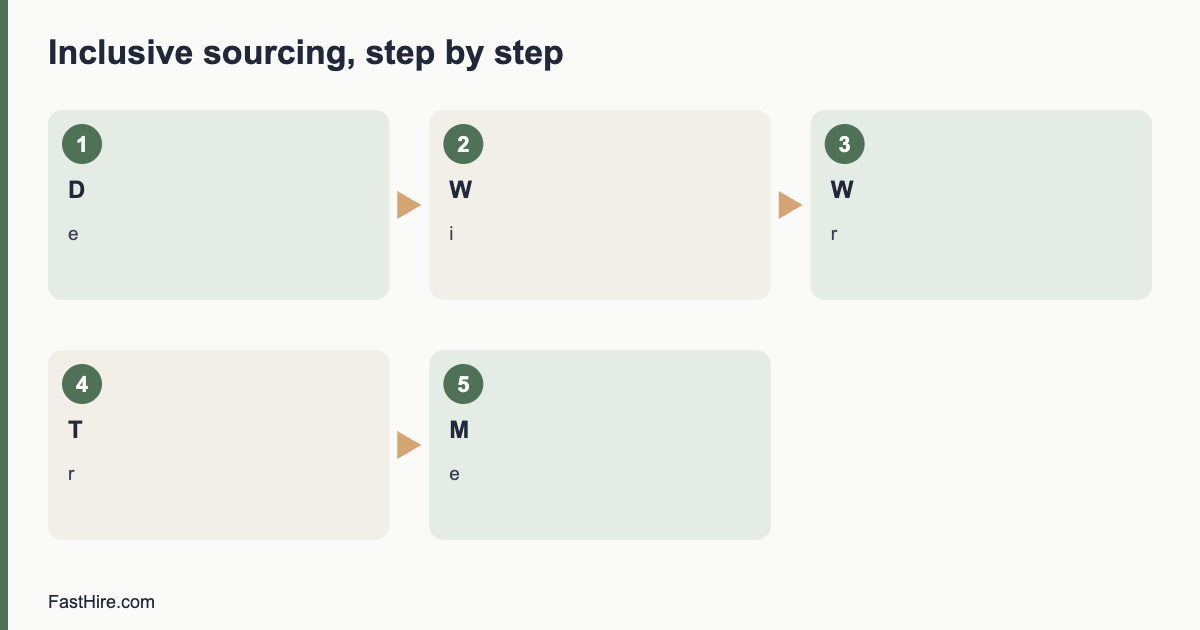
Step 3: write open outreach and ads
- Use plain words and short sentences.
- Describe the work and the support available, not the “ideal” person.
- Avoid gendered or age-linked words. See age discrimination in hiring.
- Say that you welcome applications from people of all backgrounds, and that adjustments are available.
- Show pay or the range where required or helpful. See salary in job ads.
- Use real images of your team. Avoid stock photos that show a narrow group.
- Make the application short and accessible. See accessible job applications.
Outreach message example
“Hello [name], I am hiring for a [role] at [company]. The work involves [two or three tasks]. You do not need a specific degree. We look for [skills]. The salary range is [range], and the role is [hours, place]. If you are interested, you can apply here [link], or reply with any questions. If you need adjustments for the process, tell me and we will arrange them.”
Step 4: keep selection fair
Once people apply, treat them all the same. Use the same questions, the same scale and the same reviewers. Hide names and personal details in screening. Use a scorecard. See blind CV screening, structured interviews and how to reduce interview bias. Do not add steps for some applicants or skip steps for others.
Step 5: remove barriers in the process
- Offer flexible interview times, including early or late slots.
- Offer video or phone options.
- Tell candidates what to expect, and who will be there.
- Invite requests for adjustments and answer them quickly. See reasonable adjustments in interviews.
- Pay reasonable travel costs for in-person stages where you can.
- Avoid unpaid long tasks. Keep any exercise short and tied to the job.
Step 6: measure and improve
Track the funnel by stage: reach, applications, screens, interviews, offers and hires. Where the law allows, collect optional monitoring data in a form that the hiring team does not see. Look for a stage where one group drops out far more than others. Then check the criteria, wording, questions and scoring at that stage. Fix one thing, and measure again. The four-fifths rule guide explains one simple check used in the US, with its limits.
| Stage | Measure | What a gap may mean |
|---|---|---|
| Reach | Views and clicks by channel | Channel does not reach the group |
| Apply | Starts versus completions | Form or wording is a barrier |
| Screen | Pass rate by group | Criteria or screening method is unequal |
| Interview | Score distribution | Questions or panel may be unequal |
| Offer | Acceptance and pay by group | Offer terms or process may be unequal |
Keep the data safe and use it only to improve the process. See GDPR for job applicants for the rules on special category data in the UK and EU.
Referrals and networks: handle with care
Referrals are efficient and often produce good hires, but they can repeat the shape of your current team. Balance them. Ask staff to share the open ad widely, not to name individuals. Give referred candidates no advantage in scoring. Track the mix of referred and other candidates through the funnel. If referrals dominate and the pool is narrow, add other channels.
Tools and AI in sourcing
Sourcing tools can search large databases. Check what data they use and how they rank. Avoid tools that filter by traits you cannot lawfully use, such as age or sex, even indirectly through proxies. Keep a person in charge of the decisions. Check local rules for automated tools, such as NYC Local Law 144 and GDPR Article 22. FastHire is coming soon and is designed to show evidence from CVs against each requirement, with people making every decision.
Common mistakes
- Treating inclusion as a campaign, not a change in process.
- Posting once in a community group and expecting results.
- Using words that signal a narrow profile.
- Making promises about preference in selection that the law does not allow.
- Not measuring, so no one knows what works.
- Collecting monitoring data without a notice or a safe store.
Checklist
- The role is defined by skills and outcomes.
- At least three channels are used, including some new ones.
- Ads and outreach use open, plain language.
- Selection uses blind screening, structured interviews and scorecards.
- Adjustments are offered and easy to request.
- Outcomes are measured by stage and group, where lawful.
- Findings lead to one change at a time.
- Records are kept safely and deleted on schedule.
Worked example (fictional)
A logistics company wants more applicants for warehouse supervisor roles. The recruiter rewrites the ad to list skills and outcomes, removes a degree requirement, and adds a line on flexible shifts and adjustments. She posts on open boards, shares the ad with a local employment service, a college training programme and a returners network, and asks staff to share it widely. Screening hides names and uses a scorecard. After two rounds, the funnel shows more completed applications, and a drop in the share of interviews offered to older applicants. She reviews the interview questions and finds one that asked about “energy”. She replaces it with a question about handling busy shifts, and the gap narrows in the next round.
Building relationships with communities, not just posting jobs
A single post in a community group rarely changes who applies. Relationships do. Contact organisations that serve the groups you want to reach, such as training providers, local employment services, professional networks and charities. Explain the roles, the support and the process. Ask how you can make your process easier for their members. Offer a short information session or an open day. Keep in touch even when you have no job open, so that you are known when one appears. Be clear that you cannot promise jobs, and that everyone is assessed on the same criteria.
Treat these partners as advisers. Ask them to read your ad and tell you what would put their members off. Ask what barriers they see: transport, childcare, language, a hard form, an unwelcoming website. Then fix what you can and tell them what you changed. This feedback loop is one of the most effective ways to improve both reach and fairness, and it costs only time and attention.
Returners, career changers and non-traditional routes
Many capable people reach a role by a path your ad did not imagine: after a break for care, after military service, from another field, through self-study or from a different country. Make it clear that you welcome these routes. Ask for evidence of skills in a way that suits them: a short work sample, a project description or a structured interview, rather than a long list of past titles. See work sample tests and career gaps and job hopping for how to read these histories fairly.
Support after the offer
Inclusive sourcing only works if people stay and thrive. Plan the first weeks with care: a buddy, a clear plan, honest feedback and a manager who has been briefed. Use the 30-60-90 day plan guide and first 30 days guide. Ask new hires how the process felt, and what you can do better. Feed the answers back into your sourcing and your interview design.
Finally, tell the story of your progress honestly. Share what you changed, what you measured and what you are still working on. Do not claim more than the data shows. Candidates and staff notice when words and actions differ, and trust grows when you are open about both progress and gaps. A modest, steady and honest approach to reaching more people will do more for your hiring than a loud campaign, and it keeps you on the right side of the law while you build a team that reflects the wider community you serve.
Frequently asked questions
Is it legal to target outreach at under-represented groups?
Broad outreach and encouragement to apply is generally lawful in the US, UK and EU. Selection must still be based on job-related criteria. Take advice before using preferences.
Can I set diversity quotas?
In most places, quotas or automatic preference in hiring are unlawful. Some narrow exceptions exist. Take advice.
How do I measure inclusion without collecting sensitive data?
Use optional, anonymous monitoring forms where the law allows, and check process points such as wording, criteria and drop-off by stage.
What is the first step?
Rewrite your next job ad in plain language by skills, add two new channels, and measure the funnel.
Related guides
This is general information, not legal advice.