
Use a recruitment agency when you need reach, speed or a specialist network that you cannot build yourself, and brief it as you would a colleague: with checkable requirements, a pay range, a timeline and a fair process. Agree fees, guarantee and exclusivity in writing. Review shortlists on evidence, and measure results so that you know whether to renew.
Key takeaways
- Use an agency for a clear reason: hard-to-fill roles, urgent volume, a niche market or no internal capacity.
- Give a written brief: requirements, pay range, process, timeline and fairness rules.
- Agree the fee basis, the guarantee period, exclusivity and ownership of candidate data in writing.
- Review shortlists against the same scorecard you use for any candidate.
- You remain responsible for fair treatment and for candidate data, even when an agency does the sourcing.
When an agency makes sense
| Situation | Agency can help | Alternative |
|---|---|---|
| Hard-to-fill specialist role | Access to a niche network | Targeted sourcing by your own team |
| Urgent volume hiring | Extra capacity | Hiring day and batch screening. See hiring in volume |
| New market or country | Local knowledge | Local adviser plus your own process |
| Confidential search | Discretion | Internal confidential process |
| No internal recruiter | Process support | Template process and a part-time recruiter |
| Easy-to-fill role | Rarely worth the fee | Free and low-cost channels. See post jobs for free |
Compare the cost with other options. Our guide on the cost to hire an employee lists the items to include, and how to source candidates shows what you can do in-house.
Types of agency and how they differ
- Contingency: you pay only when you hire a person the agency submitted. Quick to start, but several agencies may compete.
- Retained: you pay an up-front part and the rest on stages. Suited to senior or hard searches, with more effort from the agency.
- Temp or staffing: the agency employs the worker and places them with you. Pay, tax and some duties differ. Check the rules where you operate.
- Executive search: a retained model with deep research for senior roles.
- RPO (recruitment process outsourcing): an outside team runs part or all of your process.
In the UK, agencies and employment businesses have legal duties, explained on GOV.UK employment agencies and businesses. In the US and EU, rules vary by state and country. Ask the agency to explain which apply.
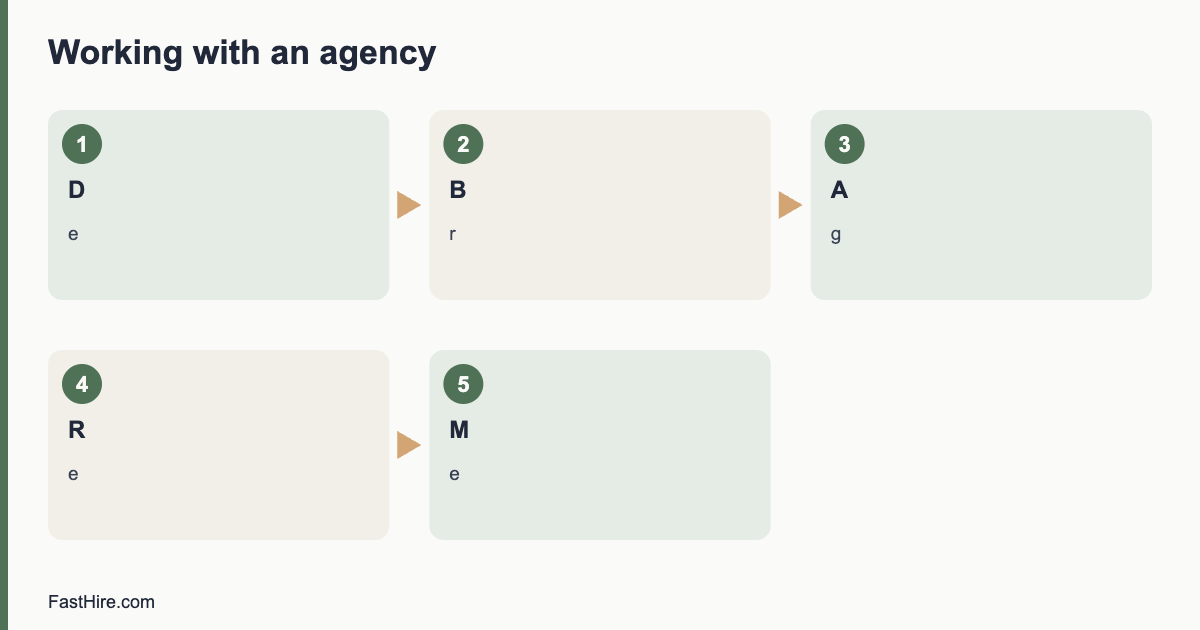
Step 1: write a brief that works
A weak brief wastes both sides time. Give the agency what you would give an internal recruiter.
| Item | What to include |
|---|---|
| Role and level | Title, team, reporting line |
| Must-haves | Checkable requirements, few and real. See checkable job requirements |
| Nice-to-haves | Clearly marked as such |
| Pay and package | The range and main benefits, agreed internally first |
| Process | Stages, interviewers, the scorecard and the timeline |
| Fairness rules | Open recruitment, no questions on protected topics, accommodations welcome |
| Sell points | Honest description of the work, team and challenges |
| Data rules | What data they may collect and how; privacy notice; retention |
| Contact and feedback | Who gives feedback and how fast |
Hold a short intake meeting with the agency and the hiring manager. Ask the agency to repeat the brief back to you in their words.
Step 2: agree fees and terms in writing
Terms vary widely. Read them carefully and ask questions before you sign. Below is a checklist of points to settle. Do not copy a number from a general guide; ask each agency and compare.
| Term | Questions to ask |
|---|---|
| Fee basis | Percentage of first-year pay, fixed fee, or hourly mark-up for temps? What pay figure counts (base only, or bonus too)? |
| Payment stages | When is each part due? On shortlist, on offer, on start? |
| Guarantee period | If the hire leaves, what do you get: refund, replacement, or credit? For how long? What conditions apply? |
| Exclusivity | Is the search exclusive? For how long? Can you use other channels? What happens to a candidate you already know? |
| Candidate ownership | If a candidate was submitted, how long does the agency claim a fee if you hire them later, by another route? |
| Temp-to-perm | What fee applies if you convert a temp to a permanent role? |
| Data | Who is the controller of candidate data? How is consent obtained? How are requests handled? |
| Fair practice | Does the agency commit to equal treatment and no discriminatory questions or ads? |
| Termination | How can you end the agreement, and what notice applies? |
Ask a lawyer to review a long or exclusive agreement. Keep a copy, and diarise the dates of any exclusivity or ownership periods.
Step 3: set the process and the rules
- Share your scorecard and ask the agency to present candidates with evidence against each requirement.
- Ask for the candidate resume or CV as it was supplied, plus a short, factual summary. Avoid vague words such as “great” or “a star”.
- Agree what the agency may say to candidates about pay and process. Candidates should hear the same story from you and the agency.
- Agree the timeline: when you give feedback, how many interviews, when the offer.
- Agree rules on contact: the agency should not push candidates, and should not share your confidential information.
Step 4: review shortlists on evidence
Treat agency candidates like any other candidates. Score them on the same scale, against the same requirements, using the same questions. Do not give extra weight because an agency recommended someone, and do not drop someone because of an agency summary. Ask for clarity where a summary is unclear. Run a shortlist review with the manager, and give prompt feedback to the agency so that it can improve.
Step 5: fairness, law and data
- You are responsible for fair treatment, even when an agency does the work. Include equal treatment duties in the contract. See the EEOC and GOV.UK employing people.
- Check that the agency does not discriminate in ads or screening. Review a sample of their ads.
- Agree who sends privacy notices. See applicant privacy notice template.
- Make sure the agency follows your retention rules for your candidates. See applicant data retention.
- Check right to work duties. Agree who does the check and keeps the record. See how to check the right to work.
- If the agency uses automated tools, ask how, and keep people in charge of decisions.
Step 6: measure quality and decide whether to renew
| Measure | What it tells you |
|---|---|
| Share of submitted candidates who meet all must-haves | Quality of screening |
| Time from brief to first shortlist | Speed |
| Interview-to-offer rate | Fit with your needs |
| Offer acceptance rate | Quality of candidate management |
| Retention at 90 days and six months | Long-term fit |
| Candidate feedback | Experience and fairness |
| Total cost per hire including all fees | Value for money |
Review these after each search. Share the results with the agency. Renew or end the relationship based on facts. Add the numbers to your hiring dashboard.
Managing several agencies
Using more than one agency can widen reach but creates risks: duplicate submissions, mixed messages and disputes over who introduced a candidate. Set a rule: the first agency to submit a candidate with a date-stamped record owns that introduction. Ask all agencies to follow the same brief. Hold a shared update each week. Consider a preferred supplier list, with agreed terms and regular review.
Common mistakes
- A vague brief, then blaming the agency for poor shortlists.
- Signing exclusivity without a clear reason or end date.
- Not reading the candidate ownership clause.
- Changing the requirements mid-search without telling the agency.
- Skipping your own scorecard for agency candidates.
- Not checking the agency ads for fair wording.
- Giving slow feedback, so that good candidates drop out.
Checklist
- Reason for using an agency is written.
- Brief is written and shared in a meeting.
- Fees, guarantee, exclusivity and ownership are in the contract.
- Fairness and data duties are in the contract.
- Shortlists are scored on your scorecard.
- Feedback is given within one or two days.
- Results are measured and reviewed.
Worked example (fictional)
A software company needs a rare data engineer. The recruiter has no network in this niche, so she briefs a specialist agency. She writes the requirements, the pay range, the process and the fairness rules, and holds a call with the agency and the manager. The contract sets a percentage fee payable on start, a guarantee period with a replacement, a non-exclusive search and a twelve-month ownership clause. The agency submits four candidates with resume or CV and a short summary. The manager scores them on the standard scorecard, and gives feedback in two days. One candidate receives an offer. After the hire, the recruiter records the cost, the time and the retention at 90 days, and decides to add the agency to a preferred list for similar roles.
How to run the first call with an agency
The first call sets the tone. Prepare a one-page brief and send it a day ahead. On the call, ask the agency to describe how it will search: which channels, which networks, how many people it expects to reach, how it screens, how long it will take to the first shortlist. Ask for examples of similar roles it has filled, and for the typical reasons candidates drop out. Ask how it handles requests for adjustments, how it records consent and how it treats candidate data. A good agency answers clearly and asks questions about your business. A weak one promises speed and quality without detail.
Ask for references from other clients, and call at least one. Ask the client whether the shortlists matched the brief, how quickly feedback was handled and whether any fee disputes arose. Check that the agency has the right registrations or licences where they are required, using official sources such as GOV.UK in the UK. Agree on one named contact on each side.
What to do when an agency submits candidates you already know
This causes many disputes. Before the search, give the agency a list of candidates already in your pipeline, or tell it how you will handle duplicates. If an agency submits a person you already have, tell it within a day, in writing, and record the date. Check the contract for how ownership is decided. If you hire a person who was submitted by an agency months ago through another route, check whether a fee claim applies. Clear records and a short written rule avoid arguments.
Keeping candidates safe and well treated
Candidates often meet the agency before they meet you. Their experience of the agency becomes their experience of your brand. Agree standards: the agency replies to candidates within a working day, tells them the truth about pay and the process, does not push them, and does not share their details without consent. Ask the agency to send feedback from you promptly and kindly. Read how to give useful feedback to rejected candidates and share it with the agency. Ask candidates how the agency treated them, and act on what you hear.
Ending the relationship well
If an agency does not deliver, say so early and clearly. Share the evidence: the shortlists, the feedback, the dates. Give it a chance to fix the problem. If it does not improve, end the agreement according to the notice terms, confirm in writing what happens to candidates in process and thank the agency. Keep the door open if the issue was fit rather than integrity. Record what you learned, so that your next brief and contract are stronger.
Keep a short agency file for each supplier: the contract, the brief for each search, the dates and the results. Review the file before each renewal. Over time it shows which agencies deliver value for which roles, and it gives you facts to use when you negotiate terms. A small amount of structure turns agency work from a series of one-off favours into a managed part of your hiring, with clear costs, clear duties and clear results.
Frequently asked questions
When should I use a recruitment agency?
When the role is hard to fill, urgent or in a niche, or when you lack capacity. For easy roles, other channels may be cheaper.
What is a normal agency fee?
It varies by market, role and agency. Ask each agency, compare in writing, and check what pay figure the fee is based on.
Do I still need my own scorecard?
Yes. Score agency candidates against the same requirements as every other candidate.
Who is responsible for fair treatment if an agency screens candidates?
You are, as the employer. Put equal treatment duties in the contract, and review the agency ads and process.
Related guides
This is general information, not legal advice.