
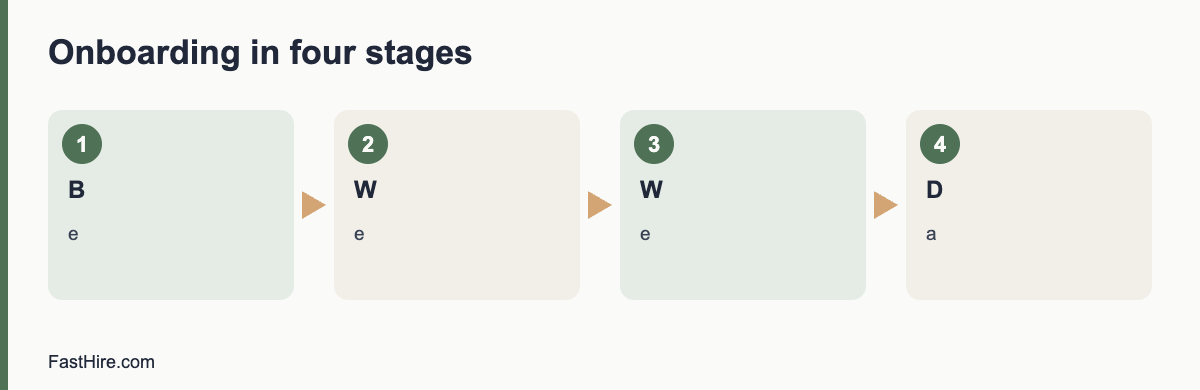
A good onboarding plan for a small business has four parts: preparation before day one, a clear first week, goals and check-ins for weeks two to four, and a 30-day review. Give the new person a named guide, access to the tools they need, a short list of outcomes and regular time to ask questions. Plan it in writing, so that it does not depend on how busy you are.
Key takeaways
- Prepare before day one: equipment, accounts, schedule and a welcome message.
- Week one is for orientation, safety, tools and meeting people. Do not overload it with tasks.
- Set three to five outcomes for the first 30 days, and discuss them on day one.
- Hold a short check-in every day in week one, then weekly.
- End with a 30-day review that covers what worked, what is unclear and what comes next.
Why onboarding matters more in a small team
In a large company there are systems, buddies and training teams. In a small business, the new person depends on you. If you are busy, they wait. A plan prevents the early weeks from turning into confusion, and it shows the person that you value them. It also protects you: the same checklist works for the second hire and the tenth.
Onboarding is also where legal and safety duties start. Employers must give the right information and a safe workplace. For overviews, see GOV.UK on employing people, the US Department of Labor wage and hour fact sheets, and the Your Europe pages on hiring and managing staff. For workplace safety, check the national authority in your country, for example OSHA in the US, the Health and Safety Executive in the UK or the national labour inspectorate in your EU member state.
Before day one: the 10-point checklist
| Task | Who | Done? |
|---|---|---|
| Send a welcome message with the start time, address or link, dress code and who to ask for | Manager | |
| Prepare the workspace or the remote kit (laptop, phone, headset, accounts) | Manager | |
| Create email, chat, software and file access, with the right level | Manager or IT helper | |
| Complete contract, tax and payroll forms | Manager | |
| Complete right-to-work checks as the law requires | Manager | |
| Prepare a one-page overview of the business, team and customers | Manager | |
| Choose a guide who is not the manager if possible | Manager | |
| Block time in the calendar for the first week | Manager and guide | |
| Write three to five outcomes for 30 days | Manager | |
| Tell the team the start date and the role | Manager |
Week one: a day-by-day plan
| Day | Focus | Activities |
|---|---|---|
| Day 1 | Welcome and basics | Tour or video call, meet the team, set up equipment, safety information, read the one-page overview, 30-minute talk about the outcomes |
| Day 2 | Tools and process | Walk through the main tools with the guide; watch one task done end to end; do a small supervised task |
| Day 3 | Customers and products | Learn the products, the customers and the common questions; shadow a call or message session |
| Day 4 | First real task | Do a real task with a guide present; get feedback the same day |
| Day 5 | Review week one | 30-minute talk: what is clear, what is unclear, what to learn next; agree goals for week two |
Keep each day light enough to leave time for questions. A new person who feels lost for a week may decide to leave. Short daily check-ins of 10 minutes help you spot problems early.
Weeks two to four
| Week | Goal | Check-in |
|---|---|---|
| Week 2 | Do routine tasks with less help; learn the main systems | Weekly 30-minute meeting with the manager; daily quick message with the guide |
| Week 3 | Take responsibility for one defined area; give a short update to the team | Weekly meeting; review one piece of work together |
| Week 4 | Work independently on routine tasks; suggest one improvement | Weekly meeting; prepare for the 30-day review |
Link the goals to the outcomes in the job description. If the role is new, see our guide to writing a job description for a role that does not exist yet, which explains how to write outcomes.
The 30-day outcomes: how to write them
An outcome describes what the person can do or deliver by day 30. Keep it measurable and fair.
| Weak outcome | Better outcome |
|---|---|
| Learn the system | Can enter and update orders in the system without help |
| Get to know the customers | Has answered 20 customer messages with a quality check by the guide |
| Be proactive | Has suggested one change to the process and explained why |
| Fit in with the team | Has met every team member and knows who to ask for each type of question |
Share the outcomes on day one so that there are no surprises. If the plan changes, update it together and write the change down.
The role of the guide
A guide is a colleague who answers questions and shows how things work. The guide is not the person’s manager or evaluator. The guide should:
- Meet the person on day one and have lunch or a break with them
- Explain unwritten rules, such as how to ask for time off and who answers which questions
- Answer small questions without judgement
- Introduce the person to others
- Report to the manager if the person seems lost or unwell, in a helpful way
Give the guide time in their own schedule. If you do not, the load falls on you or on a person who is already stretched. If you are the only manager and have no one else, schedule short daily slots with the new person and keep a shared document of questions and answers. Over time this becomes your handbook.
Documents and training to cover
| Topic | What to cover | Where to look |
|---|---|---|
| Safety | Emergency exits, first aid, safe use of equipment, who to tell about an accident | National health and safety authority |
| Policies | Time off, sick leave, expenses, data protection, equal opportunity, conduct | Your handbook or a one-page summary |
| Data protection | What data the person will handle and how to keep it safe | ICO guidance in the UK; GDPR in the EU; your state laws in the US |
| Pay | Pay date, payslip, how to report errors | Payroll provider |
| Tools | Email, chat, project tools, files | Guide and manager |
| Customers and products | Who they are and what they need | Manager and team |
Check-in questions
Use the same five questions each week. Write the answers and act on them.
- What went well this week?
- What was confusing or took longer than expected?
- What do you need to learn or have to do your work?
- Is there anything about the team, the workload or the environment I should know?
- What would you like to focus on next week?
Do not ask about health, family or personal matters. If the person shares something personal, listen and ask whether they need an adjustment. Follow the law on adjustments and leave, and take advice if needed.
The 30-day review
| Part | Questions |
|---|---|
| Outcomes | Which outcomes were met? Which were not? Why? |
| Learning | What does the person need to learn next? What training helps? |
| Role | Is the role what both sides expected? What should change? |
| Feedback to you | What did the onboarding miss? What would you change? |
| Next 60 days | Set three outcomes for the next period |
If there is a probation period, tell the person how the review links to it. Be clear and fair. If there are concerns, say so early, with specific examples, and agree a plan to improve. See the first hire plan for the full journey from the idea to the first day, and our guide on the cost of hiring to plan the budget for training time.
Common mistakes
| Mistake | Effect | Fix |
|---|---|---|
| Starting without a workspace or accounts | Person waits; feels unwelcome | Use the 10-point list |
| Giving real work with no help on day one | Stress and errors | Show first, then supervise, then release |
| No outcomes | Person does not know what good looks like | Write three to five and share them |
| Skipping check-ins when busy | Problems grow | Keep 10 minutes daily in week one |
| Only talking about tasks | The person feels isolated | Add team time and a guide |
| No feedback from the new person | You never improve the process | Ask five questions each week |
A welcome message you can copy
Hello [Name],
We are glad you are joining us on [date]. Here is what to expect on your first day.
Time and place: [time], [address or video link].
Who you will meet: [manager name] and [guide name]. [Guide name] will be your first contact for questions.
What to bring: [documents required by law, such as proof of the right to work; anything else].
What we will do: a tour, meet the team, set up your equipment and talk about your first 30 days.
Lunch: [arrangement].
If anything changes or you have questions before then, please contact me at [phone or email].
Best wishes,
[Name]
A worked example (fictional)
This example is invented. A small bakery hires its first sales assistant. The owner prepares a one-page plan.
| Week | Plan | Outcome by the end of the week |
|---|---|---|
| 1 | Safety and hygiene briefing, tour, meet the team, learn the till, shadow the guide, serve with support | Can use the till and explain the products with help |
| 2 | Serve customers with the guide nearby; learn opening and closing steps | Can open and close the shop with the guide present |
| 3 | Serve alone during quiet hours; take orders for cakes | Can take a special order correctly |
| 4 | Serve during a busy period; suggest one improvement to the display | Works independently on routine tasks; has made one suggestion |
At the 30-day review the owner asked the five weekly questions again. The new assistant said that the allergen information was the hardest part to learn. The owner added a laminated allergen chart behind the counter and a short quiz for future hires. The review improved the process for the next person.
Make it inclusive
- Ask all new starters whether they need any adjustment to get started, such as step-free access, written instructions, a quiet space or flexible breaks. Offer it in a neutral way.
- Share the schedule early so that people with caring duties or religious observance can plan.
- Use plain language and avoid idioms in written material, especially if staff speak English as a second language.
- Give the same training and the same feedback to everyone in the same role.
- Do not assume that a person needs less or more help because of age, sex or origin. Ask what would help.
An inclusive start improves retention and makes the team stronger. It also reduces the risk of unfair treatment.
Frequently asked questions
How long should onboarding last?
A structured plan for the first 30 days is a good start. Many roles need 60 to 90 days to reach full speed. Keep check-ins going during that time.
What if I have no time?
Block short slots in your calendar and use a written plan. A guide or a recorded walkthrough of key tasks also saves time.
Should onboarding be different for remote workers?
Add a stronger first week: send equipment early, schedule video calls, explain tools and make sure the person knows who to ask. Remote workers can feel isolated.
When should I give the contract?
Before or on the first day. In many countries the law requires written terms by a set time. Check your official guidance.
What do I do if the new hire is struggling?
Talk early and specifically. Ask what is hard, offer help and agree on a short plan with dates. See our upcoming guide on what to do when a new hire is not working out.
Related guides
- Hiring guides for small businesses and founders
- How to make your first hire: a step-by-step plan
- How to make a job offer: a letter template and what to include
- How to write a job description for a role that does not exist yet
- All hiring guides for employers
- How to hire an assistant or office manager: role, ad and interview
- Part-time, seasonal or temporary staff: how to hire fast and fairly
- How to hire your replacement when a team member leaves
- Do you need a probation period? How it works in each country
- How to write a 30-60-90 day plan for a new hire
This is general information, not legal advice.