
A good job offer is clear, complete and honest. Call the candidate first, then send a written offer that states the job title, start date, pay, hours, place, any conditions, the deadline for a reply and who to contact. The written offer is not the same as the full employment contract, but it must match it, and it should never promise things you cannot deliver.
Key takeaways
- Phone the candidate first, then send the letter the same day.
- Put the key terms in writing: title, pay, hours, place, start date, conditions and reply date.
- State conditions clearly, such as references or right-to-work checks.
- Give a fair time to decide, usually three to five working days.
- Rules on written terms differ by country. Check the official page for your country before you send a contract.
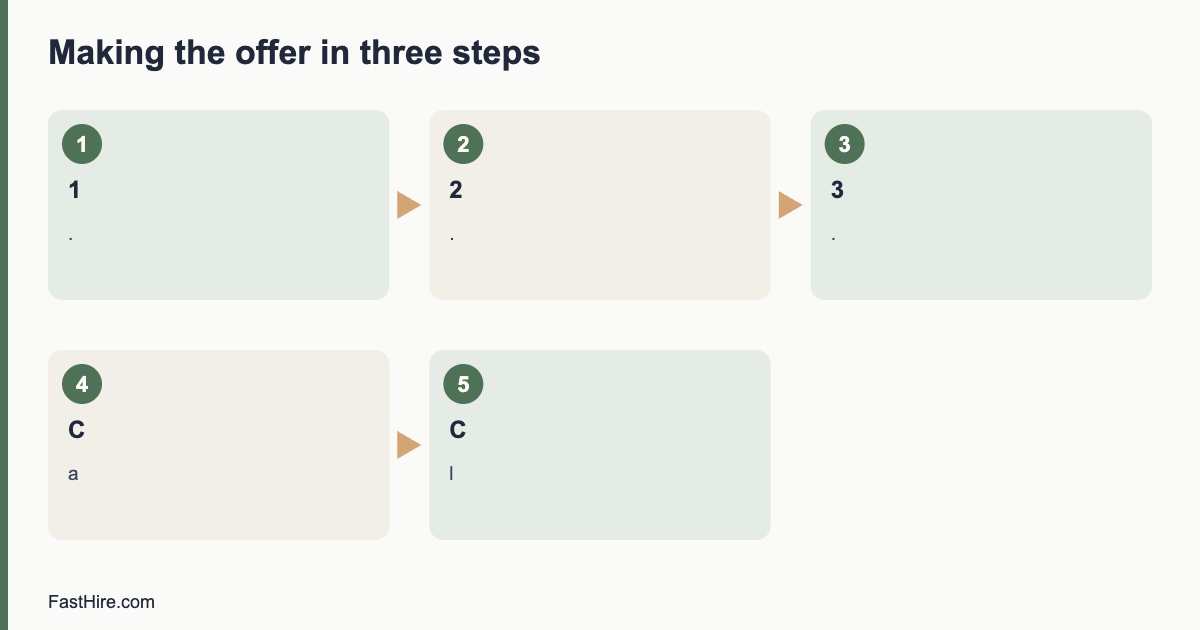
The offer in three steps
| Step | What you do | Why |
|---|---|---|
| 1. Call | Phone the candidate, share the good news, give the main terms and the reply date | Shows respect, answers first questions and lets you hear the reaction |
| 2. Write | Send the offer letter by email within a few hours | Gives the candidate the terms in writing and avoids misunderstandings |
| 3. Contract | Send the full employment contract or written terms of employment as the law requires | Covers all legal terms; the offer letter alone may not be enough |
Many small businesses skip step 3 or merge it with step 2. If you merge them, make sure the document includes everything the law requires in your country. Read the official guidance: in the UK, GOV.UK: employment contracts; in the US, there is no federal requirement for a written contract for most jobs but state rules and the Fair Labor Standards Act affect pay (see US Department of Labor: wages and the FLSA); in the EU, Directive (EU) 2019/1152 on transparent and predictable working conditions sets information duties, and each country applies them in its own way.
What to include in the letter
| Item | Details to state | Notes |
|---|---|---|
| Job title | The exact title | Match the ad |
| Start date | Date, or “to be agreed by [date]” | Allow time for notice periods |
| Pay | Amount, currency, period (hourly, weekly, yearly) and pay date | Match the range in the ad, or explain any difference |
| Hours | Hours per week, days, breaks, overtime rules | State flexible hours if they apply |
| Place of work | Address or remote arrangement | Say who pays for equipment |
| Reporting line | Name and title of the manager | Helps the candidate picture the team |
| Contract type | Permanent, fixed term, part-time; end date if fixed | Use the legal term for your country |
| Probation or trial period | Length and rules, if used | See local limits; in some places a probation period has legal rules |
| Benefits | Holiday, pension or retirement, health, other benefits | Describe only what you will provide |
| Conditions | References, right to work, qualifications, background checks if the role requires them | Say what happens if a condition is not met |
| Reply date | A date and time | Give three to five working days |
| Contact | Name, email, phone | Offer to answer questions |
Do not copy terms from a large company if you will not offer them. Avoid phrases like “competitive package” with no detail. If the pay depends on bonuses, state the bonus rules in plain words and say that they are not guaranteed unless they are.
A template you can copy
Replace the text in square brackets. Have a lawyer or advisor check the template once for your country.
[Date]
Dear [Name],
Job offer: [Job title] at [Business name]
We are pleased to offer you the position of [job title]. This letter sets out the main terms. We will send the full written terms of employment separately [or: they are attached].
Start date: [date].
Place of work: [address or remote details].
Reporting to: [name and title].
Hours: [hours per week and days].
Pay: [amount] per [hour/month/year], paid [monthly/weekly] on [date].
Contract: [permanent/fixed term until date], [full-time/part-time].
Probation: [length and rules, or “none”].
Holiday and other benefits: [summary].
This offer depends on: [satisfactory references; proof of the right to work in [country]; any other condition].
Please reply by [date and time] to confirm that you accept. If you have questions, please contact [name] at [email or phone]. We would be glad to talk.
We were impressed by [one specific, honest reason from the interview] and we look forward to working with you.
Yours sincerely,
[Name, title]
The phone call script
- Open with the news. “We would like to offer you the role of [title]. Congratulations.”
- State the main terms. Title, pay, hours, start date and conditions.
- Ask for first reactions. “How does that sound to you?”
- Answer questions honestly. If you do not know, say you will check and reply by a time.
- Give the timeline. “I will send the letter today. Please reply by [date].”
- End warmly. Thank them. Do not pressure them to decide on the call.
Do not use tactics such as an “exploding offer” with an unreasonable deadline or a false statement that there are other candidates waiting. They damage trust, and they may push the person to a worse decision. A fair time to decide is part of a respectful offer.
A worked example (fictional)
| Item | Example |
|---|---|
| Role | Operations coordinator at a small online shop (invented) |
| Pay | 24,000 per year, paid monthly, within the range in the ad |
| Hours | 30 hours per week over four days |
| Start date | 1 March, or earlier by agreement |
| Conditions | Two satisfactory references and proof of right to work |
| Reply date | Friday at 5 p.m., four working days after the offer |
The founder called the candidate on Monday, sent the letter at noon, and sent the full written terms on Tuesday. The candidate asked two questions: whether the hours could be moved to another day, and whether there was a training budget. The founder answered both in writing the next morning. The candidate accepted on Thursday. The founder then told the other finalists the outcome the same day.
Handling questions and negotiation
Candidates often ask for a change in pay, hours, start date or benefits. Decide in advance what you can offer. Have a floor and a ceiling for pay, and a list of items that can change at low cost, for example start date, flexible hours, a review date for pay or a training budget. When you negotiate:
- Treat all candidates alike. Unequal pay for the same work can create fairness and legal issues, and some places require pay equity.
- Give reasons for what you cannot change.
- Put every agreed change into the written terms.
- Do not reduce an offer because the candidate asked a question.
- If you cannot meet the request, say so with respect and ask whether the original offer still works.
After the person accepts
- Send a thank-you message and confirm the start date.
- Tell the other finalists the outcome, with respect. A short message is enough.
- Close the job ad.
- Complete the required checks as the law requires, such as right-to-work checks.
- Prepare payroll, equipment, accounts and the first-week plan.
- Stay in touch before day one with a short message from the manager.
The gap between acceptance and the first day is a risk period. A friendly message, a clear schedule and a named contact reduce the risk that the person changes their mind or arrives unprepared. See the first hire plan for the full order of steps.
Mistakes to avoid
| Mistake | Why it hurts | Fix |
|---|---|---|
| Verbal offer only | Terms are unclear; disputes later | Always follow with writing |
| Terms that differ from the ad | Lose trust; may breach rules on pay information | Explain differences honestly before sending |
| Vague conditions | The candidate quits a job for an offer that then falls through | State conditions clearly |
| A very short deadline | Pressure; poor decisions | Give three to five working days |
| No contract | Legal risk in many countries | Provide written terms as the law requires |
| Telling other finalists nothing | Damages your reputation | Reply to everyone within a day or two |
Reply templates
Acceptance confirmed
Hello [Name],
Thank you for accepting. We are glad you are joining us. Your start date is [date]. Before then, we will send you the full terms, the first-week schedule and details of who to meet on your first day. If you have any questions, please contact me at [email].
Best wishes,
[Name]
Message to the other finalists
Hello [Name],
Thank you for your time and effort during our process. We have offered the role to another candidate. We valued your skills in [one specific point], and we would be glad to keep your details for future roles if you agree. We wish you every success.
Best wishes,
[Name]
Check list before sending the offer
- The terms match the job ad, or any difference is explained.
- The pay is the same as you would offer another candidate with the same experience.
- The conditions are listed, with a way to meet each one.
- The reply date is realistic.
- Someone else has read the letter for errors.
- You have a plan for the full contract.
Offers for different situations
| Situation | What to add | What to watch |
|---|---|---|
| Part-time role | State the hours, the days and how changes are agreed | Part-time staff usually have the same rights in proportion to hours. Check local rules |
| Fixed-term role | State the end date and the reason, and say what happens at the end | Rules limit repeated fixed-term contracts in many countries |
| Seasonal role | State the season dates, the shifts and how pay is calculated | Make sure holiday pay is handled as the law requires |
| Remote role | State the country of work, equipment and costs, and the time zone | Working from another country can change tax and legal duties. Take advice |
| Commission or bonus pay | State the rules, the targets and the pay dates | Do not describe a bonus as guaranteed unless it is |
| Relocation | State what you pay for and when the person must repay it, if at all | Put repayment terms in the contract and keep them reasonable |
If you are offering a role to a person who currently lives in another country, the legal position can be complex. Our guide on hiring abroad will cover the basics. Until then, speak to an accountant who knows both countries before you make the offer.
Keep the tone human
An offer letter is also a first impression of how you manage. Use plain words. Thank the person for their time. Give one honest reason why you chose them, based on the evidence from the interview, not on personality. Avoid heavy legal language where you can. If the legal document is formal, add a short cover note in plain words that says what happens next. Candidates remember how they were treated at this point, and they tell others.
Frequently asked questions
Is an offer letter a contract?
It can form part of a contract once accepted, depending on the country. Treat it as binding on you and make sure it matches the full terms.
Do I need a written contract?
Many countries require written terms or a statement of particulars for employees. Check the official page for your country, for example GOV.UK in the UK.
How long should I give a candidate to decide?
Three to five working days is typical. Allow more time for senior roles or for people who must give notice.
Can I withdraw an offer?
Only for fair reasons, such as a failed condition, and with care. Withdrawing without a valid reason can create legal risk. Take advice before you do it.
Should I tell the candidate the pay range earlier?
Yes. State a range in the ad where you can, and make the offer within the range, unless you explain a change.
Related guides
- Hiring guides for small businesses and founders
- How to make your first hire: a step-by-step plan
- How much does it cost to hire an employee? A cost worksheet
- How to check references without breaking rules or trust
- All hiring guides for employers
- A small business onboarding plan for the first 30 days
- How to check the right to work: US, UK and EU basics
- Do you need a probation period? How it works in each country
- How to set a fair salary for a small business role
- How to turn down a candidate kindly and clearly: templates
- How to keep your best candidate warm while you decide
- How to handle a counter-offer from a candidate’s employer
- How to check references as a hiring manager: questions that work
- How to close a candidate: an honest offer conversation
This is general information, not legal advice.