

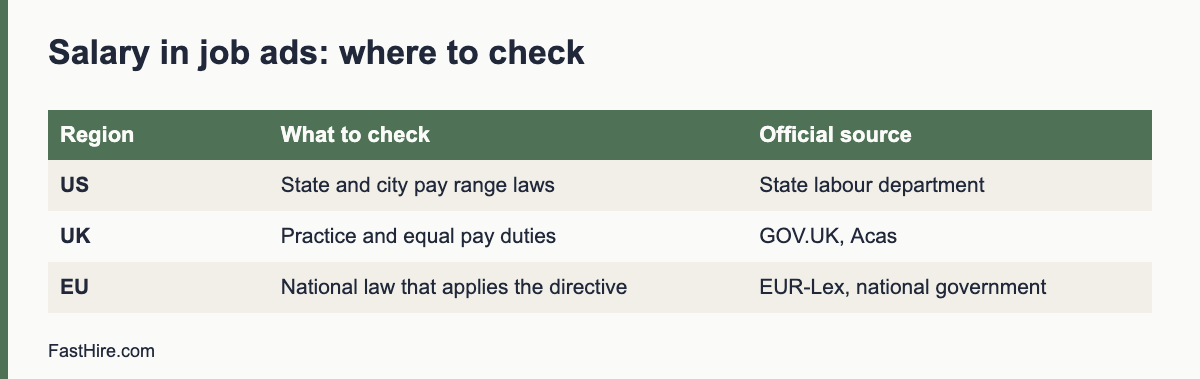
Whether you must put a salary in a job ad depends on where the job is and where you advertise. A growing number of US states and cities require a pay range. The EU has adopted a directive on pay transparency that member states must apply through national law. The UK has no single rule that covers every ad, but equal pay law still applies. This guide shows what to check and gives wording you can reuse.
Key takeaways
- Check the rules for the place where the worker will be based, not only where your office is.
- Many US states and cities require a pay range in ads. Rules differ on size of employer, remote jobs and the form of the range.
- The EU directive on pay transparency gives applicants a right to pay information before the interview. Check how your country applies it.
- In the UK, there is no general duty to publish salary in an ad, but posting a range helps fairness and reduces gaps.
- When in doubt, post a good-faith range. It is cheaper than a complaint.
Why this question matters for small employers
Large companies have lawyers who track these rules. A small employer usually does not, yet the rules often apply to small employers too. A rule may exist only for firms above a size threshold, or it may apply to all. Remote jobs add another layer: some rules apply if the worker could be based in the place, even if you are not.
The benefit of posting pay goes beyond avoiding a fine. A range filters out people who cannot accept the pay, saves interviews, and signals that you treat people fairly. Candidates often skip ads with no pay information. Our guide to setting a fair salary shows how to build the range you will post.
United States: state and city rules
There is no single federal rule requiring salary ranges in job ads for private employers. Instead, a growing number of states and cities have their own rules. They differ on several points, so check the law for each place where you hire.
| Question | What laws often say |
|---|---|
| Who is covered? | Some apply to all employers, others only above a headcount threshold |
| What must be shown? | A pay range, sometimes also benefits or bonus information |
| Which jobs? | Jobs based in the place, sometimes also remote jobs that could be done there |
| How precise? | A good-faith range, the one you really expect to pay |
| What about pay history? | Many places also ban asking about past pay |
To find the rule for a state, search the website of the state labour department, or use the US Department of Labor as a starting point to find your state office. For New York City, the city also publishes rules for its hiring-tool law, covered in our NYC Local Law 144 guide, which is a separate topic from pay ranges.
Practical rules for US employers
- Post a range that you really expect to pay. A very wide range such as “from nothing to anything” is a poor-faith range.
- If a rule covers remote jobs, check each place where the person could live.
- If you use a job board, check whether it adds a pay field and fill it in.
- Keep a copy of every ad, with the date, so you can show what you posted.
- Do not ask about pay history where it is banned. Ask about expectations after you share the range.
European Union: the pay transparency directive
The EU adopted a directive on pay transparency. Among other things, it gives job applicants the right to receive information about the starting pay or range for the job, and it limits questions about pay history. It also covers job titles and ads, which should be gender neutral. The directive is not a direct law for employers. Each member state applies it through national law, so the exact rules and timing depend on the country. Read the text on EUR-Lex and check what your national government has published.
What EU employers can do now
- Prepare a pay range for each role, based on objective, gender-neutral criteria.
- Write job titles and ads in a neutral way.
- Be ready to share pay information with applicants before the interview, in the way your national law requires.
- Do not ask about pay history. Ask about expectations after you share the range.
- Check collective agreements that may already set pay for your sector.
Our article on pay transparency in hiring covers the EU, UK and US in more depth.
United Kingdom: practice and equal pay
UK law does not require every employer to post pay in every ad, but equal pay law applies to all, and larger employers must report on gender pay. See the GOV.UK gender pay gap reporting guidance. Posting a range is good practice and helps close gaps, because it removes room for unfair bargaining. Acas also gives practical advice on fair recruitment at acas.org.uk/recruitment. If you advertise jobs that could be based in the EU, check the national rules there too.
What to put in the ad
A good pay line is short, clear and honest. Place it near the top, with the location and hours, so people see it early.
| Part | Example wording (fictional) |
|---|---|
| Range | The salary range for this role is X to Y per year. |
| What decides where you sit | Pay within the range depends on skills and experience that match the requirements. |
| Other pay | This role also includes a yearly bonus of up to Z, based on the plan shared at interview. |
| Hours and place | Full time, based in the city office, with two days from home. |
| Benefits | Paid holiday, pension and training budget. |
Replace X, Y and Z with your real numbers. Do not use a figure you do not plan to pay.
Pitfalls in the pay line
- A range that is so wide it says nothing.
- Words such as “competitive” with no number, where a number is required.
- A different range in the ad and in the offer.
- Leaving bonuses or commission vague, when they are a large part of pay.
- Ignoring the legal minimum wage for the role.
A short routine for every job ad
- Decide where the worker can be based, including remote options.
- Check the pay rules for each place. Use the official sources above.
- Build a range using the method in our salary guide.
- Check the range against current staff for equal pay.
- Write the pay line, using the table above.
- Save a copy of the ad with the date.
- Review the rule once a year, or when you hire in a new place.
Link the ad to the rest of your hiring
The ad is the start of the process. If you promise a range, keep to it in the offer. If you ask about pay later in the process, wait until you have shared the range. When you write the ad as a whole, follow our job ad guide. When you make the offer, use the offer letter template. If you run a trial period afterwards, see how probation works.
Questions to ask your adviser
- Which places do our rules cover for this job, including remote?
- Is a range enough, or do we also need to list benefits or bonuses?
- How do we show commission-based pay in an ad?
- What do we do if the job is posted on a board that cannot show the range?
- Are there fines or private claims if we get it wrong?
Worked example (fictional)
A ten-person design studio in one US state wants to hire a designer who can work from anywhere in the country. The owner checks the rules for the studio state and finds a pay range rule. The owner then reads that a few other states cover remote jobs that could be filled there. The owner decides to post one good-faith range for the role, to add it to the job board field, and to keep a dated copy of the ad. The owner also removes the past pay question from the application form, and asks for expectations after the first call. The whole check takes an afternoon, and the same routine works for the next hire.
Handling the job board and agency side
Most small employers do not post only on their own site. Job boards, social networks and agencies each have their own forms. Some have a field for a pay range, and some require it for certain places. Fill in the field when it exists, and use the same numbers everywhere. If a board cannot show a range, put the range in the text of the ad instead.
If an agency posts for you, give it the range in writing and ask it to confirm that every ad shows it. You remain responsible for what is posted in your name, so ask to see the live ad, and check it again after any edit.
A quick board checklist
- Does the board show the range in a clear place?
- Is the range the same as on your own site?
- Does the ad name the right location, including remote options?
- Is there a dated copy of the live ad in your files?
- Did you remove any question about past pay from the application form?
Talking about pay at each stage
The range in the ad is only the first point. A fair process keeps the pay conversation consistent from first contact to offer.
| Stage | What to say about pay |
|---|---|
| Ad | The range and what decides where in the range a person sits. |
| First call | Confirm the range still fits the candidate. Do not ask for pay history. |
| Interviews | Only discuss pay if the candidate raises it, and refer back to the range. |
| Offer | A number inside the range, with the reasons based on skills and scope. |
| After offer | Answer questions in writing, so the record is clear. |
If a candidate says the range is too low, thank them, and say whether there is any flexibility. If there is none, say so clearly. It saves time for both sides and it is fair to everyone who applied at that range.
Keep the records
Keep the ad, the range worksheet and notes on how you set the offer. If someone later asks why two people in the same role are paid differently, you can show the job-related reasons. If a regulator or court asks about your ad, you can show what was posted and when. Store the records safely and delete them when your retention period ends. See our article on how long to keep rejected applicant data for the privacy side.
A note on commission and bonus pay
Where pay includes commission, tips or a bonus, a plain range of base salary may not tell the whole story. Say what the base is, what the variable part is, how it is calculated, and what a typical person earns in a normal year if you can support that figure with your own records. If you cannot support it, do not state it. Avoid examples that suggest a level of earnings you have not paid in the past.
Check the local rule on whether variable pay must be included in the range you post. Where the law is not clear, include a short line that explains how the variable part works, and keep the written plan that supports it. A candidate who understands the plan is less likely to feel misled, and you are less likely to face a complaint later.
Finally, tell the hiring team. The person who answers candidate questions should know the range, the rules and the reasons, so everyone gives the same answer from the first day the ad goes live.
Frequently asked questions
Do I have to put a salary in every job ad?
Not everywhere. Some US states and cities require a range, the EU is introducing a right to pay information for applicants, and the UK has no general rule. Check the law for the place of work.
Is a range enough?
Where the law requires pay information, a good-faith range is usually the standard. Check the exact wording of your local rule.
What if I hire remote workers?
Some rules apply if the job could be done in the place. Check each place you are willing to hire in.
Can I still negotiate?
Yes. A range allows negotiation inside it. Keep the reasons job-related and written down.
Related guides
This is general information, not legal advice.