

Pay transparency in hiring means telling applicants what a job pays before they invest time, and not using their pay history to set an offer. Rules differ: the EU has a directive that member states must put into national law, several US states and cities require pay ranges in job postings, and the UK requires gender pay gap reporting by larger employers. Check the official source for each place where you hire.
Key takeaways
- Share a pay range for every role, even where the law does not require it. It saves time for everyone.
- Do not ask applicants about their pay history to set an offer. Several places ban the question, and EU rules restrict it.
- Set pay from the role, the market and your pay structure, and write down the reasons.
- Rules vary by country, state and city, and they are changing. Use official sources, and take advice for cross-border hiring.
- We do not state application dates here. Check each official source for current dates.
Why pay transparency matters in hiring
When pay is hidden, candidates guess. Some drop out because they fear the pay is too low. Some accept an offer and feel misled later. People who negotiate well may get more than people who do not, for reasons unrelated to the job. Asking about earlier pay can carry past pay gaps into the new job. Sharing a clear range reduces these problems, shortens the process and supports equal pay for equal work. It is also a way to show candidates respect for their time.
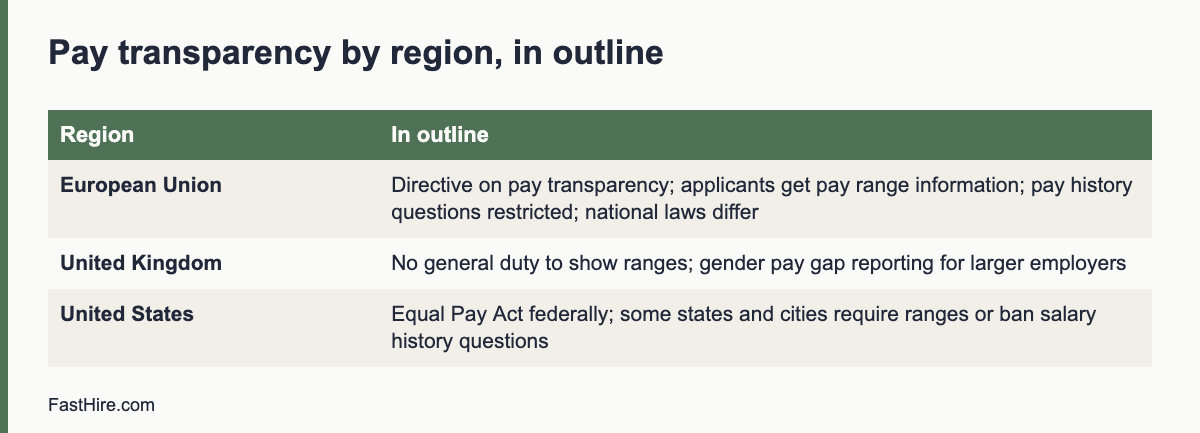
The picture by region
| Region | What exists (in outline) | Where to read |
|---|---|---|
| European Union | Directive (EU) 2023/970 on pay transparency and enforcement of equal pay. Among other things, it gives job applicants a right to receive information about the initial pay or its range, based on objective and gender-neutral criteria, before the interview or earlier, and it prohibits employers from asking applicants about their pay history. It also requires larger employers to report on pay gaps. Member states put it into national law, so national rules and timing differ | Directive (EU) 2023/970 on EUR-Lex; the EU’s Your Europe pages for employer information |
| United Kingdom | No general duty to publish pay ranges in job adverts. Employers with at least 250 staff must report their gender pay gap. The Equality Act 2010 covers equal pay between women and men for equal work | GOV.UK gender pay gap reporting guidance; Equality Act 2010 |
| United States | The federal Equal Pay Act bars sex-based wage discrimination for substantially equal work. Several states and cities also require pay ranges in job postings or bar salary history questions, with different rules on who is covered | EEOC: Equal Pay Act; check state and city labour department sites |
The table is a short orientation. Directives and statutes have conditions, definitions and exceptions. Read the official text for your case. For the EU, remember that a directive binds each member state to reach a result, and each country writes its own law. Check the status in every country where you hire, and ask a local adviser.
What this means for your hiring process
1. Put a pay range in every advert
Even where it is not required, a range helps. Write the range you are really prepared to pay for the role, not a wide band to cover every case. If the range is wide, explain what drives the position in it, such as skills or experience. Include other pay elements if they are a regular part of the package, such as bonus rules, and keep benefits listed clearly. Do not invent a range to meet a rule. A false range damages trust and may break the law.
2. Do not ask about pay history
Remove “current salary” from application forms, screening questions and interview guides. Train interviewers to avoid the question. If a candidate volunteers it, do not use it to set an offer. Instead ask about pay expectations in the context of the range: “The range for this role is X to Y. Is that in line with what you are looking for?” This keeps the focus on the job. In the EU, the directive restricts asking about pay history. Several US states and cities have similar rules.
3. Set pay from the role, not the person
Use a pay structure: levels, ranges, and criteria for placing someone in a range. Typical criteria are skills the role needs, relevant experience, scope of responsibility and market data. Write the criteria down and use them for every offer. Our guide on reading market data before you open a role explains how to gather the data, and the real cost to hire an employee explains related costs.
4. Check internal fairness before you make an offer
Compare the offer with people in similar roles. If the new hire will earn more or less than colleagues doing the same work, ask why. The reason should be job-related and written down. If not, adjust the offer or review existing pay. Differences linked to sex, race or other protected traits are a legal risk, and the EU directive adds duties around equal pay for work of equal value. The EEOC’s Equal Pay Act page and the UK Equality Act text set out the basic rules.
5. Prepare to answer questions
Employees and candidates will ask how pay is set. Prepare simple answers. A one-page explanation of your pay structure and the criteria for placement in a range is enough. Train managers to give the same answer, and agree who handles special cases.
A checklist for each role
| Check | Done? |
|---|---|
| Range set from the role, market data and internal comparison | |
| Reasons for the range and position in it written down | |
| Range shown in the advert or the first message to candidates | |
| No pay history question on forms or in interview guides | |
| Interviewers trained to avoid pay history | |
| Offer compared with colleagues in similar roles | |
| Local rules checked for the country, state or city of the job | |
| Reason for any difference from the range recorded |
Hiring across countries
If you hire in several places, you will face different rules. A simple approach is to follow the strictest rule for all roles: show a range, avoid pay history questions and document how you set pay. This reduces confusion for your recruiters and treats candidates the same everywhere. It does not replace local legal advice. Where pay data is personal data, such as the pay of a named employee, GDPR and similar laws apply. See our guide on hiring in another country.
Fairness beyond the posting
- Offer the same negotiation room to everyone. Do not reward only those who ask. Set a standard approach to negotiation and describe it.
- Review pay data by group where the law allows. Look at starting pay by role and level. Investigate gaps that you cannot explain by job-related reasons.
- Document exceptions. If you pay above the range for a reason such as a rare skill, record the reason and the approval.
- Be careful with promises. Do not tell a candidate “we will match your current pay” if that conflicts with your structure or local rules.
- Respect privacy. Do not share one person’s pay with another.
FastHire is being built to support evidence-based decisions at the screening stage. It shows each job requirement next to the exact CV passage that supports it. It does not rank, score or reject candidates. People make every decision. FastHire is coming soon.
Wording you can use
| Situation | Wording |
|---|---|
| In an advert | Pay range: [amount] to [amount] per [year / hour], depending on skills and experience. Bonus: [rule, if any]. Benefits: [list]. |
| In the first message to a candidate | The pay range for this role is [amount] to [amount]. Is this in line with what you are looking for? |
| If a candidate asks you to match their pay | We set pay from the role and our pay structure, not from earlier pay. For this role, the range is [amount] to [amount]. |
| If a candidate declines to say what they expect | That is fine. We will make an offer within the range based on the role and the skills you bring. |
| In an interview guide | Do not ask about current or past pay. If it is shared, do not record it and do not use it. |
A fictional example of setting an offer
This case is invented. A company hires a project coordinator. Its pay structure for the level has a range, and it has written criteria for placing someone in the range: relevant experience in coordinating projects of similar size, skill in the tools used, and the scope of the job. The recruiter writes a short note for the offer.
| Criterion | Evidence from the interview scorecard (fictional) | Placement |
|---|---|---|
| Project coordination experience | Led three projects of similar size in the last four years | Upper half |
| Tools | Uses the main tool and a related one; needs a short training on the reporting tool | Middle |
| Scope | The job fits the level; no extra duties | Middle |
| Internal comparison | Two current coordinators in the same range, similar experience | Offer within their band |
The note records why the offer sits where it does. If anyone later asks, the answer is written and tied to job-related criteria. The candidate’s earlier salary appears nowhere in the note.
Common mistakes
- A range too wide to be useful. “From low to very high” tells candidates nothing. Narrow it.
- A range that is not honest. Do not advertise a top figure that you will not pay in practice.
- Matching old pay. This copies past gaps into the new job.
- Hidden differences for similar roles. If two people do the same work, the reasons for different pay must be job-related.
- Telling the team nothing. When you introduce pay ranges, tell current employees first. Explain how they work, and answer questions.
- Treating pay talk as secret. In some places the law protects the right of employees to discuss pay. Check the rules.
Preparing your team
Hold a short training for recruiters and hiring managers. Cover the rules that apply to your locations, the pay structure and how to use it, how to answer a candidate who asks about pay, the questions never to ask, and where to record the reasons for an offer. Provide a one-page guide. Review it each year and when laws change. A short session now prevents awkward conversations and legal risk later.
Finally, keep records. For each hire, store the range, the placement criteria, the offer and the reasons for any exception, for the period your retention schedule allows. These records support equal pay checks and help you respond to questions from employees, candidates and regulators. Keep them in a restricted place, since pay data about named people is personal data. When laws change, update the template and the training, and note the date of the change in your procedure.
Frequently asked questions
Do I have to show a pay range in every job advert?
Not everywhere. Some US states and cities require it for covered employers, and the EU directive gives applicants a right to information on pay or its range, with details set by national law. The UK has no general duty. Even so, a range is good practice.
Can I ask about a candidate’s current salary?
In the EU, the directive prohibits asking about pay history. Several US states and cities ban it too. Even where it is legal, it can carry past pay gaps into the new job. Avoid it.
What if a candidate asks for more than the range?
You can negotiate within the rules of your pay structure, with a written reason for any exception. Keep the same approach for all candidates.
Does this apply to remote roles?
Often it depends on where the worker lives or where the employer operates. Rules for remote roles are complex. Take advice.
Where can I find the current rules?
Use the official sources linked above, and the labour department site of each state or national authority where you hire.
Related guides
- Hiring guides for fair and compliant hiring
- How to read market data before you open a role
- EU equal treatment in hiring
- UK Equality Act 2010 and recruitment
- All hiring guides for employers
- Pay transparency laws: what small employers must put in a job ad
This is general information, not legal advice.