

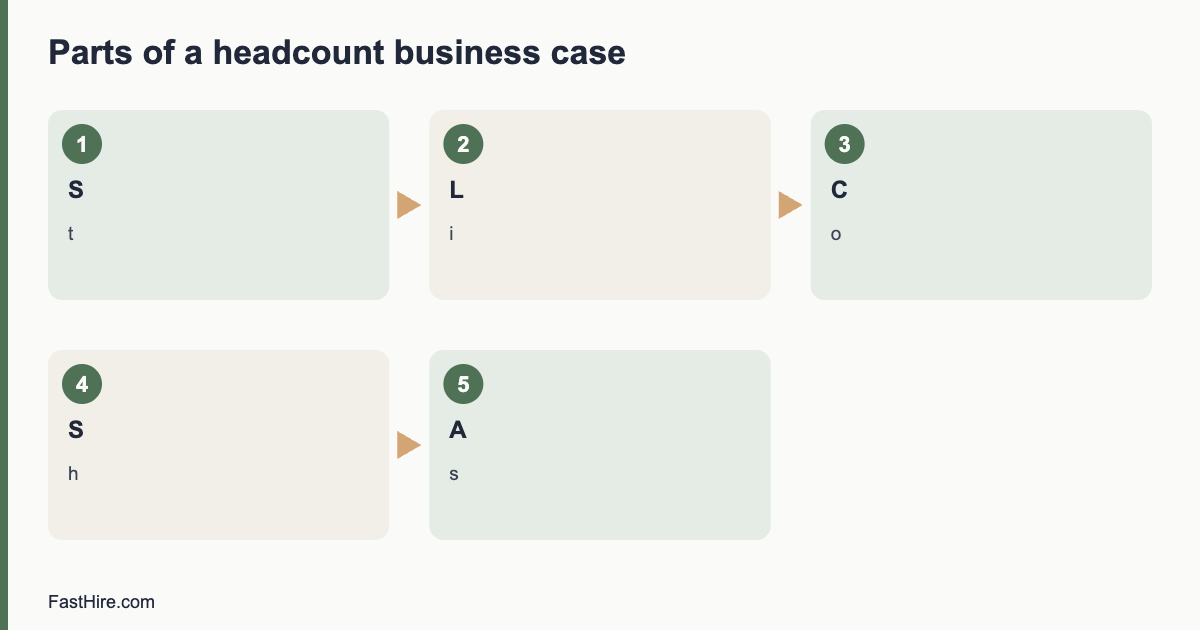
A headcount business case is a short document that asks for approval to hire. It states the problem, compares the options, costs the preferred option, shows the benefit and the risks, and asks for a clear decision. One page is often enough. This guide gives you the structure, the numbers to collect and a template to copy.
Key takeaways
- Start with the problem and its cost, not with the job title.
- Compare at least three options: do nothing, change how work is done, and hire. Show why hiring wins, if it does.
- Cost the full role: pay, taxes and benefits, tools, search, onboarding and ramp-up time.
- Use your own data and official sources. Do not invent figures.
- Name the risks and how you will check success at 90 days and six months.
Why a business case helps
Approvers must compare many requests with a limited budget. A request that says “we are busy, we need another person” gives them little to work with. A request that shows the problem, the cost of leaving it, the options and the plan makes the decision easier. It also helps you think. Sometimes the case shows that a different fix is better, and that is a good result.
Step 1: state the problem in numbers you can check
Describe what is going wrong, who it affects, and how you know. Use data from your own systems: hours of overtime, tickets waiting, late orders, lost sales, missed deadlines, customer complaints, time spent on tasks that someone else could do. Keep to figures you can show.
| Weak statement | Better statement |
|---|---|
| The team is overloaded. | The team logged overtime on most weeks of the last quarter, and a backlog of requests grew each month. Here is the log. |
| We lose customers. | We lost three accounts last quarter after slow response, according to exit notes in the customer system. |
| We need a specialist. | Two projects are on hold because no one on the team can do the data work. The projects are worth the amounts in the plan. |
If you do not have data, collect two weeks of it before you ask. A simple tally of tasks and hours is enough to start. If you use a number from outside your company, link to a trustworthy source, such as the US Bureau of Labor Statistics or the Eurostat labour market pages.
Step 2: list the options
Approvers will ask: why not do it another way? Answer the question before it is asked.
| Option | What it means | Main strength | Main weakness |
|---|---|---|---|
| Do nothing | Accept the current state | No cost | The problem continues or grows |
| Change the process | Remove or automate low-value tasks | Low cost, fast | May not be enough |
| Move work inside the company | Share the work with other teams | Uses existing people | Pulls capacity from other work |
| Use a contractor or agency | Buy capacity for a fixed time | Flexible | Higher hourly cost, less lasting knowledge |
| Hire an employee | Add a permanent role | Lasting capacity | Higher fixed cost, time to hire |
If you consider a contractor, read employee or contractor first, because the label does not decide the legal status.
Step 3: cost the preferred option
Cost the full role, not only the salary. The cost to hire an employee guide gives the list. A simple structure helps.
| Cost line | How to estimate | Source |
|---|---|---|
| Base pay | Midpoint of the range for the role and level | Your pay framework, official wage data |
| Employer taxes and contributions | Use the rate for your country and region | Tax authority or payroll provider |
| Benefits | Use the actual plan cost per person | Benefits provider |
| Tools and equipment | Quote from IT or suppliers | Internal quote |
| Search cost | Ad costs, recruiter fee if any, interviewer time | Your records |
| Onboarding and training | Manager and team time in the first months | Your estimate, with the method stated |
| Ramp-up | Period when output is below full level | Estimate, shown as a range |
For official compensation data in the US, the BLS publishes employer cost information at bls.gov/ecec. In the UK, see GOV.UK employing people for employer duties, and in the EU use national tax authorities and Eurostat. If you are not sure of a figure, give a range and say what it depends on.
Step 4: show the benefit
Link the benefit to the problem in step 1. If the problem was overtime, show the overtime removed. If it was lost sales, show the sales you expect to protect and your reasoning. Use ranges, not single numbers, and state the assumptions. Where you cannot give a number, describe the benefit in words and say how you will know it has happened.
- Direct benefit: hours saved, work completed, revenue protected or added.
- Indirect benefit: lower risk, better quality, less stress on the team, faster response.
- Time to benefit: when will the effect be visible, given the hiring time and ramp-up?
Be careful with claims. Do not promise that one hire will double output or solve every issue. Approvers trust a modest, well-argued case more than a bold one.
Step 5: name the risks
| Risk | How likely and how bad | What you will do |
|---|---|---|
| The hire takes longer than planned | Likely if the market is tight | Start early, agree interview dates up front |
| The person does not fit | Possible | Use structured interviews and a probation plan |
| Demand falls | Possible | Review at six months, consider a fixed-term or flexible contract if the law allows it |
| Budget changes | Possible | Phase the start date, agree a check point |
Naming risks does not weaken the case. It shows you have thought about what could go wrong.
Step 6: set success measures and a review date
Say how you will know the hire worked. Pick two or three measures from your problem statement, and set a target and a date. For example: backlog reduced to an agreed level by month six, overtime back to normal, or a project delivered by a set date. Add a review at 90 days and at six months.
Step 7: ask for a clear decision
End with a request that can be answered with yes, no or not yet: “I ask for approval to hire one analyst at the pay range shown, with a target start date of X, for the budget shown.” State what you will do next if the answer is yes, and what you will do if it is no.
One-page template you can copy
| Section | What to write |
|---|---|
| 1. Title and owner | Role, team, who is asking, date |
| 2. Problem | What is wrong, who it affects, the evidence (three to five lines) |
| 3. Options considered | Do nothing, process change, internal move, contractor, hire (one line each) |
| 4. Recommendation | Which option and why |
| 5. Cost | Table of cost lines, with a total range |
| 6. Benefit | Expected results, assumptions, time to benefit |
| 7. Risks and plan | Top three risks and responses |
| 8. Success measures | Two or three measures, targets, review dates |
| 9. Decision requested | The exact approval and the date needed |
Tips for a case that gets approved
- Use plain words. Short sentences. No jargon.
- Put the ask and the one-line reason at the top.
- Show the cost of waiting.
- Offer a smaller first step if the full request is large, such as a fixed-term role or a part-time start.
- Talk to the approver before you send it, so nothing is a surprise.
- Keep a copy of the case. It becomes the brief for the role.
Once approved, turn the case into a role brief and work with HR on the plan, as described in how to work with HR on a hiring plan.
Worked example (fictional)
A support lead at a software company logs that the team answered most tickets within a day last year, but in the last two quarters the median time grew and two large customers complained. The team worked extra hours in most weeks. The lead lists options: change the ticket form to cut repeat questions, share work with the onboarding team, use a temporary agency, or hire a support agent. The ticket form change would cut a part of the volume, so the lead recommends doing that first and hiring one agent. The cost table shows the pay range, taxes, benefits, tools, search and onboarding. The lead sets two measures: response time back to the earlier level by month six, and no regular overtime. The finance lead approves the hire with a review at 90 days.
How to answer the questions approvers ask
Expect questions. Prepare short answers before the meeting.
| Likely question | A good short answer |
|---|---|
| Why now? | Here is what the delay costs each month, with the evidence. |
| Why not a contractor? | A contractor costs more per hour and leaves with the knowledge. We use one for peaks only. |
| What if we cannot hire fast enough? | We have dates for interviews booked and a fallback plan using temporary help. |
| How will we know it worked? | Two measures, with targets and a review at 90 days and six months. |
| What if the work disappears? | We review at six months and have the contract terms checked against local law. |
Phasing the request when the budget is tight
If the full request is too large, offer a staged plan. Stage one might be a process fix and a fixed-term role. Stage two might be a permanent role once the measures are met. A staged plan lowers the risk for the approver and gives you a reason to come back with data. Be honest about what stage one can and cannot do.
Linking the case to fairness and compliance
Your case will lead to a job description and a hiring process. Build in fairness from the start. Write requirements that relate to the work, set a pay range that fits your pay structure, and plan an open process. This avoids rework later, and protects the company. The fair hiring hub lists the guides for each country.
What to do after approval
- Thank the approver and confirm the decision in writing, with the budget and the target start date.
- Turn the case into a role brief and a list of must-haves.
- Book the interview dates and the panel.
- Agree the pay range and the ad with HR.
- Set a date to review progress after 30 days of searching.
- Save the case. At 90 days and six months, compare the results with the measures.
At the review, be honest. If the benefit is smaller than planned, say so and explain what you learned. A track record of honest reviews makes your next request easier to approve.
Mistakes to avoid
- Asking for a job title instead of solving a problem.
- Using one big number with no range or assumptions.
- Leaving out the cost of onboarding and ramp-up.
- Skipping the options, so the approver suggests one you did not consider.
- Promising results that one person cannot deliver.
- Forgetting to set a review date, so no one checks if the hire worked.
Read your case aloud before you send it. If a sentence sounds like a slogan, replace it with a fact. If a number has no source or method, add one or remove it. A calm, honest case is the easiest one to approve, and it helps the hiring process that follows.
Frequently asked questions
How long should a headcount business case be?
One page is often enough, with a short appendix for the numbers. Longer is fine for a large request, but start with a one-paragraph summary.
What if I do not have data?
Collect a few weeks of simple data before you ask, such as tasks, hours and delays. Even rough numbers with a stated method are better than none.
Should I include the cost of search and onboarding?
Yes. They are real costs, and approvers know it. Leaving them out can damage trust later.
What if the request is declined?
Ask what would change the answer, and agree a smaller step or a date to ask again. Keep the case up to date.
Related guides
This is general information, not legal advice.