

The best hiring plans split the work clearly: the hiring manager owns the need, the criteria and the decision, and HR owns the process, the legal checks, the pay framework and the candidate record. Agree these roles, the headcount, the approvals and the timeline in the first meeting, write them down, and review progress every week. This guide shows how.
Key takeaways
- Meet HR before you post the job, not after. Bring the problem, the budget and the date you need the person.
- Use a RACI table to say who is responsible, accountable, consulted and informed at each step.
- Agree the pay range, the approval path and the timeline in writing.
- Keep one shared tracker so both sides see the same status.
- People make the final decision. HR checks the process and the legal side, and the manager chooses the person.
Why the hiring manager and HR clash
Most friction comes from unclear roles. The manager thinks HR is slow. HR thinks the manager skips steps. Both are partly right. A manager wants a person quickly. HR wants a fair, legal, consistent process that can be defended later. Neither goal is wrong, and a shared plan can meet both.
In a small company there may be no HR team. If that is your case, use this guide to split the work between the manager, an owner and any outside adviser, and read how to hire without HR.
Step 1: agree the need before you ask for headcount
Start with the problem, not the job title. What work is not getting done? What does it cost? What would change if it were done? HR can help test the answer. They may know of existing staff with spare capacity, of contractors, or of a different job design that solves the same problem.
Bring a short headcount business case to the meeting. It should cover the problem, the options, the cost, the benefit and the risks. A clear case speeds up approval.
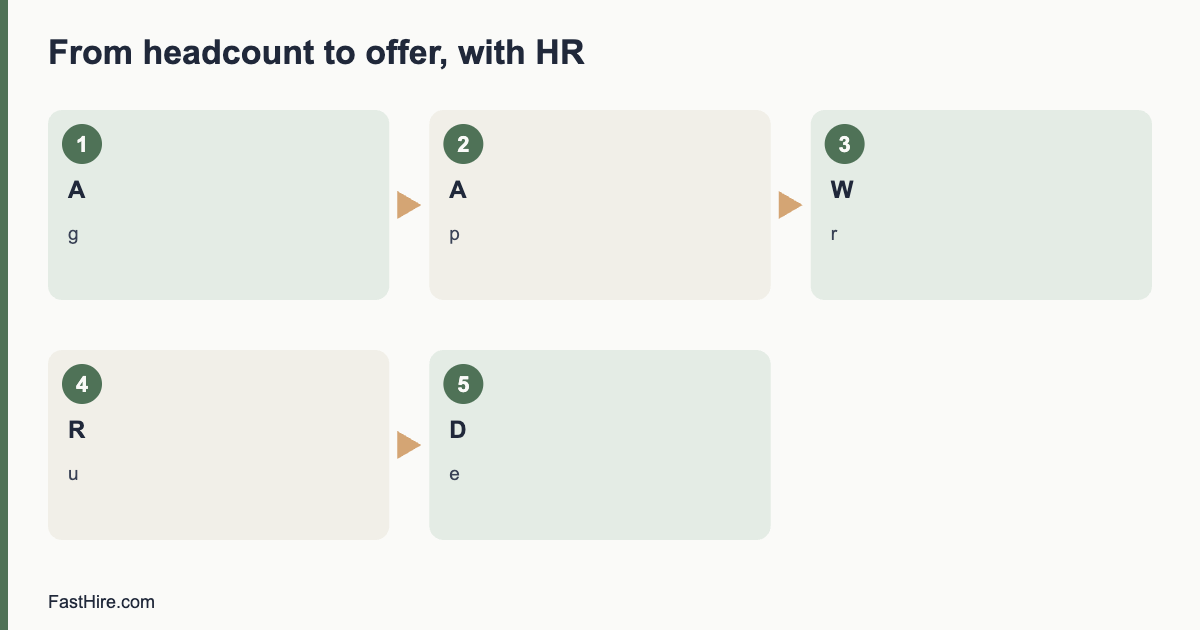
Step 2: set roles with a RACI table
RACI stands for responsible, accountable, consulted and informed. Write the names next to each step so that nothing falls between two people.
| Step | Hiring manager | HR | Finance | Candidate-facing team |
|---|---|---|---|---|
| Confirm need and budget | A | C | R | I |
| Set pay range | C | A/R | C | I |
| Write role brief and must-haves | A/R | C | I | I |
| Write and post the ad | C | A/R | I | I |
| Screen applications | A | R (process) | I | R |
| Interviews and scoring | A/R | C (training, process) | I | R |
| Reference and background checks | C | A/R | I | I |
| Offer and contract | A | R | C | I |
| Onboarding plan | A/R | R | I | R |
Adapt the names to your company. In some firms recruiters sit inside HR. In others they work in a separate team. The idea is the same: one person is accountable for each step, and everyone knows who that is.
Step 3: agree pay, level and approvals
HR usually holds the pay framework and the approval path. Ask before you talk to any candidate: what is the pay range for this level? Who must approve an offer above the middle of the range? What documents does finance need? How long does each approval take?
Our guide to setting a fair salary shows how to build a range. If you plan to post the range, check the rules in salary in job ads.
Step 4: write the brief and the ad together
The manager knows the work, and HR knows the language and the legal limits. Write the role brief together, then the ad. HR can check that requirements are job-related, that the wording is neutral, and that the ad includes required statements. The manager can check that the requirements match the real work. See also how to write checkable job requirements.
Step 5: build the timeline together
A realistic timeline protects the relationship. Work backwards from the date you need the person, and add the time for notice periods, checks and onboarding.
| Stage | Typical owner | Time to plan for |
|---|---|---|
| Headcount approval | Manager and finance | Agree in advance |
| Brief and ad ready | Manager and HR | A few days |
| Application window | HR | 1 to 3 weeks, set in advance |
| Screening | Manager and HR | Within days of closing |
| Interviews | Manager | Set dates before you post |
| Decision and offer | Manager and HR | Within days of last interview |
| Checks and notice | HR and candidate | Depends on the country and the notice period |
Read how long hiring takes for a fuller view. Block the interview dates in diaries before you post the ad. It is the single best way to cut delay.
Step 6: share one tracker
Use one spreadsheet or tool that both sides can see. Keep it simple: one row per candidate, with the stage, the date of the last action, the next action and the owner. Update it daily. Do not keep a private list.
- Candidate name or ID
- Source
- Stage
- Date of last action
- Next action and owner
- Decision and reason (short, linked to the requirements)
A shared tracker makes the weekly check-in short. It also gives you the data to improve the next hire. Our hiring dashboard spreadsheet is a good starting point.
Step 7: run a weekly check-in
Hold a 20 minute meeting once a week while the role is open. Use the same agenda each time.
- Where are we against the timeline?
- Which candidates need a decision this week?
- What is blocked, and who can unblock it?
- Do the scores show a pattern, such as strong candidates dropping out at one stage?
- What do we change for next week?
What each side should expect from the other
What HR should expect from the manager
- A clear need, with the budget and approval in hand.
- Timely feedback on candidates, within one or two working days.
- Use of the agreed process, including the same questions and scoring for everyone.
- Written reasons for each decision, tied to the requirements.
- No promises to candidates about pay, title or start date before approval.
What the manager should expect from HR
- A named contact and a stated response time.
- Clear guidance on pay, legal limits and policy, in plain words.
- Quick checks and clear steps for offers.
- Training for interviewers when needed.
- A good candidate experience, with updates and a respectful rejection message.
Legal and fairness checks that HR will raise
Expect HR to raise points that protect both the company and the candidates. Treat these as part of good hiring, not as obstacles.
- Job requirements must relate to the work. See the EEOC guidance on prohibited practices for the US, and GOV.UK employing people for the UK.
- Questions in interviews must avoid protected topics. Our interview questions you cannot ask guide lists them.
- Candidate data must be handled with care. See GDPR for job applicants.
- Reasonable adjustments must be offered when needed. See reasonable adjustments in interviews.
Common problems and fixes
| Problem | Likely cause | Fix |
|---|---|---|
| Role posted late | Approvals started after the need was urgent | Start the case early, agree approvals in advance |
| Offer rejected on pay | Range not agreed before the process | Agree the range and the approval path in step 3 |
| Candidates drop out | Slow updates | Set a response time and use templates |
| Manager skips HR steps | Pressure to move fast | Make the steps short and agree which can run in parallel |
| HR becomes the bottleneck | Too many tasks sit with one person | Review the RACI table and move tasks to the right owner |
Worked example (fictional)
A product manager needs a new analyst by the start of the next quarter. In the first meeting with HR, she brings the business case, the pay range from the framework, and a list of three dates she can interview. HR confirms the approval path, which needs two signatures, and starts it that day. They write the brief together, and HR flags that one requirement, a degree, is not needed for the work. The manager changes it to a list of skills she can check on a resume or CV. They agree a two-week application window, use a shared tracker and meet each Monday for 20 minutes. The offer goes out on time, and the new analyst starts with a plan for the first 30 days.
How to brief HR on a role so they can help
HR can do much more when the brief is clear. Bring a one-page summary to the first meeting. It should answer the questions below in plain sentences, not in jargon.
- What problem does this role solve, and how will we know it is solved?
- What are the three to five things the person must be able to do on day one?
- What can we teach, and how long will it take?
- What is the budget, and who has approved it?
- When do we need the person, and what is the latest date that still works?
- Which team members will take part in interviews, and when are they free?
- Is there an internal candidate, and how will we treat that person fairly?
If you cannot answer one of these, say so. HR can help you find the answer, but they cannot guess it. A clear gap in the first meeting is better than a surprise in week four.
Handling disagreements about the process
Disagreements are normal. A manager may want to skip a step to save time. HR may want to add a step to reduce risk. Settle these with three questions. What is the risk of skipping or adding this step? Who bears the cost if it goes wrong? Is there a lighter way to get the same protection? For example, a long background check might be replaced by a short, targeted one for a low-risk role, if policy and law allow it.
Write down the decision and the reason. Over time, these notes become your own playbook, and the same argument does not return for every hire.
Working with HR when hiring across countries
If the hire is in another country, HR often needs more time. Rules on contracts, notice, right to work and data differ by country. Raise this in the first meeting, and read how to hire in another country and how to check the right to work. Ask HR whether you need a local entity, an employer of record or a local adviser, and add the extra time to the plan.
A one-page hiring plan template
| Item | Details to fill in |
|---|---|
| Role and level | |
| Reason for hire and expected result | |
| Budget and pay range | |
| Approvers and dates | |
| Hiring manager and HR contact | |
| Interview panel and dates | |
| Source plan (channels) | |
| Start date target | |
| Risks and fallback plan |
Keep this plan in the shared tracker and update it as things change. At the end of the hire, review it. What took longer than planned? What did HR do that saved time? What would you change? These notes make the next plan better.
Keeping candidates informed
While you and HR plan, the candidate waits. Agree who sends updates, how often and in what words. A short message every few days, even when there is no news, keeps good candidates from leaving. Use templates for the common cases: application received, moving to interview, decision delayed, and rejection with thanks. The candidate update email cadence guide shows a simple schedule, and the rejection email guide shows kind wording.
Frequently asked questions
What if my company has no HR team?
Split the roles between the manager, an owner or office lead, and an outside adviser for legal and payroll questions. Write down who does what.
How early should I contact HR?
As soon as you think you may need a new person. Early talks let HR check budget, approvals and options before the clock starts.
Who makes the final hiring decision?
The hiring manager makes the decision, using the agreed criteria. HR checks the process and the legal side, and the pay framework.
What if HR and I disagree about a candidate?
Return to the written requirements and the scores. If the disagreement remains, involve a senior leader and record the reason for the final decision.
Related guides
This is general information, not legal advice.