
A good rejection email is prompt, short, kind and clear. Say that the application did not move forward, thank the person for their time, give a brief and honest reason where you can, and leave the door open if it is true. Send it to everyone, and never leave an applicant waiting in silence.
Key takeaways
- Send an outcome to every applicant. Silence is the message candidates remember most.
- Match the message to the stage: after screening, after a call, after interviews, after a final round.
- Be honest and neutral. Do not invent reasons, and do not give details that open arguments or risk legal claims.
- Offer useful feedback to people who gave you more of their time, within your capacity.
- Only invite people to a talent pool if they agree, and only say “keep in touch” if you mean it.
Why the message matters
For the candidate, a rejection is personal, even when the process is fair. For your company, it is one of the few moments when you speak to a large group of people who may become customers, colleagues or referrers. A clear and respectful message shows how you treat people. Silence does the opposite, and it is one of the most common complaints from job seekers. See our guide on how to avoid ghosting candidates and the candidate experience checklist.
Principles
- Be prompt. Send the message as soon as the decision is made. Do not hold rejections until the role is filled, unless you tell candidates that is your plan.
- Be personal where it counts. Use the name and the role title. A mail merge is fine if it reads naturally.
- Be brief. Four to eight sentences is enough for most stages.
- Be honest. Do not say “we will keep your CV on file” unless you will, and the person agreed. Do not say “you were very close” if it is not true.
- Be consistent. Use a standard structure for each stage, so that people in the same situation get the same quality of message.
- Be careful with reasons. A short, job-related reason is kind. A long list of faults is not. Avoid any reference to personal characteristics.
- Make a human available. Give a contact for questions, and answer them.
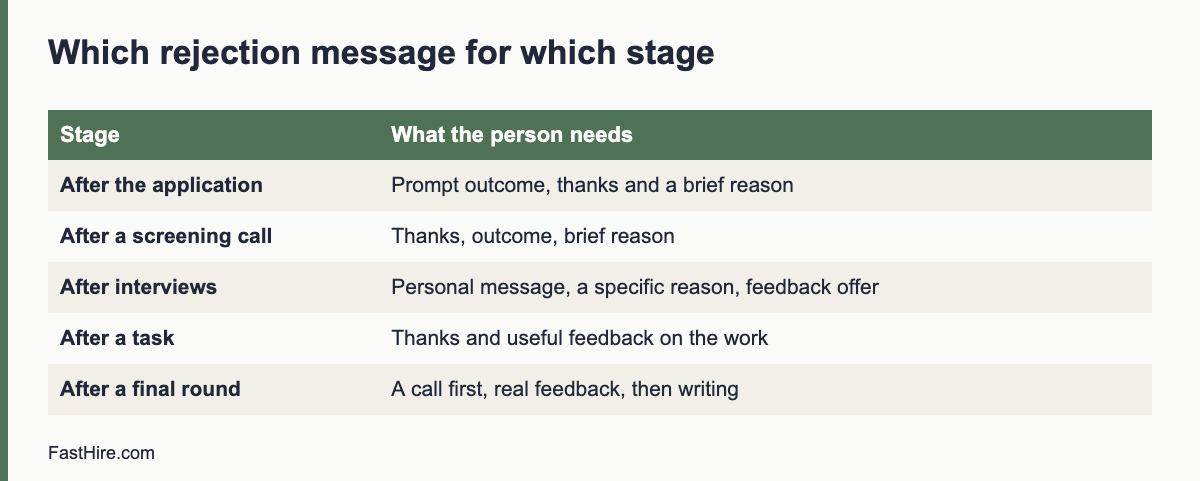
Which message for which stage
| Stage | What the person has given | What they need to hear |
|---|---|---|
| After the application | A few minutes | A clear outcome soon after you decide; thanks; a brief reason such as “we chose applicants whose experience was closer to the requirements” |
| After a screening call | 30 minutes | Thanks for the conversation; the outcome; a brief reason |
| After interviews | Several hours | A personal message from the hiring manager or recruiter; a specific reason; an offer to share feedback |
| After a task or test | Time and effort | Thanks for the work; the outcome; useful feedback on the task |
| After a final round | The most | A phone call, then an email; real feedback; sincere thanks |
Templates
1. After the application
Subject: Your application for [role]
Hello [Name],
Thank you for applying for [role] at [Company]. We read every application with care.
We have decided not to take your application forward. For this role, we chose to continue with applicants whose experience was closer to the requirements in the advert.
We appreciate your interest, and we encourage you to look at our other roles at [link] if they fit your skills.
We wish you well in your search.
Kind regards,
[Name, role]
2. After a screening call
Subject: Your application for [role]
Hello [Name],
Thank you for taking the time to talk with me on [day]. I enjoyed learning about your work on [specific topic].
After the call, we have decided not to move your application to the next stage. We are continuing with candidates whose recent experience matches [one named requirement] more closely.
If you would like a short note on how we reached this decision, reply to this email and I will send one.
Thank you again, and good luck with your search.
[Name, role]
3. After interviews
Subject: Your interview for [role]
Hello [Name],
Thank you for the time and effort you put into the interviews for [role]. It was a pleasure to meet you, and we appreciated your examples about [specific topic].
We have decided to offer the role to another candidate. The decision was close, and the main difference was [one job-related reason, such as experience leading projects of the size we need].
I would be glad to share more feedback if you would like it. Reply to this message or call me on [number].
We will keep your details only for the period in our privacy notice, and we would like to stay in touch only if you want that. Reply “yes” if you would like us to tell you about future roles.
Thank you again,
[Name, role]
4. After a task or test
Subject: Your task for [role]
Hello [Name],
Thank you for completing the task for [role]. We know it took time.
We have decided not to continue with your application. In the task, we looked for [two criteria]. Your submission showed [one strength], and we saw less evidence of [one gap].
If you have any questions about the feedback, please write to me.
We wish you the best,
[Name, role]
5. The call before the final email
For final-stage candidates, call first. Say the decision in the first sentence. Do not start with small talk, because the person will be waiting for the answer. Then give two specific points of feedback and thank them. Follow with a short written message so they have it in writing. This takes ten minutes and builds goodwill that lasts.
What to leave out
| Avoid | Why | Say instead |
|---|---|---|
| “We found someone better.” | It hurts and it is rarely helpful | “We chose to continue with another candidate whose experience was closer to the requirements.” |
| “Your CV was weak.” | Vague and unkind | Name the requirement that was not shown |
| “We will keep your CV on file.” | Often untrue, and a data protection risk | “We will delete your data by [date]. If you would like us to keep it for future roles, reply yes.” |
| “You were overqualified.” | Can read as age-related | Describe the match with the role needs |
| “We want someone who is a better fit.” | Unclear, and may hide bias | Use specific, job-related reasons |
| Any reference to age, health, family plans, nationality or other personal traits | Risky and unfair | Never mention these |
Legal and data points
Rejection messages are not a place for legal commentary, but a few points matter. Keep the reason consistent with the real reason in your records. If a candidate later challenges a decision, your notes and your email should match. In the UK and EU, candidates can ask for the personal data you hold about them, including notes, so write with that in mind. See our guides on GDPR for job applicants and retention of rejected applicant data. The Equal Employment Opportunity Commission describes unlawful practices on its page on prohibited employment policies and practices, and Acas covers the position in Great Britain on its recruitment page.
Do not offer feedback that you cannot give consistently. If you share detailed feedback with some candidates, offer the same service to others at the same stage. Give feedback from the evidence you recorded, not from memory.
Set up a system that scales
- Build templates in your applicant system for each stage, with the merge fields for name, role and company.
- Set a service level. For example, “every applicant gets an outcome within an agreed number of days after the decision”. Choose your own number and track it in your dashboard.
- Review the wording twice a year. Ask a few declined candidates, with their permission, how the message felt.
- Train managers. Many managers avoid writing rejections. Give them templates and a short call script.
- Keep a feedback bank. A short list of approved, honest reasons by requirement makes personal feedback quicker.
FastHire is being built so that decisions rest on the exact CV passage behind each requirement. That makes it easier to give a short, honest reason when someone asks. FastHire is coming soon. It does not rank, score or reject candidates. People make every decision, and people write the message.
A feedback bank you can reuse
Personal feedback takes time. A short bank of approved reasons, linked to your requirements, makes it faster and more consistent. Write each line so that it describes the evidence and not the person.
| Requirement | If the evidence was strong | If the evidence was limited |
|---|---|---|
| Handles customer emails | “Your examples showed clear, calm writing to customers.” | “We saw fewer examples of written work with customers than we needed for this role.” |
| Produces regular reports | “You described a weekly report with a clear audience and purpose.” | “We did not see a regular reporting task described in your examples.” |
| Works with other teams | “You gave a good example of coordinating with two other teams.” | “We would have liked more examples of working across teams.” |
| Leads or coaches | “You described coaching two colleagues and the result.” | “The role needs more experience leading others than your examples showed.” |
Do not say “you lacked confidence”, “you seemed nervous” or anything about manner unless the job clearly requires that and you can describe the observed behaviour. Never refer to age, health, accent, family or any protected trait. If a reviewer wrote such a comment in their notes, raise it with HR before you use the notes.
Timing: a simple rule set
| Situation | Suggested timing (set your own) |
|---|---|
| Screened out on the written application | Within an agreed number of working days after the decision |
| Declined after a call | Within one to two working days |
| Declined after interviews | Within one working day of the decision, with a call for final-round candidates |
| Role closed or put on hold | Tell everyone still in the process as soon as you know |
| Offer accepted by another candidate | Tell the other finalists after the acceptance is confirmed, and quickly |
The timings in this table are suggestions. Pick numbers that your team can meet, publish them to candidates, and track whether you meet them. A commitment you keep is better than a fast promise you break.
If you have hundreds of applicants
High volume does not remove the duty to reply. It changes how you do it. Use a merge template, send it in batches, and make the wording honest: “We received many applications for this role, and we are not able to give individual feedback at this stage.” Link to a page with tips on how applications are assessed, so applicants can improve for the next time. For the volume process itself, see screening at volume.
Frequently asked questions
Should I tell a candidate why they were rejected?
Give a brief, job-related reason when you can. For people who invested time in interviews or tasks, offer more detailed feedback. Keep it tied to the evidence you recorded.
Is it risky to give feedback?
Feedback based on job-related evidence and your written criteria is usually safer than vague or inconsistent answers. Avoid any comment on personal traits. Ask HR or a lawyer if you have concerns.
What if a candidate replies with anger?
Respond once, calmly, with thanks and a restatement of the decision. If the person becomes abusive, you do not need to continue. Pass concerns about unfair treatment to HR.
Should I send rejections in bulk?
Yes for early stages, using a merge template. For later stages, write personally.
Can I say we will keep their details?
Only if you will, and if you have a lawful basis. In the UK and EU, ask for consent first. See our guide on talent pools with consent.
Related guides
- Hiring guides for recruiters and HR teams
- How to avoid ghosting candidates: a simple service standard
- Candidate experience checklist
- Candidate update email cadence
- All hiring guides for employers
- How to give useful feedback to rejected candidates
This is general information, not legal advice.