
You can hire well without an HR team if you write the role down, use one simple process for every candidate, keep short records and give each task a named owner. HR teams add structure and memory. A small business can add the same two things with a spreadsheet, a shared inbox and a few templates.
Key takeaways
- Give hiring one owner and one backup. Unowned tasks are the main reason small teams lose good candidates.
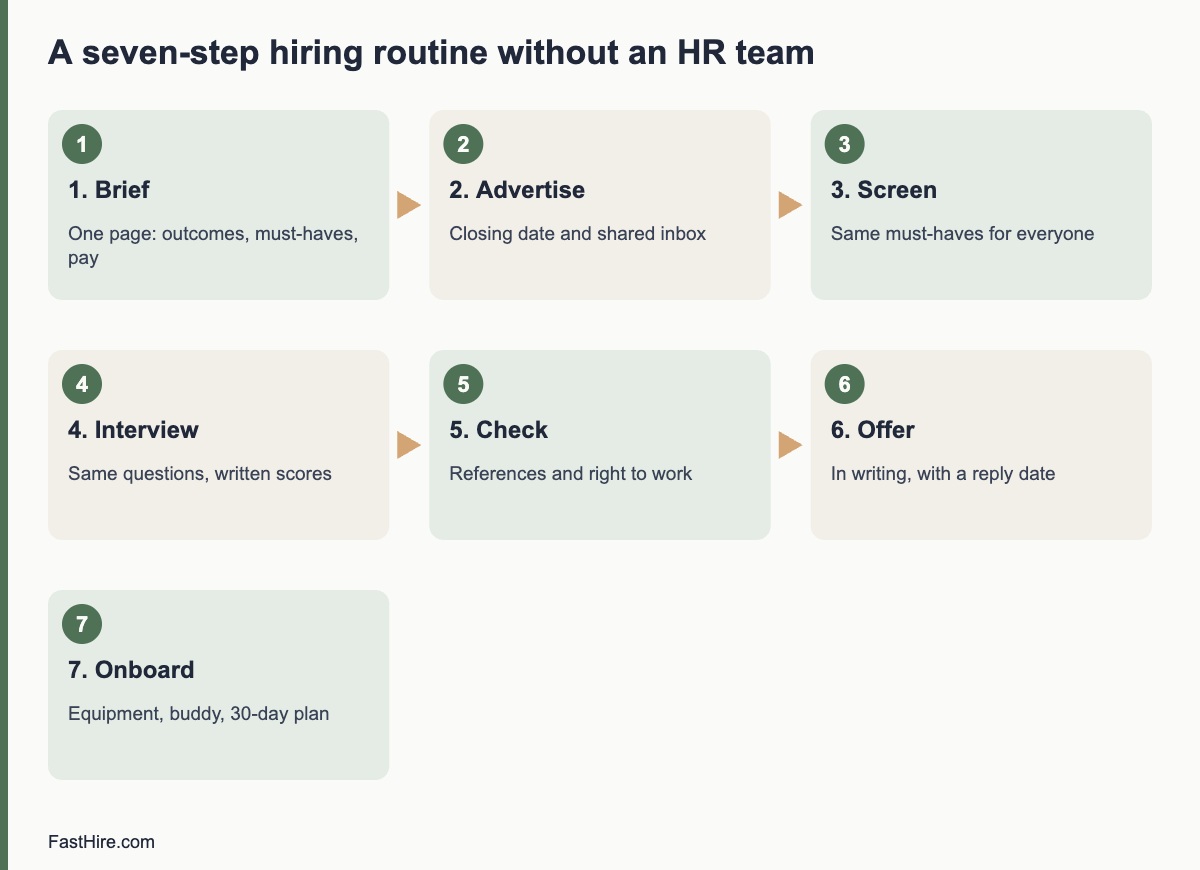
- Use a seven-step process every time: brief, advertise, screen, interview, check, offer, onboard.
- Keep three records: the role brief, a candidate sheet and interview notes.
- Treat law as a checklist by country: right to work, written terms, payroll registration and non-discrimination.
- Ask an accountant, payroll provider or employment adviser for what you cannot check yourself.
What an HR team normally does for you
Before you build a process, it helps to know what you are replacing. In a company with an HR team, HR usually covers these jobs.
- Structure: a standard way to open a role, approve it and close it.
- Writing: job descriptions, ads, offer letters and contracts.
- Fairness and law: consistent questions, non-discrimination, right-to-work checks and written terms.
- Records: who applied, who was interviewed, why decisions were made and when data was deleted.
- Onboarding: accounts, equipment, payroll set-up and a first-week plan.
- Memory: what worked last time and what to change.
You do not need a department for any of these. You need a repeatable routine and a place to write things down.
Step 1: Name an owner and set the ground rules
Choose one person to run each hire from start to finish. In a very small business, that is the founder or the office manager. Choose a backup who can answer candidates if the owner is away. Then write three rules on one page.
- Speed: every applicant gets a first reply within a set time, for example five working days.
- Fairness: every candidate for the same role is judged on the same written must-haves and gets the same core questions.
- Records: the owner keeps one folder per role with the brief, the candidate sheet and the interview notes.
Step 2: Write a one-page role brief
The brief is the most useful document in hiring. It keeps you honest when a charming candidate turns up. Keep it to one page with five parts: the purpose of the role, three to five outcomes for the first 90 days, the main tasks, the must-haves and the working conditions including the pay range.
Keep the must-haves short and checkable. “Two years of bookkeeping work in any setting” can be checked in a CV. “Great attitude” cannot. Our guides on must-haves and nice-to-haves and checkable job requirements show how.
Step 3: Advertise in a way you can manage
Post the job where your future colleagues look, and set a closing date. A closing date lets you read all applications together. Use a shared email address, such as jobs@yourcompany, so that applications do not sit in one person’s inbox. Add one question to the application, for example “Tell us about a time you solved a problem like the one in this role”, so that you can see how people write and think.
Write the ad from the brief. For a worked example, see our first hire plan. Avoid wording that points to a protected group. The US Equal Employment Opportunity Commission explains the rule on job ads on its page about prohibited employment policies and practices.
Step 4: Track every candidate in one sheet
A spreadsheet is enough for a small business. Use one row per candidate and these columns.
| Column | What to write | Why it matters |
|---|---|---|
| Name and contact | As given by the candidate | So that you can reply |
| Source | Where they found the ad | Shows which channels work |
| Must-have 1 to 5 | Yes, no or unclear, with a note from the CV | Shows the evidence behind each decision |
| Stage | Applied, screened, interviewed, offered, declined, rejected | Shows what to do next |
| Last contact date | The date you last wrote to them | Prevents candidates from waiting without news |
| Delete by | The date you will delete their data | Supports data protection rules |
Share the sheet only with the people who need it. It holds personal data, so protect it with a password or access control and delete it on schedule. In the UK and the EU, data protection law applies to applicants. The UK Information Commissioner’s Office explains the rules in its guidance on recruitment and selection.
Step 5: Screen and interview the same way each time
Screen against the must-haves only. Then plan six to eight interview questions that match the outcomes in the brief. Ask each candidate the same questions in the same order. Write notes during or straight after the interview. Score each answer on a simple scale, such as 1 to 4, and write one sentence about what the person said or did.
A small business can run this with two people in the room: one asks, one writes. Afterwards, each person scores alone before you compare. This reduces the pull of the first strong impression.
Step 6: Make the checks you need
Checks protect you and the candidate. Keep them short, and make the same checks for everyone in the same role.
- References: ask permission first, and ask each referee the same questions.
- Right to work: this is a legal duty in the US, the UK and EU member states, and the method differs. In the UK, follow the GOV.UK guide to checking a job applicant’s right to work. In the US, you complete Form I-9 after hiring.
- Qualifications or licences: check only those that the role really needs.
Step 7: Make the offer, then onboard
Confirm the offer in writing with the job title, start date, pay, hours, location, notice period and any probation period. Then complete the legal set-up. The US Small Business Administration lists the main steps for US employers. The GOV.UK recruiting and hiring page lists them for the UK. In the EU, the rules are national, so ask your payroll provider or labour authority.
Prepare day one before the person arrives: equipment, accounts, a buddy and a first-week plan. Our first hire plan has a simple 30-day structure.
Who does what: a simple split for a small team
| Task | Owner | Backup or helper |
|---|---|---|
| Role brief | Hiring owner with the future manager | Founder |
| Ad and applicant inbox | Hiring owner | Office manager |
| Screening | Hiring owner and the future manager separately | Second reviewer for a sample |
| Interviews | Future manager and one other person | Hiring owner |
| Right-to-work and payroll set-up | Office manager or founder | Accountant or payroll provider |
| Contract and legal questions | Founder | Employment adviser or lawyer |
When to bring in outside help
You do not have to do everything yourself. Pay for help with the parts where an error is costly or hard to see: employment contracts, dismissals, immigration or visa questions, pay and benefits law, and anything that looks like a discrimination claim. In the UK, the free helpline and guides at Acas are a good first place to look for recruitment questions.
Common mistakes when you have no HR team
- Hiring by conversation only. Without notes, you remember the best talker, not the best candidate.
- Changing the requirements after you have met someone you like. Write the must-haves first and keep them.
- Letting applicants wait. Silence loses good people and harms your reputation.
- Keeping every resume forever. Set a deletion date and follow it.
- Skipping the written offer. A verbal promise causes disputes later.
A weekly rhythm that keeps hiring moving
Set a fixed 30-minute slot each week while a role is open. Use it to read new applications, update the sheet, send replies and book interviews. In most small teams, speed comes from this rhythm, not from more tools.
FastHire is being built to help with the reading step, by showing each job requirement next to the exact CV passage that supports it. FastHire is coming soon. It does not rank, score or reject candidates. You and your team make every decision.
Templates you can copy today
Short, plain messages save time and treat candidates with respect. Adapt the wording to your own voice.
1. Acknowledging an application
Subject: Your application for [role]
Hello [name],
Thank you for applying for [role] at [company]. We close applications on [date]. You will hear from us by [date], whether or not we invite you to interview.
If you need any adjustment to take part in the process, such as a different interview format or extra time, please tell us and we will arrange it.
[Your name]
2. Inviting a candidate to interview
Subject: Interview for [role] on [date]
Hello [name],
We would like to invite you to an interview for [role]. It will take about 45 minutes, on [date] at [time], at [place or video link]. You will meet [names and job titles].
We will ask about your recent work and how you would handle examples from this role. You do not need to prepare slides or tasks. If another time or format would suit you better, tell us and we will find one.
[Your name]
3. Declining a candidate after interview
Subject: Your interview for [role]
Hello [name],
Thank you for the time you gave us. We have decided to continue with another candidate, whose experience matched the role more closely on [one specific, job-related reason].
We liked [one real strength]. If you would like short feedback, reply to this message and we will send it.
[Your name]
4. A one-page interview note template
| Field | What to write |
|---|---|
| Candidate and date | Name, role, interviewer |
| Question 1 to 6 | What the candidate said they did, in one or two lines |
| Evidence for each must-have | Quote or note from the interview or CV |
| Score for each answer | 1 to 4, using the same scale for every candidate |
| Open questions | What you still need to check, for example a reference |
| Recommendation | Move on, hold or decline, with the reason in one sentence |
A worked example: a six-person design studio hires an office manager
A studio with six people has no HR team. The founder, Lena, owns hiring and her colleague Tom is the backup. Lena writes a one-page brief: purpose (keep the office running so designers can focus), three outcomes (invoices sent weekly, supplier orders on time, a tidy calendar), five must-haves (one year of administration work, clear writing, accuracy with numbers, comfort with spreadsheets, availability five days a week) and a pay range.
She posts the ad for two weeks. Forty-one people apply. She reads them in one sitting against the five must-haves and marks yes, no or unclear. Twelve have all yes marks and four have unclear marks. She sends the four a single question by email. Three answer, so fifteen candidates move on. Tom and Lena each phone-screen for 15 minutes using three questions. Six candidates reach a one-hour interview with the same eight questions. They score alone, then meet for 20 minutes to compare notes. Two candidates tie, so they use a short paid task that mirrors real work: tidy a messy supplier list in 30 minutes. Lena checks two references for the top candidate and sends a written offer. This sample is an illustration only. The numbers are invented to show the flow, not results from any study or customer.
The whole process takes about five weeks, including the notice period. No special software is used. What makes it work is the written brief, the shared sheet and the same questions for everyone.
Frequently asked questions
Do I need HR software to hire without an HR team?
No. A spreadsheet, a shared inbox and a calendar are enough for most small teams. Consider software when you run several roles at once or when the sheet becomes hard to protect and keep tidy.
What is the minimum paperwork for a hire?
You should keep the role brief, the candidate sheet and your interview notes, plus a written offer and the legal documents your country requires, such as right-to-work checks and written terms.
How do I keep hiring fair without an HR person?
Use the same written must-haves and the same questions for every candidate, score each answer on a fixed scale and record your reasons. Do not ask about protected characteristics.
Who should interview candidates?
The future manager and one other person who understands the role. Two interviewers make notes more reliable and reduce the effect of personal preference.
How long should I keep applicant data?
Keep it only as long as you need it, and set a deletion date. Rules differ by country, so check your regulator’s guidance. In the UK, see the ICO page linked above.
Related guides
- Hiring guides for small businesses and founders
- How to make your first hire: a step-by-step plan for founders
- Must-haves vs nice-to-haves: cutting your applicant pile without unfair filters
- All hiring guides for employers
- How to write a job ad that attracts the right applicants
- How to screen applications quickly: a 20-minute method for small teams
- How much does it cost to hire an employee? A cost worksheet
- How to avoid hiring friends and family by mistake
- How to hire for culture without hiring clones
This is general information, not legal advice.