
Hiring takes as long as the slowest step you do not plan. For a small team, a realistic plan has six stages: prepare the role, advertise, screen, interview, decide and offer, and wait for the start date. This guide shows a week-by-week template, where time is usually lost, and how to shorten each stage without cutting fairness. The times here are planning assumptions, not statistics.
Key takeaways
- Plan the whole journey, from role brief to start date, before you open the job.
- The longest delays are usually waiting for decisions, scheduling and notice periods, not reading CVs.
- Use a planning template to the start date, then replace it with your own measured times after your first hire.
- Set a closing date, a screening day, interview slots and a decision date in advance.
- Keep candidates informed at each stage. Silence loses good people.
Two clocks: time to hire and time to start
People use “how long does hiring take” to mean two different things. Time to hire is the time from opening the role to the candidate accepting the offer. Time to start adds the notice period that the candidate must serve at their current job. In some countries notice periods are short, and in others they are several months. The notice period is not under your control, so ask about it early. Our first hire plan shows where each step fits.
Be careful with published averages. Different sources count different things, and the numbers vary by industry, role and country. If you quote a statistic, link it to a source. In this guide we offer planning assumptions that you can adjust, not market statistics.
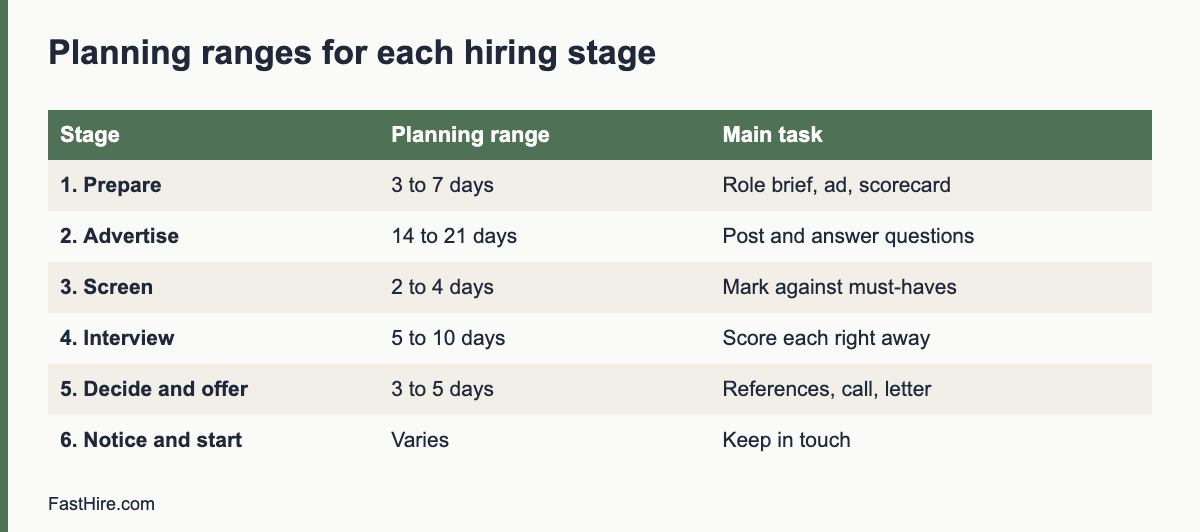
A week-by-week template
| Stage | Planning range | Main tasks | Who decides |
|---|---|---|---|
| 1. Prepare | 3 to 7 days | Write the role brief, job ad and scorecard; agree pay and process | You |
| 2. Advertise | 14 to 21 days | Post the ad, answer questions, send acknowledgements | You |
| 3. Screen | 2 to 4 days | Use a sheet to mark yes, no, unclear against the must-haves; choose who to interview | You and a second reviewer |
| 4. Interview | 5 to 10 days | Phone screens and one or two interviews; score each one right after | You and one more person |
| 5. Decide and offer | 3 to 5 days | Check references, decide, call, send the offer; give time to reply | You |
| 6. Notice and start | Varies | Wait for notice period; keep in touch; prepare onboarding | Candidate and you |
This adds up to roughly 5 to 8 weeks to the offer, plus the notice period. If your applicants are mostly unemployed or available at once, the start date can be much sooner. If they are senior and need to give three months’ notice, it will be later. These ranges are a starting point for your own plan.
Where time is usually lost
| Delay | What happens | Fix |
|---|---|---|
| Unclear role | Weeks of rewriting the ad and criteria | Write a role brief first |
| Open-ended ad | No closing date, so screening never starts | Set a closing date two to three weeks ahead |
| Slow screening | CVs wait in an inbox | Book a screening session on the calendar. Use a 20-minute method |
| Scheduling | Many emails to find an interview time | Offer fixed slots on set days |
| Waiting for a second opinion | Decision sits for a week | Name the decision maker and the date |
| Reference checks late | Another week lost | Ask for referees at the final interview |
| Offer too slow | The best candidate accepts another job | Keep the offer within 2 days of the decision |
| Notice period surprise | Start date moves by months | Ask about notice at the first call |
How to shorten each stage without lowering quality
Prepare
Prepare one hour in advance for each later step: the ad, the question list and the scorecard. Many delays start because someone writes the question list on the morning of the interview.
Advertise
Use channels that reach the right people. If you get enough suitable applicants in the first week, close early and say so in the ad (“we may close earlier if we receive many applications”). Do not leave the ad open for months. See where to post a job when you have no budget.
Screen
Screen in one block. Mark the same criteria for every person. If you have a second reviewer, split the pile in two and compare a sample of 10.
Interview
Book all first interviews in two or three days. Use 30 to 40 minute slots with 15 minutes between for notes. Use the same questions. See how to run a first interview.
Decide and offer
Hold a decision meeting right after the last interview, or on the next morning. Review the scorecards and decide. Then call the candidate and send the written offer on the same day. See how to make a job offer.
What not to speed up
- Do not skip a written list of criteria. It slows you down later when you must justify your choice.
- Do not skip right-to-work checks or other legal checks.
- Do not pressure candidates with unreasonable deadlines.
- Do not choose the first person who looks good. Compare at least three people against the same criteria, if you have them.
- Do not cut feedback to candidates. A short message takes a minute.
Speed and fairness work together when the process is clear. A written plan speeds up every step, and it also shows that you treated everyone the same.
A calendar example (fictional)
| Week | Action |
|---|---|
| Week 1 | Write role brief and ad; set pay; set interview days in the calendar |
| Weeks 2 and 3 | Ad open; answer questions; acknowledge applications |
| Week 4, Monday | Closing date. Tuesday: screening session. Wednesday: invitations sent |
| Week 4, Thursday and Friday | Phone screens |
| Week 5, Monday to Wednesday | Interviews |
| Week 5, Thursday | Decision meeting; call preferred candidate; ask for referees |
| Week 6, Monday | References checked |
| Week 6, Tuesday | Offer sent; reply date Friday |
| Week 7 | Candidate accepts; give notice; keep in touch |
| Week 11 | Start date, if notice is four weeks |
The dates are invented. Replace them with your own and put each one in your calendar before you post the job.
Tell candidates the timeline
Put the timeline in the ad and in the first message. For example: “Applications close on [date]. We will invite people to interviews on [date] and decide by [date].” People plan around dates. If your dates slip, tell them. A short message that says “we need two more days” is better than silence.
Measure your own time
| Number | How to measure | Use |
|---|---|---|
| Days from opening to closing | Date posted to date closed | Check ad length |
| Days from closing to interview | Closing date to first interview | Check screening speed |
| Days from last interview to offer | Date of last interview to date of offer | Check decision speed |
| Days from offer to acceptance | Offer date to reply | Check offer clarity |
| Days from acceptance to start | Reply date to start | Plan notice periods |
Record these in a spreadsheet for every hire. After two or three hires you will know your real timeline and where you lose time. Our upcoming spreadsheet tracker guide shows a simple layout. For the cost of waiting, see what a bad hire really costs and the cost worksheet.
Message templates that keep the timeline on track
Acknowledgement after an application
Hello [Name],
Thank you for applying for the [job title] role. We received your application. Applications close on [date]. We will contact everyone by [date] with a clear answer about the next step.
Best wishes,
[Name]
Interview invitation with slots
Hello [Name],
Thank you for your application. We would like to invite you to a 40-minute interview for the [job title] role. These slots are open on [dates and times]. Please reply with the one that suits you. The interview will be [in person at address / by video]. If you need any adjustment, please tell us and we will arrange it.
Best wishes,
[Name]
Delay notice
Hello [Name],
We need [number] more days to finish our interviews. We will contact you by [new date] with a decision. Thank you for your patience.
Best wishes,
[Name]
If you must hire faster than the template
Sometimes a person leaves with little warning, or a contract starts soon. In that case, change the plan in these ways, and keep the fair steps.
| Option | How it saves time | Risk to manage |
|---|---|---|
| Shorter ad period | Close after 7 to 10 days | Fewer applicants; check the pool is still varied |
| Combine phone screen and first interview | One conversation instead of two | Longer call; use the same questions for all |
| Interview in one block | All interviews on two days | Plan your notes and scoring time |
| Use temporary cover | A temp or freelancer covers the gap | Check the status rules in employee or contractor |
| Ask finalists for references early | Saves days at the end | Ask for permission first |
Do not drop your criteria, your scorecard or the legal checks. A hire made in a hurry that fails costs more than a short delay. Read what a bad hire really costs to compare.
A 30-minute decision meeting
Many hires stall at the decision. A fixed agenda keeps the meeting short and fair.
| Minutes | Item | Rule |
|---|---|---|
| 0 to 5 | Reminder of the must-haves and the scorecard scale | Everyone uses the same criteria |
| 5 to 15 | Each interviewer reads their scores and the evidence behind them | Scores come first, opinions second |
| 15 to 22 | Discuss differences of two points or more | Return to the notes, not to memory |
| 22 to 27 | Name the top choice and a back-up | Write the reasons |
| 27 to 30 | Agree who calls, when and what to offer | Set the date |
If the group cannot agree, do not extend the process by default. Ask which must-have is the real point of difference and whether you can test it with a short task or a reference call. Then decide by the agreed date.
When a candidate has other offers
Good candidates often have more than one process running. Ask in the first call: “Are you in other processes? What timeline are you working to?” Do not pressure or insult. If your timeline is longer than theirs, say what you can do, and let them decide. If you really want a person, you may move your steps closer together, but do not skip checks. Never invent a rival offer or a false deadline. Honest timing builds trust, and trust makes acceptance more likely.
Keep a log for next time
After the hire, spend 20 minutes with a sheet and write the real dates, the delays and one change to make. Keep it with the role brief. Next time you hire, start from this log and your timeline will be shorter. Over several hires it becomes your own benchmark, which is more useful than any general average.
Official sources for this topic: US Small Business Administration: hire and manage employees, GOV.UK: employing people. These pages are maintained by the authorities and may change, so check them for the current text.
Frequently asked questions
How long does it take to hire someone?
It depends on the role, the market and your process. Plan 5 to 8 weeks to an accepted offer for a typical small business role, plus the candidate’s notice period. Measure your own times.
Can I hire in one week?
Sometimes, for simple roles with available candidates, if you prepare in advance. Do not skip fair steps or legal checks to go faster.
What is the biggest cause of delay?
Waiting for decisions and scheduling. Fix dates in advance and name one decision maker.
Should I tell candidates the timeline?
Yes. A clear timeline reduces drop-out and questions.
What if the best candidate has a long notice period?
Ask if they can start part-time earlier, if their contract and your rules allow it. Otherwise plan temporary cover. Do not ask them to break their contract.
Related guides
- Hiring guides for small businesses and founders
- How to make your first hire: a step-by-step plan
- How to screen applications quickly: a 20-minute method
- How to make a job offer: a letter template and what to include
- All hiring guides for employers
- How many interview rounds are enough?
- How to reduce time-to-hire without lowering quality
- Time-to-hire vs time-to-fill: definitions and how to measure
- How to keep your best candidate warm while you decide
- How to handle a counter-offer from a candidate’s employer
- What to do when no one applies: a checklist for slow hiring
This is general information, not legal advice.