
To run a first interview for a small business, prepare six to eight questions tied to the must-haves of the role, ask every candidate the same questions in the same order, take notes, and score each answer on a simple scale straight after the interview. Keep it to 30 to 45 minutes, leave time for the candidate’s questions, and explain what happens next.
Key takeaways
- Prepare before the interview: the must-haves, six to eight questions, a scorecard and a note sheet.
- Ask every candidate the same core questions. Add follow-ups only to get more detail.
- Ask for real examples of past work, and for how the person would handle a realistic task.
- Score right after the interview, from your notes, before you compare with anyone.
- Never ask about protected traits such as age, family plans, health, religion or origin.
Why a first interview needs a plan
In a small business the owner often interviews alone and on instinct. The conversation feels friendly, but different candidates get different questions, and the person you like most often wins. A plan fixes that. It does not make the interview cold. It lets you listen, because you do not need to invent the next question.
Research on selection methods generally finds that structured interviews predict job performance better than unstructured ones. For a short, plain explanation, see our guide on structured interviews.
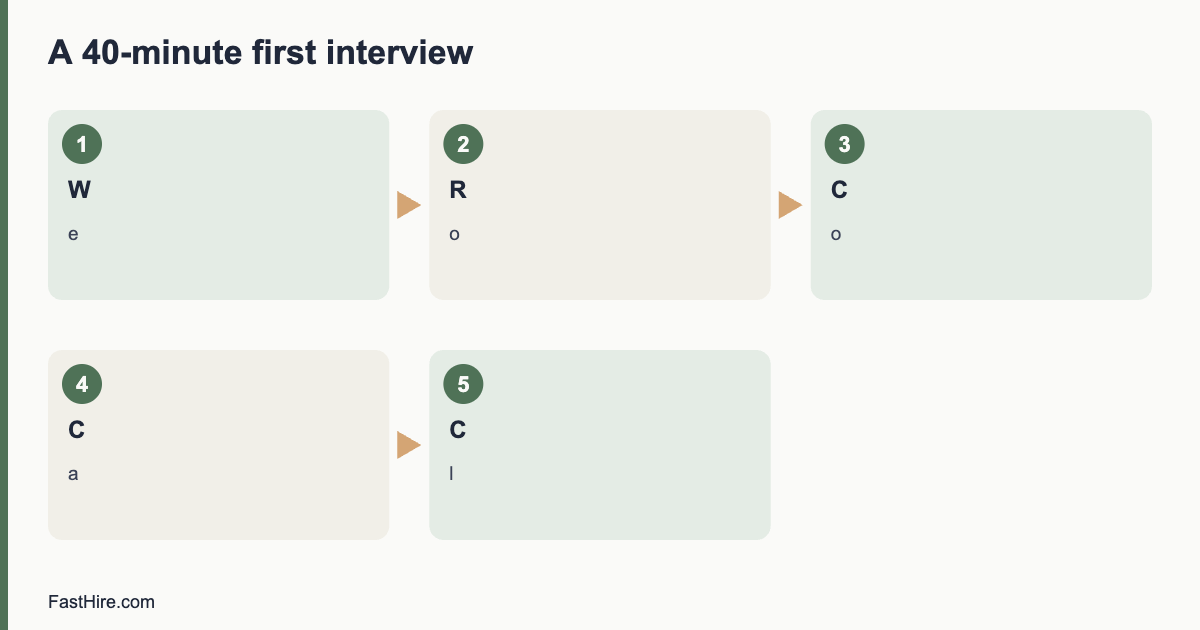
The 40-minute agenda
| Minutes | Part | What you do |
|---|---|---|
| 0 to 5 | Welcome | Greet the person, explain the agenda and the time, offer water, say that you will take notes |
| 5 to 10 | Business and role | Describe the business, the role and the team in two minutes. Ask if anything is unclear |
| 10 to 30 | Core questions | Ask six to eight prepared questions. Use the same order for everyone |
| 30 to 35 | Candidate questions | Invite questions and answer honestly |
| 35 to 40 | Close | Explain the next steps, the date you will reply and thank the person |
If the candidate needs a longer time or a different format, for example because of a disability, make the change. See the Acas page on recruitment for UK guidance on fair processes, and the EEOC small business resource centre for US basics.
The question bank
Choose six to eight questions from this list. Match them to the must-haves in your role brief. Each question asks for evidence from real experience or a realistic task.
| Area | Question | What to listen for |
|---|---|---|
| Motivation | Why are you interested in this role at our business? | Specific reasons linked to the work, not general praise |
| Experience | Tell me about the most relevant work you have done for this role. What did you do yourself? | Clear personal contribution, tasks and results |
| Problem solving | Describe a problem at work that you solved. What was the situation, what did you do and what happened? | A real situation, steps, result and learning |
| Communication | Tell me about a time you had to explain something difficult to a customer or colleague. | Clarity, listening, a good outcome |
| Reliability | Describe a time you had to meet a tight deadline. How did you plan it? | Planning, priorities, honest about problems |
| Teamwork | Tell me about a time you disagreed with a colleague. How did it end? | Respect, facts, a resolution |
| Learning | What is something new you learned in the last year? How did you learn it? | Curiosity and method |
| Role-specific task | Here is a realistic example: [short case]. What would you do first, and why? | Sensible steps, questions asked, good judgement |
| Practical fit | These are the hours and the place. Do they work for you? | A direct answer. Do not ask why not. |
For more questions and a scoring guide, see our article on behavioural interview questions.
The scorecard
Create a table with the must-haves in rows and a 1 to 4 scale. Define each level in words before you interview anyone. Fill it in right after the interview.
| Score | Meaning | Example for “communicates clearly in writing” |
|---|---|---|
| 1 | No evidence or poor evidence | Could not give an example; answer unclear |
| 2 | Some evidence, with gaps | Gave a general example with little detail |
| 3 | Good evidence | Clear example, relevant to the role, with a result |
| 4 | Strong evidence | Clear example, strong result, shows skill beyond the need of the role |
Add a column for notes with the exact words or facts that led to the score. At the end, add the scores and read the notes. Do not use the total as the decision. Use it as a prompt for your discussion and make a clear, reasoned choice. A fuller version with a worked example is in our interview scorecard template.
How to take notes
- Write facts and phrases, not opinions. “Reduced late orders from ten per week to two” is a fact. “Seems great” is an opinion.
- Use a sheet with a box per question. Do not write on the CV only.
- Tell the candidate that you will take notes, and why.
- Do not note protected traits or comments on appearance. If the candidate mentions something personal, do not use it in your decision.
- Keep notes for the period allowed by the rules in your country, and store them securely.
Questions you must not ask
Do not ask about age, date of birth, marital status, children or plans for children, pregnancy, health or disability history, religion, ethnic origin, nationality of birth, sexual orientation or political views. These can lead to discrimination claims, and they do not tell you if the person can do the job. If you need to know whether a person can do a task, ask whether they can do the task with or without reasonable adjustments, and describe the task. If you need to check the right to work, do so as the law requires for every person you plan to hire, not only for those who seem foreign to you. Our upcoming guide to what you can and cannot ask will cover the US, UK and EU rules in detail. For basics, read the Acas recruitment page and the EEOC page on prohibited practices.
After the interview
- Score within 15 minutes, while your memory is fresh.
- Write the three strongest points and the biggest doubt for each candidate.
- Wait until all first interviews are done before you compare. This reduces the effect of the first and last candidate.
- Choose the top two or three for a second step, such as a short task or a second conversation.
- Send every candidate an outcome by the date you promised.
Common mistakes
| Mistake | Result | Fix |
|---|---|---|
| Talking for 25 minutes about your business | You learn little about the candidate | Limit your talk to 5 minutes |
| Different questions for each person | You cannot compare | Use a fixed list |
| Asking hypothetical “what would you do” only | People give ideal answers | Mix with past examples |
| Scoring after all interviews | Memory blends the candidates | Score at once |
| Choosing the person you would enjoy a coffee with | Similarity bias | Use the scorecard as evidence |
| No next-step message | Candidates lose trust | Promise a date and keep it |
If you also use a short test task, read our upcoming guide on work trials and test tasks to keep them fair and paid where required. For the whole process, our first hire plan shows where the interview fits.
A worked example of scoring (fictional)
This example is invented. A small online shop interviews for an operations coordinator. The must-have being scored is “clear written communication”. The question is: “Tell me about a message you wrote to explain a problem to a customer or colleague.”
| Candidate answer (summary) | Score | Reason noted |
|---|---|---|
| “I write good emails.” No example when asked a follow-up. | 1 | No evidence. The follow-up did not produce a case |
| “I once told a customer their parcel was late. I said sorry and sent a new date.” No detail on the result. | 2 | Some evidence; no information on how the customer responded or what the person learned |
| “A courier lost 40 parcels in a week. I wrote one message to all affected customers with the new dates and a refund option. Only two complained and I replied to both the same day.” | 3 | Clear situation, action and result. Relevant to the role |
| “I created a template for delay messages that the whole team now uses, and I track replies. Complaints about delays fell after we started using it.” | 4 | Strong evidence; the person improved the process and measured the result |
Notice that the score depends on evidence, not on style. A shy candidate with a clear example should score higher than a fluent talker with none. This is one reason a scorecard is fairer than a general impression.
A short script for the start and the end
Opening
“Thank you for coming. This is a 40-minute conversation. First I will tell you about the business and the role. Then I will ask some questions, and the same questions go to every candidate. I will take notes so that I do not miss anything. You can ask your questions at the end. If you need a pause or anything changed, please tell me.”
Closing
“Thank you. We are talking to several people this week. I will contact everyone by [date] with a clear answer. If anything changes on your side, such as another offer, please tell me so that I can plan. Do you have any last question?”
A clear closing respects the candidate’s time. It also gives you a deadline that you must keep.
If you interview online
- Send the link, the time zone and the name of the interviewer in advance.
- Use the same platform and the same length for everyone.
- Tell the candidate what to do if the connection fails, for example a phone number to call.
- Do not judge the background, the room or the camera quality. They say nothing about the skill.
- Allow captions or other adjustments if the candidate asks.
Adjustments for fairness
Offer all candidates the chance to ask for changes before the interview. For example: “If you need any adjustment, such as more time, written questions in advance, or a different format, please tell us and we will arrange it.” In the UK, employers must consider reasonable adjustments for disabled applicants. In the US, the Americans with Disabilities Act covers reasonable accommodation for qualified applicants at employers of the required size. Rules differ in each EU country. Check your local rules, and remember that this is general information, not legal advice.
Prepare yourself: a 10-minute checklist
- Re-read the role brief and the must-haves.
- Print or open the CV and mark two things you want to ask about.
- Print the question list and the scorecard.
- Block 15 minutes after the interview for scoring.
- Silence your phone and close other windows.
- Prepare answers to likely candidate questions: pay range, hours, team, growth, process and timeline.
Candidates often ask about pay, the first month, how success is measured and why the role is open. Have honest answers ready. If you do not know, say so and say when you will find out. Candidates trust honest answers more than polished ones.
Frequently asked questions
How long should a first interview be?
30 to 45 minutes is enough for most small business roles. Add time for the candidate’s questions.
How many questions should I ask?
Six to eight core questions plus follow-ups. More than that leaves little time to listen.
Should I interview by video or in person?
Either works if you use the same format for everyone. Offer an alternative if a candidate needs one.
Can I ask the same questions as another interviewer?
Yes. When several people interview, use the same question set and compare notes afterwards.
What if the candidate talks too little?
Ask a follow-up: “Can you tell me more about what you did yourself?” or “What happened next?” Give a few seconds of silence.
Related guides
- Hiring guides for small businesses and founders
- Structured interviews: what they are and how to run one
- Interview scorecard template with a worked example
- Behavioural interview questions with a scoring guide
- All hiring guides for employers
- What you can and cannot ask in a job interview: US, UK and EU
- How to hire your first salesperson without a sales manager
- How to take interview notes that help you decide
- How to interview when you are not trained to
- How to avoid hiring friends and family by mistake
- How to turn down a candidate kindly and clearly: templates
- How to keep your best candidate warm while you decide
- How to handle a counter-offer from a candidate’s employer
- How to hire for culture without hiring clones
This is general information, not legal advice.