
Behavioural interview questions ask candidates to describe what they actually did in a past situation, for example “Tell me about a time you had to learn something quickly.” The answers show how a person works. To use them well, choose four to six skills from your role brief, ask the same questions of every candidate, listen for the situation, the person’s own actions and the result, and score each answer against written anchors.
Key takeaways
- Use behavioural questions to test skills that a resume or CV cannot show, such as judgement, communication and reliability.
- Choose four to six skills from the role brief. More questions give thinner answers.
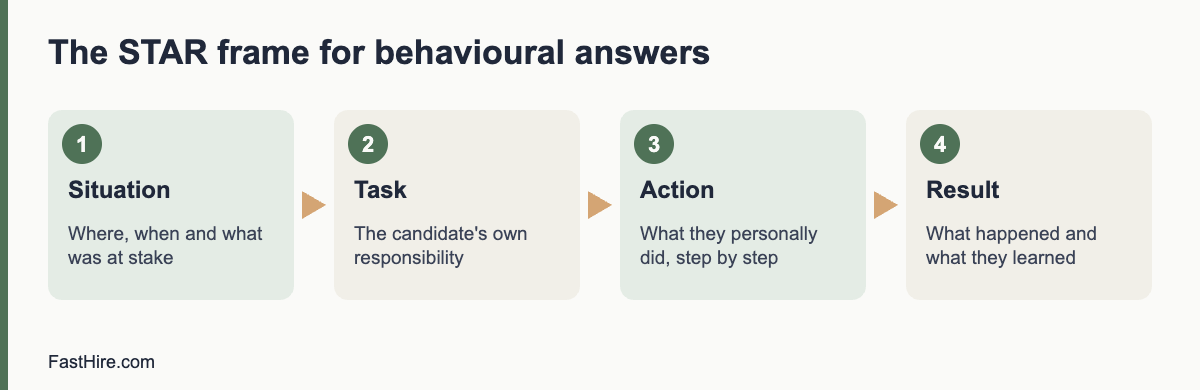
- Listen for the STAR parts: situation, task, action and result. Ask a follow-up for any missing part.
- Score each answer on a 1 to 4 scale with written anchors, alone and straight after the interview.
- Avoid questions that reach into protected topics such as age, family plans, health or religion.
What behavioural questions are
A behavioural question asks about the past: “Tell me about a time when …”. The idea is simple. How someone acted in a similar situation is a useful guide to how they will act in your role. The US Office of Personnel Management describes a structured interview as one that systematically asks about past behaviour, hypothetical situations, or both, on its page about structured interviews. Behavioural questions are the past-behaviour half of that approach. The other half, situational questions, asks what the candidate would do in a described case.
Both types work best inside a structured interview: the same questions for every candidate, in the same order, scored on one scale. Our guide to structured interviews explains how to build the whole process. This article gives you the question bank and the scoring guide.
The STAR frame: what a good answer contains
| Part | What the candidate should say | Follow-up if missing |
|---|---|---|
| Situation | The context: where, when and what was at stake | “Can you set the scene? What was happening at the time?” |
| Task | The candidate’s own responsibility or goal | “What was your part in this?” |
| Action | What the candidate personally did, step by step | “What did you do first? Then what?” |
| Result | What happened, and what they learned | “How did it end? What would you do differently?” |
Many candidates answer with “we” and general statements such as “I always communicate well”. Your job is to move them to a specific example and to what they themselves did. A polite way is: “That is helpful. Can you give me one example and walk me through what you did?” Use the same short list of follow-ups with every candidate, so that all of them have an equal chance to give detail.
A scoring guide that works across questions
| Score | What the answer shows |
|---|---|
| 1 | No relevant example, a very general answer, or an action that shows poor judgement |
| 2 | A relevant example, but the candidate’s own part, the action or the result is unclear |
| 3 | A clear, relevant example with the candidate’s actions and a sensible result |
| 4 | A clear example with strong judgement, awareness of impact on others and a lesson that the candidate applied again |
For each question, add one or two lines of specific anchors in your scorecard. See our scorecard template. Write notes on what the candidate said and did, not on how they spoke. Score within 15 minutes of the interview, alone.
Question bank: 25 questions by skill
Pick one question per skill. Choose the skills from your role brief. Each question can be adapted to the role by changing the example in brackets.
Communication
- Tell me about a time you had to explain something complex to someone who did not know the topic. What did you do?
- Describe a time a message you sent was misunderstood. What happened and what did you do?
- Tell me about a time you had to give someone bad news at work.
- Describe a time you had to persuade a colleague to change their view.
Problem solving
- Tell me about a problem at work that had no clear answer. How did you approach it?
- Describe a time you found an error in your own or someone else’s work. What did you do?
- Tell me about a time you had to solve a problem with limited information or time.
- Describe a decision you made with only part of the data. How did it turn out?
Working with others
- Tell me about a time you disagreed with a colleague. What did you do?
- Describe a project where you depended on other people to finish your work. How did you manage that?
- Tell me about a time you helped a colleague who was struggling.
- Describe a time when someone gave you critical feedback. What did you do with it?
Reliability and planning
- Tell me about a time you had several urgent tasks at once. How did you decide what to do first?
- Describe a time you missed a deadline or nearly did. What happened and what changed afterwards?
- Tell me about a plan you made and then had to change. How did you adapt?
- Describe a task you completed that nobody was checking. Why did you do it the way you did?
Learning and adaptability
- Tell me about a time you had to learn a new tool or process quickly. How did you go about it?
- Describe a time when your role or priorities changed suddenly. What did you do?
- Tell me about a mistake you made at work. What did you learn?
- Describe something you taught yourself in the last year, and why.
Customer or stakeholder focus
- Tell me about a time you dealt with an unhappy customer or client. What did you say and do?
- Describe a time you went beyond what was asked to help a customer or colleague.
- Tell me about a time you had to say no to a request. How did you handle it?
Choosing questions for a role: an example
Take a customer support team lead with a role brief that lists coaching, handling pressure, fairness and process improvement as the main areas. You could choose: “Tell me about a time you helped a colleague who was struggling” (coaching), “Tell me about a time you had several urgent tasks at once” (pressure), “Tell me about a time you disagreed with a colleague” (fairness), and “Tell me about a time you changed how a team did something” (process improvement). Add two situational questions about the specific context, and you have six questions for a 45-minute interview.
What strong and weak answers can look like
Here are two short sample answers to “Tell me about a time you found an error in your own work.” They are fictional and shown to practise scoring.
Answer A: “In my last job I send weekly sales summaries. One Monday I noticed the total was too high because I had double counted a region. I told my manager before anyone used it, sent a corrected file the same hour and added a check that compares the total to the sum of the regions. It has not happened since.”
Answer B: “I try to be very careful, so mistakes are rare. If I find one I fix it. I think attention to detail is one of my strengths.”
Answer A names the situation, the actions and the result, and shows a lasting change. It would score a 3 or 4. Answer B is general and gives no example. It would score a 1. A follow-up such as “Can you give me one specific example?” gives the candidate a fair chance to improve, and you score the improved answer.
Fairness checks for behavioural questions
- Ask about work, not about private life. Questions about family plans, health, religion, age or similar topics are not job-related and can lead to discrimination. The US Equal Employment Opportunity Commission explains the limits on its page about prohibited employment policies and practices.
- Allow examples from outside paid work. Volunteer work, study, caring responsibilities and personal projects can show the same skills. Say so in your introduction.
- Do not require examples that only some groups can have. For example, “a time you managed a large team” may exclude capable people. Ask about leading a task, not holding a title.
- Offer adjustments. Some candidates need questions in writing, extra time or a different format. The Acas page on recruitment explains the duty to make reasonable adjustments in Great Britain.
- Be consistent. The same questions, the same probes and the same scale for everyone.
Common mistakes
- Asking about “a time” when the candidate has none. Offer a situational version of the same question instead, for example “What would you do if …?”, to every candidate who needs it.
- Accepting “we” answers without asking about the candidate’s part.
- Scoring the story, not the behaviour. A fluent speaker may give a vivid story about a small action.
- Stacking too many questions. Six well-explored questions beat twelve thin ones.
- Treating one answer as proof. A single example is evidence, not certainty. Combine it with the CV, work sample and references.
FastHire is being built to put the written evidence in front of you before the interview, by showing each job requirement next to the exact CV passage that supports it. Then your interview time goes to the skills that need a conversation. FastHire is coming soon. It does not rank, score or reject candidates. People make every decision.
A 45-minute running order
| Minutes | Part | Notes for the interviewer |
|---|---|---|
| 0 to 5 | Welcome and explanation | Read the same opening to every candidate. Explain that you will take notes. |
| 5 to 35 | Six behavioural questions | About five minutes each. Use the fixed probes only. Do not rescue a weak answer with hints. |
| 35 to 40 | Candidate questions | Answer honestly. Note what the candidate asks, because it shows what matters to them. |
| 40 to 45 | Close and next steps | Give the date by which you will reply. Offer a contact for adjustments or questions. |
A probe card for interviewers
Print these on a card and keep them in view. They help you stay neutral and give every candidate the same chance.
- “Can you set the scene for me?”
- “What was your part in this?”
- “What did you do first? What did you do next?”
- “What was the result?”
- “What would you do differently now?”
Avoid leading probes such as “So you were the one who solved it?” or “That sounds like good teamwork, right?”. They put words in the candidate’s mouth and make scores harder to defend. If a candidate is stuck, repeat the question once, offer a moment to think, and then move on. After the interview, write a one-line note for each answer in the candidate’s words before you score. Notes first and scores second keeps you honest about what you actually heard.
Frequently asked questions
What is the difference between behavioural and situational questions?
Behavioural questions ask about what a candidate did in the past. Situational questions describe a case and ask what the candidate would do. Both can be used in a structured interview.
How many behavioural questions should I ask?
Six to eight in a 45 to 60 minute interview, with a short follow-up for each. Pick skills from the role brief.
What if a candidate has no work example?
Allow examples from study, volunteering or personal projects. For entry-level roles, add a situational version of the question for every candidate.
Can I ask different candidates different questions?
Avoid it. Different questions make comparison unreliable and can lead to unequal treatment. Keep core questions identical and use only the same fixed follow-up probes.
How do I score an answer that is vague?
Ask one fixed follow-up, such as “Can you give one specific example?”. If the answer stays vague, score it low and write the reason in your notes.
Related guides
- Hiring guides for hiring managers
- Structured interviews: what they are and how to run one
- Interview scorecard template with a worked example
- How to define a role before you hire: a one-page role brief
- All hiring guides for employers
- How to give fast interview feedback without cutting corners
- Interview questions for managers: a bank for leadership hires
- How to interview for potential and not just experience
- How to interview when you are not trained to
- Career gaps, job hopping and short stints: how to read them fairly
- How to check references as a hiring manager: questions that work
This is general information, not legal advice.