Category: Hiring managers

Define the role, run structured interviews and give fast feedback, with scorecards and question banks you can reuse.

  • How to close a candidate: an honest offer conversation

    How to close a candidate: an honest offer conversation

    To close a candidate honestly, call them with the offer, tell them the decision first, explain the terms plainly, ask what concerns they have, answer truthfully, agree a clear date for their reply, and follow up in writing. Do not use pressure, invented deadlines or promises you cannot keep. Candidates who say yes with full information stay longer.

    Key takeaways

    • Prepare the pay, the extras, your limits and the answers to likely questions before you call.
    • Lead with the decision, then the main terms. Keep the call calm and direct.
    • Ask open questions about concerns and listen. Answer honestly, including about weak points.
    • Give a fair deadline and send the written offer the same day.
    • No pressure tactics: no fake rivals, no short fuses, no promises beyond what you can deliver.

    What closing means, and what it does not

    In sales language, closing is about pushing for a yes. In hiring, closing means helping a person make a good decision with full information. You want them to join, but you also want them to stay, and a person who feels pressured or misled is less likely to do either. An honest offer conversation is clear, warm and fair. It gives the candidate what they need to decide and respects their right to say no.

    Step 1: prepare before you call

    • Pay: the offer inside your range. See how to set a fair salary.
    • Extras: bonus, holiday, flexibility, training, review date. Only list what you can deliver.
    • Limits: the most you can offer, the latest start date, and what you can and cannot change.
    • Approvals: confirm that you have the authority to make the offer.
    • Candidate profile: what they said they care about, from the interviews. Use their words.
    • Likely concerns: pay, commute, growth, team, manager, workload. Prepare honest answers.
    • Documents: the written offer, ready to send. See offer letter template.
    • Conditions: references, right to work and any other checks. See how to check the right to work.

    Check the fairness of your offer against others in the team who do similar work. If the offer differs, be ready to explain the job-related reason. See pay transparency in hiring.
    x

    Step 2: the call script

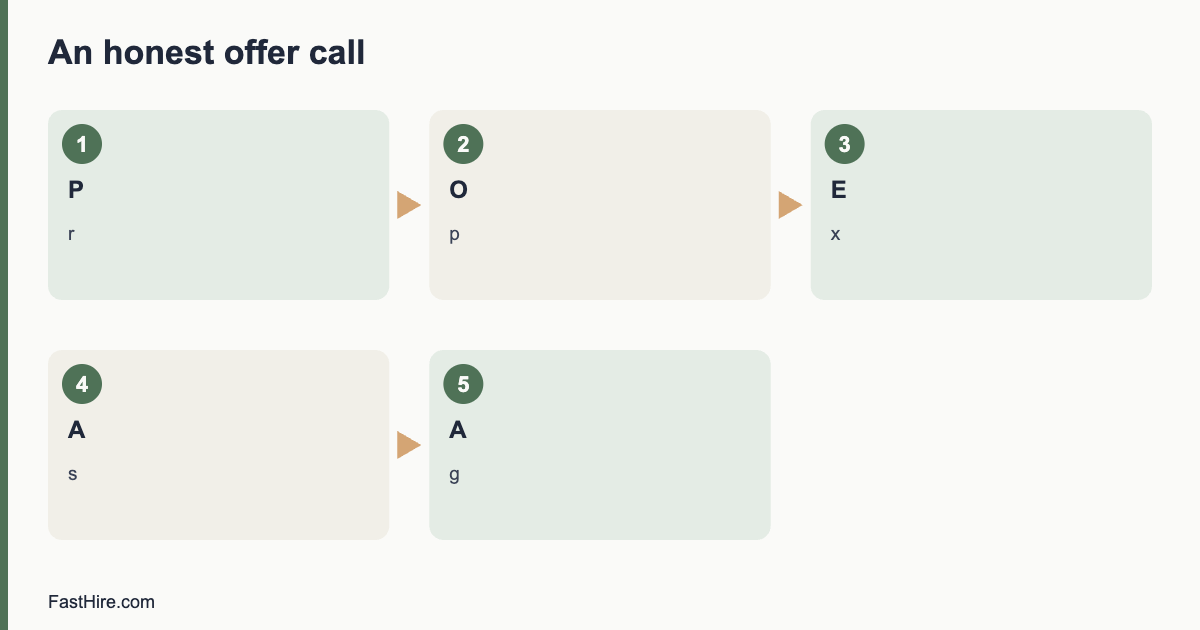
    1. Greeting and good news: “Hello [name], thank you for taking my call. I am pleased to say that we would like to offer you the [role].”
    2. Why them: one or two true points from the interviews. “Your examples of [skill] stood out.”
    3. Main terms: pay, start date, hours, place, key conditions. Keep it short.
    4. Pause: “How does that sound?” Let them respond.
    5. Ask: “Is there anything that would make this a clear yes for you, or anything you are unsure about?” Listen.
    6. Answer honestly. If you do not know, say so and promise a time to reply.
    7. Timeline: “Could you let me know by [date]? I will send the written offer today.”
    8. Close warmly: “I would be delighted to have you join us. Please call me with any question.”

    Step 3: handle common concerns honestly

    ConcernHonest approachAvoid
    Pay is lower than hopedExplain the range and how you set it. Say what can move and what cannot. Offer a review date only if you will hold it.Promising a raise that is not agreed
    Growth path unclearDescribe the real routes and timing. Say what you do not know.Inventing titles
    Workload or hoursGive the real picture, including peak periods.Saying “it is fine” if it is not
    Manager styleOffer a conversation with the manager and a future colleague.Speaking badly of anyone
    Another offerAsk the date and what matters. Do what you can within your limits.Pressure or false rivals
    Commute or flexibilitySay what is possible now and what is not. Put any agreement in writing.Making verbal promises

    If the candidate raises a counter-offer from their employer, see how to handle a counter-offer.

    Step 4: pay conversation

    Speak about pay clearly. State the number and what it covers. Explain how it relates to the range and to their skills. If the candidate asks for more, ask what they base the request on. If you can move inside your range for a job-related reason, do so and say why. If you cannot, say so plainly and offer other value if you honestly can. Do not hint that more may come later unless it is planned. Keep records of the final number and the reasons.

    Do not ask about past pay where the law bars it, and do not let past pay set the offer. Use the job and the range. See salary in job ads for related rules.

    Step 5: set a fair timeline

    Give enough time to decide. A few days is usual, and more for a big move. Say the date, and why. If the candidate asks for more time, consider it if you can, and agree a new date. If you have a hard limit, explain it and let the candidate choose. Do not invent a deadline to push them. Keep your other finalists informed honestly, as in how to keep your best candidate warm.

    Step 6: confirm in writing

    Send the written offer the same day, with the key terms: role, start date, pay, hours, place, probation, notice and conditions. Make sure it matches what you said. Add a line inviting questions. Read the probation period guide to check how to describe probation terms by country.

    What not to do

    • Do not use fake urgency, such as “another candidate is waiting”, unless it is true and relevant.
    • Do not promise a promotion, bonus or remote days that you cannot guarantee.
    • Do not criticise the current employer or the candidate other options.
    • Do not ask about protected topics, such as plans for children, to judge commitment.
    • Do not announce the hire to others before the candidate accepts.
    • Do not make the candidate feel guilty for asking questions.

    Legal and fairness points

    • Offers should be based on job-related factors. Equal pay rules apply in the US, UK and EU. See the EEOC equal pay page and GOV.UK employing people.
    • Make sure verbal and written terms match. A verbal promise can create obligations.
    • Keep the candidate data private and use it only for hiring. See GDPR for job applicants.
    • Right to work checks and other conditions should apply to every hire in the same way.

    If the candidate says no

    Thank them for their time and their honesty. Ask, without pressure, what made the difference. The answer is useful for your next offer. Keep the door open: “If things change, I would be glad to hear from you.” Then move to your second choice without delay, honestly and respectfully. Record the reason for the decline to improve your pay range, your timeline or your pitch next time.

    If the candidate says yes

    Worked example (fictional)

    A hiring manager prepares an offer for a senior analyst. She sets the pay inside the range, lists the extras she can deliver (a learning budget and a review at six months), and writes her limit. On the call she says, “We would like to offer you the role. Your example of rebuilding the forecast model stood out.” She lists the pay, the start date and the conditions, and asks, “What would make this a clear yes?” The candidate says that the commute is long. The manager explains that two days from home are possible now, and that more would need the team agreement, so she cannot promise it. The candidate asks for a few days. The manager agrees a date, sends the written offer that day, and the candidate accepts with two days to spare.

    Tone: how to sound like a person, not a script

    A script helps you cover the points, but the call should sound like you. Use plain words, short sentences and a warm voice. Smile when you speak; people can hear it. Pause after you give the good news and let the candidate react. If they sound unsure, say so kindly: “I hear some hesitation. What is on your mind?” Then listen without rushing to answer. If you disagree with a point, say so respectfully and give your reason. A calm, honest voice builds more trust than a polished pitch.

    Take notes during the call. Afterwards, send a short message that repeats the main terms and the date for the reply. This avoids misunderstanding, and it helps the candidate think. If they ask questions later, answer within a day.

    Sell the job truthfully

    Candidates want to know why this job and this team. Prepare three true points: what the work is, what the person will learn or achieve, and what is good about the team or the way it works. Use examples from your own team: a recent project, a way of working, a person who grew in the role. Include one honest challenge, such as a busy season or a tool that is being replaced. Candidates remember honesty, and it shows that you trust them with the truth.

    Closing a candidate who is passive or quiet

    Some candidates give little away. They may be cautious, shy or deciding alone. Do not read silence as a no. Ask a few open questions: “What would you like to know about the first weeks?” “Who else would you like to speak to before you decide?” Offer a second conversation with a future colleague. Give them time. Check in at the agreed date with a short message. If you hear nothing by then, call once and then close politely with a final date.

    Closing across borders and time zones

    If the candidate lives in another country, the offer needs more care. Contracts, tax, notice and right to work rules differ. Make sure the terms match local law, and say who will explain them. Read how to hire in another country before you call. Choose a time that suits the candidate, write dates with the time zone, and offer a video call rather than a long audio call if that helps.

    Review your closing after each hire

    After the candidate accepts or declines, take ten minutes to review. Note how long the offer took from decision to call, what concerns came up, what you said, what the candidate chose and why. Ask newly hired people, after a month, what helped them say yes and what they wish they had known. Ask people who declined, kindly, what made the difference. Put the answers in a simple log. After a few hires, you will see patterns: perhaps pay is rarely the issue but flexibility is, or perhaps speed matters most. Use the patterns to improve your offers, your timelines and your conversations. This turns each close into a lesson for the next, and over time raises your acceptance rate without any need for pressure.

    Share what you learn with other managers, and keep a shared set of honest answers to the common questions: pay, growth, hours, remote days, training. A shared set avoids contradictions between managers and makes it easier for HR to check that every candidate hears the same truth. Update the set each year or when policies change, and remove any answer that is no longer accurate.

    Frequently asked questions

    Is it okay to sell the job to a candidate?

    Yes, if you are honest. Describe the real strengths and the real challenges. Do not exaggerate or promise what you cannot deliver.

    How long should I give a candidate to decide?

    A few days is common, and more for a large move. Agree a date and keep to it. Avoid invented deadlines.

    Should I call or send an email first?

    Call first for the human touch, then send the written offer the same day.

    What if the candidate asks for more pay?

    Check your range and fairness to others. If you can move for a job-related reason, do so. If not, explain and offer other value if you honestly can.

    Related guides

    This is general information, not legal advice.
  • How to make a hiring decision when the team disagrees

    How to make a hiring decision when the team disagrees

    When interviewers disagree, return to the written requirements, compare the evidence for each one, and look for the exact point where scores differ. If the gap remains, gather more evidence with a work sample or reference check, then apply a tie-break rule agreed in advance. The hiring manager decides, and the reasons and any dissent are recorded.

    Key takeaways

    • Disagreement is normal and useful. It shows where the evidence is thin or unclear.
    • Start with the requirements and the notes, not with opinions or the strongest voice.
    • Seek more evidence when the disagreement is about a fact you can check.
    • Agree a tie-break rule before the interviews: who decides and how.
    • Record the decision, the reasons and any dissent, and give feedback to candidates.

    Why panels disagree

    Panels disagree for several reasons. Interviewers asked different questions and saw different parts of the candidate. They used different standards for a score. They weighed requirements differently. Some were swayed by the manner of the candidate and others by the content. A few disagreements are about the facts, and many are about the weight of the facts. If you can name the cause, you can solve it.

    CauseSignFix
    Different evidenceInterviewers saw different questionsUse the same core questions for all, as in structured interviews
    Different standardsOne person scores 3 where another scores 1 for the same answerCalibrate the scale with examples
    Different weightsAgreement on facts, disagreement on importanceSet weights before the interviews
    Style biasDebate about manner and “feel”Ask for evidence tied to a requirement
    Group pressureOne senior voice sets the viewScore alone first, then discuss

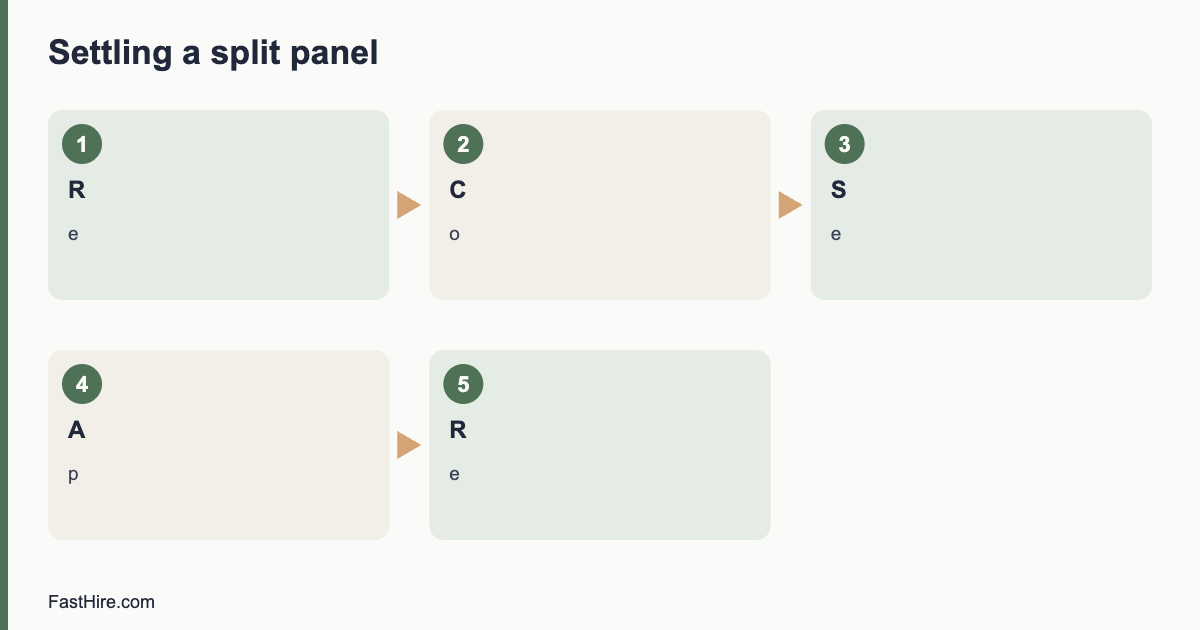
    Step 1: collect scores alone before the debrief

    The simplest way to reduce group pressure is to ask each interviewer to write scores and notes alone before the meeting. This gives you each person real view, not a view shaped by the first speaker. Use the same scorecard. See the interview scorecard guide and the debrief meeting guide.

    Step 2: return to the requirements

    Open the debrief by reading the requirements and weights. Then take them one at a time. For each, ask each interviewer for the evidence behind their score. This changes the talk from “I liked her” to “she gave an example of re-planning a late delivery”. Opinions without evidence carry little weight.

    x

    Step 3: find the point of difference

    Look at the score grid. Where is the biggest gap? For each gap, ask: did you hear different answers, did you read the same answer differently, or do you weigh the requirement differently? Write the cause next to the gap. This quickly clarifies whether you need more evidence or a decision about priorities.

    Step 4: gather more evidence when the gap is about facts

    If the gap is about something you can check, check it. Options include:

    • A short work sample on the point in dispute, scored by all. See work sample tests.
    • A reference call with a question aimed at the doubt. See reference check questions.
    • A short follow-up conversation with the candidate, with one structured question on the gap.
    • A review of the original resume or CV for the specific claim.

    Tell the candidate the reason for the extra step and the timing. Keep other finalists informed. Do not drag the process out for weeks. See how to keep your best candidate warm.

    Step 5: apply a tie-break rule

    Before interviews, agree how you will decide if the panel is split. Common rules are listed below. Choose one and write it in the plan.

    RuleHow it worksBest forWatch out for
    Hiring manager decidesThe manager takes the panel input and decidesMost rolesThe manager must show reasons tied to the requirements
    Weighted score decidesThe highest weighted total wins, subject to essential minimumsRoles with clear criteriaScores can hide a serious gap on one item
    Veto on essentialsAny panelist can block a candidate who fails an essential requirement, with evidenceSafety or trust rolesVetoes need evidence, not a feeling
    Senior sign-offA more senior person reviews evidence and decidesCross-team rolesDelay and extra bias if that person was not in the interviews

    Avoid majority votes unless they follow a review of the evidence. A vote can hide strong evidence from one person and weak evidence from the others.

    Step 6: record the decision and the dissent

    Write a short record: the decision, the three main reasons tied to the requirements, and any disagreement that remains, with the reasons. Recording dissent is not a sign of failure. It shows that you took the issue seriously, and it helps later, when you check how the new hire is doing against the doubts. After 90 days, review: were the doubts justified? What does it teach you about your questions and your scales?

    What not to do

    • Do not let the loudest or most senior voice settle the matter without evidence.
    • Do not take a vote without looking at the evidence.
    • Do not change the requirements or weights midway to favour a person.
    • Do not hire the “compromise” candidate that no one rated highest on the essentials.
    • Do not drag out the process while you hope the disagreement will disappear.
    • Do not tell the candidate that the panel was split. Give clear, job-related feedback.

    When the disagreement is about fairness

    Sometimes one interviewer raises a concern about bias: a comment about age, a remark about accent, a view that a person will not fit. Take it seriously. Return to the requirements and the evidence, and set aside the remark. Note the concern and the response. If it is serious, involve HR. Fairness law applies, and a record that shows you took it seriously is important. See the EEOC, GOV.UK employing people and how to reduce interview bias.

    Facilitating the meeting

    1. Share the grid and the notes in advance.
    2. State the aim: to decide on evidence.
    3. Take each requirement in turn.
    4. Ask quiet people first, and the senior person last.
    5. Summarise the point of agreement and the point of difference.
    6. Decide, or agree the next step and the date.
    7. Close with thanks, and send the record the same day.

    Checklist

    • Requirements and weights were agreed before interviews.
    • Each interviewer scored alone with notes.
    • The debrief started from the requirements.
    • The cause of each gap was named.
    • More evidence was gathered where facts were in dispute.
    • A tie-break rule was applied as planned.
    • The decision, reasons and dissent are recorded.
    • Candidates receive clear, job-related feedback.

    Worked example (fictional)

    A panel of three interviews two finalists for a customer success lead. Two interviewers prefer Candidate A, who was lively and confident. One prefers Candidate B, who was quiet but gave detailed examples. The manager reads the requirements aloud and takes each in turn. On “handles escalations”, B scored 3 with a specific example, and A scored 1 with a general answer. On “builds relationships”, A scored 3. The weights set before the interviews give escalation handling the higher weight. The group agrees to ask both candidates for a short written reply to a realistic escalation scenario. B scores higher. The manager decides on B, records the reasons and the original disagreement, and thanks A with specific feedback and an invitation to apply for future roles.

    Common disagreement patterns and how to answer them

    “I just have a feeling about this person”

    Feelings are information, but they are not evidence. Ask the person to turn the feeling into an observation: “What did you see or hear that led to it?” Often the answer is a real point, such as the candidate avoiding a question or giving a vague example. Sometimes it is style or similarity. If the point is real and relates to a requirement, test it with a follow-up question or a reference. If it is not, set it aside and say why.

    “They are too junior” or “too senior”

    Ask what requirement the person fails. If it is a skill, it can be scored. If it is a concern about pay, interest or growth, it can be asked about directly. Avoid using these words as stand-ins for age. Consider whether the level mismatch can be solved by changing the scope or the support.

    “They would not fit the team”

    Ask which behaviour would clash with a team standard. If you cannot name one, the concern is likely about similarity. See how to hire for culture without hiring clones.

    “The other candidate is safer”

    Safe choices can be right, but they should rest on evidence of results, not on familiarity. Ask what makes one safer, and whether the other has been tested by the same questions. If the choice is between a proven profile and a more varied one, the matrix in how to compare candidates with different backgrounds helps.

    Disagreement between the manager and HR or the recruiter

    Sometimes the split is not inside the panel but between the manager and the recruiter or HR. The recruiter may see a risk in the process, such as a missing check, an unequal question or an unexplained pay gap. The manager may see a strong candidate. Treat process concerns as serious. Fix the process point first, then return to the decision. Agree in advance who owns which part, as in how to work with HR on a hiring plan.

    How to give feedback when the panel was split

    Candidates do not need to know that the panel was split. Give them the main job-related points that decided the outcome. Say what was strong and what was missing against the requirements. Use the guidance in how to give useful feedback to rejected candidates. If the margin was narrow, say that the decision was close, and invite the person to apply again. Keep any internal comments about individuals out of the message.

    Prevention: set up the panel so that disagreement is productive

    Most hard disagreements can be eased before the first interview. Choose a small panel, usually two to four people, each with a clear reason to be there. Brief them on the requirements, the weights, the questions and the scoring scale. Hold a ten minute calibration before the first interview, using a sample answer, so that everyone scores in the same way. Agree the tie-break rule and say who decides. Book the debrief for the same day as the last interview, while memories are fresh. Ask everyone to write scores before they speak.

    These steps cost little and change the quality of the talk. Instead of a long argument about impressions, you have a short, structured conversation about evidence. Panel members feel heard, because their scores and notes are on the table. The hiring manager feels more confident, because the decision rests on a record. Candidates are treated more fairly, because the same standards are used for all.

    Review each decision after 90 days. If the new hire is doing well, note what the panel saw that predicted it. If not, note what was missed. Share the lessons with the panel. Over time, the group learns what good evidence looks like in your business, and disagreements become faster to settle and more likely to end in a good hire.

    Keep the record of each split decision in one shared folder, so that new managers can read past examples and see how the evidence was weighed. Remove names where privacy requires it.

    Frequently asked questions

    What if the panel is split evenly?

    Return to the requirements and weights, gather more evidence on the point of difference, and apply your tie-break rule. The hiring manager decides, with reasons recorded.

    Should we vote?

    Only after reviewing the evidence, and not as the sole method. A vote can hide strong evidence from a minority.

    What if the hiring manager disagrees with the whole panel?

    Ask for the evidence behind the view. If it is strong, consider more evidence or a second round. If not, follow the agreed rule and record the reasons.

    Should I tell the candidate there was disagreement?

    No. Give clear, job-related feedback without describing the internal debate.

    Related guides

    This is general information, not legal advice.
  • How to check references as a hiring manager: questions that work

    How to check references as a hiring manager: questions that work

    A good reference check tests what you still do not know after the interview. Get the candidate consent, prepare questions from the job requirements, ask the same questions of every referee, score the answers on a fixed scale, and follow up on anything unclear. This guide gives you a question bank, a scoring sheet and rules for staying fair and lawful.

    Key takeaways

    • Ask for consent first, and use only the referees the candidate names, unless they agree to more.
    • Base questions on the requirements, and ask the same core questions for every candidate.
    • Ask for facts and examples, not opinions about personality or private life.
    • Do not ask about health, disability, family, pregnancy, religion or other protected topics.
    • Write down what the referee said, score it, and keep the record for the right time.

    What a reference can and cannot tell you

    A reference tells you how someone worked for another person. It can confirm facts such as dates and role, show what the person did well, and flag concerns about reliability or conduct. It cannot tell you everything. Referees are chosen by the candidate, and some are cautious or brief because of company policy. Treat a reference as one source among several, alongside interviews, work samples and your scorecard.

    For a shorter guide aimed at small businesses, see how to check references. This article goes deeper for hiring managers who want a structured routine.

    Before the call

    1. Check your policy and the law. Many places allow references with consent. See the ICO guidance on recruitment and selection for the UK, and GDPR for job applicants for the EU and UK.
    2. Ask the candidate for two or three referees and explain the questions you will ask. Ask which referee knows their recent work best.
    3. Ask permission before you contact a current employer, and respect a request to wait until after the offer.
    4. Choose a time and a method that suit the referee: a short call is better than an email.
    5. Prepare four to eight questions from the requirements, and a scoring sheet.

    Make the reference a condition of the offer where that is fair and clear, and say so in the offer letter. See the offer letter template.

    x

    The opening of the call

    Introduce yourself, say why you are calling, and confirm the referee relationship with the candidate. Explain that you will ask the same questions for every candidate, that the candidate gave permission, and that you will keep notes. Ask how long they worked together and in what roles. Then move to the questions. Say thank you at the end and ask if there is anything else you should know that is relevant to the role.

    Question bank

    Facts and role

    • What was the person job title and main duties?
    • How long did they work for you, and what were the dates?
    • Who did they report to, and did they manage anyone?
    • What was the scope of their work, such as the size of the team, budget or customers?

    Performance and results

    • What were the main results this person achieved? Can you give an example?
    • How did their work compare with what the role required?
    • How did they handle deadlines and changing priorities?
    • What would you say was the quality of their work, and how did you know?

    Working with others

    • How did this person work with colleagues and customers?
    • Can you give an example of how they handled a disagreement or a difficult situation?
    • How did they respond to feedback?
    • Did they help others learn or succeed?

    Reliability and conduct

    • How reliable was the person in attendance and meeting commitments?
    • Were there any conduct or performance concerns that you formally recorded? What was the outcome? (Only ask what is fair and lawful in your country.)
    • Would you rehire this person, and in what kind of role?

    Match to this role

    • We need someone who can [requirement]. Can you tell me about a time the person did that?
    • What kind of support or manager style helps this person do their best work?
    • Is there anything about this person approach that we should plan for in the first months?

    Questions to avoid

    AvoidWhyAsk instead
    Was the person often sick?Health information is private and may be protectedHow reliable was the person in meeting commitments?
    Do they have young children?Family status is not job-relatedNot asked
    How old are they?Age is protectedNot asked
    What religion or background do they have?ProtectedNot asked
    Did they ever claim a benefit or take sick leave?Private and possibly protectedNot asked
    Would you describe them as a team player?Vague opinionGive me an example of how they worked with the team

    See interview questions you cannot ask. The same limits apply to reference calls.

    Scoring the answers

    Use a short scale for each requirement you tested.

    ScoreMeaning
    0Concern about this requirement, with an example
    1No evidence, or vague answer
    2Clear positive evidence with an example
    3Strong positive evidence with scope, result and enthusiasm

    Write the key phrases the referee used, not your interpretation. Note the date, the time and the name and role of the referee. Share the summary with the panel as one input to the decision.

    Reading between the lines

    Some references are short because the referee is limited by policy to dates and title. This is not a bad sign on its own. Others are warm but vague. Others hint at a problem without saying it. Do not guess at the meaning of silence or tone. Ask a clear follow-up: “Can you give me an example?” or “Is there anything about this person approach that would affect their work in the role we described?” If a worry remains, ask the candidate for another referee, or ask the candidate to talk it through. Give them a fair chance to respond to any serious concern before you decide.

    Fairness and legal points

    • Apply the same process to all finalists.
    • Do not use a reference to learn about protected traits.
    • Treat a negative reference as information to verify, not as proof. Give the candidate a chance to respond to a serious concern.
    • Keep notes factual and available if the candidate asks for their data, where the law allows.
    • Keep the records for the right time and delete them after. See how long to keep rejected applicant data.
    • Check local rules on references: in the US see EEOC, in the UK see GOV.UK employing people.

    When a referee will not speak

    Some companies forbid references beyond dates. Ask what they can confirm, and record it. Then use other sources: another referee, a client, a colleague who worked closely with the person, or a work sample. Do not penalise the candidate for a policy of their old employer.

    Written references and online reference tools

    Email or form-based references are easier to schedule but give less detail. If you use them, send the same questions to every referee and ask for specific examples. If you use a tool, check how it handles data, and offer a human option. Never treat a tool score as a decision. People should read the answers and decide.

    Checklist

    • The candidate has agreed to the check and named referees.
    • Questions come from the requirements and are the same for all finalists.
    • Questions on protected topics are excluded.
    • Answers are written down and scored.
    • Any concern is verified, and the candidate gets a fair chance to respond.
    • The record is stored securely and deleted on time.

    Worked example (fictional)

    A hiring manager needs a project coordinator. She asks the candidate for two referees and permission to call. She prepares six questions tied to the requirements: planning, supplier work, working with the team, reliability, handling changes and results. On the call, the referee gives a clear example of how the candidate rescued a late delivery by re-planning with the supplier. On reliability, the referee is brief. The manager asks for an example, and the referee describes one missed deadline that the candidate reported early and fixed. The manager scores planning at 3 and reliability at 2, records the notes and shares the summary with the panel. The candidate receives an offer, conditional on the right to work check.

    How to run the call well

    The best reference calls feel like a conversation, not an interrogation. Start with a few easy fact questions to build rapport. Use the question bank in order, but follow the referee lead when they offer a useful example. Ask “what happened next?” and “what did the person do?” to draw out details. Take notes as you go, and read back key points to check that you heard them right. Keep the call to about fifteen or twenty minutes, and thank the referee for their time.

    Listen for specifics. A strong reference includes a concrete example, a result and a sense of how the person worked with others. A weak reference stays general: “great person, very nice”. If you hear only general praise, ask for one example. If the referee cannot give one, record that as no evidence, not as a concern.

    Checking facts that matter

    Some facts can be checked from a reliable source, and some must be: a licence or a certificate required by law, a professional registration, or a qualification that the job truly needs. Ask the candidate for proof, or check with the issuing body, as the law allows. Do this for every candidate for the same role. Do not check facts that the role does not need. Keep proof of what you checked. See criminal record checks in hiring for rules on checks of that kind, which differ from references.

    Timing in the hiring process

    Take references late, for finalists only, so that you do not burden referees or alarm candidates who are still in their current job. A common sequence is: interviews, decision in principle, references, conditional offer, other checks, final offer. If you need to speak to a current employer before the offer, get the candidate clear consent first. Keep the other finalists informed about timing, as in how to keep your best candidate warm.

    What to do with the information

    • Add the scored summary to the candidate file with the interview scores.
    • Use it to confirm or question the interview evidence, not to start a new line of judgement.
    • If the reference raises a new concern, discuss it with HR and ask the candidate to respond.
    • Use useful reference comments to plan onboarding, such as support needs or working style, if the candidate agrees.
    • Do not share the details of what a referee said with anyone who does not need them.

    Reference scoring sheet you can copy

    Requirement testedQuestion askedReferee answer (key words)Score 0-3
    PlanningGive an example of how they planned a project
    Working with othersHow did they handle a disagreement?
    ReliabilityHow reliable were they in meeting commitments?
    ResultsWhat was their main result, and how did you measure it?
    Would rehire?Would you rehire them, and in what role?

    Fill in the sheet during the call and finish it within an hour while the details are fresh. Add a short overall note about anything that needs checking, and flag it to HR if there is a concern. If you use the same sheet for every finalist, you get a clear, fair record that you can compare, and a simple way to explain your decision later. Review the sheet once a year: remove questions that never give useful answers and add questions that reflect what you learned from recent hires. Over time, your reference check becomes shorter, sharper and more useful.

    Frequently asked questions

    Do I need the candidate permission to call a referee?

    In many places you should have it, and you must follow data protection rules. Ask first, and respect requests about current employers.

    How many references should I take?

    Two or three are usual. Choose referees who know the recent work. One strong, detailed reference is better than three vague ones.

    What if a reference is negative?

    Check the facts, ask for examples, and give the candidate a chance to respond. Do not decide on one opinion.

    Can I call people the candidate did not name?

    Only if the candidate agrees, and local law allows it. Contacting unnamed people can breach trust and data rules.

    Related guides

    This is general information, not legal advice.
  • How to compare candidates with different backgrounds

    How to compare candidates with different backgrounds

    To compare candidates with different backgrounds fairly, write the requirements first, translate each candidate evidence into the same terms, score each requirement on a fixed scale, weigh the requirements before you see the candidates, and record the decision. An evidence matrix makes this simple. It keeps you from comparing job titles, schools or stories, and helps you compare what each person can do.

    Key takeaways

    • Compare evidence against the same requirements, not titles, employers or schools.
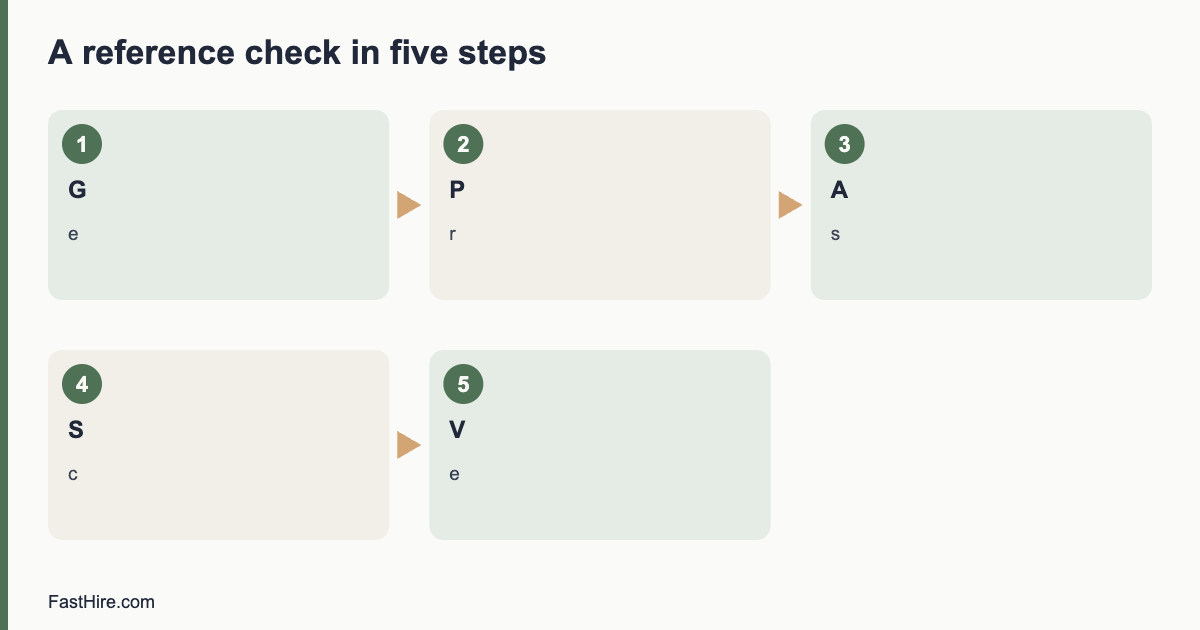
    • Use an evidence matrix: requirements in rows, candidates in columns, a score and a note in each cell.
    • Set the weights before interviews, so you do not shift them to favour a person.
    • Guard against anchoring on the first or the most memorable candidate.
    • Write the decision and the reasons, and check them with a second person.

    The problem with unlike candidates

    Imagine three finalists: one with ten years in a large company, one from a small start-up who did many things, and one who changed careers after study and a project role. Each has strengths. If you compare them by impression, the person with the most familiar background tends to win. If you compare them against the requirements, the winner is the person who can best do the work. The method matters most when candidates are unlike each other.

    Step 1: write requirements that all backgrounds can meet

    Requirements should describe what the person must do, not where they must have done it. “Has run a budget of at least this size” can be met in a large firm, a start-up or a charity. “Worked at a top firm” cannot be justified as a requirement. Use checkable job requirements and keep the list short. See also must-haves vs nice-to-haves.

    Step 2: translate each background into the same terms

    This is the key step. A candidate from a large firm may say “managed a portfolio of accounts”. A candidate from a small firm may say “I looked after our ten biggest customers”. Both are evidence of customer management, at different scales. Translate each into your requirement: what did they do, how big was it, what was the result?

    RequirementLarge-firm candidate saysSmall-firm candidate saysCareer-changer saysCommon terms to compare
    Manages customersManaged 40 accounts with a teamLooked after top ten customers aloneRan a volunteer programme of 30 clientsNumber, role, result
    Plans workPlanned quarterly projects with a PMOPlanned all jobs on a whiteboardRan a project for a study groupScope, tools, outcome
    Uses dataBuilt dashboards in a BI toolUsed a spreadsheet for weekly numbersAnalysed survey data for a dissertationTool, task, decision made

    Ask follow-up questions in interviews to get the scope and result for each. Use the same questions with everyone. See structured interviews and behavioural interview questions.

    x

    Step 3: build the evidence matrix

    List the requirements in rows and the candidates in columns. In each cell, write a score from zero to three and a short note of the evidence. Use a fixed scale, such as: 0 no evidence, 1 weak, 2 clear, 3 strong with scope and result.

    RequirementWeightCandidate ACandidate BCandidate C
    Requirement 1High
    Requirement 2High
    Requirement 3Medium
    Requirement 4Low

    Fill in the matrix right after each interview, before you talk to others. This protects against the pull of the group view. Ask each interviewer to complete it on their own, then combine.

    Step 4: set weights before you see the candidates

    Not all requirements matter equally. Decide which are essential and which are useful. A simple approach: high, medium and low, or points that add up to 100. Fix the weights in the role brief or the kickoff, and do not change them after you meet the candidates. Changing weights to suit a favourite is a common source of bias. If a weight must change because you learned something new about the job, change it for everyone and record why.

    Step 5: guard against anchoring and other traps

    • Anchoring: the first candidate sets the standard. Compare each candidate with the requirements, not with the previous person.
    • Recency: the last interview is remembered best. Use notes.
    • Contrast: a very weak candidate makes the next one look better. Use fixed scoring.
    • Halo: one strong trait colours the rest. Score each requirement alone.
    • Similarity: favouring people like you. Ask a second reviewer to read the evidence.
    • Prestige: giving extra credit to well-known names. Ask what the person did.

    Our guide to reducing interview bias covers these in more depth.

    Step 6: discuss, decide and record

    Hold a short debrief meeting. Show the matrix. Start with the largest differences in scores between reviewers and discuss the evidence. Do not argue about feelings. Agree the scores, then look at the totals and at the high-weight requirements. If two candidates are close, look at the evidence behind high-weight items, and consider a final step such as a work sample or reference check.

    Record the decision and the reasons in terms of the requirements. A paragraph is enough. Keep the matrix.

    Do not use a score as the decider

    A matrix supports a decision. It does not make it. A person with the highest total may still be a poor choice if they score zero on an essential requirement. Set a rule in advance: any candidate who scores zero on an essential requirement does not progress, unless the team agrees there is a plan to close the gap. People make the final call, and the reasons should be written.

    Fairness and legal points

    Comparing candidates from other countries and systems

    Education and job titles differ across countries. A degree name or a grade may not mean the same thing elsewhere. Ask what the person studied and did, rather than relying on the label. Where a formal qualification is a legal requirement, use an official comparison service in your country. For everything else, compare skills and results. This keeps your process fair to people who trained abroad, and widens your pool.

    Checklist

    • Requirements and weights are written before interviews.
    • Every candidate answers the same core questions.
    • Evidence is translated into the same terms.
    • Each interviewer scores alone first.
    • The matrix shows scores and notes for every cell.
    • Essential requirements have a minimum.
    • The decision and the reasons are recorded.
    • A second person has read the notes for close calls.

    Worked example (fictional)

    A hiring manager must pick between three finalists for an operations lead. Candidate A is from a large manufacturer and has run a team of eight. Candidate B is from a small business and has run the whole operation alone. Candidate C is a career changer who ran a large volunteer event. The manager uses a matrix with four requirements and weights set before interviews: planning (high), managing people (high), using data (medium) and supplier work (medium). Each interviewer scores alone. The matrix shows A strong on people, B strong on planning and suppliers, and C strong on planning but with little data experience. The panel talks about the evidence for planning and people, the high-weight items, and decides to offer the job to B with a plan to build the people-management skills. The manager records the reasons and gives A and C specific feedback.

    Handling a candidate you simply like

    Liking a candidate is not wrong. It becomes a problem when it replaces evidence. If you notice that you like someone, say it to yourself and ask: what evidence do I have for each requirement? Fill in the matrix for that candidate first, before you look at others. If the evidence is strong, your liking and the evidence agree, and the choice is easy. If the evidence is thin, you have a reason to ask more questions or to consider other candidates. This habit protects you from your own preferences without asking you to ignore the human side of the work.

    What to do when requirements change mid-process

    Sometimes you learn something new about the job halfway through. A project changes, a team member leaves, or a candidate shows a skill you did not think to ask for. It is fine to update the requirements. Do it openly. Note the change and the reason, tell the panel, and apply it to every candidate. That may mean re-scoring earlier interviews or asking earlier candidates a follow-up question. If you cannot do this fairly, keep the original criteria and add the new item to the plan for the first months. Never apply a new criterion to one candidate only.

    A short script for the comparison meeting

    1. The lead states the requirements and weights in one minute.
    2. Each reviewer shares their scores for the first requirement, one at a time, without discussing.
    3. The group discusses the largest gaps, asking for the evidence from notes.
    4. Scores are updated if new evidence appears. Reasons are noted.
    5. Repeat for each requirement.
    6. Look at totals and the essential items. Discuss any risk, such as a zero on an essential requirement.
    7. The hiring manager states the decision and the three main reasons.

    Keep the meeting to 30 or 45 minutes. Share the matrix in advance. Send a written summary within a day, and use it to give feedback to candidates who did not get the job, as in how to give feedback to rejected candidates.

    Using the matrix after the hire

    The matrix is useful after the decision too. Keep it with the hire file. At 90 days, compare the new hire performance with the scores. Where the person did better or worse than expected on a requirement, ask why. Was the question a good test? Was the weight right? Was the evidence misread? Use the answers to improve the next set of questions and the next set of weights. Over several hires, this feedback loop makes your comparisons sharper and fairer, and it gives you proof that your process predicts good work, which is the best defence of any hiring decision.

    Share the lessons with other managers. A short note on what you changed and why spreads good habits through the company. If different managers use different matrices, standardise a simple template so that people can compare notes. A shared approach also makes it easier for HR to check fairness and for new managers to learn the routine. Small, repeated improvements matter more than one perfect tool.

    If you find that your matrix scores often differ by a wide margin between reviewers, treat that as useful information. It may point to unclear requirements, unclear scale descriptions or a lack of shared understanding. Fix these by adding examples to each score level, and by running a short practice scoring session with a recorded or written sample answer. This calibration step takes thirty minutes and improves the consistency of every later decision, which in turn makes the whole process fairer for candidates.

    Frequently asked questions

    How do I compare someone from a big company with someone from a start-up?

    Translate each background into the same terms: what they did, the scale and the result. Score against the requirements, not the employer name.

    Should I use weights?

    Yes, if some requirements matter more. Set them before you meet the candidates and keep them the same for everyone.

    What if two candidates tie?

    Look at the evidence behind high-weight items, add a work sample or reference check, and record the reasons for the choice.

    Can I use a numeric score alone?

    No. The score supports the decision. People should review the evidence and make the final call.

    Related guides

    This is general information, not legal advice.
  • Career gaps, job hopping and short stints: how to read them fairly

    Career gaps, job hopping and short stints: how to read them fairly

    A career gap or a short job is a prompt for a question, not a reason to reject. Ask whether it matters for this role, look at the whole pattern, ask one open question, and judge the answer on evidence. Reasons for gaps and short stints are many: care, health, study, redundancy, contract work, moves and bad employers. This guide shows how to read them fairly.

    Key takeaways

    • A gap or short job is information to explore, not proof of a problem.
    • Decide first whether tenure or continuity truly matters for the role, and write down why.
    • Ask one neutral, open question and listen. Do not ask about health, family plans or other protected topics.
    • Judge skills and results on evidence. Compare the pattern across the whole career, not one line.
    • Apply the same rules to every candidate, and record your reasons.

    What the data says, and what it does not

    Many managers treat short stints as a warning. Before you do, look at the facts about working life. The US Bureau of Labor Statistics reports the median number of years that wage and salary workers have been with their current employer, and it varies by age, industry and occupation. In its January 2026 supplement, the median was 4.1 years across all workers; see the BLS employee tenure release. It also shows that younger workers have shorter tenure than older ones, which is natural early in a career. A rule that rejects short stints can therefore penalise young people and some industries more than others.

    The data does not tell you about the person in front of you. It only tells you that changing jobs is common. Use it as a reminder to ask rather than assume.

    Why people have gaps and short stints

    ReasonExamples
    CareRaising children, caring for a relative
    HealthIllness or recovery, including mental health (personal and private)
    Study and trainingCourses, a degree, a career change
    Work patternsContract, seasonal, project or gig work
    Business eventsRedundancy, closure, restructuring, a merger
    MovesRelocation, a partner job, a move to another country
    Poor fit or conditionsA bad manager, unsafe work, unpaid wages, a role that differed from the ad
    Personal circumstancesBereavement, legal matters, military service, travel

    Many of these are protected or private. You should not ask for detail on health, family or similar topics. Give the candidate the choice to share as much as they wish, or to say that it is private.

    Step 1: decide whether it matters for the role

    Ask what the job needs. A role with a long learning curve and high training costs may benefit from someone who stays for years. A role in a fast-moving field, a project role or a seasonal role may not. Write one sentence: “For this role, tenure matters because [reason]” or “does not matter because [reason]”. If you cannot write it, do not use tenure as a filter.

    Make this part of your role brief and your must-haves. A requirement such as “can commit to the project for twelve months” is clearer and fairer than a general preference for long jobs.

    Step 2: look at the whole pattern

    • Is there growth in scope or responsibility, even across several short jobs?
    • Do short jobs coincide with contracts, projects or known events in the industry?
    • Are the skills and results strong in each job?
    • Is there a recent period of stability?
    • Do references say the person delivered during short stints?

    A person who changed jobs five times in five years but built skills and results each time may fit a role better than a person with one job for a decade and little growth. Judge on the match with the requirements. See what to look for on a resume or CV.

    x

    Step 3: ask one open question

    If the pattern matters for the role, ask a neutral question and listen. Keep the same question for everyone with a similar pattern.

    SituationQuestion to askQuestion to avoid
    Gap between jobsIs there anything about the period between these roles that you would like to tell me, in relation to this role?Why did you not work for a year? Were you ill?
    Several short jobsTell me about the reasons for your moves, and what you looked for in each.Why can you not hold a job?
    One very short jobWhat did you learn from that role, and what did you look for next?What did you do wrong?
    Return after care or studyWhat have you done to keep or update your skills?Do you plan to have more children?

    If the candidate says it is private, accept that and move on. Do not press. Judge the rest of the evidence. See interview questions you cannot ask.

    Step 4: judge the answer on evidence

    A good answer is not a perfect story. It shows that the person can reflect, learn and commit where it matters. Score two things: how well the answer addresses the actual concern for this role, and the evidence of skills and results. If the concern is reliability for a twelve-month project, ask about commitments they have kept. If it is skills after a gap, ask what they learned and show them a short work sample. Our work sample tests guide can help.

    Fairness and legal points

    Gaps and short jobs often link to protected traits. Care duties can cause gaps, and they do not fall equally on everyone. People with a disability or long-term condition may have gaps. Younger workers have shorter jobs, as noted above. Immigrants may have gaps while their status was settled. A blanket rule against gaps or short stints can therefore have an unequal effect and may be hard to justify.

    • In the US, see the EEOC for prohibited practices, including disability, sex, age and national origin.
    • In the UK, the Equality Act protects against discrimination on grounds including disability, sex, age and pregnancy and maternity. See GOV.UK employing people.
    • In the EU, national equal treatment law applies. See our EU guide.

    If a candidate shares a protected reason, do not use it against them. Return to the job requirements and keep your notes job-related. For reasonable adjustments in the process, see reasonable adjustments in interviews.

    Rules for your hiring team

    1. A gap or short stint alone is never a reason to reject.
    2. Decide in the role brief whether tenure matters, and why.
    3. Use one standard question for all candidates with a similar pattern.
    4. Never ask about health, family plans, religion or other protected topics.
    5. Score evidence of skills and results.
    6. Record the reasons in terms of the requirements.
    7. Review your decisions: do gaps or short stints lead to rejection more often for any group?

    Red flags that are real, and red flags that are not

    Often a real concernOften not a real concern
    Dishonest dates or titles that fail a checkA gap with no explanation given
    Repeated departure under serious conduct issues, confirmed by referencesSeveral contract roles in a field where contracts are normal
    A pattern of leaving soon after training, where the role needs long commitment and the candidate cannot discuss itA move after redundancy
    Claims that cannot be verifiedCareer change after study

    Verify, do not guess. Reference checks, used fairly, can confirm facts. See how to check references.

    Candidates who return to work

    People returning after a break often have strong skills but low confidence. Be clear in the ad that you welcome them. Offer a structured interview and a work sample so that they can show current skills. Some employers run return-to-work programmes with a supported start; if you consider one, set clear goals and a support plan, like those in how to write a 30-60-90 day plan.

    Worked example (fictional)

    A hiring manager reviews two resumes for a project coordinator role. Candidate A has had four jobs in five years, each a 12 to 18 month contract in construction, with rising scope. Candidate B has had one job for eight years with little change in duties. The manager first checks the role brief: the project lasts eight months, so continuity during that time matters, not total years. She asks Candidate A one question: “Tell me about the reasons for your moves.” A explains that each contract ended with the project, and offers two references. B is asked about growth in the role and gives clear examples of recent change. The panel scores both on the same sheet. A scores higher on coordinating suppliers and receives the offer, and the manager records the reasons.

    What to do with gig, freelance and portfolio careers

    Many people now build careers from contracts, freelance work and projects. On a resume or CV, these can look like many short jobs. Read them as a portfolio. Ask for the scope, the client type, the result and the length of each project. Check whether the work grew in size and difficulty. Ask for two references from clients. Treat this experience as real work, because it is, and score it against the same requirements as any other.

    Using references and work samples to settle doubts

    If a short stint worries you, a fair reference or a short task can settle the question better than a guess. Ask the candidate for permission, and ask the referee the same set of questions you would ask for any candidate: what were the duties, how did the person perform, would you work with them again. Our reference checking guide explains how to do it fairly. A short, paid work sample, scored on a fixed scale, shows current skill after a gap. Both tools shift the decision from a pattern on paper to evidence about the work.

    Training your team to read patterns fairly

    Show your interviewers two anonymised resumes: one with a gap and one with several short jobs. Ask them to say what they would ask, and what they would not ask. Compare their answers with the guidance in this article. Agree on the standard question and the scoring rule. Repeat the exercise every year, and add real examples from your own hiring, with names removed, to keep the training grounded in what your team actually sees.

    Finally, review your outcomes. If candidates with gaps or short stints are rarely invited to interview, find out why. Check your screening notes. Check whether a rule is applied without a reason. Fix the rule or the habit, and watch the next round of results. Fair reading of work history widens your pool and improves the quality of your hires.

    Quick checklist before you decide

    • I wrote down whether tenure or continuity matters for this role, and why.
    • I looked at the whole career pattern, not one line.
    • I asked one neutral open question, the same as for others.
    • I did not ask about health, family plans or other protected topics.
    • I checked evidence of skills and results, with a reference or work sample if needed.
    • I recorded my reasons in terms of the requirements.
    • I compared my decision with those for other candidates with similar patterns.

    Keep this list with your scorecard. If you cannot tick a line, pause and fix it before you decide. A few extra minutes protects the candidate and your company, and it leads to better hires, because you are looking at what the person can do rather than at a pattern on a page.

    Frequently asked questions

    Is job hopping a red flag?

    Not by itself. Ask whether tenure matters for the role, look at the whole pattern, and judge skills and results. Many short jobs have good reasons.

    Can I ask why there is a gap in a resume?

    You can ask a neutral, open question if the gap matters for the role. Do not ask about health, family plans or other protected topics, and accept that the person may keep it private.

    How long is a long gap?

    There is no fixed rule. What matters is whether the person can do the job now. Check current skills with a work sample or structured questions.

    Should I reject someone with three short jobs in a row?

    Not on that alone. Check the reasons, the results and the match with the requirements.

    Related guides

    This is general information, not legal advice.

  • What to look for on a resume or CV: a manager guide

    What to look for on a resume or CV: a manager guide

    Read a resume or CV against your written must-haves, not against a general impression. For each must-have, look for evidence: a task, a result, a tool, a qualification, a period of time. Note questions to ask at interview, and score every candidate the same way. This guide shows what to look for, what to ignore and how to avoid common traps.

    Key takeaways

    • Start from your must-haves. Without them, you will judge by style and instinct.
    • Look for evidence, not labels. “Led a team” is a label. “Led a team of four to deliver X by Y” is evidence.
    • Judge the quality of examples: scope, role, result, and how recent.
    • Treat gaps, job changes and unusual paths as questions to ask, not as faults.
    • Ignore signs that do not predict work: name, photo, age, address, school prestige, and font.

    Before you open the first resume or CV

    Decide what you are looking for. Write the must-haves and the nice-to-haves, as explained in must-haves vs nice-to-haves and how to write checkable job requirements. A good must-have can be checked on a document. “Has used a spreadsheet to build a monthly report” can be checked. “Passionate about data” cannot.

    Set up a simple sheet: one row per candidate, one column per must-have, and a column for notes and interview questions. If you also work with a recruiter, share the sheet. For volume, see how to screen applications quickly.

    Step 1: match each must-have to evidence

    Go through the document with one must-have at a time. Highlight the text that supports it, and write a short note. If you cannot find evidence, mark it as not shown. This is different from not met: the person may have the skill but not have written it down. You can ask at the interview or in a short screening call.

    Must-haveEvidence to look forNote
    Managed a budgetA budget amount or scope, what it covered, any resultAsk about the largest item
    Used a specific toolTool name, what it was used for, how oftenAsk for a task example
    Worked with customersRole, type of customers, volume, outcomeAsk about a hard case
    Held a licence or qualificationName, issuing body, statusCheck the original if it is a legal need
    Led or trained othersNumber of people, outcomeAsk how they handled a problem

    Our guide on screening resumes with must-haves and evidence goes deeper on this step, and shows how FastHire is designed to place each requirement next to the exact passage that supports it, so you see the evidence at once. FastHire is coming soon, and people make every decision.

    x

    Step 2: judge the quality of the evidence

    Not all evidence has equal weight. Ask four questions about each example.

    • Scope: how big was the task, team, budget or customer base?
    • Role: did the person do it, lead it or only help?
    • Result: what changed because of the work? Is there a measure?
    • Recency: when did they do it, and are the tools or rules still the same?

    A short, concrete example beats a long, vague one. “Cut the time to close the month from six days to four by changing the order of tasks” says more than “improved processes”. Be careful, though: people who are not used to writing about themselves may under-describe their work. Ask a question before you reject.

    Step 3: read for patterns, not single lines

    Look at the whole document. Does the person show steady growth in responsibility? Do they learn new tools? Do they stay long enough to see results of their work? These are useful signals, but they are not rules. A person who moved often may have worked on contracts. A person who stayed long may have had many roles inside one company.

    Signs that are worth a question

    • A skill is listed but no job mentions using it.
    • A title is senior but the described tasks are junior, or the reverse.
    • Dates that do not add up.
    • A big claim with no scope.
    • Very generic text that could fit any job.

    Each of these is a prompt for a question, not proof of a problem. Use a short screening call or interview question to check.

    What not to read into a resume or CV

    Some features feel important but do not predict work, and some can cause unfair treatment. Set them aside.

    FeatureWhy to set it aside
    Name, photo, addressCan reveal sex, ethnicity, age or background, and are not job-related
    Age or graduation yearAge discrimination law can apply
    Marital status, childrenNot job-related, and can lead to unfair assumptions
    Gaps in work historyCommon and often for good reasons. Ask about them neutrally if it matters, or not at all
    School name or brandWeak link to ability, and can favour people with more money or connections
    Design, fonts, layoutTell you about the writer tools, not the work
    Spelling errorsMatter only if accuracy in writing is a real requirement. Consider the writer first language and any disability such as dyslexia

    The law differs by country, but the principle is shared. In the US, the EEOC lists prohibited practices. In the UK, see GOV.UK employing people and the Equality Act guidance. In the EU, see the equal treatment guide. For ideas on reducing bias in the screening step, read how to reduce bias in resume screening.

    Step 4: prepare interview questions from what you saw

    The resume or CV is a list of claims. The interview tests them. For each finalist, write two or three questions that come from the document.

    • “You list a budget of X. What did it cover, and what was your part?”
    • “The role description mentions a tool. Show me how you used it in one real task.”
    • “There is a gap between these two jobs. Is there anything you want to tell me about that period?” Ask only if the gap matters for the job, and only in a neutral way.

    Then use a structured interview, as in how to run structured interviews, so each person answers the same core questions.

    Step 5: score and compare

    Use a simple scale, such as zero for no evidence, one for weak, two for clear and three for strong. Score each must-have, add notes, and set a threshold for moving to the next stage. Keep the scale the same for all candidates. Where possible, ask a second person to score a sample, and compare. If your scores differ widely, talk about why and adjust the criteria.

    ScoreMeaningExample
    0No evidence on the documentNo mention of the tool
    1Weak or vagueLists the tool with no detail
    2Clear evidenceUsed the tool for a named task
    3Strong evidenceUsed the tool for a task with scope and a result

    Do not add up scores blindly. The total is a guide. Look at must-haves one by one, and discuss close cases. People decide, not the sheet.

    Using tools and AI for screening

    If a tool helps you read resumes or CVs, keep a person in charge. Check what the tool does, what data it uses, and whether it can explain its output. Some places have rules for automated hiring tools, such as New York City Local Law 144 and GDPR Article 22. FastHire is coming soon and is designed to show evidence, not to rank or reject people.

    A one-page checklist

    • Must-haves and nice-to-haves are written before screening.
    • One sheet is used for all candidates.
    • Evidence is noted for every must-have, with its source on the document.
    • Questions are noted for each gap or unclear claim.
    • Name, photo, age and similar details are set aside.
    • A second person checks a sample of scores.
    • Reasons for each decision are written in terms of the requirements.

    Common mistakes

    • Reading for style, so good writers win over good workers.
    • Rejecting on one weak line when the rest is strong.
    • Over-valuing brand-name employers and schools.
    • Changing the criteria after you see the candidates.
    • Making a decision in the first 10 seconds and then looking for reasons.
    • Keeping no record of why you rejected a person.

    Worked example (fictional)

    A hiring manager needs an operations coordinator. The must-haves are: schedules for a team of ten, uses a spreadsheet for weekly reports, and deals with suppliers. Candidate A writes “excellent organiser” and lists two job titles. Candidate B writes “planned weekly rotas for nine staff, built a stock report in a spreadsheet each Friday, and agreed delivery dates with four suppliers”. The manager scores A at one on each, because no evidence is shown, and B at two or three. She still invites A to a short call, because the document might hide good experience. In the call, A gives clear examples, and moves on. The sheet shows how each decision was reached.

    Reading resumes or CVs for different kinds of role

    Early career candidates

    People with little work history show their skills through study projects, volunteering, part-time work and personal projects. Look for the same evidence: what they did, how big it was, and what resulted. Do not penalise a lack of years of experience if the must-haves do not require it.

    Career changers

    A person moving from another field may have strong transferable skills, such as planning, writing, handling customers or analysing data. Map each must-have to the closest example, even if the job title differs. Ask how they learned the missing parts and how fast they can close the gap.

    Senior candidates

    For senior roles, look for scope, decisions and results over time. Ask about the biggest decision and what they would change. Be wary of credit for team results without a clear description of the personal role.

    Technical roles

    A list of tools tells you little by itself. Look for what was built or fixed, with what constraints, and for whom. A short work sample can check the skill more fairly than a long list of keywords. See work sample tests.

    How to handle documents in different formats and countries

    Resume and CV formats differ by country. In the US, a resume is usually one or two pages and leaves out personal details. In the UK and much of Europe, a CV can be longer and may include more background. In some countries, photos and dates of birth are common on a CV, even though they are not job-related. Treat them in the same way: set them aside. If you receive a document from another country, adjust your expectations on format, and focus on content.

    Make it easy for all candidates to apply. If someone cannot send a standard document, offer another route. Our guide to accessible job applications gives ideas.

    Keeping records of your screening

    Keep your sheet, your notes and the reasons for each decision. If a candidate asks why they were not selected, or if a regulator asks about your process, you can show that you used job-related criteria. Keep the records for the period that applies in your country, then delete them. The article on how long to keep rejected applicant data explains this in more detail.

    Frequently asked questions

    How long should I spend on each resume or CV?

    Enough to check each must-have against the evidence. With a clear sheet, this can take a few minutes. Longer reading is for finalists.

    Should I reject a resume or CV with spelling mistakes?

    Only if accurate writing is a real requirement of the job. Even then, consider that the person may write in a second language or have a condition such as dyslexia.

    How should I treat a gap in employment?

    Do not assume the worst. Ask a neutral question only if the dates matter for the job. Many people have gaps for care, study, health, redundancy or travel.

    Is it fair to use a score?

    Yes, if the criteria are job-related, applied equally and checked. A score supports a decision made by people. It does not replace it.

    Related guides

    This is general information, not legal advice.
  • How to write a 30-60-90 day plan for a new hire

    How to write a 30-60-90 day plan for a new hire

    A 30-60-90 day plan sets out what a new hire will learn, do and own in their first three months. Write it before day one, share it on the first day, and review it at each stage. It should have a few clear goals for each period, a way to check progress, and room for change. This guide gives you a template and examples.

    Key takeaways

    • Keep it short: three to five goals for each 30 day period, each one something you can see.
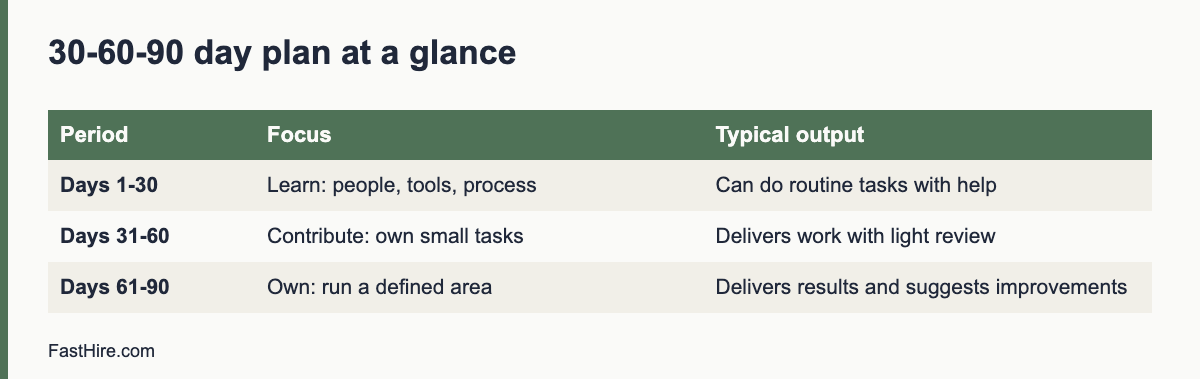
    • Days 1-30: learn. Days 31-60: contribute. Days 61-90: own a defined area.
    • Write goals as outcomes, not activities. “Complete training” is weak. “Handle five customer cases alone, with a quality check” is stronger.
    • Review in a one-to-one at day 30, 60 and 90. Ask the new hire what they need.
    • Treat the plan as a guide. Update it when the work or the person shows a better path.

    What a 30-60-90 day plan is for

    New hires often do not know what good looks like. A plan answers that question. It also helps you: it forces you to decide what matters before the person arrives. A plan lowers the chance of mixed messages and gives both sides a shared view of progress.

    The plan does not replace the first 30 days onboarding, which covers paperwork, access and welcome tasks. The plan adds work goals on top. If your company runs a probation period, the plan is a natural base for the reviews described in how probation periods work.

    Step 1: start from the role brief

    Take the main outcomes from your role brief. What results should the person deliver in the first year? Work backwards: what must they have learned and done by day 90 to be on track? Then split the path into three stages.

    Step 2: set the goals for each stage

    Days 1 to 30: learn

    The first month is about orientation. The person meets the team, learns the tools, understands the customers and the goals, and does small tasks with support. Goals should be about learning and early practice.

    • Meet each member of the team and key partners, with a note of what each does.
    • Learn the main tools and complete the access and safety steps.
    • Shadow or review the main processes, and write a short summary in your own words.
    • Complete a small first task with feedback.
    • Agree how you and the manager will work together: how often to meet, how to ask for help.

    Days 31 to 60: contribute

    In the second month, the person starts to own small pieces of work. They need less guidance on routine tasks and more feedback on quality. Goals shift from learning to doing.

    • Complete a defined set of tasks alone, with a quality check.
    • Take part in team meetings and share one idea or question each week.
    • Find one process problem and suggest a fix.
    • Build a working relationship with one partner outside the team.
    • Show progress against a simple measure, such as tasks done on time.

    Days 61 to 90: own

    In the third month, the person runs a defined area from start to finish. They deliver results, show judgment and begin to help others.

    • Own a project or area with clear results and a date.
    • Present results to the team or manager.
    • Make one improvement and measure its effect.
    • Write a short plan for months four to six.
    • Give feedback on onboarding so the next hire has a better start.
    x

    Step 3: make each goal clear and checkable

    A good goal passes four tests. It is specific. You can see whether it was met. It is within the person control. It has a date. Compare these examples.

    Weak goalBetter goal
    Learn the CRM.By day 20, log and update ten customer records in the CRM with no errors found in a manager check.
    Be proactive.By day 60, bring two ideas to the team meeting, with a note of the expected effect.
    Improve communication.By day 45, send a weekly status update by Friday noon, and ask for feedback at day 60.
    Take ownership.By day 90, run the monthly report from start to finish, with delivery on the agreed date.

    Step 4: add support, not only goals

    A plan with goals but no support is a test, not a plan. For each stage, say what help the person will get: training, a buddy, a regular meeting, access to data, time away from other work. Ask what else they need.

    SupportWhoWhen
    Welcome and tool accessManager and ITBefore day one
    Buddy for questionsA teammateFirst 60 days
    Weekly one-to-oneManagerEvery week
    Skills trainingManager or learning leadAs planned in the first month
    Feedback on first outputsManagerWithin 2 working days

    Step 5: schedule the reviews

    Book the reviews before day one. A 45 minute meeting at day 30, 60 and 90 works for most roles. Use the same questions each time so the new hire can prepare.

    1. What went well in the last 30 days?
    2. What was harder than expected?
    3. Which goals did you meet, and which not? What got in the way?
    4. What help do you need from me?
    5. Should we change any goals for the next stage?

    Take notes and share them. Notes protect both sides and make the final review simple. If the plan feeds a probation decision, keep the same notes for everyone in the same role.

    Template you can copy

    SectionDay 1-30 (Learn)Day 31-60 (Contribute)Day 61-90 (Own)
    Goals (3-5 each)
    How we will check
    Support and training
    Review date and notes

    Examples for three roles (fictional)

    Customer support agent

    • Day 30: complete product training, handle common tickets with a buddy check, learn the escalation rules.
    • Day 60: handle the full range of standard tickets alone, with a quality check on a sample.
    • Day 90: lead one improvement, such as a new reply template, and show its effect.

    Marketing coordinator

    • Day 30: learn the brand guide and tools, edit and publish two posts with review.
    • Day 60: plan and run a monthly email, report results.
    • Day 90: own the content calendar for one channel and suggest next quarter themes.

    Junior accountant

    • Day 30: learn the system and close routine, post entries under review.
    • Day 60: complete reconciliations for assigned accounts with a manager check.
    • Day 90: run a month-end task area alone and document the steps.

    Adjusting for different roles and levels

    Senior people need less time to learn tools but more time to understand context and people. Start them with listening: meet stakeholders, review past decisions, and learn the history. Their day 90 goal might be a plan for the year, with early wins already delivered. Junior people need more practice and feedback. Their goals should focus on skills and quality.

    For remote or hybrid people, add goals for connection: virtual coffees with colleagues, clear rules for response times, and regular video one-to-ones. Make sure equipment and access arrive before day one. For people with a disability or health need, agree adjustments early, and see reasonable adjustments in interviews for the thinking that also applies at work.

    Fairness, privacy and legal points

    • Use the same plan structure for everyone in the same role, so reviews are consistent.
    • Keep notes factual and related to the work. Do not record health, family or other private matters unless needed and allowed.
    • Treat the plan as personal data. Store it securely and limit access.
    • If the plan is part of a probation process, follow the rules in your country. See the UK employer overview on GOV.UK and the US SBA guide to hiring.

    Common mistakes

    • Too many goals. Five per stage is the practical limit.
    • Goals that depend on others, with no support.
    • No review dates, so the plan fades after week two.
    • Setting day 90 goals that need a year of experience.
    • Never updating the plan, even when priorities change.
    • Using the plan only to find fault, not to help.

    Worked example of a review conversation (fictional)

    At day 60, a manager and a new analyst meet. The analyst met two of three goals. The report goal slipped because the data was late, not because of the work. The manager asks what would help, and the analyst asks for earlier access to the data feed. The manager agrees to arrange it, and moves the report goal to day 75. They write the change in the plan, and note the agreed support. The analyst leaves with a clear next step, and the manager has a record of why the date moved.

    How to write goals when the work is hard to measure

    Some roles produce results that are hard to count in the first months. In that case, use quality, timeliness and feedback instead of volume. Ask: what would a good colleague notice? What would a customer notice? Turn those signs into goals.

    • Quality: a named reviewer rates the work against a simple checklist.
    • Timeliness: tasks are done by the agreed date in most cases.
    • Feedback: two or three partners say in a short check-in that work with the person is easy and clear.
    • Learning: the person can explain the process in their own words and teach it to a colleague.

    Avoid goals that reward speed at the cost of care. A new person who rushes may make mistakes that cost more later. Make quality part of the goal.

    The manager part of the plan

    The plan is also a promise from you. Write three commitments of your own, and share them with the new hire.

    1. I will hold a one-to-one every week for the first 90 days.
    2. I will give feedback on your first outputs within two working days.
    3. I will introduce you to the people you need, by the end of week two.

    Keep these commitments. A manager who misses the first two meetings tells the new hire what matters, and it is hard to undo. If you must move a meeting, move it and say why. The first impression of your management is built in the first weeks.

    Using the plan with a probation period

    If your contract includes a probation period, link the plan to it. The goals become the evidence for the decision, and the review dates match. Use the same form for everyone in the same role. Check local law on what probation means in your country, as it differs in the US, UK and EU. Our guide to probation periods explains the differences.

    What to do if the plan is not working

    Plans fail for many reasons. Look at the cause before you judge the person.

    SignPossible causeAction
    Goals missed repeatedlyGoals too hard or unclearRewrite the goals with the person
    No questions askedPerson feels unsafe to askSet a weekly time for questions, and ask first
    Work quality is unevenMissing trainingAdd targeted training or a buddy
    Slow progress on one areaSkill gapAgree a development plan and a review date
    Person seems disengagedRole differs from what was describedTalk openly, check the role brief against the work

    If problems remain after support, record what you tried and follow your local process. Do not wait until day 90 to raise a concern. Raise it when you see it, kindly and clearly.

    Frequently asked questions

    How long should a 30-60-90 day plan be?

    One page is usually enough. List three to five goals for each stage, the support, and the review dates.

    Should the new hire help write it?

    Yes, from day one. The manager drafts it before they arrive, and the person suggests changes after learning more. This builds ownership.

    What if the new hire is ahead of plan?

    Raise the goals or bring forward the next stage. Keep the aim of steady, sound progress.

    What if the new hire is behind plan?

    Find the cause. It may be unclear goals, lack of support or a skill gap. Fix what you can, then review again soon.

    Related guides

    This is general information, not legal advice.

  • How to build a headcount business case

    How to build a headcount business case

    A headcount business case is a short document that asks for approval to hire. It states the problem, compares the options, costs the preferred option, shows the benefit and the risks, and asks for a clear decision. One page is often enough. This guide gives you the structure, the numbers to collect and a template to copy.

    Key takeaways

    • Start with the problem and its cost, not with the job title.
    • Compare at least three options: do nothing, change how work is done, and hire. Show why hiring wins, if it does.
    • Cost the full role: pay, taxes and benefits, tools, search, onboarding and ramp-up time.
    • Use your own data and official sources. Do not invent figures.
    • Name the risks and how you will check success at 90 days and six months.

    Why a business case helps

    Approvers must compare many requests with a limited budget. A request that says “we are busy, we need another person” gives them little to work with. A request that shows the problem, the cost of leaving it, the options and the plan makes the decision easier. It also helps you think. Sometimes the case shows that a different fix is better, and that is a good result.

    Step 1: state the problem in numbers you can check

    Describe what is going wrong, who it affects, and how you know. Use data from your own systems: hours of overtime, tickets waiting, late orders, lost sales, missed deadlines, customer complaints, time spent on tasks that someone else could do. Keep to figures you can show.

    Weak statementBetter statement
    The team is overloaded.The team logged overtime on most weeks of the last quarter, and a backlog of requests grew each month. Here is the log.
    We lose customers.We lost three accounts last quarter after slow response, according to exit notes in the customer system.
    We need a specialist.Two projects are on hold because no one on the team can do the data work. The projects are worth the amounts in the plan.

    If you do not have data, collect two weeks of it before you ask. A simple tally of tasks and hours is enough to start. If you use a number from outside your company, link to a trustworthy source, such as the US Bureau of Labor Statistics or the Eurostat labour market pages.

    Step 2: list the options

    Approvers will ask: why not do it another way? Answer the question before it is asked.

    OptionWhat it meansMain strengthMain weakness
    Do nothingAccept the current stateNo costThe problem continues or grows
    Change the processRemove or automate low-value tasksLow cost, fastMay not be enough
    Move work inside the companyShare the work with other teamsUses existing peoplePulls capacity from other work
    Use a contractor or agencyBuy capacity for a fixed timeFlexibleHigher hourly cost, less lasting knowledge
    Hire an employeeAdd a permanent roleLasting capacityHigher fixed cost, time to hire

    If you consider a contractor, read employee or contractor first, because the label does not decide the legal status.

    x

    Step 3: cost the preferred option

    Cost the full role, not only the salary. The cost to hire an employee guide gives the list. A simple structure helps.

    Cost lineHow to estimateSource
    Base payMidpoint of the range for the role and levelYour pay framework, official wage data
    Employer taxes and contributionsUse the rate for your country and regionTax authority or payroll provider
    BenefitsUse the actual plan cost per personBenefits provider
    Tools and equipmentQuote from IT or suppliersInternal quote
    Search costAd costs, recruiter fee if any, interviewer timeYour records
    Onboarding and trainingManager and team time in the first monthsYour estimate, with the method stated
    Ramp-upPeriod when output is below full levelEstimate, shown as a range

    For official compensation data in the US, the BLS publishes employer cost information at bls.gov/ecec. In the UK, see GOV.UK employing people for employer duties, and in the EU use national tax authorities and Eurostat. If you are not sure of a figure, give a range and say what it depends on.

    Step 4: show the benefit

    Link the benefit to the problem in step 1. If the problem was overtime, show the overtime removed. If it was lost sales, show the sales you expect to protect and your reasoning. Use ranges, not single numbers, and state the assumptions. Where you cannot give a number, describe the benefit in words and say how you will know it has happened.

    • Direct benefit: hours saved, work completed, revenue protected or added.
    • Indirect benefit: lower risk, better quality, less stress on the team, faster response.
    • Time to benefit: when will the effect be visible, given the hiring time and ramp-up?

    Be careful with claims. Do not promise that one hire will double output or solve every issue. Approvers trust a modest, well-argued case more than a bold one.

    Step 5: name the risks

    RiskHow likely and how badWhat you will do
    The hire takes longer than plannedLikely if the market is tightStart early, agree interview dates up front
    The person does not fitPossibleUse structured interviews and a probation plan
    Demand fallsPossibleReview at six months, consider a fixed-term or flexible contract if the law allows it
    Budget changesPossiblePhase the start date, agree a check point

    Naming risks does not weaken the case. It shows you have thought about what could go wrong.

    Step 6: set success measures and a review date

    Say how you will know the hire worked. Pick two or three measures from your problem statement, and set a target and a date. For example: backlog reduced to an agreed level by month six, overtime back to normal, or a project delivered by a set date. Add a review at 90 days and at six months.

    Step 7: ask for a clear decision

    End with a request that can be answered with yes, no or not yet: “I ask for approval to hire one analyst at the pay range shown, with a target start date of X, for the budget shown.” State what you will do next if the answer is yes, and what you will do if it is no.

    One-page template you can copy

    SectionWhat to write
    1. Title and ownerRole, team, who is asking, date
    2. ProblemWhat is wrong, who it affects, the evidence (three to five lines)
    3. Options consideredDo nothing, process change, internal move, contractor, hire (one line each)
    4. RecommendationWhich option and why
    5. CostTable of cost lines, with a total range
    6. BenefitExpected results, assumptions, time to benefit
    7. Risks and planTop three risks and responses
    8. Success measuresTwo or three measures, targets, review dates
    9. Decision requestedThe exact approval and the date needed

    Tips for a case that gets approved

    • Use plain words. Short sentences. No jargon.
    • Put the ask and the one-line reason at the top.
    • Show the cost of waiting.
    • Offer a smaller first step if the full request is large, such as a fixed-term role or a part-time start.
    • Talk to the approver before you send it, so nothing is a surprise.
    • Keep a copy of the case. It becomes the brief for the role.

    Once approved, turn the case into a role brief and work with HR on the plan, as described in how to work with HR on a hiring plan.

    Worked example (fictional)

    A support lead at a software company logs that the team answered most tickets within a day last year, but in the last two quarters the median time grew and two large customers complained. The team worked extra hours in most weeks. The lead lists options: change the ticket form to cut repeat questions, share work with the onboarding team, use a temporary agency, or hire a support agent. The ticket form change would cut a part of the volume, so the lead recommends doing that first and hiring one agent. The cost table shows the pay range, taxes, benefits, tools, search and onboarding. The lead sets two measures: response time back to the earlier level by month six, and no regular overtime. The finance lead approves the hire with a review at 90 days.

    How to answer the questions approvers ask

    Expect questions. Prepare short answers before the meeting.

    Likely questionA good short answer
    Why now?Here is what the delay costs each month, with the evidence.
    Why not a contractor?A contractor costs more per hour and leaves with the knowledge. We use one for peaks only.
    What if we cannot hire fast enough?We have dates for interviews booked and a fallback plan using temporary help.
    How will we know it worked?Two measures, with targets and a review at 90 days and six months.
    What if the work disappears?We review at six months and have the contract terms checked against local law.

    Phasing the request when the budget is tight

    If the full request is too large, offer a staged plan. Stage one might be a process fix and a fixed-term role. Stage two might be a permanent role once the measures are met. A staged plan lowers the risk for the approver and gives you a reason to come back with data. Be honest about what stage one can and cannot do.

    Linking the case to fairness and compliance

    Your case will lead to a job description and a hiring process. Build in fairness from the start. Write requirements that relate to the work, set a pay range that fits your pay structure, and plan an open process. This avoids rework later, and protects the company. The fair hiring hub lists the guides for each country.

    What to do after approval

    1. Thank the approver and confirm the decision in writing, with the budget and the target start date.
    2. Turn the case into a role brief and a list of must-haves.
    3. Book the interview dates and the panel.
    4. Agree the pay range and the ad with HR.
    5. Set a date to review progress after 30 days of searching.
    6. Save the case. At 90 days and six months, compare the results with the measures.

    At the review, be honest. If the benefit is smaller than planned, say so and explain what you learned. A track record of honest reviews makes your next request easier to approve.

    Mistakes to avoid

    • Asking for a job title instead of solving a problem.
    • Using one big number with no range or assumptions.
    • Leaving out the cost of onboarding and ramp-up.
    • Skipping the options, so the approver suggests one you did not consider.
    • Promising results that one person cannot deliver.
    • Forgetting to set a review date, so no one checks if the hire worked.

    Read your case aloud before you send it. If a sentence sounds like a slogan, replace it with a fact. If a number has no source or method, add one or remove it. A calm, honest case is the easiest one to approve, and it helps the hiring process that follows.

    Frequently asked questions

    How long should a headcount business case be?

    One page is often enough, with a short appendix for the numbers. Longer is fine for a large request, but start with a one-paragraph summary.

    What if I do not have data?

    Collect a few weeks of simple data before you ask, such as tasks, hours and delays. Even rough numbers with a stated method are better than none.

    Should I include the cost of search and onboarding?

    Yes. They are real costs, and approvers know it. Leaving them out can damage trust later.

    What if the request is declined?

    Ask what would change the answer, and agree a smaller step or a date to ask again. Keep the case up to date.

    Related guides

    This is general information, not legal advice.

  • How to work with HR on a hiring plan

    How to work with HR on a hiring plan

    The best hiring plans split the work clearly: the hiring manager owns the need, the criteria and the decision, and HR owns the process, the legal checks, the pay framework and the candidate record. Agree these roles, the headcount, the approvals and the timeline in the first meeting, write them down, and review progress every week. This guide shows how.

    Key takeaways

    • Meet HR before you post the job, not after. Bring the problem, the budget and the date you need the person.
    • Use a RACI table to say who is responsible, accountable, consulted and informed at each step.
    • Agree the pay range, the approval path and the timeline in writing.
    • Keep one shared tracker so both sides see the same status.
    • People make the final decision. HR checks the process and the legal side, and the manager chooses the person.

    Why the hiring manager and HR clash

    Most friction comes from unclear roles. The manager thinks HR is slow. HR thinks the manager skips steps. Both are partly right. A manager wants a person quickly. HR wants a fair, legal, consistent process that can be defended later. Neither goal is wrong, and a shared plan can meet both.

    In a small company there may be no HR team. If that is your case, use this guide to split the work between the manager, an owner and any outside adviser, and read how to hire without HR.

    Step 1: agree the need before you ask for headcount

    Start with the problem, not the job title. What work is not getting done? What does it cost? What would change if it were done? HR can help test the answer. They may know of existing staff with spare capacity, of contractors, or of a different job design that solves the same problem.

    Bring a short headcount business case to the meeting. It should cover the problem, the options, the cost, the benefit and the risks. A clear case speeds up approval.

    Step 2: set roles with a RACI table

    RACI stands for responsible, accountable, consulted and informed. Write the names next to each step so that nothing falls between two people.

    StepHiring managerHRFinanceCandidate-facing team
    Confirm need and budgetACRI
    Set pay rangeCA/RCI
    Write role brief and must-havesA/RCII
    Write and post the adCA/RII
    Screen applicationsAR (process)IR
    Interviews and scoringA/RC (training, process)IR
    Reference and background checksCA/RII
    Offer and contractARCI
    Onboarding planA/RRIR

    Adapt the names to your company. In some firms recruiters sit inside HR. In others they work in a separate team. The idea is the same: one person is accountable for each step, and everyone knows who that is.

    x

    Step 3: agree pay, level and approvals

    HR usually holds the pay framework and the approval path. Ask before you talk to any candidate: what is the pay range for this level? Who must approve an offer above the middle of the range? What documents does finance need? How long does each approval take?

    Our guide to setting a fair salary shows how to build a range. If you plan to post the range, check the rules in salary in job ads.

    Step 4: write the brief and the ad together

    The manager knows the work, and HR knows the language and the legal limits. Write the role brief together, then the ad. HR can check that requirements are job-related, that the wording is neutral, and that the ad includes required statements. The manager can check that the requirements match the real work. See also how to write checkable job requirements.

    Step 5: build the timeline together

    A realistic timeline protects the relationship. Work backwards from the date you need the person, and add the time for notice periods, checks and onboarding.

    StageTypical ownerTime to plan for
    Headcount approvalManager and financeAgree in advance
    Brief and ad readyManager and HRA few days
    Application windowHR1 to 3 weeks, set in advance
    ScreeningManager and HRWithin days of closing
    InterviewsManagerSet dates before you post
    Decision and offerManager and HRWithin days of last interview
    Checks and noticeHR and candidateDepends on the country and the notice period

    Read how long hiring takes for a fuller view. Block the interview dates in diaries before you post the ad. It is the single best way to cut delay.

    Step 6: share one tracker

    Use one spreadsheet or tool that both sides can see. Keep it simple: one row per candidate, with the stage, the date of the last action, the next action and the owner. Update it daily. Do not keep a private list.

    • Candidate name or ID
    • Source
    • Stage
    • Date of last action
    • Next action and owner
    • Decision and reason (short, linked to the requirements)

    A shared tracker makes the weekly check-in short. It also gives you the data to improve the next hire. Our hiring dashboard spreadsheet is a good starting point.

    Step 7: run a weekly check-in

    Hold a 20 minute meeting once a week while the role is open. Use the same agenda each time.

    1. Where are we against the timeline?
    2. Which candidates need a decision this week?
    3. What is blocked, and who can unblock it?
    4. Do the scores show a pattern, such as strong candidates dropping out at one stage?
    5. What do we change for next week?

    What each side should expect from the other

    What HR should expect from the manager

    • A clear need, with the budget and approval in hand.
    • Timely feedback on candidates, within one or two working days.
    • Use of the agreed process, including the same questions and scoring for everyone.
    • Written reasons for each decision, tied to the requirements.
    • No promises to candidates about pay, title or start date before approval.

    What the manager should expect from HR

    • A named contact and a stated response time.
    • Clear guidance on pay, legal limits and policy, in plain words.
    • Quick checks and clear steps for offers.
    • Training for interviewers when needed.
    • A good candidate experience, with updates and a respectful rejection message.

    Legal and fairness checks that HR will raise

    Expect HR to raise points that protect both the company and the candidates. Treat these as part of good hiring, not as obstacles.

    Common problems and fixes

    ProblemLikely causeFix
    Role posted lateApprovals started after the need was urgentStart the case early, agree approvals in advance
    Offer rejected on payRange not agreed before the processAgree the range and the approval path in step 3
    Candidates drop outSlow updatesSet a response time and use templates
    Manager skips HR stepsPressure to move fastMake the steps short and agree which can run in parallel
    HR becomes the bottleneckToo many tasks sit with one personReview the RACI table and move tasks to the right owner

    Worked example (fictional)

    A product manager needs a new analyst by the start of the next quarter. In the first meeting with HR, she brings the business case, the pay range from the framework, and a list of three dates she can interview. HR confirms the approval path, which needs two signatures, and starts it that day. They write the brief together, and HR flags that one requirement, a degree, is not needed for the work. The manager changes it to a list of skills she can check on a resume or CV. They agree a two-week application window, use a shared tracker and meet each Monday for 20 minutes. The offer goes out on time, and the new analyst starts with a plan for the first 30 days.

    How to brief HR on a role so they can help

    HR can do much more when the brief is clear. Bring a one-page summary to the first meeting. It should answer the questions below in plain sentences, not in jargon.

    • What problem does this role solve, and how will we know it is solved?
    • What are the three to five things the person must be able to do on day one?
    • What can we teach, and how long will it take?
    • What is the budget, and who has approved it?
    • When do we need the person, and what is the latest date that still works?
    • Which team members will take part in interviews, and when are they free?
    • Is there an internal candidate, and how will we treat that person fairly?

    If you cannot answer one of these, say so. HR can help you find the answer, but they cannot guess it. A clear gap in the first meeting is better than a surprise in week four.

    Handling disagreements about the process

    Disagreements are normal. A manager may want to skip a step to save time. HR may want to add a step to reduce risk. Settle these with three questions. What is the risk of skipping or adding this step? Who bears the cost if it goes wrong? Is there a lighter way to get the same protection? For example, a long background check might be replaced by a short, targeted one for a low-risk role, if policy and law allow it.

    Write down the decision and the reason. Over time, these notes become your own playbook, and the same argument does not return for every hire.

    Working with HR when hiring across countries

    If the hire is in another country, HR often needs more time. Rules on contracts, notice, right to work and data differ by country. Raise this in the first meeting, and read how to hire in another country and how to check the right to work. Ask HR whether you need a local entity, an employer of record or a local adviser, and add the extra time to the plan.

    A one-page hiring plan template

    ItemDetails to fill in
    Role and level
    Reason for hire and expected result
    Budget and pay range
    Approvers and dates
    Hiring manager and HR contact
    Interview panel and dates
    Source plan (channels)
    Start date target
    Risks and fallback plan

    Keep this plan in the shared tracker and update it as things change. At the end of the hire, review it. What took longer than planned? What did HR do that saved time? What would you change? These notes make the next plan better.

    Keeping candidates informed

    While you and HR plan, the candidate waits. Agree who sends updates, how often and in what words. A short message every few days, even when there is no news, keeps good candidates from leaving. Use templates for the common cases: application received, moving to interview, decision delayed, and rejection with thanks. The candidate update email cadence guide shows a simple schedule, and the rejection email guide shows kind wording.

    Frequently asked questions

    What if my company has no HR team?

    Split the roles between the manager, an owner or office lead, and an outside adviser for legal and payroll questions. Write down who does what.

    How early should I contact HR?

    As soon as you think you may need a new person. Early talks let HR check budget, approvals and options before the clock starts.

    Who makes the final hiring decision?

    The hiring manager makes the decision, using the agreed criteria. HR checks the process and the legal side, and the pay framework.

    What if HR and I disagree about a candidate?

    Return to the written requirements and the scores. If the disagreement remains, involve a senior leader and record the reason for the final decision.

    Related guides

    This is general information, not legal advice.
  • How to decide whether to promote internally or hire externally

    How to decide whether to promote internally or hire externally

    Promote from within when you have a person who meets the must-have requirements today, or can meet them with a short, defined plan, and when the role does not need skills the team lacks. Hire from outside when the gap is large, when you need a new skill or view, or when no one inside can do the job in a reasonable time. Either way, use the same criteria and the same steps for every candidate.

    Key takeaways

    • Decide with criteria, not with habit. Write the must-haves first, then see who meets them.
    • Run the same process for internal and external candidates, including the same questions and scoring.
    • Tell internal candidates early and give feedback to those who miss out.
    • Count the full cost: a promotion creates a vacancy elsewhere, and a hire costs search, onboarding and ramp-up time.
    • Check fairness: do not favour familiar people, and do not overlook quiet performers.

    Why this decision is harder than it looks

    Internal promotion feels safe because you know the person. External hiring feels fresh because you do not know the flaws yet. Both feelings are biased. You see the daily work of an internal candidate but not their potential at the next level. You see the interview answers of an external candidate but not their work in your setting. A good process lowers the weight of both feelings and raises the weight of evidence.

    Step 1: define the role at the next level

    A promotion is not a reward for the last job. It is a hire into a different job. Start with a clear role brief, and write the must-haves and nice-to-haves for the new role. Ask: what will this person do in the first six months that they do not do now? What decisions will they make? Who will they manage or influence?

    Step 2: list the candidates and the evidence

    Make a short list of internal candidates and a plan to find external ones. For each internal candidate, collect evidence against each requirement. For each external candidate, you will collect the same evidence through resumes or CVs, interviews and work samples.

    RequirementEvidence from internal workEvidence from external process
    Leads a small teamLed a project team, feedback from membersExamples from past roles, references
    Plans a budgetManaged a project budgetDescribed a past budget, case exercise
    Handles clientsClient emails, call notesReferences, role play
    Learns fastTime to master recent toolsExamples in interview
    x

    Step 3: use the same process

    Internal candidates should not skip the interview because you know them, and external candidates should not face extra hurdles. The same questions, the same scorecard and the same panel make the comparison fair. Our structured interview guide and interview scorecard give you the tools.

    Be careful with prior knowledge. If you manage an internal candidate, you may hold opinions that are not based on the requirements. Ask another panel member, ideally from a different team, to score the candidate as well, and compare the scores.

    Step 4: weigh the trade-offs

    FactorFavours internal whenFavours external when
    SkillsThe person has or can quickly gain the key skillsThe key skills are missing inside
    TimeYou need someone in place soonYou can wait for a search
    Culture and contextDeep knowledge of the product and customers matters mostA fresh view is needed to change direction
    Team moraleGrowth paths are important to the teamThe team has been through many promotions already
    CostYou can fill the vacant role cheaplyThe backfill cost is high or the gap is large
    RiskPerformance is provenThe role is new and needs a different profile

    No single factor decides. Score each factor from one to five for each option, and discuss the gaps. Avoid the trap of picking the option you already prefer and then finding reasons.

    Step 5: count the full cost

    A promotion leaves a vacancy. If you promote an analyst to manager, you still need an analyst. The cost of the promotion includes the backfill search, the training of the new person and the time the promoted person needs to learn the new role. An external hire costs search time, onboarding time and a learning period. Our guide on the cost to hire an employee covers the main items, and the cost of a bad hire shows what happens if the choice goes wrong.

    Step 6: communicate with care

    How you tell people matters. Internal candidates who miss out can feel hurt, and their reaction affects the team.

    • Tell internal candidates early that the role is open and how the process works.
    • Interview every internal applicant who meets the basic requirements. A courtesy interview with no real chance is unfair.
    • Give written, specific feedback to those who do not get the job, with a development path.
    • Announce the result to the team with a clear reason that links to the criteria.
    • Support the person who gets the job with a plan for the first 90 days.

    Fairness checks

    Internal hiring can hide bias. Watch for these patterns.

    • Only people in your own team get the chance to apply.
    • The job is promised to someone before the process starts.
    • Part-time staff, remote staff or people on leave never hear about the opening.
    • Criteria are rewritten to suit the preferred person.
    • Women, minority staff or older staff are passed over without clear reasons.

    Discrimination law applies to promotions as well as to hiring. In the US, see the EEOC page on prohibited employment practices. In the UK, see GOV.UK employing people and the Acas recruitment guidance. In the EU, national equal treatment law applies, as in our EU equal treatment guide. Post internal vacancies where all eligible staff can see them.

    A decision table you can copy

    QuestionInternal candidateExternal option
    Meets all must-haves today?
    Can meet them within an agreed plan?
    Time to productive in the role
    Cost including backfill
    Risk if it goes wrong
    Effect on team

    When a hybrid works

    You can run the process in parallel: open the role to internal and external candidates, score everyone on the same scorecard, and choose the best fit. Or you can promote someone into a stretch role with a clear plan and a review date, and hire externally to cover the gap. Both options need honest talk with the person and a written plan.

    Worked example (fictional)

    A team lead leaves a customer support team of eight. The manager has two internal candidates: a senior agent who is liked by the team, and a quieter agent with strong quality scores. The manager writes the must-haves: coaching skills, planning shifts, handling escalations, and basic reporting. Both internal candidates and three external applicants complete the same structured interview and a shift planning exercise. The quiet agent scores highest on planning and reporting, the senior agent on coaching. The panel picks the senior agent with a development plan for planning skills, and gives the quiet agent written feedback and a stretch project. The team sees that the process was fair, and the manager has a record of the reasons.

    How to assess potential, not only past results

    Promotion decisions often rest on past results in the current job. The next job is different, so ask what evidence shows that the person can do the new work. Look for signs such as taking on tasks beyond the role, learning new tools fast, helping others succeed, and making sound choices under pressure. Use the potential-based interview guide to turn these signs into questions.

    Be careful not to confuse confidence with ability. A person who speaks well in meetings is not always the best person to lead. A quieter person may do careful, steady work that suits the new role. Score each person against the written requirements, and ask for examples.

    What to do when an internal candidate is close but not ready

    Sometimes the person is almost there. You have three choices.

    1. Promote with a plan. Write two or three goals, a mentor, a review date at 90 days, and clear support. Only choose this if the gaps are not safety or legal risks.
    2. Offer a stretch role or an acting role for a fixed time, with a review. Make it clear in writing that it is temporary.
    3. Say not yet. Give a clear development plan and a date to reconsider. Make sure it is honest and that you follow through.

    Whichever you choose, write down the reasons in terms of the requirements. Vague reasons such as “not ready” or “not the right fit” are hard to act on and can hide bias.

    Managing the effect on the team

    A promotion changes relationships. The new manager used to be a peer. Others may have wanted the job. Prepare for this.

    • Meet each unsuccessful candidate in private before the public announcement.
    • Hold a short team meeting to explain the new structure and the reasons.
    • Ask the new manager to meet each team member one-to-one in the first two weeks.
    • Agree how the new manager will handle friendships and past conflicts.
    • Check in with the team after 30 days and listen for problems.

    The first 30 days onboarding guide also works for internal moves. Do not assume that a known person needs no support.

    Using data without over-trusting it

    Performance reviews, sales numbers and quality scores can help, but they have limits. They may reflect the quality of a territory, the mix of tasks or the opinion of a past manager. Use them as one input among several. If you use any automated tool to rank or screen internal candidates, check the rules where you work, keep a person responsible for the decision, and be ready to explain the result. People make the decision, and tools only support it.

    Short checklist before you decide

    • The role has written must-haves and nice-to-haves.
    • All eligible internal staff knew about the opening.
    • Internal and external candidates took the same steps.
    • At least two people scored each candidate on the same sheet.
    • The full cost, including backfill, is calculated.
    • Feedback is ready for those who do not get the job.
    • A 90-day plan is ready for the person who does.

    Questions to ask the internal candidate

    • What parts of the new role are you most ready for, and what is new to you?
    • Tell me about a time you led others without formal authority. What was the result?
    • What would you change in the team in your first 90 days, and why?
    • Who would you want around you to cover your gaps?
    • What support do you need from me to succeed?

    Ask the same questions of external candidates, adapting only the context. Score all answers on the same one-to-five scale, with a note of the evidence. If the internal candidate gives a weaker answer than the external one, discuss it openly in the debrief rather than defaulting to what you already know. The debrief guide at interview debrief meeting shows a fair way to run that discussion and to record the decision.

    Frequently asked questions

    Is it better to promote from within?

    Not always. Internal promotion helps morale and speed, but it can limit new ideas. Use criteria and evidence for every case.

    Do I have to interview an internal candidate?

    It is good practice, and often required by company policy. A fair, structured interview gives the person a real chance and gives you evidence.

    How do I give feedback to an internal candidate who did not get the job?

    Meet in person, say the decision first, give two or three specific reasons tied to the requirements, and agree a development step with a date.

    Should we post the job externally if we already have a candidate?

    If you have a strong internal candidate and a clear reason, you may fill the role internally. Make sure your policy and local law allow it and that other eligible staff had a fair chance to apply.

    Related guides

    This is general information, not legal advice.