Category: Hiring managers

Define the role, run structured interviews and give fast feedback, with scorecards and question banks you can reuse.

  • Must-haves vs nice-to-haves: cutting your applicant pile without unfair filters

    Must-haves vs nice-to-haves: cutting your applicant pile without unfair filters

    When a role attracts a large number of applications, the temptation is to cut the pile fast. Add a filter, reject anyone missing a keyword, and get down to a number you can read. It works, in the sense that the pile gets smaller. Whether it gets smaller in the right way is another question.

    The tool most hiring teams already have for this is the split between must-haves and nice-to-haves. Used well, it lets you narrow a pile quickly and defensibly. Used badly, it quietly turns preferences into hard rules and excludes people who could have done the job. This post is about using it well.

    Key takeaways

    • A must-have is a requirement where missing it means you would not hire the person, even if everything else is excellent.
    • Keep the must-have list to three to five items, each written so that a reviewer can find proof in a CV or an interview.
    • Nice-to-haves help you choose between people who already meet the must-haves. Do not use them to reject.
    • Test every requirement for fairness: could it exclude a group for reasons unrelated to the work?
    • Write the list before you read applications, and keep it the same for everyone.
    x

    What makes something a must-have

    A must-have is a requirement where, if a candidate does not meet it, you would not hire them even if everything else about them was excellent. That is a high bar, and it should be.

    A good way to test each requirement is to imagine the strongest possible applicant who lacks just that one thing. Would you really turn them down?

    • A pharmacist without a professional registration: yes, you would have to. Must-have.
    • A data analyst who has used every major BI tool except the one you happen to use: probably not. They could learn it. Nice-to-have.
    • A delivery driver without a driving licence: yes. Must-have.
    • A marketing manager without a marketing degree but with years of running campaigns: almost certainly not. Not even a nice-to-have, perhaps.

    Most roles have three to five genuine must-haves. If your list is longer, some of them are preferences wearing a must-have badge.

    Common traps

    Copying last year’s advert

    Requirements accumulate. Each time a role is reopened, someone adds a line about the thing the last hire struggled with, and nothing is ever removed. Before you reuse an advert, go through each requirement and ask whether the current team still needs it.

    Must-haves that describe the last person

    It is natural to picture whoever did the job before and write down their background. But their exact path is one route into the role, not the only one. “Has worked at a Big Four firm” describes a person. “Has prepared statutory accounts for limited companies” describes the work.

    Proxies instead of the real thing

    Degrees, years of experience and job titles are often used as stand-ins for skills. They are quick to filter on, which is why they are popular. They are also where unfairness tends to hide. A requirement for a degree can exclude capable people from backgrounds less likely to have gone to university. A requirement for a number of years can disadvantage younger candidates, and sometimes older ones too.

    In the UK, the Equality Act 2010 treats a rule that applies to everyone but puts people with a protected characteristic at a particular disadvantage as indirect discrimination, unless the employer can show it is a proportionate means of achieving a legitimate aim. In the Netherlands, the Algemene wet gelijke behandeling and related acts work in a similar way, and the College voor de Rechten van de Mens gives opinions on complaints about recruitment. A must-have that you cannot justify in terms of the work is a risk, not just a missed opportunity.

    Language requirements set higher than the job needs

    “Native English speaker” or “moedertaal Nederlands” excludes people based on where they grew up rather than how well they speak. If the job needs strong language skills, describe the level and the use instead: “Can write formal letters to customers in Dutch” or “Can present to clients in English”. That is checkable, and it is about the work.

    Writing nice-to-haves that help

    Nice-to-haves are useful. They tell candidates what would make them stand out and give reviewers a way to tell apart applicants who all meet the must-haves. The trouble is that many candidates, and many reviewers, read them as hidden must-haves.

    A few habits make them work better:

    • Label them clearly. Put them under a separate heading such as “Useful but not required”. Do not mix them into the main list.
    • Say they are optional. A short line like “If you meet the requirements above but not these, we would still like to hear from you” makes a real difference to who applies.
    • Keep them short. Three or four is plenty. A long list of extras signals that you expect all of them.
    • Never filter on them. Nice-to-haves are for reading and comparing, not for rejecting.

    Filtering on must-haves without silent exclusion

    Once you have a short list of real must-haves, it is reasonable to use them to narrow the pile. How you do it matters.

    Make the filter visible

    If a filter removes applications, someone on the hiring team should be able to see how many it removed and why. A filter that silently drops people gives you no way of noticing when it goes wrong. Seeing “this filter hid 40 applications” is a prompt to look at a few of them.

    Look at what was filtered out

    Read a sample of the applications a filter excluded, especially early on. Keyword filters miss people who describe the same experience in different words. “Managed the books” and “ran bookkeeping” mean the same thing; a filter looking for “accounts” may catch neither. A quick look tells you whether your must-have is doing what you meant.

    Let candidates answer factual questions themselves

    For must-haves that are facts rather than skills (right to work, a licence, availability to start), ask the candidate directly with a yes/no question. It is more accurate than inferring the answer from a CV, and it respects the candidate’s own account of their situation.

    Keep a person responsible for every rejection

    Filters can sort and narrow, but someone should own the decision to reject. If a candidate asks why they were not taken forward, a person on your team should be able to answer with reference to a requirement the candidate did not meet. If your process relies on automated decisions with significant effects, UK GDPR and the GDPR in the Netherlands add specific rules on solely automated decision-making. The ICO’s guidance on automated decision-making is a sensible starting point.

    A quick checklist

    Before you publish an advert or set up a filter, run through these:

    1. Do I have three to five must-haves, and could I justify each one in terms of the work?
    2. Have I removed requirements that are proxies (years, degrees, job titles) where the real skill can be stated directly?
    3. Are language requirements described as a level and use, not as nationality or mother tongue?
    4. Are nice-to-haves clearly labelled as optional, and am I sure no filter uses them?
    5. Will I be able to see how many applications a filter excluded, and will I look at some of them?
    6. Are factual must-haves asked as yes/no questions the candidate answers themselves?
    7. Is there a person who owns each rejection and could explain it?

    The point of the split

    Separating must-haves from nice-to-haves is not paperwork. It is how you make your applicant pile smaller for good reasons, while being able to explain those reasons to a candidate, a colleague or a regulator. A short, honest must-have list, applied visibly and checked by a person, is quicker to review and fairer to the people applying. Both of those are worth having.

    If you have not yet written your requirements in a way candidates can check, start with how to write job requirements candidates can actually check themselves against.

    A 20-minute sorting exercise

    Most lists of requirements grow over time. Different people add items, and nobody removes them. A short exercise with the hiring manager can fix this. You need the draft list, a timer and a shared document.

    1. Write every requirement on its own line. Include skills, experience, qualifications, tools and traits. Aim to get all items on the page in five minutes.
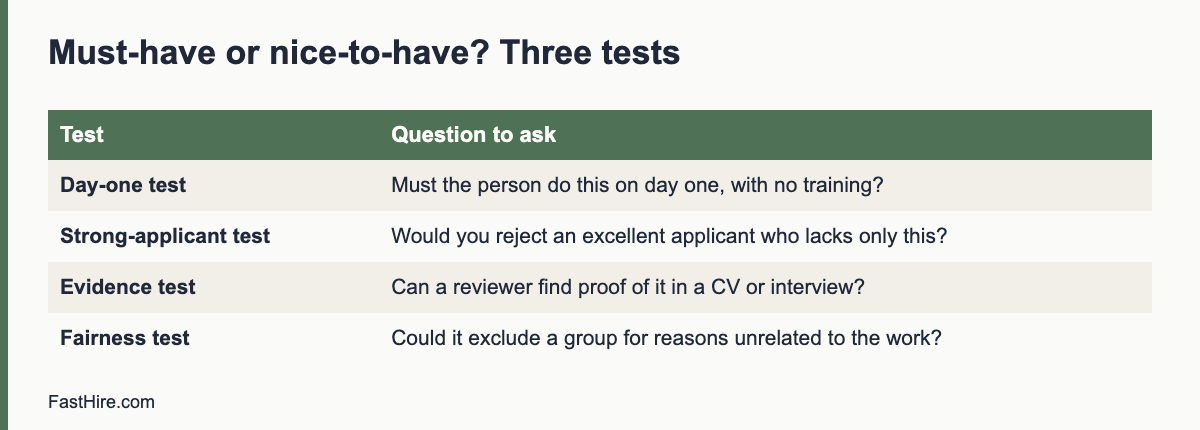
    2. Apply the day-one test. For each line ask: must the person do this on their first day, without training? If the answer is “they could learn it in three months”, move it to nice-to-have or to the onboarding plan.
    3. Apply the strong-applicant test. Imagine an excellent applicant who lacks only this item. Would you still decline them? If not, it is not a must-have.
    4. Apply the evidence test. Write what a reviewer would see in a CV or hear in an interview as proof. If you cannot write it, rewrite the item or drop it.
    5. Apply the fairness test. Ask whether the item could exclude people because of age, sex, race, religion, disability, family status or nationality, without being needed for the work. Examples of risky items: “recent graduate”, “native speaker”, “no career gaps”. Replace each with a precise skill or task.
    6. Count. If more than five must-haves remain, vote on the three that matter most and move the rest down.

    Save the final list in the role brief and share it with everyone who will review applications.

    A fictional example: operations coordinator

    This example is invented to show the method. A manager lists eight requirements for an operations coordinator. After the exercise, the list changes as shown.

    Original requirementResultReason
    Degree in businessDroppedStrong applicants without a degree could do the job; the work needs skills, not the qualification
    Five years in operationsRewritten as must-have: “has coordinated schedules or orders for a team, paid or unpaid”Checks the task, allows different routes
    Excel expertRewritten as must-have: “builds and checks spreadsheets for tracking work”Describes the task and leaves out vague “expert”
    Knows our order systemNice-to-haveCan be learned in the first month
    Excellent communicatorRewritten as must-have: “writes clear emails to customers or suppliers”Observable in a task or CV example
    Young, energetic team playerDropped“Young” signals age; “energetic” is not measurable; teamwork is tested in interviews
    Own transportDroppedNot needed for the work; may exclude people unfairly
    Fluent in a second languageNice-to-haveHelpful but not essential

    The final list has three must-haves, each with a way to check it, and two nice-to-haves. The pool grows, and each reviewer knows what to look for.

    How must-haves connect to evidence in a CV

    A must-have is only useful if you can see it. After you write the list, add an “evidence” column that says what counts. For “writes clear emails to customers or suppliers”, evidence could be a job task that includes customer email, a link to a writing sample, or a description of a project that required written replies. What does not count alone: the phrase “excellent communicator”. Our guide on screening resumes against must-haves with evidence shows how to record a yes, no or unclear mark for each applicant with the CV passage behind it. If a CV does not show a must-have clearly, mark it unclear and ask the same short question of every applicant in that position, instead of rejecting them.

    Using nice-to-haves well

    • Use them to choose between candidates who all meet the must-haves, never to remove people from the pile.
    • Limit them to three to five. More than that creates noise.
    • Weigh them in the final decision, not in the first screening.
    • Say which ones can be learned. A candidate without a nice-to-have but with strong must-haves may become a strong hire with training.
    • Avoid hidden must-haves. If a nice-to-have decides every outcome, it is a must-have and belongs on the list, with a test.

    Keep the list stable

    Changing requirements after you have read some CVs is a common source of unfairness. People tend to change the list to fit the candidates they like. If a change is needed, write down what changed and why, apply it to everyone, including applicants you already declined, and tell the recruiter. See our guide on how to write checkable job requirements for more on wording.

    The official sources on equal treatment give the baseline for fairness. In the US, see the Equal Employment Opportunity Commission page on prohibited employment policies and practices. In Great Britain, see Acas on recruitment. In the EU, see the Employment Equality Directive and your national law.

    FastHire is being built around this split. It shows each job requirement next to the exact CV passage that supports it, so you can see which must-haves a CV shows and which are unclear. FastHire is coming soon. It does not rank, score or reject candidates. People make every decision.

    Frequently asked questions

    How many must-haves should a role have?

    Three to five is a good range. A longer list shrinks the pool and often contains items that could be learned.

    Is a degree ever a must-have?

    Yes, when the law or a regulator requires a qualification, such as for a licensed profession. In other cases, ask whether the skills can be shown in other ways.

    What if I get too few applicants who meet all must-haves?

    Check whether each must-have passes the day-one test. Move items that can be learned to nice-to-have, and review the advert and pay range.

    Can I use keyword filters for must-haves?

    Be careful. Keyword filters can miss people who use different words. Use them to find passages, and have a person read before anyone is declined.

    Should candidates see the must-haves?

    Yes. Put them in the advert in plain words. Candidates can then judge their own fit before they apply.

    Related guides

    This is general information, not legal advice.
  • How to hire your replacement when a team member leaves

    How to hire your replacement when a team member leaves

    When a team member leaves, do not copy their job description into a new advert. First check whether the role should stay the same. Then capture what the person knows before they go, write a fresh brief, plan cover for the gap, and start recruiting while the leaver is still there if the rules and the relationship allow it.

    Key takeaways

    • A resignation is a chance to ask what the role needs now, not only to refill it.
    • Capture knowledge in the notice period: processes, contacts, files, open work and risks.
    • Write a new role brief with must-haves and tasks, using what the leaver actually did.
    • Plan interim cover so the team is not overloaded while you hire.
    • Treat the leaver with respect. Their goodwill helps the handover and your employer brand.
    x

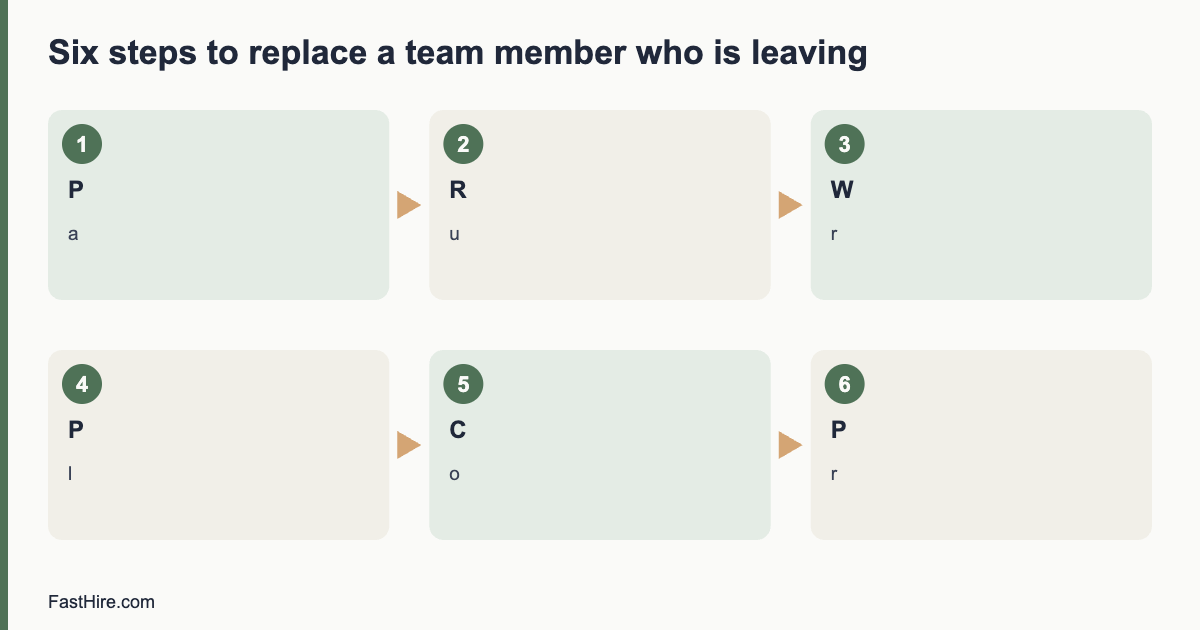
    Step 1: Pause and check the role

    The first reaction to a departure is often to hire the same person again. Pause for a day and ask four questions with your manager and, if relevant, finance.

    QuestionIf yesIf no
    Is the work still needed at the same level?Continue with the same roleConsider a smaller or different role
    Has the work changed since the role was written?Update the brief with the new tasksKeep the current brief, but check each task
    Could part of the work be moved to others or to a tool?Reduce the scope and say soKeep the full scope
    Is there someone inside the company who wants this role?Talk to them before you advertiseGo to an open search

    Check budget and approval rules in your company. In the UK, the US and EU alike, the way you describe and pay the role matters for fairness, so look at what the departing person was paid only as a reference. Do not set pay by what the previous person earned alone. Our guide to the cost of a bad hire explains why careful role design pays back.

    Step 2: Run a structured handover

    Knowledge leaves with the person unless you collect it. A good handover is a plan with dates, not a hope. Start on the first day of the notice period, or as soon as you know the date of leaving.

    1. Meet the leaver in the first week. Ask what they would want a successor to know. Keep it friendly and practical.
    2. List the work. Recurring tasks, deadlines, tools, contacts, access rights and open projects. Ask them to estimate the time each takes.
    3. Record the how. For each key task, write a short guide or record a screen video of the process. Use checklists with steps.
    4. Record the who. List the main internal and external contacts, with notes on what each one needs.
    5. Record the where. Files, folders, logins to be transferred under your security rules, and passwords never shared by email or chat.
    6. Identify risks. Which tasks only this person can do? Which have deadlines in the next 90 days?
    7. Assign owners. For each task, name who will cover it in the gap and who will own it after the new hire starts.
    8. Schedule a final review. In the last week, check the handover list and fill gaps.

    Be careful with personal data and access. When the person leaves, remove access to systems on their last day, in line with your policies. Do not ask the leaver to hand over personal account details. See the official pages on employing people for the UK and for the US if you need to review your obligations around leaving.

    Step 3: Write a fresh brief

    Use what you learned in the handover to write a role brief. It should list the top three outcomes in the first year, the main tasks, the must-have skills (as evidence you can check), and the nice-to-have skills. Do not copy the old job description. Descriptions drift, and old text may contain requirements that excluded good people. Read must-haves vs nice-to-haves for a method to separate them.

    Ask the people who work with the role what they need from it. A short survey of three questions is enough: what does this role do well for you, what is missing, and what should the next person do first? Use plain language and share the results with the recruiter at your kickoff meeting.

    Step 4: Plan the timeline

    Hiring takes time. Plan from three dates: the leaver’s last day, the date you want the new person to start, and the notice period that a likely candidate might have to serve. Notice periods vary by country, contract and level of seniority, so ask candidates early. Our guide on how long hiring takes helps you build a realistic plan from your own records. The table below shows the order of steps. It gives no durations, because these depend on your process.

    StageOwnerOutput
    Approval and role checkHiring manager and financeDecision on the role
    Handover planHiring manager and leaverList of tasks, owners and dates
    Role brief and advertHiring manager and recruiterBrief, advert, scorecard
    Sourcing and screeningRecruiterShortlist with evidence
    InterviewsHiring manager and panelScorecards and decision
    Offer and noticeRecruiter and hiring managerAccepted offer and start date
    OnboardingHiring managerFirst-week plan

    Where the law and the relationship permit, start the search while the leaver is still working. The overlap helps the handover and shortens the gap. But do not ask the leaver to interview their own replacement unless they agree and the conflict is managed. Be open and kind in how you handle it.

    Step 5: Cover the gap

    A gap puts pressure on the team. Decide how to cover the work before people burn out.

    • Triage the tasks. Sort into must-do now, can wait, and can be dropped. Tell the team and stakeholders what will wait.
    • Share the load fairly. Spread must-do tasks across several people, and agree how long this lasts.
    • Consider temporary help. An agency worker, a contractor or a fixed-term contract may fit. Check employment status and local rules. See the official pages on employment status in the UK and the IRS guidance on independent contractors or employees if you are unsure.
    • Review overtime rules. In the US, the Fair Labor Standards Act sets overtime rules for many workers. See the Department of Labor. In the UK and EU, working time rules apply. Do not ask people to work beyond legal limits.
    • Say thank you. Recognise the extra work. A short note and flexibility later often matter more than a gesture.

    Step 6: Prepare the next person to succeed

    Use the handover guides to build a first-month plan. Our onboarding guide gives a day-by-day outline. Tell the new hire what their predecessor did well, what was hard, and what you want them to change. Introduce them to the contacts you listed. If the leaver is open to it, ask whether they can answer a few questions by email in the first month. Many leavers are happy to help, but do not rely on it.

    Learn from the exit

    Departures are data. If the person leaves after a year, ask why. Hold an exit conversation that the leaver chooses to join, and ask neutral questions: what worked, what did not, and what would have kept you? Write themes without names, and share them with leadership. If several people leave a team for the same reason, the answer lies in the work, not in the hiring. A better advert cannot fix a role that people leave for the same reason every year.

    FastHire is being built for the screening stage that follows. It shows each job requirement next to the exact CV passage that supports it, so the new brief you write turns directly into evidence checks. FastHire is coming soon. It does not rank, score or reject candidates. People make every decision.

    A handover table you can copy

    Task or areaHow oftenWhere the guide isKey contactsRisk if missedOwner during gapOwner after hire
    Monthly report to financeMonthlyShared folder, guide v1Finance leadLate report; budget questionsNameName
    Customer onboarding callsWeeklyChecklist in team wikiCustomer successPoor first impressionNameName
    Supplier ordersTwice a monthOrder templateTwo suppliersStock shortageNameName

    The rows above are fictional examples. Replace them with the real tasks. Add one row for every task that could cause a problem in the first 90 days. Review the table in the final week with the leaver and the people who will cover the work.

    Tell people what is happening

    Departures cause uncertainty. A short, clear message prevents rumours. Agree the wording with HR and the leaver before you send it.

    Team message:
    [Name] will leave us on [date] to [take a new role / for personal reasons / retire]. We thank [Name] for their work on [two examples]. Until a replacement joins, [Name] and [Name] will cover [tasks], and we will move [tasks] to later. We expect to start recruiting on [date]. If you work with [Name] and have questions, please speak to me.
    Stakeholder message:
    From [date], please contact [Name] for [topic]. A permanent contact will be named when we hire. Thank you for your patience.

    Do not share the reason for leaving unless the leaver wants it shared. Do not say anything negative about the person. Others on the team will watch how you treat a leaver and will draw conclusions about how they would be treated.

    Common mistakes

    • Copying the old advert. It carries old requirements and may no longer match the work.
    • Waiting until the last day to start the handover. Knowledge capture needs time.
    • Setting pay by the old salary. Set pay by the role, the market and your rules.
    • Letting the team absorb the work for months. Set an end date for the cover plan and review it every two weeks.
    • Skipping the exit conversation. You lose the chance to learn why people leave.

    A note on internal candidates

    When a role opens, someone on your team may want it. Treat internal candidates with the same care as external ones. Use the same brief, the same questions and the same scorecard. Tell internal candidates the outcome in person, give specific feedback and explain what they could do to be ready for a later role. A team that sees fair treatment of internal applicants is more likely to stay and to apply again. Also check that an internal move does not leave a hidden gap: if you promote one person, a second role opens, and the same planning steps apply to that role.

    Keep the learning from this search. After the new hire has been in the role for three months, spend 20 minutes with them and with the team. Ask what the handover missed, which parts of the brief matched the real work and which did not, and what you would change next time. Update the handover template and the brief for the next departure. Over a few cycles, the process gets faster and calmer, and less depends on any one person.

    Frequently asked questions

    Should I tell candidates why the role is open?

    Be honest and neutral. “The role is open because the previous post holder is moving on” is enough. Do not share private details about the leaver.

    Can I hire before the leaver goes?

    Yes. A parallel search shortens the gap, if the leaver is open to the handover. Check any rules in your company about advertising a role that is still filled.

    Should the leaver interview candidates?

    Only if they agree and understand the conflict. They can often help with a technical review of tasks, but the decision stays with the hiring manager and panel.

    How do I prevent one person carrying all the knowledge in future?

    Document recurring tasks as you go, and share key contacts and files with a second person. Review it twice a year.

    What if I cannot match the leaver’s pay?

    Set pay from the role, the market and your budget. Do not match pay to the leaver’s pay by default. Check the pay rules for your country.

    Related guides

    This is general information, not legal advice.
  • How to take interview notes that help you decide

    How to take interview notes that help you decide

    To take interview notes that help you decide, use a prepared sheet with one box per question, write facts and short quotes instead of opinions, mark each note against a must-have, score straight after the interview, and leave out anything about protected traits. Tell the candidate you will take notes, store them securely and keep them only as long as the rules allow.

    Key takeaways

    • Notes are evidence for the decision. Write what the candidate said and did, not what you felt.
    • Use a prepared sheet: question, evidence, score. Link each note to a must-have.
    • Record facts and numbers. Avoid labels such as “good fit” or “not senior enough”.
    • Never note protected traits or comments on appearance. Remove them if you wrote them.
    • Candidates may be able to request their data in some countries. Write notes you could stand behind.
    x

    Why notes matter

    Memory is unreliable. An hour after an interview you remember the start and the end, strong feelings and the last candidate. Notes preserve the middle. They also protect fairness. A decision based on written evidence for each criterion is easier to explain, check and defend than a decision based on impressions. Notes help the debrief, the feedback to candidates and the reference check. See how to run a debrief meeting and how to give fast interview feedback.

    What good notes look like

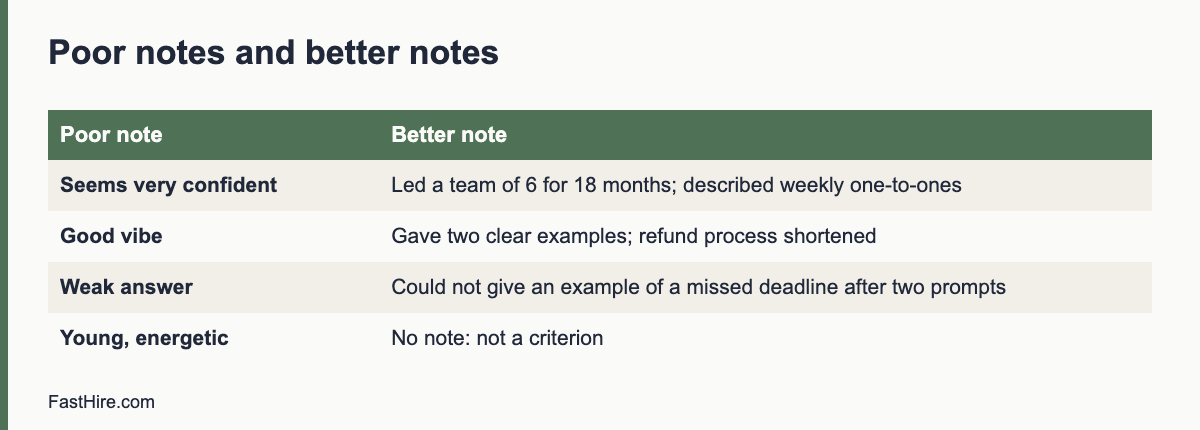
    Poor noteWhy it is poorBetter note
    “Seems very confident”Opinion; style not evidence“Led a team of 6 for 18 months; described weekly one-to-ones and a hiring plan”
    “Good vibe”Feeling; similarity bias“Gave two clear examples of resolving customer complaints; result: refund process shortened”
    “Probably will leave soon”Guess; may relate to age or familyNo note. If a retention concern is job-related, ask a question about career plans for this role
    “Young, energetic”Age signalNo note
    “Weak answer”No evidence“Could not give an example of handling a missed deadline; said ‘it did not happen’ after two prompts”
    “Struggled with English”Vague; may relate to origin“Answer to question 3 took three attempts to clarify; written test shows clear writing” (only if language level is a stated criterion)

    Good notes quote key phrases, state numbers and name the actions the candidate took. They link to the criterion being tested. They are short enough to write while listening.

    A note sheet you can copy

    QuestionCriterionEvidence (facts and quotes)Score (1 to 4)
    1. Tell me about a time you handled a difficult customer.Customer skills
    2. Describe how you plan a week with many deadlines.Planning
    3. Tell me about a mistake you made at work.Learning
    4. Walk me through your use of [tool].Tools
    5. Availability and noticePractical fit

    Add a header with the candidate’s name or code, the role, the date, the interviewer and the start and end time. Add a box at the bottom for the three strongest points, the biggest doubt and the overall recommendation. Fill in the last box after you score.

    Techniques that work

    Write in short forms

    Use abbreviations you will understand later, such as “Q2: led proj, 6 ppl, 18 mo, shipped on time”. Replace them with full words if you share the notes. Do not try to write everything. Write the facts that matter for the criteria.

    Mark each note against a criterion

    Draw a line or use a code (C1, C2, C3) for each criterion. After the interview, you can scan the sheet and see what evidence you have for each must-have.

    Use silence

    While you write, tell the candidate: “I am noting what you said, please continue.” Pauses are normal. A short silence often leads to more detail.

    Capture exact words for key points

    Write exact phrases when the wording matters, for example a number, a promise, or a clear statement about what the candidate did themselves. Use quotation marks to show these are exact words.

    Separate observation from interpretation

    Write observations in one column and interpretation in another, or do the interpretation later in your score. For example: observation, “said ‘the team did most of it’ when asked about the result”; interpretation, “unclear personal contribution; ask follow-up”.

    When two people interview together

    Split the roles. One person asks the questions and listens; the other takes notes. Switch roles for the second half. Compare notes after scoring alone, not before. Do not share impressions in front of the candidate. See how to run an interview panel well.

    What not to write

    • Protected traits: age, sex, race, religion, disability, sexual orientation, pregnancy, family status and similar. Remove them if the candidate volunteered them.
    • Comments about appearance, accent, voice or clothing, unless a stated and lawful job requirement relates to them.
    • Guesses about the reason for a gap, a move or a choice.
    • Comparisons with other candidates. Compare in the debrief using scores.
    • Insults, jokes or private opinions. Notes can be read later by others.

    If you wrote something you should not have, cross it out or delete it before filing and tell the HR contact if it relates to a legal risk. Do not alter records after a complaint has been made. Take advice. See what you can and cannot ask.

    Recording and tools

    MethodProsCons and rules
    Paper sheetSimple, no data risk if stored safelyHard to share; handwriting; must be stored and destroyed
    Digital document or formSearchable, sharedNeeds access control and retention rules
    Applicant tracking systemCentral; links to the candidate recordCheck retention and access settings
    Audio or video recordingComplete recordNeeds a lawful basis and the candidate’s knowledge; many countries require explicit notice or consent; heavy to store
    Automatic transcription toolsFastCheck data protection, accuracy, bias and where data is processed; people must still make the decision

    If you record or transcribe, tell candidates in advance, explain why, how long you keep it and who sees it. In the UK and EU, data protection law applies. See the ICO employment guidance and the GDPR text. In the US, recording laws differ by state, with some requiring all parties to consent. Take local advice. This is general information, not legal advice.
    Storing, sharing and deleting notes

    1. Store notes in one secure place with access only for the hiring team.
    2. Do not email notes to personal accounts or share in public chat.
    3. Label them with a code or name, role and date.
    4. Set a deletion date based on the law and your retention policy. For unsuccessful candidates this is often a limited period. Check the rules for your country.
    5. Delete or anonymise after the date and record that you did.
    6. If a candidate asks to see their data, follow the legal process. In the UK and EU, this may be a subject access request.

    Write every note as if the candidate might read it, because in some places they may be able to. This is a good test of tone and fairness.

    A worked example (fictional)

    This example is invented. An interviewer uses a sheet with five questions. For question 1, she writes: “Handled 30-40 tickets a day; used a help desk tool; refund replies; one angry customer: apologised, issued refund in 1 day, customer thanked team in follow-up”. She scores 3. For question 3, the candidate says, “I do not make mistakes.” After a prompt, the candidate gives a minor example. She writes: “First answer: none. After prompt: sent wrong template once; checked tone after; now reads twice before sending”. She scores 2 and notes the need for a follow-up on learning from errors. She does not write about the candidate’s accent or the fact that he mentioned his children in small talk. After the interview she writes three strongest points and one doubt, files the sheet and joins the debrief with her notes ready. The debrief takes 20 minutes because the evidence is clear.

    From notes to score: a five-minute routine

    1. Read your notes for question 1. Underline the facts that relate to the criterion.
    2. Compare them with the scale anchors. Choose the score that matches the evidence, not the best answer you heard that day.
    3. Write one line to justify the score.
    4. Repeat for each question. Do not go back to change a score unless you find a clear error.
    5. Write the three strongest points, the biggest doubt and the recommendation. Add the time.

    The routine takes five to ten minutes after a 45-minute interview. It turns a messy page into clean evidence. If you find that you cannot score a question, note “no evidence” and ask the candidate a follow-up in a later step, such as a reference call or a short written question.

    Sharing notes in the debrief

    In the debrief, share your scores and the evidence lines, not the full page. Others can ask to see the notes if they need to check. Do not read out personal remarks. If another interviewer’s note includes a protected trait or an opinion without evidence, ask them to remove it or restate it as a fact related to a criterion. A short, polite prompt keeps the record clean for everyone.

    Notes for candidates who are not hired

    Notes also support feedback. When you decline a late-stage candidate, use your notes to choose two job-related points: one strength and one gap in the evidence. This is faster and more accurate than writing from memory. Keep the language neutral and based on the criteria. See how to give fast interview feedback.

    Over time, review a sample of your own notes. Ask whether another person could understand the evidence, whether the notes relate to the criteria and whether any comment would look unfair if read aloud. Adjust your habits. Better notes improve every later step in the hiring process.

    Notes on a screen: tips for video interviews

    • Place the note sheet on a second screen or on paper, not over the video window, so that you can keep eye contact.
    • Tell the candidate if you look down to write, so they do not read it as a lack of interest.
    • Do not use the chat window for notes that could be shared by mistake.
    • Mute notifications and close other applications.
    • Check that your note file is not in a shared folder that others can open by mistake.

    Notes on a screen can also be copied or shared more easily than paper. Use a document that is saved in a private location with a clear name, and delete drafts. If you use a tool that records or transcribes, check settings before the interview. Treat every file as personal data that you are responsible for.

    A short checklist

    • The note sheet matches the question list.
    • Each note is linked to a criterion.
    • Facts, numbers and quotes are written down.
    • No protected traits or appearance comments.
    • Scores are written within 15 minutes.
    • The file is stored securely and a deletion date is set.

    When in doubt, return to the purpose of the notes: they exist so that a decision can be explained with facts. If a note does not help to explain a decision, leave it out. Concise, factual notes are easier to score and to review, and they save time in every later step of the process.

    Remember that clear notes are a gift to your future self. A month later, when the new hire asks why they were chosen, or a colleague asks for the evidence behind a decision, you can answer in a minute with facts, instead of reconstructing a conversation from memory.

    Frequently asked questions

    Should I take notes during an interview?

    Yes. Tell the candidate you will, and why. Notes protect fairness and help your decision.

    What should I write down?

    Facts, numbers, key phrases and actions the candidate took, linked to your criteria. Leave out feelings and protected traits.

    Can I record an interview?

    Only with a lawful basis and usually with the candidate’s knowledge or consent. Check local rules.

    How long should I keep interview notes?

    Only as long as needed and as the law allows. Set a deletion date in your retention policy.

    Can candidates see my notes?

    In some places they can request their personal data, including notes. Write notes you could stand behind.

    Related guides

    This is general information, not legal advice.
  • How to write job requirements candidates can actually check themselves against

    How to write job requirements candidates can actually check themselves against

    Most job adverts ask candidates to do something impossible: read a list of adjectives and decide whether they qualify. “Excellent communicator.” “Strong commercial awareness.” “Proactive self-starter.” Nobody reads those lines and thinks “no, that is not me”. So everyone applies, and the work of figuring out who actually fits lands back on your desk.

    A requirement is only useful if a candidate can check it against their own experience and give an honest yes, no or “partly”. This guide walks through how to write requirements that pass that test. It applies whether you hire in Manchester or in Utrecht, and whatever tools you use.

    Key takeaways

    • A requirement is checkable when a candidate, or a reviewer, can point to proof in a CV or an answer.
    • Describe the work or the outcome, not the personality. Name the level in terms of tasks, not years.
    • Split compound items so that each line has one test.
    • Keep the list short: three to five must-haves are easier to check than twelve.
    • Test every line for fairness before you publish it.
    x

    The test: could a candidate point to the evidence?

    Before a requirement goes into the advert, ask one question: if a candidate had this, where in their CV or their working life would it show up?

    If the answer is a specific thing (a qualification, a tool they have used, a type of work they have done, a responsibility they have held) the requirement is checkable. If the answer is “it would come across in how they write” or “you can just tell”, it is not a requirement. It may still matter, but it belongs in the interview, not the filter.

    Some quick rewrites:

    • “Excellent communication skills” becomes “Has written customer-facing documents, such as reports, proposals or help articles”.
    • “Strong Excel skills” becomes “Has built spreadsheets with lookups and pivot tables for regular reporting”.
    • “Commercially minded” becomes “Has worked to a sales or budget target and can describe how they tracked it”.
    • “Fluent Dutch” becomes “Can hold a work meeting in Dutch (roughly B2 level or higher)”.

    Each rewrite is longer. A candidate reading it knows whether they have done that thing. You, reading their application, know what to look for.

    Describe the work, not the person

    Requirements written about personality (“dynamic”, “energetic”, “a good cultural fit”) are hard to check and easy to apply unfairly. They invite reviewers to fill the gap with gut feeling, which is where bias tends to creep in.

    Requirements written about the work are different. “Has handled a caseload of customer complaints from first contact to resolution” describes something a candidate either did or did not do. It also tells them what the job involves, which helps the people who would hate it to decide not to apply.

    A useful habit: write down the three to five things the person will spend most of their week doing. Then write each requirement as evidence that someone has done one of those things before, or something close to it.

    Be specific about level, not about years

    “Five years’ experience” is one of the most common requirements in job ads, and one of the least useful. Years are a proxy. What you usually want is a level of responsibility or a range of situations the person has handled. Someone can do the same thing for five years, and someone else can cover a lot of ground in two.

    Time-based requirements also carry a legal risk. In the UK, a requirement that is harder for one age group to meet can amount to indirect discrimination under section 19 of the Equality Act 2010 unless you can show it is a proportionate means of achieving a legitimate aim. The Netherlands has comparable protection against age discrimination in employment under the Wet gelijke behandeling op grond van leeftijd bij de arbeid. Neither law bans asking for experience. Both mean you should be able to explain why the specific thing you asked for is needed.

    So instead of “5+ years in accounts payable”, try “Has run a month-end close for accounts payable, including supplier reconciliations”. That says what you actually need, and a strong candidate with three years can recognise themselves in it.

    Name the tool, or say you do not care which one

    “Experience with CRM systems” leaves a candidate guessing. Do you use Salesforce and need someone who knows it? Or would any CRM do, because the skill is keeping customer records tidy?

    Pick one:

    • If a specific tool matters, name it: “Has used Salesforce to manage a sales pipeline”.
    • If it does not, say so: “Has used any CRM (for example HubSpot, Salesforce or Pipedrive) to manage customer records”.

    The second version widens your pool without lowering the bar. It also prevents candidates who used a different system from ruling themselves out.

    Split compound requirements

    “Experience in project management and stakeholder engagement in a regulated environment” is three requirements in a trench coat. A candidate who has two of the three cannot answer it honestly with a yes or a no.

    Break it up:

    1. Has planned and delivered a project with a fixed deadline.
    2. Has reported progress to senior people outside their own team.
    3. Has worked in a regulated sector such as finance, healthcare or energy.

    Now the candidate can check each one, and you can see which parts they have. You may also discover, once it is written out, that only one of the three is really essential.

    Separate the yes/no facts

    Some things are not about skill at all. They are facts about the candidate’s situation:

    • Do they have the right to work in the UK, or in the Netherlands?
    • Can they start by a certain date?
    • Can they work on site in Rotterdam three days a week?
    • Do they hold a driving licence, if the job involves driving?

    These belong in short yes/no questions that the candidate answers themselves, not mixed into the skills list. Keep them to what the job really needs, and do not ask for information you have no reason to collect. Under UK GDPR and the GDPR in the Netherlands, collecting only what you need is a legal principle, not just good manners. The UK regulator, the ICO, has guidance on recruitment and selection that is worth reading before you design an application form.

    Keep the list short

    A long list does not make an advert more rigorous; it puts off people who meet the core needs. Aim for three to five requirements that genuinely decide whether someone can do the job, then a short, clearly labelled list of things that would be a bonus. (There is a separate post on how to split must-haves from nice-to-haves.)

    A worked example

    Here is a requirements section for a customer support lead role, before and after.

    Before:

    • Excellent communicator with a passion for customers
    • 5+ years in customer service
    • Experience with ticketing systems
    • Strong leadership skills
    • Degree preferred

    After:

    • Has handled customer queries by email or chat, including complaints, and resolved them without escalation in most cases.
    • Has led or coached a small team (two or more people), including running regular one-to-ones.
    • Has used a ticketing system such as Zendesk, Freshdesk or similar to manage a shared queue.
    • Can write clear help articles or reply templates in English.

    Yes/no questions: right to work in the UK; able to work UK hours.

    The “after” version drops the degree (the work does not need it), drops the years (the coaching requirement captures the level), and turns every line into something a candidate can find, or not find, in their own history.

    Why this pays off

    When candidates can check themselves against your requirements, more of the people who apply are people who meet them. When you review, you are comparing evidence against clear statements instead of reading between the lines.

    It takes an extra half hour to write requirements this way. That half hour comes back many times over at the review stage, and it gives every applicant a fairer, clearer picture of what you are asking for.

    Twelve rewrites you can copy

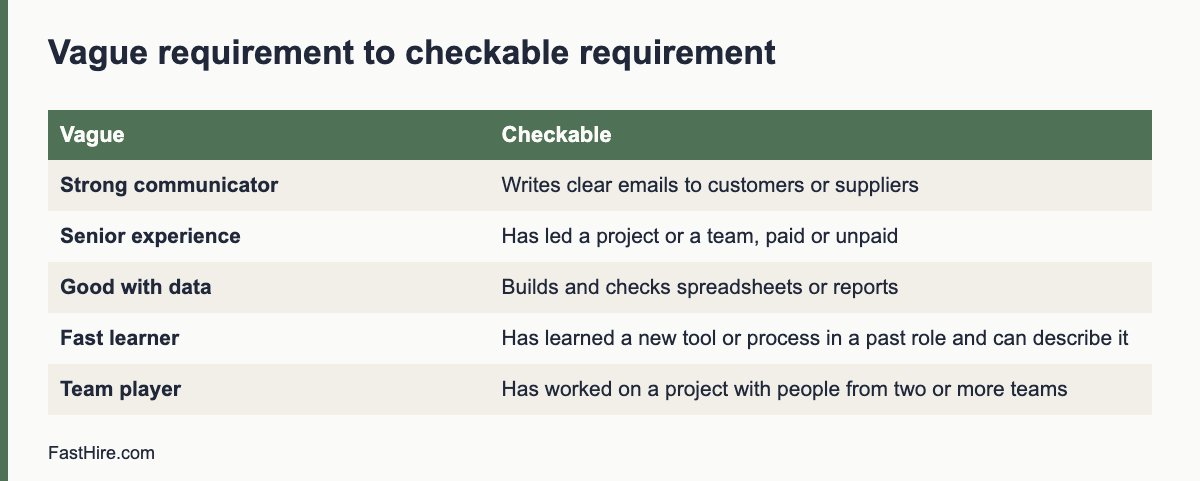
    Vague requirementWhy it is hard to checkCheckable version
    Excellent communication skillsEveryone claims it; no task namedWrites clear emails or reports for customers, suppliers or colleagues
    Senior-level experienceTitles differ across companiesHas led a project, a team or a process change, paid or unpaid
    Strong analytical skillsNo task namedUses data to answer a business question, for example building a monthly report
    Proficient in Excel“Proficient” means different thingsBuilds spreadsheets with formulas and checks totals for accuracy
    Self-starterA trait, not a taskHas started or improved a process without being asked, and can describe it
    Busy environment experienceUnclear what paceHas handled several customer requests or deadlines in the same day
    Team playerA trait, not a taskHas worked on a project with people from two or more teams
    Customer-focusedVagueHas resolved customer complaints or questions in writing or by phone
    Detail-orientedCannot be checked on a CVHas checked records or documents for errors as a regular task
    5+ years of experienceYears do not show skillHas done [named task] on [number] projects or for [named volume]
    Degree requiredMay exclude people with the skillDegree only if the law or a regulator requires it; otherwise, name the knowledge
    Native English speakerSignals national originWrites and speaks English at the level needed for [task], for example handling customer calls

    Three questions to check each line

    1. Could a candidate point to proof? For example, a job task, a project, a result or a sample of work. If the proof would be “I am a good communicator”, the line is not checkable.
    2. Could two reviewers agree? Give two colleagues the same CV and the requirement. If they mark it differently, the wording is too loose.
    3. Is it needed on day one? If the person could learn it in the first three months, move it to nice-to-have. See must-haves vs nice-to-haves.

    A fairness check on every line

    Wording can exclude people without anyone intending it. Before you publish, read each line with these questions in mind.

    CheckExample of a problemBetter wording
    Age“Digital native”, “recent graduate”, “up to 10 years of experience”Name the tool or the task
    Sex or gender“Salesman”, “he will”“Sales representative”, “the person”
    Disability“Must be able to stand for eight hours” for an office roleDescribe the essential tasks and allow for adjustments
    National origin“Native speaker”, “must be from the area”State the language level needed for the tasks
    Family status“Must be able to work late any day”State the actual schedule needs and any flexibility
    Other“Cultural fit”Describe observable behaviours linked to the work

    The official sources on equal treatment give the baseline. In the US, see the Equal Employment Opportunity Commission page on prohibited employment policies and practices. In Great Britain, see Acas on recruitment. In the EU, see the Employment Equality Directive and your national law. Our guide to interview questions you cannot ask covers a related set of risks.

    A requirement card

    For each must-have, fill in one short card. Keep the cards in the role brief, and share them with the recruiter and the interview panel.

    FieldExample (fictional)
    RequirementWrites clear emails to customers
    Why it mattersThe role answers 30 to 50 customer emails each day, and unclear replies create repeat contacts
    What counts as proofA job task that includes customer email; a writing sample; a described example of resolving a complaint in writing
    What does not count aloneThe phrase “excellent communicator”
    How we will checkCV passage first; one question in the interview; a short writing task for finalists
    Fairness check doneYes, by [name], [date]

    Cards take five minutes each, and they make later steps faster. The recruiter knows what to look for in a CV. The interviewers know what to ask. The candidate can read the card and decide honestly whether to apply.

    FastHire is being built around checkable requirements. It shows each job requirement next to the exact CV passage that supports it, so a reviewer can verify the evidence in seconds, and candidates can check their fit before they apply. FastHire is coming soon. It does not rank, score or reject candidates. People make every decision.

    Frequently asked questions

    What is a checkable job requirement?

    It is a requirement written so that a reviewer or a candidate can find proof of it in a CV or in an answer, such as “writes clear emails to customers”, instead of “excellent communicator”.

    How long should a requirement list be?

    Three to five must-haves is a good range. More than that reduces the pool and makes checking slow.

    Should I list years of experience?

    Only when the years connect to a task or volume you can describe. Years alone do not show skill and can exclude people who learned quickly.

    Can candidates check their fit before applying?

    Yes, if the advert is specific. Put the must-haves in plain words and say how you will check them.

    How do I test a new requirement?

    Give two colleagues the requirement and a few real CVs. If they disagree on the marks, rewrite the wording.

    Related guides

    This is general information, not legal advice.

  • How to write a good interview plan for a new role

    How to write a good interview plan for a new role

    A good interview plan maps each must-have for the role to one interview stage and one question or task, names who will assess it, and sets the scoring scale before you meet any candidate. For a new role, start with the outcomes the person must deliver, choose two to four stages, and make sure no must-have is tested twice or missed.

    Key takeaways

    • Start from the must-haves, not from a standard list of questions.
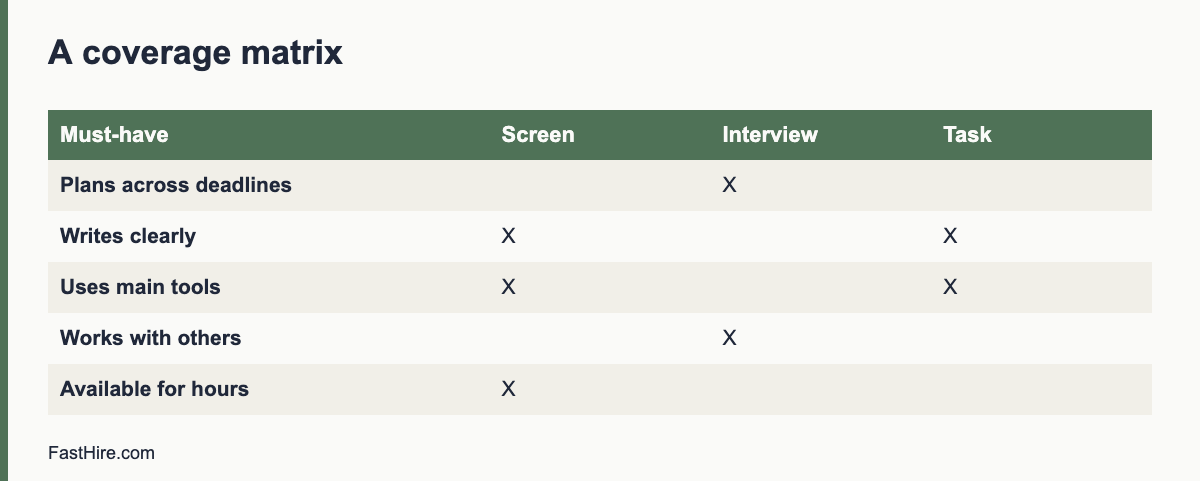
    • Use a coverage matrix: each must-have appears in at least one stage and has a named assessor.
    • Two to four stages are enough for most roles. Each stage must test something new.
    • Brief interviewers, share the scorecard and agree the scale before the first interview.
    • Plan the candidate experience: timing, format, adjustments and a clear next step at each stage.
    x

    Why plan for a new role

    A new role has no history of what works. Interviewers often fall back on their favourite questions or on talk about personality. The result is an uneven process in which each candidate is judged on different things. A plan fixes this by linking every question to a requirement of the job. It also saves time, because you do not repeat topics or add stages that give no new information. If you have not yet written the role, begin with the one-page role brief and the guide to job descriptions for new roles.

    The five-step planning method

    StepTaskOutput
    1List the must-haves and outcomesThree to six items, each checkable
    2Choose assessment methodsOne method per must-have
    3Group into stagesTwo to four stages with time limits
    4Assign assessors and write questionsNames, questions and scoring guides
    5Plan logistics and communicationsSchedule, invitations, adjustments, feedback dates

    Step 1: List the must-haves

    Use the role brief. Write each must-have as a short statement that can be checked from evidence, for example “writes clear customer emails” or “plans work across several deadlines”. Avoid traits such as “driven” or “polished” unless you can define the behaviour.

    Step 2: Choose a method for each must-have

    MethodGood forLimits
    CV or resume reviewBasic experience, qualifications, toolsSelf-reported; can hide skill that is not written
    Phone or video screenMotivation, availability, basic fit with must-havesShort; use a script
    Structured behavioural interviewPast examples of skills and behaviourDepends on question quality and scoring. See behavioural questions
    Situational questionHow the person would handle a realistic problemAnswers can be idealised
    Work sample or taskDirect evidence of a skillTakes candidate time; keep it short and fair. Pay if it is long
    Portfolio reviewCreative and technical workCheck who did the work
    Reference checkConfirm facts and working styleLimited detail; see references

    Choose the method that gives the best evidence for the least burden on the candidate. Using more than one method for the same must-have rarely adds value. A mix of methods across different must-haves is better.

    Step 3: Group the methods into stages

    Typical stages for a mid-level role are: (1) a short screen of 20 minutes, (2) a structured interview of 45 to 60 minutes, and (3) a work sample or a second interview with a future colleague. Senior roles may add a short presentation. Entry-level roles may need only two stages. Each stage should answer a new question. If you cannot say what a stage will tell you that you do not already know, remove it.

    Step 4: Assign assessors and write questions

    Pick interviewers who know the work. Give each person a clear area. Write the questions in advance and share them with the interviewers. Do not let each interviewer ask the same general questions. Write a scoring guide: what a 1, 2, 3 and 4 looks like for each question. Our interview scorecard template shows an example.

    Step 5: Plan logistics and communication

    Decide the dates, the format, the length, the room or link and who sends invitations. Offer adjustments. Plan feedback dates. See how to give fast interview feedback.

    The coverage matrix

    Copy this table into a spreadsheet and fill it in. Each row is a must-have. Each column is a stage. Put an X where the must-have is tested, and write the assessor.

    Must-haveStage 1: 20-min screenStage 2: Structured interviewStage 3: Work sampleAssessor
    Plans work across deadlinesXHiring manager
    Communicates clearly in writingX (email sample)X (short written task)Recruiter, then manager
    Uses the main toolsX (quick check)XTeam lead
    Works with othersXFuture colleague
    Available for the hoursXRecruiter

    If a row has no X, you will not learn about that must-have. If a row has three X marks, you may be over-testing it. Aim for one or two per must-have.

    A worked example (fictional)

    This example is invented. A mid-sized company creates a new role: a customer onboarding specialist. The hiring manager writes four must-haves. She builds this plan.

    StageFormatTimeTestsAssessor
    1. ScreenPhone call with a script20 minutesAvailability, basic experience, written communication through a short email exercise sent in advanceRecruiter
    2. InterviewStructured behavioural interview, 6 questions50 minutesPlanning, working with customers, learning new toolsHiring manager and a senior colleague
    3. TaskDraft a welcome email and a one-page onboarding plan for a made-up customer45 minutes, paid time or optional take-home with a clear limitWritten clarity and planningTeam lead
    4. DecisionDebrief30 minutesAll scores reviewedFacilitator, then manager

    The plan has four steps but only three candidate-facing stages, and it takes about two hours of the candidate’s time. Each stage tests something new. The task uses a made-up case, not the company’s real data. The plan was shared with the candidate in the invitation, so there were no surprises.

    Time limits and candidate effort

    • Plan the total candidate time in hours. For most roles, three hours is a reasonable ceiling. For senior roles, it may be higher.
    • Do not ask for unpaid work that looks like real work for your business. Use a made-up case. If the task is long, pay for it.
    • Tell candidates the number of stages and the likely timeline in the job ad.
    • Offer a choice of times, and an alternative format if needed.
    • Remember that people who are working need slots outside office hours or by video.

    Brief the interviewers

    Hold a 20-minute briefing before the first interview. Cover:

    1. The role, the must-haves and the outcomes.
    2. The stage structure and each person’s area.
    3. The questions, in order, and the scoring guides.
    4. What not to ask. See our guide on what you can and cannot ask.
    5. How and when to submit scores and notes.
    6. How to describe the company and the role honestly.

    Give new interviewers a chance to practise with a colleague. Even five minutes of practice improves note-taking and reduces nervous talking.

    Plan for fairness and access

    IssueWhat to plan
    AdjustmentsOffer in every invitation: more time, written questions in advance, a quiet room, step-free access, a different format. Respond quickly
    Same questionsUse the same questions and time for every candidate, apart from adjustments
    Diverse panelInclude people with different backgrounds where you can
    Clear criteriaShare what you assess, in general terms, so candidates can prepare
    Fair tasksTest skills the job needs. Avoid tasks that favour people with free time or special tools
    RecordsPlan how you will store notes and for how long

    For the legal duties around adjustments, see Acas for the UK, the EEOC for the US and your national equality body in the EU. This is general information, not legal advice.
    Checklist before you open the role

    • Role brief and must-haves are final.
    • Coverage matrix is complete.
    • Questions and scoring guides are written.
    • Interviewers are named, briefed and have calendar time.
    • The task, if any, has been tested by a current employee.
    • Invitation templates are ready, with an adjustment offer.
    • Debrief date is booked.
    • Feedback standard is agreed.

    Question writing: from must-have to question

    Must-haveDraft questionFollow-upsScoring guide (1 to 4)
    Plans work across deadlinesTell me about a time you had several deadlines at once. How did you decide the order?What did you drop or delay? What happened?1: no example. 2: general example, no method. 3: clear method, outcome stated. 4: clear method, strong outcome, learning applied later
    Works with customersDescribe a customer problem you solved. What did you do yourself?How did the customer respond?1: no example. 2: example, little personal action. 3: clear personal action and result. 4: strong result and improvement to the process
    Learns new toolsTell me about the last tool you had to learn quickly. How did you do it?How long did it take to be productive?1: no example. 2: example, unclear method. 3: clear method, productive within a stated time. 4: also taught others or documented it

    Write the scoring guide before the first interview, and keep it fixed. If you change it, apply the change to every candidate. See behavioural interview questions for more examples.

    Choosing the order of stages

    Put the cheapest, most informative stage first. A short screen costs the candidate and you little time and removes clear mismatches on must-haves. Put the heaviest stage, such as a task or a panel, last, so that only finalists spend that effort. Use this order of effort: CV review, short call, structured interview, task or panel, references. If a must-have is a hard requirement such as a licence or the right to work in the country, check it early, in a way that you apply to all candidates.

    Keeping the plan alive

    After the first three interviews, check the plan against what you see. Ask: Did the questions produce usable evidence? Did interviewers use the scale in the same way? Did candidates understand the task? If a question produces the same answer from everyone, replace it. If interviewers differ widely on one must-have, clarify the scoring guide. Record any change and apply it to all candidates. At the end of the search, save the plan, the matrix and your notes. Next time you hire a similar role, you can start from the improved version and finish the plan in under an hour.

    Tools you can use

    You do not need special software to run a good plan. A shared spreadsheet holds the coverage matrix and the scores. A shared document holds the questions and the scoring guides. A calendar holds the schedule. If you use an applicant tracking system, check that it lets you attach scorecards and record dates. Whatever you use, keep the plan in one place that every interviewer can open, and keep it up to date, so that everyone works from the same version. When a person asks “what do we ask in stage two?”, the answer should be one click away.

    Review the plan with one person who has not seen it before. Ask them to find a must-have with no question, or a question with no must-have. Fix both before you open the role.

    Official sources for this topic: EEOC: employment tests and selection procedures, Acas: recruitment. These pages are maintained by the authorities and may change, so check them for the current text.

    Frequently asked questions

    How many stages should a hiring process have?

    Use the fewest that test your must-haves. Two to four is typical. Each stage should give new information.

    How many interviewers should I include?

    Two to four people. More people add scheduling cost and rarely improve the decision.

    Should every candidate do a work sample?

    Only the finalists, if the task tests a must-have that other methods cannot. Keep it short, relevant and paid if long.

    Can I change the plan during the process?

    Only for clear reasons, such as a flawed question. Apply the change to all candidates, including those already seen, where practical.

    What if I do not have time to plan?

    Use the coverage matrix only. Even a 30-minute plan improves the quality of the process.

    Related guides

    This is general information, not legal advice.
  • How many interview rounds are enough?

    How many interview rounds are enough?

    Use as many interview rounds as it takes to test each must-have once, and no more. For most roles that means two to three rounds: a short screen, one structured interview, and for some roles a work sample or a conversation with future colleagues. Add a round only if it tests something new, and remove any round that repeats what you already know.

    Key takeaways

    • Count rounds by what they test, not by tradition or seniority.
    • Two to three rounds suit most roles. Entry-level roles may need two. Senior roles may need three or four with different focus.
    • Every extra round costs candidate time, your team’s time and the risk of losing the candidate.
    • Do not add more rounds when your scores are clear. Doubt about a must-have is a reason to test it, not to repeat the same questions.
    • Tell candidates the number of rounds and the timeline at the start.
    x

    The cost of one more round

    Each round has a cost that is easy to miss. For you, there are the hours of interview time, the preparation, the notes and the debrief. For the candidate, there is time off work, travel or preparation, and stress. For both sides, there is a delay of days or weeks. Candidates with other offers may accept elsewhere while you wait. The cost of a round is not a reason to skip a useful one. It is a reason to ask what it gives you.

    You can estimate the internal cost with simple arithmetic. Multiply the number of interviewers by the hours per interview, add 30 minutes each for preparation and notes, and multiply by the number of candidates. Then compare it with the information you gain.

    ItemExample (fictional)Hours
    Interview length1 hour1
    Interviewers per round33
    Preparation and notes, per interviewer30 minutes1.5
    Debrief30 minutes, 3 people1.5
    Total per candidate, per round7
    Candidates in the round428 hours

    In this invented example, one extra round for four candidates costs 28 hours. That is almost a full work week of staff time. If the round adds no new information, the cost buys nothing. If the round tests a must-have that the earlier rounds could not, the cost may be worth it. Use your own numbers.

    How to decide: five questions

    1. Which must-haves are still untested? If every must-have has evidence from at least one method, you may be ready to decide.
    2. Which stage would test the missing one best? Pick the shortest method that gives real evidence, such as a 30-minute task.
    3. Is the evidence conflicting? If interviewers disagree on a must-have, add one targeted check, not a full round.
    4. Who needs to meet the candidate? Include a future colleague if team fit in specific behaviours matters. Do not add a person only for status.
    5. Would a candidate see this stage as fair? If you cannot explain why the stage exists, remove it.

    Use the coverage matrix in our interview plan guide to check these questions on one page.

    Guide by role type

    These are planning suggestions based on common practice and logic, not research findings. Adjust them for your context.

    Role typeSuggested roundsWhat each round testsNotes
    Entry-level or high-volume21. Short screen for availability and basics. 2. Structured interview with a short taskKeep total candidate time under two hours
    Individual contributor, mid-level2 to 31. Screen. 2. Structured interview. 3. Work sample or colleague meetingRun the work sample only for finalists
    Specialist or technical31. Screen. 2. Technical interview or task. 3. Interview on collaboration and contextUse a task that mirrors real work, with a made-up case
    People manager31. Screen. 2. Structured interview on managing people. 3. Panel or case with the teamInclude a skip-level or peer, but only for stated reasons
    Senior leader3 to 41. Screen. 2. Structured interview. 3. Case or presentation. 4. Meetings with peers and the person they report toPay for substantial case work; keep each meeting different

    For senior roles, the extra round often adds meetings with stakeholders. Do these as conversations with a clear purpose, not a repeat interview. If the purpose is only “to get to know them”, reduce it to a short call.

    Signs you have too many rounds

    SignWhat it meansAction
    Interviewers ask the same questionsRounds repeatMerge rounds or change the questions
    Scores do not change between roundsNo new informationRemove the later round
    Candidates drop out between roundsThe process is too slow or longShorten the timeline, combine rounds
    The team adds interviews “to be safe”Fear of a wrong decision, not evidenceDefine the open question; add a targeted check only
    The decision is made but you plan another meetingThe meeting is symbolicMake the offer
    Hiring takes much longer than your planDelaysSee how long hiring should take

    Signs you have too few rounds

    • You cannot name evidence for one or more must-haves.
    • Only one person met the candidate and that person is unsure.
    • The decision depends on a “feeling”.
    • The role carries high risk, such as handling money or safety, and you have not run proper checks.
    • Interviewers disagree strongly and there is no way to settle it.

    In these cases, add the smallest step that addresses the gap: a work sample, a reference call, or a 30-minute conversation with a future colleague focused on one must-have.

    Combine rather than add

    You can often reduce rounds by combining them. Examples:

    • Screen plus first interview. For roles with few applicants, a 45-minute structured call replaces two shorter calls.
    • Interview plus task. Include a 20-minute task in the interview, such as editing a short text or planning a schedule.
    • Panel in place of three single interviews. One panel with a clear question allocation can replace several meetings. Brief the panel and keep it small. See our upcoming guide on panels.
    • One day, several short sessions. For finalists, hold three 30-minute sessions on a single day, each testing a different must-have.

    Combining reduces elapsed time, which helps with candidates who have other offers. It should not reduce the quality of evidence. Use the same questions and scoring in the combined session as in separate ones.

    Fairness across rounds

    More rounds can raise the risk of unfairness. Each round gives more room for informal impressions, and each step can drop people for different reasons. Keep the process fair with these habits:

    • Define what passes each round, in writing, before you start.
    • Use the same questions and time for all candidates in a round.
    • Record the reason for each decision to move on or end the process.
    • Offer adjustments in every invitation.
    • Check that candidates who are dropped have an equal chance to explain, for example by a follow-up question on unclear points.
    • Review, where the law allows, whether certain groups drop out at a particular round more than others. If so, check the round for barriers, such as time, location or a task that favours certain backgrounds.

    For the legal duties on adjustments and non-discrimination, see Acas, the EEOC and your national equality body. See also how to reduce bias in resume screening, which also applies to later rounds.

    A worked example (fictional)

    This example is invented. A team plans to hire a financial analyst and considers four rounds: a screen, a technical interview, a case study and a meeting with the director. The hiring manager draws the coverage matrix and finds that the director meeting repeats the technical interview. She replaces it with a 30-minute conversation about how the analyst would work with the director, and moves it into the case study session as the last 30 minutes. The process now has three rounds. The total candidate time falls from five hours to three. The plan is shared in the invitation. Two of five finalists mention in feedback that they liked knowing the whole process from the start.

    What to tell candidates

    The process for this role has [number] steps:
    1. A 20-minute call on [week].
    2. A 50-minute interview on [week].
    3. A 45-minute task or a meeting with the team on [week].
    We expect to make a decision by [date]. If you need any adjustment, please tell us and we will arrange it.

    A clear outline lets candidates plan their time and shows that you respect it. If the plan changes, tell them promptly and explain why.

    A round-by-round checklist

    Before adding a round, confirmYes / No
    A named must-have is untested or in doubt
    The new round uses a different method or a different assessor
    The questions or task are written, with a scoring guide
    Candidates are told the purpose, length and date
    An adjustment offer is included in the invitation
    The extra time is acceptable to the candidate and the team
    The decision date is still realistic

    If you answer “no” to the first item, do not add the round. If you answer “no” to the others, fix the gap before you proceed.

    How to handle a request for “just one more meeting”

    Stakeholders often ask for an extra meeting near the end. This is a normal request, but it is a risk to the timeline and to fairness. Reply with questions, not with a refusal.

    1. “Which must-have are you trying to check?” If there is none, suggest a short call instead.
    2. “What would you do differently if the meeting goes well or badly?” If the answer is nothing, the meeting is not needed.
    3. “Can we do this as the last 30 minutes of an existing round?” This keeps the elapsed time short.
    4. “Will every finalist have the same meeting?” If not, the process is not equal. Offer it to all or to none.

    If the meeting goes ahead, give the person the scorecard and the questions. Collect their input in writing before the debrief. This keeps the new voice in the same structure as the others.

    Measure your own process

    After each search, record the number of rounds, the total hours and the days from first contact to offer. Compare them across roles. If one type of role regularly needs four rounds and ends with a good hire, keep it. If the later rounds rarely change a decision, cut them next time. Your own data will tell you more than any general guide, including this one.

    Keep the outcome of this review short and visible. A one-page note with the number of rounds, the hours spent and the reasons for any change is enough. Share it with the hiring team at the start of the next search, and use it to set the plan before candidates apply. Teams that review their process after each search tend to cut waste quickly, because they can see which steps added information and which did not.

    Official sources for this topic: EEOC: employment tests and selection procedures, Acas: recruitment. These pages are maintained by the authorities and may change, so check them for the current text.

    Frequently asked questions

    How many interview rounds are normal?

    Two or three for most roles. Roles with high risk or high seniority may need more. There is no ideal number, so count what each round tests.

    Should the CEO or director always meet the candidate?

    Only if they have a clear role in the decision or the person will work closely with them. Otherwise a short call may be enough.

    Can I make a decision after one round?

    Yes, if you have evidence on every must-have and the scores are clear. This is common for entry-level and urgent roles.

    Do more rounds reduce the risk of a bad hire?

    Not by themselves. Better evidence reduces risk. Repeating the same questions adds time but little information.

    What if my team wants another interview?

    Ask which must-have is still in doubt and what would settle it. Add the smallest check that does so.

    Related guides

    This is general information, not legal advice.
  • Interview questions for managers: a bank for leadership hires

    Interview questions for managers: a bank for leadership hires

    To interview for a manager role, choose four to six management competencies the job needs, such as setting direction, hiring and developing people, giving feedback, managing performance, working across teams and making decisions. Ask each candidate for specific past examples and, for a few questions, a realistic scenario. Score the answers on a written scale and check claims with references.

    Key takeaways

    • Define what the manager must achieve through other people before you write questions.
    • Ask about real situations: what the candidate did, what the team did and what changed.
    • Include scenario questions to test judgement on situations the candidate has not seen.
    • Probe for results through others: team outcomes, development of people, retention of skilled staff.
    • Score on a scale, record evidence and check with references from people who reported to the candidate.
    x

    What makes a manager role different

    Individual contributors are judged by their own output. Managers are judged by what their team delivers, how people develop and how the team works with others. A strong individual contributor may be a weak manager, and the reverse can be true. Questions about technical skill alone will not show management ability. Questions about leadership style in general terms, such as “what kind of manager are you?”, produce well-rehearsed answers. Ask for evidence.

    Use a structured approach: the same questions for each candidate, a scoring guide and a debrief. See structured interviews, behavioural interview questions and the interview scorecard.

    Step 1: Choose the competencies

    CompetencyWhat it means in practiceWeight for your role (low, medium, high)
    Setting directionTurns goals into clear priorities and tasks for the team
    Hiring and building a teamDefines roles, interviews fairly, onboards well
    Developing peopleCoaches, delegates, gives growth opportunities
    Feedback and performanceGives clear feedback; handles poor performance fairly and early
    Decision makingGathers evidence, decides, explains reasons
    Working across teamsBuilds relationships, resolves conflicts, aligns work
    Managing resourcesPlans budget, time and workload
    Change and resilienceLeads the team through uncertainty
    Inclusion and fairnessTreats people equally, adjusts for needs, follows the law

    Pick four to six that matter most for this job. Ask your own manager and the team members who will report to the new manager what they need most. Link the competencies to outcomes, for example “the team meets its delivery goals with less rework”. Use the one-page role brief.

    Step 2: The question bank

    Setting direction and priorities

    QuestionFollow-up probesStrong answer shows
    Tell me about a time you had to set priorities for your team with limited resources.What did you drop? How did you explain it?Clear criteria, communication, effect on results
    Describe a goal you set for your team. How did you check progress?What changed? What did you do when progress stalled?Measures, regular reviews, adaptation
    Tell me about a plan that failed. What did you learn?What did you change afterwards?Ownership and learning

    Hiring and building a team

    QuestionFollow-up probesStrong answer shows
    Tell me about the last person you hired. How did you decide?What criteria? What evidence? What did you do differently from before?Written criteria, structured process, evidence
    How have you helped a new team member succeed in the first 90 days?What support? What was the result?Plan, regular check-ins, outcomes
    Describe a time you changed your hiring process.Why? What was the result?Learning, fairness, measurement

    Developing people

    QuestionFollow-up probesStrong answer shows
    Tell me about someone you helped grow. What did you do?What did they do? What happened to their career?Specific coaching actions, shared credit
    How do you decide what to delegate?Give an example where it went well or badly.Judgement, support, accountability
    Tell me about a time a team member disagreed with you. What did you do?Did you change your view?Listening, openness, clear decision

    Feedback and performance

    QuestionFollow-up probesStrong answer shows
    Tell me about a time you had to give difficult feedback.How did you prepare? What did the person say? What happened next?Specific, respectful, follows up
    Describe a time a team member was not meeting expectations. What did you do?How early did you act? How did you document it? What was the result?Early action, clear standards, fair process, support, outcome
    How do you recognise strong work?Give an example.Specific, timely, fair

    Decisions, conflict and working across teams

    QuestionFollow-up probesStrong answer shows
    Tell me about a decision you made with incomplete information.What did you do to reduce risk? What happened?Evidence, options, reasons, review
    Describe a conflict between two teams. What was your role?What did you do to resolve it?Facts, listening, agreement, follow-up
    Tell me about a time you disagreed with your own manager.How did you raise it?Respect, evidence, professionalism

    Fairness and inclusion

    QuestionFollow-up probesStrong answer shows
    Tell me about a time you adjusted how you managed to meet a team member’s needs.What was the need? What did you change?Flexibility, fairness, legal awareness
    How do you make sure everyone on your team has an equal chance to contribute?Give an example.Concrete practices, not slogans
    Describe a time you spotted unfair treatment in your team. What did you do?What was the result?Courage, process, escalation when needed

    Do not ask about family plans, health, age, religion or other protected traits. See what you can and cannot ask.

    Step 3: Scenario questions

    Scenarios test judgement. Describe a realistic situation and ask what the candidate would do first, what they would check, and why. Use a made-up case.

    Scenario (fictional)What to listen for
    Two senior team members refuse to work together on a key project. The deadline is in three weeks. What do you do in the first week?Facts first, individual talks, shared goal, clear roles, follow-up, escalation if needed
    A strong performer repeatedly misses team meetings. Others are starting to complain. What do you do?Curiosity before judgement, a direct conversation, clear expectations, support, fairness
    You inherit a team with low morale and high turnover. What do you do in your first 30 days?Listening, data, quick wins, no blame, a plan with the team
    Your budget is cut by 10 percent. How do you decide what to change?Priorities, communication, fairness, impact on people

    Do not expect a perfect answer. Look for structure, questions asked, awareness of people impact and a clear first step. Score on the same scale as the other questions.

    Step 4: Scoring guide

    ScoreMeaningExample for “gives difficult feedback”
    1No evidence or poorCould not give an example, or described avoiding the conversation
    2Some evidence, gapsGave an example but did not follow up or explain the result
    3Good evidenceClear preparation, direct conversation, follow-up, improved result
    4Strong evidenceAll of 3, plus changed a team practice or coached other managers to do the same

    Score each competency separately, and write the evidence. Do not let one strong answer cover weak ones. Compare candidates by competency in the debrief. See how to run a debrief meeting.

    Step 5: Check with the right references

    For a manager, ask for references from people who reported to them, as well as peers and their own manager. With permission, ask:

    • What was it like to work for this person? Give an example of how they helped you or the team.
    • How did they handle disagreement, pressure and mistakes?
    • How did they give feedback? Was it fair and clear?
    • What would you want a new team to know about working with them?
    • Would you work for them again, and why?

    See how to check references for consent and data rules. Treat reference comments as one signal, and look for patterns.

    Red flags and green flags

    Red flagGreen flag
    Uses “I” for every success and “they” for every failureCredits the team and owns mistakes
    Cannot name a person they developedNames people and what they did
    Speaks badly of former teams without examplesDescribes problems with facts and what they changed
    Only talks about technical workTalks about outcomes through others
    Avoids detail about poor performersDescribes fair, early, documented action
    Gives general philosophy but no exampleGives specific examples and numbers they can explain

    Use red flags as prompts for follow-up questions, not as proof. A single poor answer is not a verdict. Look at the pattern across questions and sources.

    Interviewing a first-time manager

    Candidates who have not managed before cannot answer questions about managing people. Ask about the building blocks instead: leading a project, mentoring a colleague, onboarding a new teammate, coordinating work across people, handling a disagreement and giving feedback to peers. Look at potential and willingness to learn. See our upcoming guide on interviewing for potential. Plan support: training, a mentor and regular check-ins in the first six months.

    A worked example (fictional)

    This example is invented. A company hires a customer support manager. The hiring manager chooses four competencies: setting priorities, developing people, feedback and performance, and working across teams. She writes two questions for each and one scenario. Three interviewers each score on a 1 to 4 scale and write evidence. Candidate A gives a vivid story about reducing response time by redesigning shifts, but cannot name a person they developed. Candidate B describes coaching a junior agent from a low score to a team-leader role, including what feedback she gave and how often. In the debrief, the scores for “developing people” are 2 for A and 4 for B. For “setting priorities”, A scores 4 and B scores 3. The group chooses B because developing people is the top-weighted competency for this role, and plans to give B coaching on priority setting in the first quarter. A reference from B’s former direct report confirms the story.

    Structure of a 75-minute manager interview

    MinutesPartContent
    0 to 5WelcomeAgenda, notes, adjustments
    5 to 10Role contextTeam, goals, challenges, reporting line
    10 to 55Core questionsSix to eight questions on the chosen competencies, with follow-ups
    55 to 65ScenarioOne realistic scenario with discussion
    65 to 72Candidate questionsAnswer honestly, including about the team’s challenges
    72 to 75CloseNext steps and date

    Be open about the real challenges of the role. A candidate who hears an honest description can judge fit, and a candidate who is misled may leave early. Describe the team size, the current performance, known problems and the support you can give.

    What to avoid

    • Asking only about technical achievements.
    • Accepting stories where the candidate did everything alone.
    • Changing the question for each candidate.
    • Skipping the scoring because the candidate seems impressive.
    • Using the interview to compare with a former manager you liked.
    • Allowing a single interviewer to dominate the decision.

    A manager hire affects everyone on the team, so the cost of a poor choice is higher than for an individual role. See what a bad hire really costs for a way to estimate that cost. Spend the time to prepare questions, brief interviewers and check references from people who worked under the candidate.

    Official sources for this topic: EEOC: prohibited employment policies and practices, Acas: recruitment. These pages are maintained by the authorities and may change, so check them for the current text.

    Frequently asked questions

    What are the best interview questions for managers?

    Questions that ask for specific past examples of setting priorities, developing people, giving feedback, making decisions and working across teams, plus a few scenarios. Score all candidates on the same scale.

    How do I assess leadership if the candidate has never managed?

    Ask about leading projects, mentoring, onboarding others and giving peer feedback. Look at potential and plan support.

    Should I ask about management style?

    You can, but ask for an example. Style labels are easy to rehearse.

    How many questions should I ask?

    Six to ten core questions in a 60 to 75 minute interview, plus follow-ups. Cover your chosen competencies.

    Can I ask a manager candidate about their family plans?

    No. Keep to job-related topics. Do not ask about family, health, age or other protected traits.

    Related guides

    This is general information, not legal advice.

  • How to interview for potential and not just experience

    How to interview for potential and not just experience

    To interview for potential, define what potential means for the role in observable terms, such as learning speed, problem solving, adaptability and motivation. Then collect evidence with past examples of learning something new, a short learning exercise and a plan for support. Score on a written scale, and do not let “potential” replace the must-haves or become a label for people who look like you.

    Key takeaways

    • Potential is not a feeling. Define it as behaviours you can observe: how the person learns, solves new problems and adapts.
    • Ask for examples of learning something hard, and run a short learning exercise where the candidate learns a task and applies it.
    • Keep a small set of true must-haves. Potential can replace experience only for skills that can be learned in your timeframe.
    • Guard against bias: “potential” is often given to people who resemble the manager.
    • Plan the support: training, a buddy, clear goals and regular feedback.
    x

    What potential means, and what it does not

    Employers often say they hire for potential. The phrase is vague. It can mean learning ability, ambition, a good attitude or simply “I like this person”. To make it useful, translate it into behaviours that you can check. For many roles, these four are a practical starting point:

    DimensionWhat it looks likeEvidence you can collect
    Learning speedPicks up new tools, rules or domains quickly and applies themExamples of learning a new area; a short learning exercise
    Problem solvingBreaks down unfamiliar problems, asks useful questions, tests ideasA case or scenario; examples of solving a new problem
    AdaptabilityChanges approach when facts change; handles uncertaintyExamples of changing plans; behaviour when the task changes during an exercise
    Drive and persistenceKeeps going through difficulty and seeks feedbackExamples of long projects; how the person responded to failure

    Potential is not a replacement for evidence. It is a different type of evidence. It also does not mean youth. Many experienced people change fields and learn fast. Link back to your role brief and decide what the person must be able to do on day one and what they can learn in three to six months.

    Decide which requirements can be learned

    Use a simple split. For each requirement in the role brief, ask: Can a capable person learn this within our onboarding time, with the support we can give? If yes, it can be a learnable item. If no, it is a day-one must-have.

    Requirement (fictional example for a junior analyst)Day-one must-have or learnable?Reason
    Basic spreadsheet useDay-one must-haveNeeded for the first task, and easy to test
    Our specific reporting toolLearnableTraining takes about two weeks
    Clear written EnglishDay-one must-haveReports go to clients from week two
    Knowledge of our industryLearnableReading and mentoring can cover it in three months
    Statistics at graduate levelDay-one must-have for this roleThe first project uses it

    Be honest with yourself. If you list 12 learnable items, the person will need a lot of support, and you must plan time for it. See must-haves vs nice-to-haves.

    Interview questions that show potential

    DimensionQuestionFollow-upsWhat a strong answer shows
    Learning speedTell me about the hardest thing you learned in the last two years. How did you go about it?How long did it take? How did you know you were improving?A method (practice, feedback, resources), time scale and result
    Learning speedTell me about a time you started a job or project where you had little experience. How did you get up to speed?What helped? What would you do differently?Active steps, asking for help, applying quickly
    Problem solvingDescribe a problem you had never seen before. What did you do first?What did you check? What did you learn?Structure, questions, testing ideas
    AdaptabilityTell me about a time a plan changed at short notice.How did you respond? What happened?Calm, flexible, clear thinking
    DriveTell me about something you stuck with despite setbacks.What kept you going? What did you change?Persistence with reflection
    FeedbackTell me about useful feedback you received. What did you do with it?What changed?Openness and action
    Transferable skillsWhat skills from your previous work would help in this role? Give an example.How would you apply them here?Clear links between past and new tasks

    Use the same questions for all candidates and a scoring guide. See behavioural interview questions. Do not ask about age, family or health, even to judge “energy” or “commitment”. See what you can and cannot ask.

    A learning exercise

    A learning exercise shows how a person learns now, which is stronger than a story about the past. It takes 30 to 45 minutes. It has four parts.

    1. Teach. Give the candidate a short guide, a data set or a mini-lesson on something new to them (for example a simple rule set or a small tool). Allow 10 to 15 minutes to read it.
    2. Apply. Give a task that uses what they read. For example, apply the rules to five cases.
    3. Change. Mid-task, add a new fact or rule and see how they adjust.
    4. Reflect. Ask: What was easy? What was hard? What would you ask if you could?
    CriterionScore 1Score 3Score 4
    Understanding the new materialMisreads the main ruleApplies the main rule correctlyApplies it and spots an edge case
    Applying itMany errorsFew errorsNo errors; checks own work
    Adapting to changeIgnores the changeAdjusts after promptingAdjusts at once and explains
    Asking questionsNo questionsRelevant questionsQuestions that improve the approach

    Use made-up material and tell candidates that you are not testing prior knowledge. Offer adjustments, extra time or alternative formats. Keep the exercise to the time stated. See how to assess skills with a work sample test for fairness and pay rules.

    Guard against bias in “potential”

    Potential is a judgement about the future, and judgements about the future are easily shaped by bias. Managers often see potential in people who resemble themselves: same school, same background, same style. Others may be judged on their “experience” and not on their capacity. Use these controls:

    • Define potential in writing before the interviews.
    • Use evidence, not labels. Write what the person said or did that shows the dimension.
    • Use the same questions and the same exercise for everyone.
    • Do not use age, years of experience as a proxy, or “energy” as a signal. Age discrimination law applies in many places. See Acas, the EEOC and the EU directives.
    • Include a second reviewer on a sample of scores.
    • Check the results by stage, where lawful, for patterns.

    See also how to reduce bias in resume screening and the UK Equality Act guide. This is general information, not legal advice.

    A scorecard for potential

    DimensionEvidence from interviewEvidence from exerciseScore (1 to 4)Support needed
    Learning speed
    Problem solving
    Adaptability
    Drive

    Combine this with the scores for your day-one must-haves. Do not allow a high potential score to cover a missing must-have. Do not allow a low potential score to hide strong day-one evidence. In the debrief, discuss each dimension and make the final decision using both sets of scores. See how to run a debrief meeting.

    Plan the support before you hire

    SupportDetail
    Learning planA 90-day plan with milestones, reading, courses and tasks
    Buddy or mentorA named person who answers questions weekly
    Clear goalsThree to five outcomes for each month
    Regular feedbackWeekly 30-minute meeting in the first quarter
    ReviewA 30, 60 and 90-day review; adjust the plan
    BudgetTime and money for training

    If you cannot provide this support, reduce the number of learnable items or hire for more experience. Hiring for potential without support is not a strategy, it is a gamble that transfers risk to the new person. See the onboarding plan for a template.

    A worked example (fictional)

    This example is invented. A team hires a junior data analyst. The must-haves are spreadsheet skills and clear writing. The learnable items are the company’s reporting tool and the sector. Four finalists take a 40-minute learning exercise: they read a one-page guide to a simple pricing rule, apply it to five orders, then get a new discount rule and apply it to three more. Candidate A, a recent graduate, applies the rule carefully and asks two good questions. Candidate B, a career changer from retail, makes two errors in the first part, then corrects them and applies the new rule correctly. Candidate C, who has similar experience to the team, applies the rules quickly but does not check the new rule. The panel scores learning speed as 3, 3 and 2, and adaptability as 3, 4 and 2. The panel also checks must-haves: all have them. They choose between A and B on the interview scores and references, and make a plan for B’s support, because B had the stronger adaptability score and the interview evidence of learning a new field. They record the reasons.

    What to say to candidates about the exercise

    Hello [Name],

    The next step is a 40-minute exercise. You will read a short guide on something that may be new to you, apply it to a few cases and then adapt when we add a new rule. We are not testing prior knowledge. We want to see how you learn and solve problems. You may take notes and ask questions. If you need extra time, a different format or any other adjustment, please tell us and we will arrange it.

    Best wishes,
    [Name]

    A clear explanation lowers stress and gives a fairer picture of how people work. Candidates who know what to expect perform closer to their ability.

    Evaluating career changers and returners

    Potential is often most visible in people who have changed field, returned after a break, or learned on their own. Their CVs may not match the usual pattern. Look for transferable skills and the way they learned. For a career gap, ask neutral questions about what the person did and learned, not why they left. Do not assume anything about the reason. See our guide on reading career gaps and short stints fairly. Be careful not to treat people with a different background as a risk by default. Test their evidence with the same standards as others.

    Check the outcome after hire

    Track whether people hired for potential succeed. Set a simple check at 90 days and six months: did they reach the learning goals, how did the manager rate their results, and what support did they need? Compare with other hires. If the ratings are lower, review the support plan, the exercise and the must-have list before you conclude anything about potential itself. If ratings are strong, record what worked and reuse it. Over a few hires, you will see which of your questions and exercises relate to later performance, and you can drop the rest.

    Official sources for this topic: EEOC: employment tests and selection procedures, Acas: recruitment. These pages are maintained by the authorities and may change, so check them for the current text.

    Frequently asked questions

    What does “hire for potential” mean?

    It means choosing a person based on their ability to learn and grow into the role, not only on current skills. Define it in behaviours you can observe.

    How do I assess potential in an interview?

    Ask for examples of learning something hard, use a learning exercise, and score the evidence on a written scale.

    Is potential just another word for age?

    It should not be. Using age or years of experience as a proxy can be discriminatory. Focus on learning behaviour.

    Can potential replace experience?

    Only for skills that can be learned within your onboarding time. Keep real day-one must-haves.

    What support does a high-potential hire need?

    A learning plan, a mentor, clear goals, regular feedback and reviews.

    Related guides

    This is general information, not legal advice.
  • How to interview when you are not trained to

    How to interview when you are not trained to

    If you have never been trained to interview, use a simple structure: prepare the criteria and five to seven questions, open clearly, ask each question the same way for every candidate, listen and probe for examples, take notes, leave time for the candidate’s questions and score straight after. This gives you most of the benefit of training in about 45 minutes of preparation.

    Key takeaways

    • You can run a fair, useful interview with a short plan: criteria, questions, notes, scale.
    • Listen more than you talk. Aim for the candidate to speak about 80 percent of the time.
    • Ask for examples, then probe: what did you do, what happened, what did you learn?
    • Avoid questions about protected traits. Keep small talk neutral.
    • Score right after the interview and compare with the criteria, not with your mood.
    x

    You do not need a special talent

    Many managers are asked to interview with no training. They worry about asking the wrong thing, running out of questions or being too friendly or too hard. Interviewing is a skill, but a simple method gets you most of the way. The method has six parts: know what you are looking for, plan your questions, create a calm setting, listen and probe, take notes and decide on evidence. This guide takes each part in turn. For a short template, see how to run a first interview.

    Step 1: Know what you are looking for (15 minutes)

    Write three to five must-haves for the job. Each should be something the candidate can show with an example. Use the role brief if you have one. If you do not, answer these questions in writing: What will the person do in the first three months? What skills or experience do they need on day one? What can they learn on the job?

    Step 2: Plan five to seven questions (15 minutes)

    For each must-have, choose one question that asks for a real example. Add one question about motivation and one about practical matters such as availability. Use the same questions for every candidate. You can copy from behavioural interview questions. Write them down, with a space for notes below each one.

    Question typeExampleWhy
    ExperienceTell me about the most relevant work you have done for this role.Starts with strength; shows fit
    Skill exampleDescribe a time you [did the key task]. What did you do and what happened?Past behaviour as evidence
    ProblemTell me about a problem you solved at work. How did you approach it?Thinking and action
    LearningWhat is something you learned recently? How?Growth
    MotivationWhy does this role interest you?Interest; expectations
    PracticalDo the hours and the place work for you?Fit; avoid personal questions

    Step 3: Create a calm setting

    • Choose a quiet room or a stable video link.
    • Send the candidate the time, length, place, names and an offer of adjustments in advance.
    • Be on time and ready. Silence your phone.
    • Start with a warm welcome and a short outline of the meeting.

    Thank you for coming. I will tell you a little about the role, then ask some questions, and leave time for yours. I will take notes so that I do not miss anything. The meeting will take about 40 minutes. Is that fine?

    Step 4: Listen and probe

    The most useful habit is to ask short, open questions and then be quiet. Silence feels long, but waiting three or four seconds often brings more detail. When an answer is vague, probe.

    If the candidate saysYou can probe with
    “We did a lot of customer work.”“What did you do yourself? Can you give an example?”
    “I am good at planning.”“Tell me about a time you planned something complex. What steps did you take?”
    “It went well.”“How did you know? What was the result?”
    “It was a team effort.”“What was your part in it?”
    “I would do it differently now.”“What would you change, and why?”
    A very short answer“Can you tell me more?” or “What happened next?”

    Keep probes neutral. Do not lead. Do not finish the candidate’s sentences. Do not fill silence with hints. If you do not understand a term, ask. It is not a weakness to say, “Can you explain that for me?”

    Step 5: Take notes and stay on track

    Write facts and short quotes. Link them to the must-haves. Leave out protected traits and feelings. See how to take interview notes. If a candidate talks for too long, you can say, “Thank you, that is helpful. I want to make sure we cover everything, so let me move to the next question.” If the candidate goes off topic, bring them back with a friendly prompt.

    Step 6: Close well

    Leave five minutes for the candidate’s questions. Answer honestly, including about challenges. Explain the next step and the date. Thank the candidate. Do not promise a result. After the candidate leaves, score at once using the scale. See the interview scorecard.

    What not to ask

    Avoid questions about age, family plans, marital status, health, religion, ethnic origin, nationality of birth, sexual orientation and political views. They can lead to unfair decisions and legal risk. If the candidate raises such topics, do not follow up and do not note them. Rewrite risky questions to focus on the task. For example, instead of “Do you have children?”, say, “The role requires two weekend shifts a month. Can you work those?” See what you can and cannot ask.

    Common mistakes of untrained interviewers

    MistakeEffectFix
    Talking too muchLittle evidencePlan to talk 20 percent of the time
    Making up questions on the spotUnequal candidatesWrite the list in advance
    Deciding in the first five minutesConfirmation biasScore each answer; delay overall view
    Friendly chat that drifts to personal topicsRisk and biasNeutral small talk
    Selling the job too hardCandidates cannot judge fitBe honest about challenges
    No notesPoor memoryUse a sheet
    Skipping feedbackPoor candidate experienceSend an outcome by the date promised

    Handling your own nerves

    • Prepare the sheet. Preparation lowers nerves.
    • Take a few slow breaths before the candidate arrives.
    • Remember that the candidate is also nervous. A warm start helps both.
    • If you lose your place, look at the sheet and say, “Let me check my notes.”
    • If you make a mistake, such as asking a risky question, pause, apologise briefly and move on. Do not use the answer. Tell HR if needed.

    A 45-minute preparation plan

    MinutesTask
    0 to 15Write must-haves from the job tasks
    15 to 30Choose and write five to seven questions
    30 to 40Write the scale and prepare the note sheet
    40 to 45Read the CV, mark two points to ask about, plan the first five minutes

    With this plan you can interview with confidence even without formal training. After the interview, ask a colleague who has experience to review your notes and scores, and ask for feedback on your questions. Improve the list for the next time. Consider a short course or a coaching session if you will interview often. Many professional bodies, such as CIPD in the UK, publish guidance on good recruitment practice.

    A worked example (fictional)

    This example is invented. A restaurant manager who has never interviewed before needs to hire a server. She spends 45 minutes writing three must-haves: works well in a busy team, communicates with customers and can work evenings. She picks six questions and a scale. In the interview she talks for five minutes, asks the questions in order, and probes twice with “What did you do yourself?” and “What happened next?”. She takes notes on the sheet and does not write about the candidate’s appearance. At the end she answers two questions about tips and shifts. After the interview she scores each question, writes three strongest points and one doubt, and compares with the other two candidates the next day. She offers the job to the candidate with the strongest evidence of working in a busy team and tells the others the outcome within two days.

    Practice before the real interview

    Ask a colleague to play the candidate for ten minutes. Ask your questions, take notes and score the answers. Then swap roles. You will find which questions are unclear, how long each takes and where you tend to talk too much. Practice also helps you notice your own habits: nodding too much, finishing sentences, or reacting more to answers you like. Fix them before the first candidate arrives. Ten minutes of practice often improves the real interview more than an hour of reading advice.

    Keep the candidate at ease without losing the structure

    Structure does not mean coldness. You can be warm and still ask the same questions. Smile, use the candidate’s name, thank them for their answers and show that you listen by summarising: “So you led the move to the new system and trained the team. Is that right?” Summaries show respect and check that you understood. They also give the candidate a chance to correct you. Avoid reacting differently to answers you like and to answers you do not like. Keep your tone steady, and save your judgement for the scoring.

    If the interview is not going well

    SituationWhat to do
    The candidate is too nervousSlow down, offer water, repeat the question in different words, give time
    The candidate is not suitable for the roleComplete the interview politely, using the same questions. Do not cut it short unless the candidate asks. Score at the end
    The candidate dominates the conversationUse a polite interruption and return to the questions
    You feel a strong liking or dislikeName it to yourself and return to the evidence. Score by the scale
    The candidate raises a complaint about a former employerListen briefly, then ask for the facts that relate to the role
    You run out of timePrioritise the must-have questions and arrange a short follow-up call for the rest

    If in doubt, take a short break, check your sheet and continue. The sheet is there to support you. Remember that a respectful interview is a good outcome for every candidate, whether or not they get the job.

    After your first interviews

    Hold a ten-minute review with yourself or a colleague. Which question gave the best evidence? Which gave none? Where did you talk too much? Which note was most useful when you scored? Write the answers in one short list and change your question sheet before the next candidate. Small improvements after each interview add up quickly. After five interviews your sheet will be better than any template, because it reflects your role, your team and your own style of listening.

    Share your improved sheet with the next manager who has to interview. Teams that pass on their question lists and scoring guides build a common standard, so that candidates meet a consistent process whichever manager they see, and new managers do not start from zero.

    Official sources for this topic: Acas: recruitment, EEOC: prohibited employment policies and practices. These pages are maintained by the authorities and may change, so check them for the current text.

    Frequently asked questions

    How do I interview if I have no training?

    Use a simple structure: criteria, written questions, notes, a scale and a clear close. Prepare for 45 minutes and score straight after.

    How many questions should I ask?

    Five to seven main questions for a 40 to 45 minute interview, plus probes.

    What if the candidate asks me a hard question?

    Answer honestly, or say you will find out and reply by a date.

    Should I tell the candidate I am new to interviewing?

    You do not need to. Be clear, polite and prepared. If you want to say it, it is fine; honesty rarely harms.

    How do I know if I interviewed well?

    Check whether your notes give evidence for each criterion and whether another person could understand your scores. Ask for feedback from colleagues.

    Related guides

    This is general information, not legal advice.

  • How to avoid bias in interviews: 12 practical controls

    How to avoid bias in interviews: 12 practical controls

    To reduce bias in interviews, use twelve practical controls: define job-related criteria first, use the same questions, ask for past examples, take notes, score each answer before you form an overall view, hide scores from other interviewers until yours are filed, use a diverse panel, plan adjustments, watch the first minutes, separate small talk from scoring, debrief on evidence, and check outcomes over time. No control removes bias alone, but together they make decisions fairer and easier to explain.

    Key takeaways

    • Bias is normal human thinking. The aim is to make it harder for bias to change the decision.
    • The strongest controls are structural: same questions, written criteria, scoring before discussion, and records.
    • Interviewer habits matter: do not decide in the first five minutes, and keep small talk neutral.
    • Offer adjustments to everyone, and check the process for barriers.
    • Measure outcomes over time, where the law allows, and fix patterns you cannot justify by job-related reasons.
    x

    How bias shows up in interviews

    BiasWhat it looks like in an interviewControl that helps
    First impressionDeciding in the first minutes, then looking for facts to support itScoring after each answer; set questions; delay overall judgement
    SimilarityPreferring people with the same school, hobby, accent or styleCriteria first; evidence scoring; diverse panel
    Halo and hornOne strong or weak trait colours everythingScore each competency separately
    ConfirmationAsking leading questions that confirm a first viewSame questions for all
    ContrastComparing a candidate with the previous one rather than with the criteriaScore against the scale, not against others
    StereotypingAssuming skills or limits from age, sex, race, accent or disabilityJob-related questions only; notes on evidence
    Affect or likeabilityChoosing the person you enjoy talking toEvidence-based scorecard
    GroupthinkThe most senior voice sets the view in the debriefWritten scores first; speak in order

    These tendencies affect everyone. They do not mean that interviewers are bad people. They mean that the process should not depend on perfect self-control. The law looks at what you did and at the effect, not only at your intent. See disparate treatment vs disparate impact.

    The twelve controls

    1. Write job-related criteria first

    Decide the must-haves from the role brief before the first interview. Each criterion should link to a task. See the role brief and must-haves vs nice-to-haves.

    2. Use the same questions in the same order

    Differences in questions create differences in scores that have nothing to do with candidates. Use a structured guide. See structured interviews. Allow follow-up probes to clarify, but give each candidate a similar chance.

    3. Ask for past examples and realistic tasks

    Behaviour in the past and in realistic tasks gives more evidence than opinions about oneself. See behavioural interview questions.

    4. Take notes of facts, not feelings

    Write what the candidate said or did. Avoid words such as “good vibe”. Do not write about protected traits or appearance. Tell the candidate that you are taking notes.

    5. Score each answer on a defined scale

    Use a 1 to 4 scale with written anchors. Score after each answer or each block, not at the end. See the interview scorecard.

    6. File your scores before you talk to others

    Ask each interviewer to submit scores and evidence within two hours, before any discussion. This protects independent judgement and avoids anchoring on the loudest view.

    7. Use a diverse panel where you can

    Different interviewers notice different things. Include people from different teams, levels and backgrounds. Do not ask one person to be the “representative” of a group. Train all panel members equally.

    8. Plan adjustments and access

    Offer adjustments in every invitation. Make the room, the platform and the timing accessible. Use the same length and questions for all, with changes as needed. See the UK Equality Act guide and the EU equal treatment overview.

    9. Do not decide in the first five minutes

    Be aware of your own first impression, and treat it as a hypothesis to test. Write it down if it helps, then look for evidence that could prove it wrong. Start with the first question as if you knew nothing.

    10. Keep small talk neutral

    Small talk often drifts into family, age, home town and hobbies. Choose neutral topics, keep it short and do not score it. If the candidate shares personal information, do not follow up and do not use it. See what you can and cannot ask.

    11. Debrief on evidence

    In the debrief, read the scores first and discuss differences. Ask for examples. Speak in order from the most junior. See how to run a debrief meeting.

    12. Check outcomes over time

    Where the law allows, compare pass rates by stage and source. Look for patterns you cannot explain. Review what happened to hires at six months. See the four-fifths rule explained for a US method and note that other countries use different tests.

    A one-page interviewer checklist

    BeforeDuringAfter
    Read the criteria and questionsStart with the first question as if no view yetScore within 15 minutes
    Read the CV for facts, not impressionsAsk the same questions; use probesWrite the evidence for each score
    Offer adjustmentsTake notes of factsFile scores before any discussion
    Plan neutral small talkKeep to job-related topicsRemove any notes on protected traits
    Block time for notesLet the candidate finishJoin the debrief with evidence ready

    Training interviewers in 45 minutes

    1. 10 minutes: Explain the biases in the table above with a short example each.
    2. 10 minutes: Practise the notes sheet and the scale with a recorded or written example answer. Everyone scores it alone, then compare.
    3. 10 minutes: Practise rewriting five risky questions into safe ones.
    4. 10 minutes: Role-play the first five minutes and the small talk.
    5. 5 minutes: Agree the rules for the debrief.

    Repeat once a year. Training alone may not change results. It tends to work best when the structure is in place: the guide, the scale and the scoring habits.

    Limits and honest cautions

    No set of controls can promise a bias-free interview. Controls reduce risk, and they can add work. Some, such as panels, add scheduling time. Some, such as strict scripts, can feel less natural. Balance structure with warmth: a structured interview can still be friendly. Also remember that the interview is only one stage. Bias can enter in the ad, the screening and the offer. See how to reduce bias in resume screening and the overview of blind CV screening.

    A worked example (fictional)

    This example is invented. A team notices that candidates who studied at a few well-known universities are more often chosen, though the role does not require a particular degree. The hiring manager adds controls: written criteria that remove “degree from a top university”, a question list, a scale with anchors, scores filed before discussion and a second reviewer on 20 percent of applications. After two searches, the team compares scores. They find that interviewers still give slightly higher scores to candidates who share their background in the first question, which is about motivation. They replace it with a question about a specific work example and score it with an anchor. The change is recorded and applied to all candidates in the next search.

    Example question rewrites

    Biased or risky questionWhy it is riskyBetter question
    “Tell me about yourself.”Open; invites personal details and rewards confident talkers“Tell me about your most relevant work for this role. What did you do yourself?”
    “Where do you see yourself in five years?”Rewards rehearsed answers; may disadvantage people with caring duties“What skills do you want to build in this role, and how would you go about it?”
    “Are you a culture fit?”Vague; rewards similarity“Tell me about a time you worked in a team with different views. What happened?”
    “Do you have any commitments outside work?”May reveal family, health or religion“The role needs these hours. Can you work them?”
    “How old is your experience?”Age proxy“What recent projects show the skill?”

    Rewrite your own question list this way. Ask a colleague who did not write the questions to review them. Keep the revised list in a shared place and version it with a date.

    Handling bias you see in colleagues

    If you notice a colleague asking a risky question or using biased language in a debrief, act early and calmly. Use a neutral prompt: “Which criterion does that relate to?” If it continues, speak to the person after the meeting and, if needed, raise it with HR. Keep a short note of what happened. In most cases the person did not mean harm and welcomes a quiet correction. Where a comment shows intent to discriminate, escalate to HR and take advice. Create a culture where anyone can say, “Let us check this against the criteria.”

    Remote and phone interviews

    Remote interviews bring their own risks. Sound quality, accents, lighting and home settings can colour the judgement. Decide in advance that you will ignore the background, the camera quality and the accent unless the job needs specific speech skills, and score only the content of the answers against the criteria. Give candidates the same time and the same tools. Allow captions. Ask whether a candidate needs a different format, such as a phone call. Offer a back-up plan for connection failures so that technical problems do not become a hidden filter.

    Measure what happens

    QuestionData to reviewAction if the answer is “no”
    Do interviewers use the same questions?Question logs or checklistsRetrain; use a shared guide
    Do scores differ widely between interviewers?Score gridClarify anchors; calibrate on a sample
    Do certain steps lose more people from one group?Pass rates by stage, where lawfulReview the criteria and the step
    Do hires succeed at six months?Manager rating, probation outcomeReview criteria and questions
    Do candidates report a fair process?Short surveyFix the issues they name

    Calibration: practise scoring together

    Before a big search, run a 30-minute calibration. Give all interviewers the same written example answer to one question. Ask each person to score it alone with the anchors. Compare the scores. If they differ by two points or more, discuss why and adjust the anchor wording. Repeat with a second example. After this, interviewers use the scale in a more similar way, and the scores in the debrief mean the same thing to everyone. Keep the examples for new interviewers. Calibration costs little and improves the quality of every later decision.

    Finally, share a one-page summary of these controls with every new interviewer and ask them to confirm they have read it before their first interview. A short, signed-off page makes the rules visible, sets a shared standard and gives you a simple record that interviewers were briefed.

    Keep the list of controls visible in the interview room or in your calendar invitation, so that the habits are in front of you when you need them. Habits become easier with repetition, and the second search will feel faster than the first.

    Official sources for this topic: EEOC: prohibited employment policies and practices, Acas: recruitment. These pages are maintained by the authorities and may change, so check them for the current text.

    Frequently asked questions

    Can I remove bias completely from interviews?

    No. You can reduce it with structure, evidence and checks, and you can make decisions easier to explain.

    Does unconscious bias training work?

    Training raises awareness, but results usually change more when the process changes: same questions, written criteria and scoring habits.

    Should every interview have a panel?

    Not always. A panel adds views, but it adds cost. Use at least two perspectives on important decisions, and share independent scores.

    Is small talk a problem?

    It can be if it drifts into protected topics or influences the score. Keep it short and neutral and do not score it.

    How do I know if my interviews are fair?

    Check consistency of questions and scoring, review outcomes where the law allows, and ask candidates for feedback on the process.

    Related guides

    This is general information, not legal advice.