Category: Hiring managers

Define the role, run structured interviews and give fast feedback, with scorecards and question banks you can reuse.

  • How to assess skills with a work sample test

    How to assess skills with a work sample test

    A work sample test asks a candidate to do a short piece of real job work, then scores the result against a written guide. To use one well, test only the skills the job needs, keep the task short, give clear instructions, use a made-up case, pay for long tasks, score blind to name where possible, and give every candidate the same task, time and support.

    Key takeaways

    • Choose a task that mirrors a real part of the job and tests a must-have you cannot judge from the CV.
    • Keep it short: 30 to 90 minutes in most cases. Pay if it takes longer or looks like real work for your business.
    • Write the brief, the time limit and the scoring guide before you send it to anyone.
    • Use a made-up case. Never use a task to get free work.
    • Offer adjustments and an alternative format. Score every candidate on the same guide.
    x

    What a work sample test is, and when to use it

    A work sample puts the candidate in a small version of the job. A bookkeeper reconciles a short set of fictional accounts. A support agent answers three sample customer messages. A designer improves a layout brief. A manager plans a short schedule with conflicts. Because it shows what the person can do, it can give stronger evidence than a conversation about what they have done.

    Use a work sample when: the must-have is a skill that can be shown in an hour or less; the CV and interview cannot confirm it; and you are down to a few finalists. Do not use one as a first filter for all applicants. That asks too much time from too many people. See our interview plan guide for where it fits in the stages.

    RolePossible taskSkill testedSuggested time
    Customer supportReply to three fictional customer messages with different problemsWritten clarity, empathy, policy use30 to 45 minutes
    Operations coordinatorPlan a week of deliveries from a short list with conflictsPlanning, priorities45 minutes
    Marketing coordinatorWrite a short email and a subject line for a given audience and goalWriting, audience focus45 minutes
    Finance assistantFind errors in a small sample sheetAccuracy, method45 to 60 minutes
    DeveloperFix a small bug in a given code sample, or review a short pull requestReading code, reasoning60 to 90 minutes
    ManagerPrepare a one-page plan to handle a fictional staffing gapJudgement, planning60 minutes

    Design the task in seven steps

    Step 1: Choose the must-have

    Pick one to three must-haves from your role brief. The task must tell you something new about each. If the task tests many things at once, it is hard to score fairly.

    Step 2: Write a made-up case

    Create a short scenario with fictional names and data. Make it realistic but not secret. Do not use real customer data. Do not ask for work that you will use in your business.

    Step 3: Write the brief

    State the goal, the materials provided, the time limit, the format of the answer, the tools allowed and how you will score. Use short sentences. State that the task is not a promise of a job.

    Step 4: Write the scoring guide

    Criterion1: weak2: partial3: good4: strong
    AccuracyMajor errorsSeveral errorsMinor errorsNo errors; checks shown
    ClarityHard to followPartly clearClearClear and well structured for the reader
    MethodNo method visibleSome steps visibleSound methodSound method and trade-offs explained
    Use of the briefIgnores the briefPartly follows itFollows itFollows it and notes assumptions

    Step 5: Test the task

    Ask a current employee to do the task. Time them. Check whether the instructions are clear, and whether a good answer exists within the time. Adjust the scope or the time limit.

    Step 6: Plan fairness

    Give every finalist the same brief, time and support. Offer extra time or a different format when a person needs an adjustment, such as a screen reader, extra time or a spoken alternative. Do not make the task depend on tools or access that only some candidates have.

    Step 7: Score and give feedback

    Score each answer against the guide, ideally with names hidden. Two scorers on a sample reduce errors. Record the scores in the scorecard. Send feedback to all finalists. See how to give fast interview feedback.

    Pay, time and respect for candidates

    Task lengthSuggested approachReason
    Up to about 30 minutesDo it in the interview, supervised or as a live exerciseLow burden; no payment needed
    30 to 90 minutesOffer a time slot, or a take-home with a clear time limit; do not expect more time to be spent than statedModerate burden; many candidates work full time
    More than 90 minutesPay a fair fee, or reduce the taskLong tasks can be unpaid work, and exclude people with limited free time
    Anything that creates value for your businessPay, or do not askUnpaid work may be unfair and, in some places, unlawful

    The rules on paid and unpaid trial work differ by country. In the US, the Department of Labor explains when unpaid work may break wage laws in its FLSA pages. In the UK, check the minimum wage rules on GOV.UK. In the EU, each country has its own rules. When in doubt, pay for the time. This is general information, not legal advice.
    Templates

    Brief to the candidate

    Hello [Name],

    As the next step, we would like you to do a short exercise. It shows us how you work on a task similar to the job. It is a made-up case with fictional data.

    Time: about [60] minutes. Please do not spend more than [75] minutes.
    What to do: [two or three sentences].
    What we give you: [file or text].
    What to send back: [format] by [date and time].
    How we score: [clarity, accuracy, method and use of the brief]. Every candidate gets the same task and the same guide.
    Adjustments: if you need extra time, a different format or any other support, please reply and we will arrange it.
    Pay: [fee, or “this exercise is unpaid because it takes under 60 minutes”].

    Thank you,
    [Name]

    Feedback after the task

    Hello [Name],

    Thank you for completing the exercise. We scored it against the guide we sent. Your strongest point was [specific point]. The area where we saw less evidence was [specific point]. We will contact you by [date] with a decision on the next step.

    Best wishes,
    [Name]

    A worked example (fictional)

    This example is invented. A team hires a customer support lead. The must-have is “handles a hard customer message with clarity and care”. The brief gives three made-up messages: a late parcel, a wrong item and an angry complaint. The candidate has 45 minutes. Two scorers use the guide above. Candidate A writes three polite but generic replies, and scores 2 on method. Candidate B writes clear replies, explains the steps she would take internally and notes assumptions, and scores 4 on method. The scores go into the scorecard next to the interview scores. In the debrief, the group sees that the interview scores were similar, and the task separates the two candidates on a must-have that matters. The evidence is clear, and the decision is easy to explain.

    Risks and how to reduce them

    RiskWhy it mattersControl
    BiasScorers react to style, names or handwritingBlind scoring, a written guide, two scorers on a sample
    Unfair accessSome people lack time, tools or a quiet spaceOffer time options, tools and adjustments
    Free workThe task looks like real workMade-up case; pay for long tasks
    Over-testingToo many tasks drive away good peopleOne task, only for finalists
    Cheating or outside helpTake-home tasks may be done with helpAsk follow-up questions about the answer in the interview
    Weak link to the jobThe task does not match real workAsk current employees to check it

    Use the task as one piece of evidence, together with the interview and references. Do not let it decide alone. Review the task after each search: did the scores relate to later performance? If not, change the task.

    Example tasks with scoring notes

    Task (fictional)What a strong answer showsCommon weak answer
    Plan deliveries for five days with three vehicles and two driver absencesA clear schedule, explicit assumptions, a back-up plan and a note on which orders may slipA schedule that ignores the absences or has no assumptions
    Write a reply to a customer who received a damaged itemAcknowledges the problem, states what will happen and when, is short and politeLong apology with no clear action
    Review a short budget sheet with three deliberate errorsFinds the errors, explains each, and suggests how to prevent themFinds one error and rewrites the sheet without explanation
    Plan a 30-minute team meeting to resolve a conflict between two colleaguesAgenda, ground rules, fair process, follow-up actionA plan that assigns blame in advance

    Notice that the strong answer also shows reasoning. If the task allows a short note on assumptions, you can see how the person thinks, not only the final output. Add a line to the brief: “Please add a short note with any assumptions you made.”

    Using the task in the interview

    Ask each finalist to talk through the answer for ten minutes. Ask: What was the hardest part? What would you do with more time? What did you assume? This helps you check that the candidate did the work, and shows how they respond to questions. It also gives people who write less well a chance to show their thinking in speech. Score the answer and the talk-through on separate lines so that you can see each clearly.

    What to do with scores

    Treat the work sample as one input. Add the scores to the scorecard, next to the interview scores and the reference notes. Look at the pattern across methods. If a candidate does well in the interview but poorly on the task, ask why. The task might have been unclear, or the interview might have covered a different part of the skill. Do not discard either piece of evidence without a reason. Record your reasoning in the decision record. See how to run a debrief for a method to resolve conflicting evidence.

    Keep a library of tasks. After each search, save the brief, the scoring guide and notes about what worked. Remove any task that candidates found unclear. Replace any task whose answers can be found online. Over time you build a set of tested tasks for each role family, and the next search starts faster and fairer.

    Frequently asked questions

    Should work sample tests be paid?

    If they take more than about an hour, or if they create value for your business, pay. For short tasks done in the interview, payment is not usual. Check local wage rules.

    How long should a work sample be?

    Usually 30 to 90 minutes. Longer tasks reduce the number of people who can apply and can feel unfair.

    Can I use a real problem from my business?

    Avoid it. Use a made-up case so that you are not taking free work and no confidential data is shared.

    What if a candidate refuses to do the task?

    Ask why, and offer an alternative if they have a good reason, such as a disability or a time limit. Do not assume lack of interest.

    Is a work sample better than an interview?

    Each tests different things. A task shows what the person can do now. An interview shows past behaviour and how the person thinks. Use both when needed.

    Related guides

    This is general information, not legal advice.
  • Interview scorecard template with a worked example

    Interview scorecard template with a worked example

    An interview scorecard is a one-page form where each interviewer rates every candidate on the same criteria, with a short note of evidence for each rating. Build it from the role brief: list the must-haves and four to six competencies, define a rating scale with anchors, score alone straight after each interview and compare scores in the debrief. A scorecard turns a feeling into something you can discuss and check.

    Key takeaways

    • Build the scorecard from the role brief, not from a generic template.
    • Separate must-haves (pass or not yet shown) from competencies (rated 1 to 4 or 1 to 5).
    • Add a line of evidence for every score. A score with no evidence does not count.
    • Score alone, immediately after the interview and before any discussion.
    • Use scores to structure the decision, not to replace judgement. A person decides.
    x

    What a good scorecard does

    A scorecard has four jobs. It reminds interviewers what to look for, so that they do not drift into talk about hobbies and shared friends. It gives each candidate the same measuring stick. It records the reasons for a decision. And it makes the debrief shorter, because the first ten minutes of argument are replaced by a table.

    A scorecard does not make a decision for you. Scores are a summary of what people noticed. If the scores say one thing and your reading of the evidence says another, ask why, and write the answer down. In some places, using automated scoring tools triggers specific legal duties, so keep the scorecard a human tool, completed and understood by the interviewer.

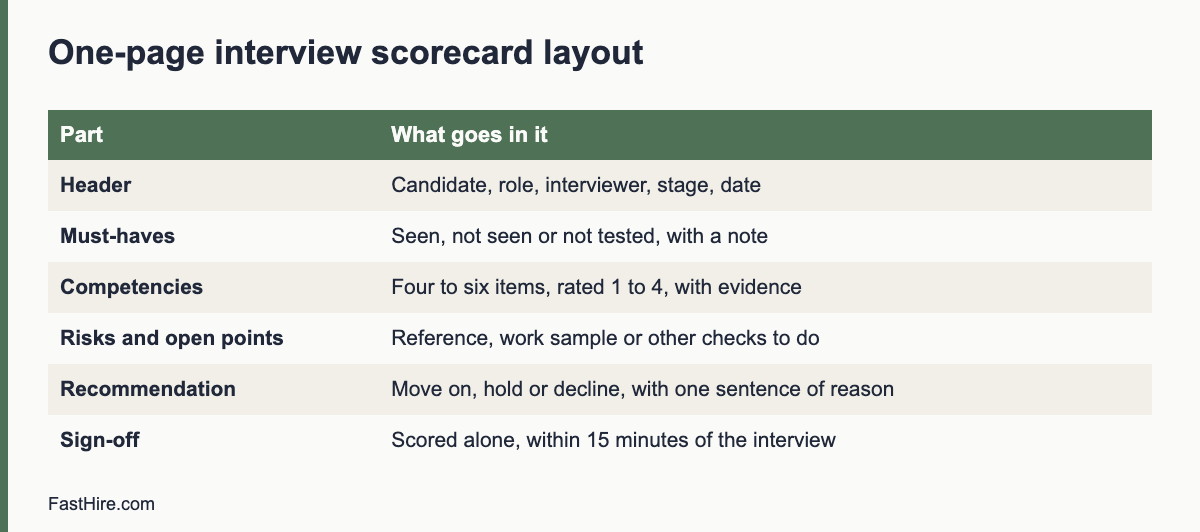
    The layout of a one-page scorecard

    PartWhat goes in itWhy
    HeaderCandidate, role, interviewer, date, interview stageTraceability
    Must-havesEach must-have from the brief with “seen”, “not seen” or “not tested” and a noteKeeps the decision tied to the requirements
    CompetenciesFour to six competencies, each rated 1 to 4 with a line of evidenceCompares candidates on skills the interview tested
    Risks and open pointsAnything to check, for example a reference or a work sampleMakes the next step clear
    RecommendationMove on, hold or decline, with one sentence of reasonForces a position
    Sign-offInterviewer name and time of scoringShows that the score was made alone and promptly

    Step 1: Choose what to score

    Start with the role brief. Copy the must-haves into the top part of the scorecard. These are not rated. They are either seen in the application or interview, not seen, or not yet tested. If a must-have is not seen, the candidate does not move forward unless you have a good reason and write it down.

    Then pick four to six competencies that the interview can test. They should be connected to outcomes in the brief. For a project coordinator, these might be planning, communication, problem solving, reliability and working with others. Avoid vague items such as “attitude” or “energy”. If you cannot write an anchor for an item, remove it.

    Step 2: Define the rating scale

    Use a 1 to 4 scale. It avoids the neutral middle and keeps the form simple. Write a general meaning for each number and then, for each competency, write one line for what a 1 and a 4 look like.

    ScoreGeneral meaning
    1Little or no evidence, or evidence of poor practice
    2Some evidence, but incomplete or inconsistent
    3Clear evidence that meets what the role needs
    4Strong evidence that clearly exceeds what the role needs

    Add one rule: a score of 4 must be backed by a specific example. This reduces score inflation, which is the habit of giving high scores to candidates you like.

    Step 3: Add weights only if you can explain them

    Not all competencies matter equally. You can give a competency more weight, for example a double weight for the one that matters most for the 90-day outcomes. Do this before the first interview and write the reason in the brief. Do not change weights after you meet candidates. If weights make you uneasy, skip them and compare the profile of scores instead of a total.

    A worked example

    This example is fictional. It shows how two interviewers might score two candidates for a project coordinator role. The role brief has three must-haves: two years of coordination work, clear written English and working knowledge of a project tool. Five competencies are scored from 1 to 4, and “planning” has a double weight because on-time delivery is the main outcome.

    Competency (weight)Candidate A: score and evidenceCandidate B: score and evidence
    Planning (x2)3: described a 12-week plan with milestones and a weekly check4: described adjusting a plan when a supplier failed, with dates and impact
    Communication (x1)4: gave a clear, structured answer to every question3: clear, but needed prompts to give detail
    Problem solving (x1)3: solved the example by splitting the task3: used a similar approach and added a check
    Reliability (x1)3: gave a specific example of covering for a colleague2: example was vague about the outcome
    Working with others (x1)3: described a conflict and how it ended3: described a joint deadline with a clear role split
    Weighted total (max 24)3×2 + 4 + 3 + 3 + 3 = 194×2 + 3 + 3 + 2 + 3 = 19

    The totals are equal at 19. This is exactly where a scorecard helps. Instead of a vague argument, the panel can see that Candidate A is stronger in communication and reliability, and Candidate B in planning. The panel can ask: which strength matters more for the first 90 days? It can also decide to run a short work sample on planning for Candidate A, or to check a reference on reliability for Candidate B. The scorecard did not decide. It showed where to look.

    Step 4: Score alone and promptly

    Each interviewer fills in their own scorecard within 15 minutes of the interview, before they talk to anyone else. Memory fades quickly, and the first strong opinion in the room tends to pull everyone with it. Collect the scorecards before the debrief starts. See our guide on structured interviews for question design and anchors.

    Step 5: Compare in the debrief

    1. Put every interviewer’s scores in one table, with the evidence next to each.
    2. Look first at the must-haves. Is any not seen for a candidate?
    3. Look at large differences between interviewers. Ask for the evidence behind each. A big gap often means the interviewers saw different things or read the anchors differently.
    4. Agree the next step, such as a reference check or a short work sample, to settle open points.
    5. Record the decision and the reason in two sentences.

    What to do about common problems

    ProblemWhat it looks likeFix
    Score inflationAlmost every candidate gets 3s and 4sRequire an example for every 4. Review the average per interviewer.
    Halo effectOne strong answer lifts every scoreScore one competency at a time, with the evidence in front of you.
    Similarity biasHigher scores for people who are like the interviewerAsk: what is my evidence? Have a second interviewer score.
    Late scoringScores written the next dayBlock 15 minutes after each interview in the calendar.
    Weighting driftWeights change after meeting candidatesFix weights before interviews and write them in the brief.
    Over-reliance on totalsThe highest total wins by one pointRead the evidence. Treat small differences as ties.

    Keeping the scorecard fair and lawful

    Scorecards help show that you used job-related criteria. They only help if the notes are factual. Write what the candidate said or did. Do not write comments about age, sex, race, religion, disability, family plans or similar topics. The US Equal Employment Opportunity Commission explains the main limits on its page about prohibited employment policies and practices. The Acas page on recruitment explains the position in Great Britain.

    Scorecards and notes are personal data. In the UK and the EU, tell candidates how you use their data and delete it when you no longer need it. The Information Commissioner’s Office explains the rules in its guidance on recruitment and selection. A candidate may ask to see notes about them, so write notes that you would be comfortable sharing.

    A blank scorecard to copy

    Interview scorecard
    Candidate: ______ Role: ______ Interviewer: ______ Date and time of scoring: ______

    Must-haves (seen / not seen / not tested, with a note)
    1. ______
    2. ______
    3. ______

    Competencies (score 1 to 4 and evidence; weight in brackets)
    1. ______ (x__): Score __ Evidence: ______
    2. ______ (x__): Score __ Evidence: ______
    3. ______ (x__): Score __ Evidence: ______
    4. ______ (x__): Score __ Evidence: ______
    5. ______ (x__): Score __ Evidence: ______

    Risks and open points: ______
    Recommendation: move on / hold / decline
    Reason in one sentence: ______

    FastHire is being built so that the evidence behind the must-haves is easy to see. It shows each job requirement next to the exact CV passage that supports it, so the interview can concentrate on what the CV cannot show. FastHire is coming soon. It does not rank, score or reject candidates. People make every decision.

    Sample competencies for common roles

    Use these as starting points, then change them to match your own role brief. Keep to four to six.

    RolePossible competencies to scoreEvidence to ask for
    Customer support agentClear writing, patience under pressure, problem solving, learning new tools, reliabilityA real ticket they handled; how they replied; what they learned
    Sales representativeListening, planning the week, handling objections, honesty with customers, follow-throughA deal won and a deal lost; what they did differently next time
    Software developerProblem solving, code quality, collaboration, learning, communication of trade-offsA project they built; a decision they changed after feedback
    Operations coordinatorPlanning, accuracy, communication, prioritising, working with suppliersA schedule they ran; a problem they caught before it grew
    Team leadCoaching, fairness, decision making, handling conflict, delivering outcomesA person they helped improve; a hard decision and the result

    Using scorecards across several rounds

    If you run more than one interview, give each round a different focus and its own scorecard, but keep the must-haves the same. For example, round one tests communication and role knowledge, and round two tests planning and working with others. Avoid asking the same question twice, because a repeated question tests memory, not skill. Before the final round, gather all scorecards into one table with the evidence, and look at the whole picture instead of the last interview.

    When a candidate does a work sample, score it with the same 1 to 4 scale and the same anchors for every candidate. Ask two people to score it separately, and compare. A short rubric written before the task is set, such as “includes a clear summary”, “numbers are correct” and “next steps are listed”, keeps the scoring objective.

    Keep it short enough to use

    A scorecard that takes 30 minutes to fill in will be filled in badly or late. Aim for 10 to 15 minutes. If interviewers complain, remove competencies rather than evidence lines. Evidence is what makes the scorecard worth keeping. A short form with real notes is better than a long form with ticks.

    Frequently asked questions

    What should an interview scorecard include?

    The candidate and role, the must-haves, four to six competencies with a rating scale and a line of evidence each, risks and open points, a recommendation and a sign-off with the time of scoring.

    Should I use a 1 to 5 or a 1 to 4 scale?

    Both work. A 1 to 4 scale avoids the neutral middle score. Choose one scale and use it for every candidate.

    Do I need weights?

    Not always. Use weights only when one competency clearly matters more for the 90-day outcomes, and set them before the first interview.

    Can candidates see my scorecard?

    In some countries, candidates can ask for the personal data you hold about them, and notes may be included. Write notes that are factual and that you could explain.

    What if two candidates have the same total?

    Look at the evidence and at where each is strongest. Decide which strength matters more for the outcomes in the brief, or use a short work sample or reference to settle the difference.

    Related guides

    This is general information, not legal advice.
  • How to give fast interview feedback without cutting corners

    How to give fast interview feedback without cutting corners

    To give interview feedback fast without cutting corners, decide the standard before you interview, write short notes during the interview, score each candidate within hours, and send an outcome within two working days. Give every candidate a clear result. Offer two or three job-related reasons to candidates who reach the late stages. Never mention protected traits or compare people.

    Key takeaways

    • Set a response time for each stage and tell candidates what it is.
    • Take notes and score while the interview is fresh. Feedback follows from the scorecard.
    • Everyone gets an outcome. Later-stage candidates get short, specific, job-related reasons.
    • Keep the message kind, factual and short. Do not argue, compare or guess.
    • Avoid risky content: protected traits, hints about age or family, and promises you cannot keep.
    x

    Why speed matters

    For a candidate, an interview is a large effort. They prepare, take time off and share their experience. Silence after an interview feels like rejection, and it leaves a bad memory of your business. Slow feedback also costs you good candidates: people with several options accept the first clear offer. A clear, quick message protects your reputation and keeps strong candidates engaged. It also helps people who are not selected to move on.

    Speed does not mean carelessness. The risk of fast feedback is that you say something vague, personal or inaccurate. The answer is preparation: decide what you will say, based on the scorecard, before the interview ends.

    Set a service standard

    StageStandard (suggested)Message
    Application receivedAutomatic reply immediately, human reply within 2 working daysThanks; closing date; next step date
    After screeningWithin 2 working days after the screening dateInvite or decline with a brief reason
    After a phone screenWithin 2 working daysInvite or decline
    After an interviewWithin 2 working days, or by the date you gaveNext step or decline with job-related reasons
    After final interviewWithin 2 to 3 working daysOffer, or decline with specific, job-related feedback
    After an offer is acceptedSame dayTell other finalists

    These times are suggestions. Pick times you can keep, then put them in the job ad and the invitation. A promise you keep is better than a short promise you break. See the recruiter kickoff meeting for how to agree response times with your recruiter or HR partner.

    Fast feedback in four steps

    Step 1: Capture evidence during the interview

    Use a notes sheet with a box for each question. Write facts and short quotes. This is the raw material of the feedback. Without it you rely on memory. Learn the method in our guide to interview scorecards.

    Step 2: Score within two hours

    Score right after the interview, before the next one begins. Use your agreed scale. Write one line for each score. This also prepares the debrief meeting.

    Step 3: Choose the message type

    Decide the outcome and match it to a template: move forward, hold, or decline. For declines, choose between a short message and one with specific feedback. Use specific feedback for finalists.

    Step 4: Send, record and follow up

    Send the message by email, or phone for finalists. Record the date. If the candidate replies with questions, answer once, kindly, with the same facts. Do not enter a long debate.

    What to include in feedback

    IncludeExampleWhy
    A clear result“We will not move forward with your application.”No one should guess
    A thank you“Thank you for the time you gave to the interview.”Respect
    One to three job-related reasons (late stages)“For this role we needed more experience in X. Your examples were stronger in Y.”Helps the candidate learn
    A positive, true point“Your explanation of how you handled the delayed shipment was clear.”Balance and honesty
    What happens next“We will keep your details for 6 months if you agree.”Clarity; check the data rules
    Contact“If you have questions, reply to this email.”Open door

    Do not add pity, empty praise or false hope. Do not promise that “we will definitely call you for the next role” unless you will.

    What not to say

    Do not sayWhySay instead
    “You were too old / too young for the team.”Age discriminationKeep reasons to the job criteria
    “We found someone who is a better culture fit.”Vague; can hide bias“We selected a candidate whose experience in X matched the role most closely.”
    “The other candidate was stronger than you.”Comparison; may reveal personal data“We needed stronger evidence of X.”
    “You seemed nervous.”Subjective; may relate to disability or anxiety“We needed more detail in your examples.”
    “We are not sure why, the manager just did not like you.”Not a valid reasonReview your reasons before you send
    “You asked about leave / children.”Risk of discrimination claimsDo not refer to such questions in the decision

    If you are unsure about a statement, leave it out. A simple “we selected another candidate” is better than a risky reason. Remember that notes and messages may be requested by the candidate under data protection or legal processes. Write only what you can stand behind.

    Templates

    Decline after screening

    Hello [Name],

    Thank you for applying for the [job title] role. We reviewed your application against the requirements for this role. We will not move forward with it at this stage. We appreciate your interest and wish you well in your search.

    Best wishes,
    [Name]

    Decline after an interview, with feedback

    Hello [Name],

    Thank you for meeting us on [date]. We enjoyed hearing about [specific, true point]. After comparing all candidates against the same criteria, we have decided not to move forward. For this role, we needed more experience in [skill]. If you would like to ask a question, you can reply to this email. We wish you every success.

    Best wishes,
    [Name]

    Hold message

    Hello [Name],

    Thank you for your interview. We need until [date] to finish our interviews. We will contact you by [date] with a decision. Thank you for your patience.

    Best wishes,
    [Name]

    Move forward

    Hello [Name],

    Thank you for your interview. We would like to invite you to [next step] on [date options]. It will take about [time]. If you need any adjustment, please tell us.

    Best wishes,
    [Name]

    Handling pushback

    1. Thank the candidate for the reply and keep the tone calm.
    2. Repeat the job-related reason, in the same words.
    3. Do not reopen the decision unless you find a clear mistake.
    4. If the candidate raises a discrimination concern, do not argue. Record the message, thank them, and escalate to HR or a legal advisor.
    5. Close politely: “We appreciate your interest and wish you well.”

    Do not share notes about other candidates. Do not give details that would reveal who else applied. If a candidate formally asks to see the data you hold about them, follow the data protection rules. In the UK and EU, see the ICO employment pages and the GDPR.

    Internal feedback to interviewers

    Feedback is also useful inside the hiring team. After each process, hold a 15-minute review with the interviewers. Ask what made scoring easy or hard, and which question gave the best evidence. Update your question list. Over time the process speeds up, because the questions and scoring guides improve.

    Give each interviewer a short note about their notes: Were they specific? Did they stay on the criteria? Did they avoid unsuitable questions? Be kind and specific. See also structured interviews for a method that makes this easy.

    A worked example (fictional)

    A hiring manager interviews four finalists for a logistics planner. She writes notes on a sheet and scores each person within an hour. On Friday afternoon she sends a hold message to all four and tells them she will decide by Tuesday. On Monday she holds a 30-minute debrief with the recruiter and one colleague. On Tuesday morning she calls the chosen candidate, then sends three decline emails by noon. Two use the short template. One goes to the runner-up and says: “Your planning example from the warehouse project was strong. For this role we needed more experience with the specific scheduling system we use. We would like to keep your details for six months if you agree.” The runner-up replies with thanks, and agrees. Total time spent on feedback: 45 minutes.

    A feedback checklist

    • Response times set and shared with candidates
    • Notes taken during the interview
    • Scores written within two hours
    • Message type chosen
    • No protected traits or comparisons mentioned
    • One to three job-related reasons for late-stage candidates
    • Date recorded in the tracking sheet
    • Data kept and deleted on schedule

    Feedback for different outcomes

    OutcomeWho gets itLengthContact method
    Declined after applicationAll declined applicants2 to 4 sentencesEmail, template
    Declined after a phone screenAll screened candidates3 to 5 sentencesEmail, template
    Declined after first interviewAll interviewed candidates5 to 7 sentences with one or two reasonsEmail
    Declined after final interviewFinalistsA short call or a detailed email with two or three reasonsCall, then email
    Offer madeChosen candidateCall first, then letterCall and email

    A call is a kind gesture for finalists. It lets them ask a question and ends the process with respect. Keep it to five minutes. Tell them the outcome in the first sentence, then give the reasons.

    A script for a feedback call

    1. Say the outcome first. “Thank you for your time. I am calling to tell you that we have decided to offer the role to another candidate.”
    2. Thank the person. “We valued the effort you gave to the process.”
    3. Give two or three job-related reasons. “For this role we needed more depth in X. Your examples of Y were strong.”
    4. Invite one question. “Is there anything you would like to ask?”
    5. Close. “We would be glad to keep your details for future roles, if you agree. We wish you every success.”

    Do not read out comments from other interviewers. Do not make a promise about future roles unless you plan to keep it. Write a two-line note after the call about what you said.

    Make feedback part of your process, not extra work

    Feedback becomes slow when it is a separate task. Build it into the process. Put a “message sent” column in the tracking sheet. Block 30 minutes in your calendar on the day after each interview block. Save templates in your email so that you can send them in a click. Set a rule with your recruiter: for each rejected finalist, the recruiter sends the message, and the hiring manager supplies two bullet points of job-related reasons. This division of work cuts the time and keeps the tone consistent.

    If you use software to track applicants, check whether it can send templates and record dates. Whatever you use, people must decide and write the reasons. Tools can help send and track, but they cannot know the reasons for a decision.

    Frequently asked questions

    How fast should interview feedback be?

    Within two working days is a good standard. Tell candidates the date you will contact them and keep it.

    Do I have to give reasons to every candidate?

    Not always. Everyone should get an outcome. Give brief reasons to candidates who reached the later stages, if you can do it safely and fairly.

    Is it risky to give feedback?

    It can be if you include protected traits, comparisons or opinions. Keep to job-related reasons from your scorecard.

    What if I do not have time?

    Use templates. A short, polite decline takes less than five minutes and is far better than silence.

    Can candidates see my notes?

    In some places, yes, through data protection rights. Write notes that are factual and job-related.

    Related guides

    This is general information, not legal advice.
  • Behavioural interview questions with a scoring guide

    Behavioural interview questions with a scoring guide

    Behavioural interview questions ask candidates to describe what they actually did in a past situation, for example “Tell me about a time you had to learn something quickly.” The answers show how a person works. To use them well, choose four to six skills from your role brief, ask the same questions of every candidate, listen for the situation, the person’s own actions and the result, and score each answer against written anchors.

    Key takeaways

    • Use behavioural questions to test skills that a resume or CV cannot show, such as judgement, communication and reliability.
    • Choose four to six skills from the role brief. More questions give thinner answers.
    • Listen for the STAR parts: situation, task, action and result. Ask a follow-up for any missing part.
    • Score each answer on a 1 to 4 scale with written anchors, alone and straight after the interview.
    • Avoid questions that reach into protected topics such as age, family plans, health or religion.
    x

    What behavioural questions are

    A behavioural question asks about the past: “Tell me about a time when …”. The idea is simple. How someone acted in a similar situation is a useful guide to how they will act in your role. The US Office of Personnel Management describes a structured interview as one that systematically asks about past behaviour, hypothetical situations, or both, on its page about structured interviews. Behavioural questions are the past-behaviour half of that approach. The other half, situational questions, asks what the candidate would do in a described case.

    Both types work best inside a structured interview: the same questions for every candidate, in the same order, scored on one scale. Our guide to structured interviews explains how to build the whole process. This article gives you the question bank and the scoring guide.

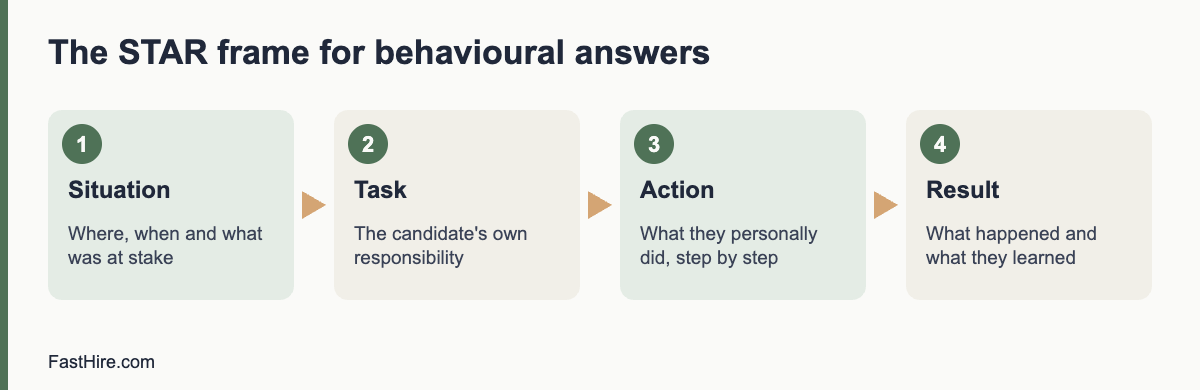
    The STAR frame: what a good answer contains

    PartWhat the candidate should sayFollow-up if missing
    SituationThe context: where, when and what was at stake“Can you set the scene? What was happening at the time?”
    TaskThe candidate’s own responsibility or goal“What was your part in this?”
    ActionWhat the candidate personally did, step by step“What did you do first? Then what?”
    ResultWhat happened, and what they learned“How did it end? What would you do differently?”

    Many candidates answer with “we” and general statements such as “I always communicate well”. Your job is to move them to a specific example and to what they themselves did. A polite way is: “That is helpful. Can you give me one example and walk me through what you did?” Use the same short list of follow-ups with every candidate, so that all of them have an equal chance to give detail.

    A scoring guide that works across questions

    ScoreWhat the answer shows
    1No relevant example, a very general answer, or an action that shows poor judgement
    2A relevant example, but the candidate’s own part, the action or the result is unclear
    3A clear, relevant example with the candidate’s actions and a sensible result
    4A clear example with strong judgement, awareness of impact on others and a lesson that the candidate applied again

    For each question, add one or two lines of specific anchors in your scorecard. See our scorecard template. Write notes on what the candidate said and did, not on how they spoke. Score within 15 minutes of the interview, alone.

    Question bank: 25 questions by skill

    Pick one question per skill. Choose the skills from your role brief. Each question can be adapted to the role by changing the example in brackets.

    Communication

    1. Tell me about a time you had to explain something complex to someone who did not know the topic. What did you do?
    2. Describe a time a message you sent was misunderstood. What happened and what did you do?
    3. Tell me about a time you had to give someone bad news at work.
    4. Describe a time you had to persuade a colleague to change their view.

    Problem solving

    1. Tell me about a problem at work that had no clear answer. How did you approach it?
    2. Describe a time you found an error in your own or someone else’s work. What did you do?
    3. Tell me about a time you had to solve a problem with limited information or time.
    4. Describe a decision you made with only part of the data. How did it turn out?

    Working with others

    1. Tell me about a time you disagreed with a colleague. What did you do?
    2. Describe a project where you depended on other people to finish your work. How did you manage that?
    3. Tell me about a time you helped a colleague who was struggling.
    4. Describe a time when someone gave you critical feedback. What did you do with it?

    Reliability and planning

    1. Tell me about a time you had several urgent tasks at once. How did you decide what to do first?
    2. Describe a time you missed a deadline or nearly did. What happened and what changed afterwards?
    3. Tell me about a plan you made and then had to change. How did you adapt?
    4. Describe a task you completed that nobody was checking. Why did you do it the way you did?

    Learning and adaptability

    1. Tell me about a time you had to learn a new tool or process quickly. How did you go about it?
    2. Describe a time when your role or priorities changed suddenly. What did you do?
    3. Tell me about a mistake you made at work. What did you learn?
    4. Describe something you taught yourself in the last year, and why.

    Customer or stakeholder focus

    1. Tell me about a time you dealt with an unhappy customer or client. What did you say and do?
    2. Describe a time you went beyond what was asked to help a customer or colleague.
    3. Tell me about a time you had to say no to a request. How did you handle it?

    Choosing questions for a role: an example

    Take a customer support team lead with a role brief that lists coaching, handling pressure, fairness and process improvement as the main areas. You could choose: “Tell me about a time you helped a colleague who was struggling” (coaching), “Tell me about a time you had several urgent tasks at once” (pressure), “Tell me about a time you disagreed with a colleague” (fairness), and “Tell me about a time you changed how a team did something” (process improvement). Add two situational questions about the specific context, and you have six questions for a 45-minute interview.

    What strong and weak answers can look like

    Here are two short sample answers to “Tell me about a time you found an error in your own work.” They are fictional and shown to practise scoring.

    Answer A: “In my last job I send weekly sales summaries. One Monday I noticed the total was too high because I had double counted a region. I told my manager before anyone used it, sent a corrected file the same hour and added a check that compares the total to the sum of the regions. It has not happened since.”

    Answer B: “I try to be very careful, so mistakes are rare. If I find one I fix it. I think attention to detail is one of my strengths.”

    Answer A names the situation, the actions and the result, and shows a lasting change. It would score a 3 or 4. Answer B is general and gives no example. It would score a 1. A follow-up such as “Can you give me one specific example?” gives the candidate a fair chance to improve, and you score the improved answer.

    Fairness checks for behavioural questions

    • Ask about work, not about private life. Questions about family plans, health, religion, age or similar topics are not job-related and can lead to discrimination. The US Equal Employment Opportunity Commission explains the limits on its page about prohibited employment policies and practices.
    • Allow examples from outside paid work. Volunteer work, study, caring responsibilities and personal projects can show the same skills. Say so in your introduction.
    • Do not require examples that only some groups can have. For example, “a time you managed a large team” may exclude capable people. Ask about leading a task, not holding a title.
    • Offer adjustments. Some candidates need questions in writing, extra time or a different format. The Acas page on recruitment explains the duty to make reasonable adjustments in Great Britain.
    • Be consistent. The same questions, the same probes and the same scale for everyone.

    Common mistakes

    • Asking about “a time” when the candidate has none. Offer a situational version of the same question instead, for example “What would you do if …?”, to every candidate who needs it.
    • Accepting “we” answers without asking about the candidate’s part.
    • Scoring the story, not the behaviour. A fluent speaker may give a vivid story about a small action.
    • Stacking too many questions. Six well-explored questions beat twelve thin ones.
    • Treating one answer as proof. A single example is evidence, not certainty. Combine it with the CV, work sample and references.

    FastHire is being built to put the written evidence in front of you before the interview, by showing each job requirement next to the exact CV passage that supports it. Then your interview time goes to the skills that need a conversation. FastHire is coming soon. It does not rank, score or reject candidates. People make every decision.

    A 45-minute running order

    MinutesPartNotes for the interviewer
    0 to 5Welcome and explanationRead the same opening to every candidate. Explain that you will take notes.
    5 to 35Six behavioural questionsAbout five minutes each. Use the fixed probes only. Do not rescue a weak answer with hints.
    35 to 40Candidate questionsAnswer honestly. Note what the candidate asks, because it shows what matters to them.
    40 to 45Close and next stepsGive the date by which you will reply. Offer a contact for adjustments or questions.

    A probe card for interviewers

    Print these on a card and keep them in view. They help you stay neutral and give every candidate the same chance.

    • “Can you set the scene for me?”
    • “What was your part in this?”
    • “What did you do first? What did you do next?”
    • “What was the result?”
    • “What would you do differently now?”

    Avoid leading probes such as “So you were the one who solved it?” or “That sounds like good teamwork, right?”. They put words in the candidate’s mouth and make scores harder to defend. If a candidate is stuck, repeat the question once, offer a moment to think, and then move on. After the interview, write a one-line note for each answer in the candidate’s words before you score. Notes first and scores second keeps you honest about what you actually heard.

    Frequently asked questions

    What is the difference between behavioural and situational questions?

    Behavioural questions ask about what a candidate did in the past. Situational questions describe a case and ask what the candidate would do. Both can be used in a structured interview.

    How many behavioural questions should I ask?

    Six to eight in a 45 to 60 minute interview, with a short follow-up for each. Pick skills from the role brief.

    What if a candidate has no work example?

    Allow examples from study, volunteering or personal projects. For entry-level roles, add a situational version of the question for every candidate.

    Can I ask different candidates different questions?

    Avoid it. Different questions make comparison unreliable and can lead to unequal treatment. Keep core questions identical and use only the same fixed follow-up probes.

    How do I score an answer that is vague?

    Ask one fixed follow-up, such as “Can you give one specific example?”. If the answer stays vague, score it low and write the reason in your notes.

    Related guides

    This is general information, not legal advice.
  • How to define a role before you hire: a one-page role brief

    How to define a role before you hire: a one-page role brief

    A role brief is a one-page document that says why the role exists, what the person must achieve, what they must be able to do and what the job offers. Write it before you open the vacancy, agree it with the people who will work with the new hire, and use it for the ad, the screen, the interviews and the first 90 days. It takes one to two hours and saves weeks.

    Key takeaways

    • Start with outcomes, not duties or a copied job description.
    • Use seven sections: purpose, outcomes, tasks, must-haves, nice-to-haves, team and conditions, and the hiring process.
    • Keep must-haves to three to five items that a person can check from a resume or CV.
    • Agree the brief with your recruiter, your manager and the main colleagues before you advertise.
    • Review the brief against five tests before you publish it, and change it only with a written reason.
    x

    Why define the role first

    Most hiring managers start with an old job description or a list of tasks they want to hand over. The result is a long list that describes the last person, not the next one. Candidates see a vague ad. Recruiters guess. Interviewers ask different questions because nobody agreed what good looks like. The hire may be a fine person who does not do what you needed.

    A brief fixes this by forcing three choices early: what changes if this person succeeds, what they need to be able to do on day one and what you can teach. These choices shape every later step. If you skip them, you will make them anyway, but under time pressure and without the people who should have a say.

    The seven sections of a one-page role brief

    SectionThe question it answersExample
    1. PurposeWhy does this role exist?Keep our five customer teams supplied with accurate weekly reports
    2. Outcomes (90 days and 12 months)What will be different if this person succeeds?In 90 days: weekly reports sent on time with fewer than two corrections a month
    3. Main tasksWhat will they spend their time on?Pull data, check it, write the summary, answer questions from team leads
    4. Must-havesWhat must they be able to show on day one?2 years of reporting work in any setting; advanced spreadsheet skills; clear writing
    5. Nice-to-haves and teachable skillsWhat can they learn here?Our reporting tool; our sector terms
    6. Team and conditionsWho do they work with, where and when? What is the pay range?Reports to Head of Operations; hybrid; salary range [range]
    7. Hiring processWho decides and by when?Two interviews, one work sample, decision within 3 working days of the last interview

    Section 1: Purpose

    Write one sentence. Use the form “This role exists so that [who] can [do what].” If you need two sentences, the role may be two roles. A clear purpose helps when you have to trade off: which skill matters more, and which duty can stay with someone else?

    Section 2: Outcomes

    List three to five results you expect in the first 90 days and in the first 12 months. Write them as things you could see or measure: “closes the monthly accounts by the fifth working day”, not “improves finance processes”. Outcomes tell you what to ask in the interview and how to judge the first months.

    Section 3: Main tasks

    List the regular work, in order of time spent. Five to eight lines is enough. Mark the one or two tasks that are hardest or most important. Tasks are useful for the ad and the onboarding plan, but they should not drive the must-haves. Many tasks can be learned.

    Section 4: Must-haves

    This is the most important section. A must-have is something a person must already be able to do, because you cannot or will not train it in the first weeks, and because you will reject a candidate who lacks it. Write each one so that a stranger can check it in a resume or CV. For more detail, see Must-haves vs nice-to-haves: cutting your applicant pile without unfair filters and How to write job requirements candidates can actually check themselves against.

    A quick test: for each must-have, ask “Would I really turn down an otherwise excellent candidate who lacks this?” If the answer is “probably not”, move it to nice-to-have.

    Section 5: Nice-to-haves and teachable skills

    List what is helpful but not essential. Add a short note on what you will teach. This makes it clear to candidates and recruiters that missing items are fine, and it reminds you to plan the training.

    Section 6: Team and conditions

    Name the manager, the main colleagues, the location, the hours and the pay range. If the pay is not agreed, agree it now. Without a range you cannot write an honest ad, and you risk a late-stage surprise. Some places require pay information in job ads or on request, so check the rules where the person will work.

    Section 7: Hiring process

    Say who will screen, who will interview and who decides. List the steps and the time each takes. Agree how quickly interviewers must give feedback. A process that is clear to you and the recruiter keeps candidates moving. We cover feedback speed in how to give fast interview feedback.

    A worked example

    This example is fictional and is only meant to show the level of detail.

    Role brief: Operations Reporting Analyst

    Purpose: This role exists so that our five customer teams can plan each week with accurate numbers.

    Outcomes. In 90 days: weekly reports go out every Monday by 10:00 with no more than two corrections a month; the team leads confirm they use them in their planning meetings. In 12 months: the person has replaced two manual reports with a shared dashboard and trained team leads to read it.

    Main tasks (most time first): pull and check data from three systems; write the weekly summary; answer team questions; maintain the dashboard; document report definitions.

    Must-haves: at least two years of reporting or analysis work, paid or unpaid; advanced spreadsheet skills, shown by an example; clear written English; can work with a team lead to define a report.

    Nice-to-haves (we will teach): our reporting tool; our sector terms; basic SQL.

    Team and conditions: reports to the Head of Operations; works with five team leads; three days in the office, two from home; salary range [range].

    Process: screen by the recruiter and the manager; 45-minute interview with two interviewers; one 45-minute work sample; decision within three working days of the last interview.

    Notice what the brief leaves out: a degree requirement, “strong communication skills” and “team player”. If the role truly needs a qualification, say which and why. If it only needs the skill, test for the skill.

    How to build the brief with your team in 90 minutes

    1. Before the meeting (20 minutes). Write a draft of sections 1 and 2. Send it to the recruiter and to two people who work closely with the role.
    2. Meeting, part one (30 minutes). Review purpose and outcomes. Ask: “If we hired the perfect person, what would you see after three months?” Rewrite until everyone agrees.
    3. Meeting, part two (30 minutes). List tasks, then pick must-haves. Challenge each one with the “would I turn down an excellent candidate?” test.
    4. After the meeting (10 minutes). Fill in sections 6 and 7. Send the final one-page brief to everyone. Ask for objections within one working day.

    If you work with a recruiter, use the brief as the agenda for your first meeting. Our guide on how to run a kickoff meeting with your recruiter shows how.

    Five tests before you publish

    TestPass if
    ClarityA person outside the team can say what the new hire will do after reading the brief
    CheckabilityEvery must-have can be confirmed from a resume or CV or a short, job-related test
    FairnessNo must-have excludes people for reasons unrelated to the job, such as age, a specific school or a native language
    RealismThe pay range, the outcomes and the must-haves fit the market, and the person can reach the outcomes in the time given
    AgreementThe manager, the recruiter and the main colleagues all agree and have said so in writing

    On fairness: use job-related criteria and apply them to everyone. The US Equal Employment Opportunity Commission lists protected traits and practices to avoid on its page about prohibited employment policies and practices. In Great Britain, the Acas page on recruitment explains how the Equality Act applies to hiring decisions. In the EU, equal treatment rules are set in EU and national law, so check the country where you hire.

    Common traps

    • Copying the last job description. It lists tasks the previous person did, including tasks that no longer matter.
    • Title inflation. A senior title with a junior brief attracts the wrong people and creates pay problems later.
    • Solution first. “We need a data scientist” may hide the real need, which could be better reports. Define the outcome and then choose the role.
    • Everything is a must-have. A list of twelve must-haves describes a person who does not exist.
    • Moving the target. If you add a new must-have after interviews begin, you risk treating candidates unequally.

    How to use the brief in the rest of the process

    Treat the brief as the source for everything else. The ad takes its purpose, tasks, must-haves and pay from sections 1, 3, 4 and 6. The screen uses section 4. The interview questions come from section 2 and section 4. The scorecard uses the must-haves as its rows. The 30-60-90 day plan is section 2 with dates. If a new fact appears, update the brief first and tell everyone.

    FastHire is being built around this chain. It shows each job requirement next to the exact CV passage that supports it, and candidates check their fit before applying. FastHire is coming soon. It does not rank, score or reject candidates. People make every decision. A clear brief makes that evidence much easier to read.

    Questions that sharpen a weak brief

    If your draft feels vague, ask the people closest to the role these ten questions. Write the answers in the brief.

    1. What is the one thing that goes wrong today because this role is empty?
    2. Who will rely on the new hire, and what do they need first?
    3. What would a very good first month look like? What would a poor one look like?
    4. Which task is the hardest, and what makes it hard?
    5. Which skills can we teach in four weeks, and which can we not?
    6. What did the last person do well that we must keep?
    7. What did we wish they had done differently?
    8. Who will the person work with most, and how do those people prefer to work?
    9. What is the lowest and highest pay we can offer, and what is the reason for the gap?
    10. What will make us say “yes” or “no” at the end of the process, and who will decide?

    Collect the answers in a shared document and ask people to comment before the meeting. Disagreement is useful here. It shows what you must settle before candidates arrive. If two senior colleagues give different answers to question one, the role is not ready to advertise.

    Turning the brief into an ad in 15 minutes

    Copy the purpose into the opening lines. Turn the main tasks into five to seven bullet points. Copy the must-haves as they stand. Add the nice-to-haves with the words “you can still apply without these”. Paste the conditions and the pay range, then list the process steps and dates. Remove internal terms that candidates will not know. Our guide to writing a job ad has a full template and a before-and-after example.

    Frequently asked questions

    How long should a role brief be?

    One page. If it runs longer, the role is probably too broad or the brief contains detail that belongs in the ad or the onboarding plan.

    Is a role brief the same as a job description?

    No. A job description often lists duties and formal requirements for HR files. A role brief focuses on outcomes, must-haves and the hiring process, and is meant to guide decisions.

    Who should approve the brief?

    The hiring manager, the recruiter or HR partner, and the person who owns the budget. Ask the main colleagues for comments before you finalise it.

    Can I change the brief after interviews start?

    Only for a good reason, and write the reason down. Changing requirements midway makes it hard to compare candidates fairly. If you must change it, tell everyone and apply the change to all candidates.

    Do I share the brief with candidates?

    Share the parts that help candidates decide: purpose, outcomes, tasks, must-haves, conditions and process. Keep internal notes, such as budget limits beyond the range, private.

    Related guides

    This is general information, not legal advice.
  • How to run a kickoff meeting with your recruiter

    How to run a kickoff meeting with your recruiter

    A recruiter kickoff meeting is a 45 to 60 minute conversation where you and your recruiter agree what the role is, what good looks like, who does what and how fast each step must be. Bring a one-page role brief, agree the must-haves, review three sample profiles together, set response times for both sides and end with a written summary. This meeting is the best chance to save weeks later.

    Key takeaways

    • Bring a written role brief. Do not start from a blank page in the meeting.
    • Agree must-haves, nice-to-haves and pay range, and write them down.
    • Review three sample profiles to calibrate: one clear yes, one clear no, one maybe.
    • Set response times for both of you, such as feedback on shortlists within one working day.
    • Send a written summary within 24 hours and ask the recruiter to confirm it.
    x

    Why the kickoff matters

    Recruiters work with what you tell them. If the brief is thin, they fill the gaps with guesses, and you spend the next weeks correcting profiles that miss the mark. A good kickoff turns a few vague wishes into a shared definition of success. It also builds a working relationship: the recruiter learns how you decide, and you learn how they work.

    The meeting matters whether your recruiter is internal, an agency partner or an HR generalist who also runs hiring. The structure is the same. If you have never written a brief, start with our guide to the one-page role brief.

    Before the meeting: what to prepare

    • A one-page role brief. Purpose, 90-day outcomes, tasks, must-haves, nice-to-haves, conditions and process.
    • Pay range and approval. Confirm the range is approved. A recruiter cannot sell a role with a pay range that may change.
    • Three sample profiles. Choose real or anonymised resumes or CVs: one you would hire, one you would reject and one you are unsure about. If you have none, write three short imaginary profiles.
    • Your calendar. Block interview slots for the next two weeks, so that you can promise speed.
    • The interview panel. Know who will interview and who will decide.

    Send the brief and the samples one working day before the meeting, so that the recruiter can come with questions.

    A 60-minute agenda

    TimeTopicOutput
    0 to 5 minGoal and context: why this role, why nowShared purpose
    5 to 20 minWalk through outcomes, tasks and must-havesAgreed must-haves and nice-to-haves
    20 to 30 minReview three sample profilesCalibrated view of yes, no and maybe
    30 to 40 minMarket and pay checkRealistic range and time estimate
    40 to 50 minProcess, roles and response timesNamed owners and deadlines
    50 to 60 minCandidate experience and fairnessAgreed message to candidates and how you will avoid bias

    The 15 questions to answer in the meeting

    1. Why does this role exist now, and what happens if it stays empty for two months?
    2. What are the three to five outcomes for the first 90 days?
    3. What are the must-haves? How will we check each one from a resume or CV or a short test?
    4. What is on the nice-to-have list, and what will you teach?
    5. What are the pay range, the benefits and the location rules? Which of these can move?
    6. Who is on the interview panel, and what will each person assess?
    7. How many interview rounds will there be, and how long will each last?
    8. Is there a work sample? How long is it, and will candidates be paid for long tasks?
    9. How fast will you give feedback on each shortlist? What is the recruiter’s promise to candidates?
    10. Which channels will the recruiter use? Is there a referral or an internal candidate?
    11. What is the realistic number of candidates you want to interview?
    12. What is the target date for the offer and for the start?
    13. What message do we send to candidates who are not selected?
    14. How will we monitor fairness, for example by using the same questions and the same criteria?
    15. What will we do if the first two weeks produce no good candidates?

    Calibrating with three sample profiles

    Calibration is the most underused part of a kickoff. Show the recruiter three profiles and say what you would do with each, and why. The reasons matter more than the verdicts. Use the must-haves as your language.

    ProfileYour decisionReason to give the recruiter
    A: Two years of reporting work in a shop, strong spreadsheet exampleYesMeets all four must-haves with evidence
    B: Recent degree, no work experience, no examples of reportingNoDoes not show the work-experience must-have. Please do not send profiles like this
    C: One year of reporting plus volunteer finance work, strong writing sampleMaybe, sendExperience is short, but volunteer work counts. Include if other must-haves are met

    Be careful to base each reason on the job. Do not say “he feels senior” or “she looks like a good fit”. If you notice yourself giving vague reasons, return to the brief and turn the reason into a must-have or drop it. This habit also helps avoid unfair filters. The US Equal Employment Opportunity Commission lists practices to avoid on its page about prohibited employment policies and practices.

    Agree who does what

    TaskYou (hiring manager)RecruiterOther
    Role brief and must-havesOwnChallenge and adviseHR approves
    Job adReview and approveWrite and publishBrand or comms review
    Sourcing and screeningReview shortlistsOwnUse agreed must-haves
    InterviewsOwnSchedule and prepare candidatesPanel members
    Feedback to candidatesGive feedback to the recruiter within one working dayDeliver to candidatesHR checks wording
    OfferDecidePrepare and make the offerHR and finance approve

    Write the response times next to each step. A small number of agreements, such as “shortlist feedback within one working day” and “candidate updates every five working days”, often matter more than any tool.

    Fairness and data points to agree

    Say out loud how you will keep the process fair. Agree that every candidate gets the same questions and the same scoring scale, that notes are factual, and that nobody asks about protected characteristics. The Acas page on recruitment explains how discrimination law applies to hiring in Great Britain.

    Also agree how candidate data will be handled. If your recruiter is an agency or consultant, ask who is responsible for the data, where it is stored, who can see it and when it will be deleted. In the UK, the Information Commissioner’s Office explains the responsibilities of employers and recruiters in its guidance on recruitment and selection.

    The written summary: a template

    Subject: Kickoff summary for [role]

    Hello [recruiter name],

    Thank you for the meeting today. Here is what we agreed.

    Purpose and outcomes: [two lines].
    Must-haves: [list]. Nice-to-haves: [list].
    Pay range and conditions: [range, location, hours].
    Process: [steps, panel, timings]. Offer target date: [date].
    Sample profiles: A yes, B no, C maybe, for the reasons we discussed.
    Response times: shortlist feedback within [one working day]; candidate updates every [five working days].
    Open items: [list with owner and date].

    Please confirm or correct by [date].

    [Your name]

    After the kickoff: the first two weeks

    1. Day 1: receive the written confirmation and the job ad draft. Reply within a working day.
    2. Day 3 to 5: review the first shortlist. Give feedback in writing, linked to the must-haves, so that the recruiter can adjust.
    3. Day 7: check progress. If you have fewer candidates than expected, review the brief together. Adjust the sourcing, the pay range or the must-haves, and record why.
    4. Day 10 to 14: hold the first interviews. Share notes with the recruiter in the format you agreed.

    Common kickoff mistakes

    • Treating the recruiter as an order taker. Ask them to challenge your brief and to bring market data.
    • Leaving the pay range open. It slows the process and harms trust with candidates.
    • Listing ten must-haves. The recruiter will read this as “send nothing” or “send everyone”.
    • Not blocking interview times. Candidates lose interest in a long gap.
    • Giving verbal feedback only. Written feedback is easier to act on and to audit later.

    FastHire is being built to help with the evidence that sits behind a shortlist. It shows each job requirement next to the exact CV passage that supports it, so a hiring manager and a recruiter can look at the same evidence. FastHire is coming soon. It does not rank, score or reject candidates. People make every decision.

    Adapting the kickoff to your situation

    SituationWhat to add to the standard agenda
    Internal recruiterAgree how this role ranks against other open roles, and how many hours per week the recruiter can give it. Capacity is the usual hidden constraint.
    External agencyAgree fees, the guarantee period, exclusivity, how candidates are presented and who owns candidate data. Put the terms in writing before work starts.
    Urgent hireCut the must-haves to the minimum, agree a one-week interview window and decide in advance who can approve an offer. Do not skip the written brief.
    Hard-to-fill roleAdd a market check: how many people have these skills, where they work and what they earn. Agree what you can change if the first two weeks fail, such as pay, location, or the balance of must-haves.
    Many similar rolesAgree one shared scorecard and one screening method, so that every hiring manager judges candidates the same way. Meet weekly to compare notes.
    Internal move possibleAgree how internal candidates will be considered, and make sure they go through the same assessment as external ones.

    Weak and strong kickoffs: a short comparison

    This comparison is illustrative. It shows how two different kickoffs for the same role can lead to different results.

    In the weak kickoff, the manager joins the call for 15 minutes, says “we need someone strong in reporting, ideally with a finance background, quick to start”, and sends last year’s job description. The recruiter sends twelve profiles in a week. The manager rejects eleven with comments such as “not senior enough” and “not quite right”. Nobody can say what the comments mean. The recruiter guesses again. Three weeks pass with no interviews.

    In the strong kickoff, the manager sends a one-page brief a day early. The meeting reviews three sample profiles with written reasons: yes because the CV shows two years of reporting work, no because there is no work experience, maybe because the experience is short but the volunteer work counts. The recruiter sends five profiles in three days. The manager replies with a yes or no and one reason per profile, linked to a must-have, the same day. Interviews start in week two. The recruiter can adjust because the feedback is specific.

    The difference is not effort, but information. A kickoff turns your preferences into criteria that another person can apply without you.

    Frequently asked questions

    How long should a recruiter kickoff meeting be?

    Aim for 45 to 60 minutes. If you have a written brief and sample profiles, 45 minutes is usually enough.

    Who should attend?

    The hiring manager and the recruiter at least. For senior roles or unclear roles, add the HR partner and one senior colleague who works closely with the role.

    What if I do not have a role brief?

    Use the meeting to write one, but plan for 90 minutes and a follow-up. A shorter option is to write sections one to four before the meeting.

    How many sample profiles do I need?

    Three is enough: one yes, one no and one maybe. Each should come with a reason linked to the must-haves.

    What response times are realistic?

    Many teams agree on feedback within one working day for shortlists and candidate updates every five working days. Pick times you can meet and put them in writing.

    Related guides

    This is general information, not legal advice.

  • How to prepare candidates for an interview

    How to prepare candidates for an interview

    Tell every candidate the same things before an interview: the format, the length, who they will meet, what you will ask about, whether there is a task, how to ask for changes, and when they will hear back. Candidates who know what to expect give clearer answers, and you compare people on their skills, not on how well they guess the process.

    Key takeaways

    • Send the same preparation message to every candidate, at least two working days before the interview where possible.
    • Share the format, length, people, topics, any task, logistics and the date of the decision.
    • Invite requests for adjustments in the message itself and make it easy to ask.
    • Do not share the exact questions unless the format needs it. Share the topics and the competencies.
    • Preparing candidates is fair, not a favour. It helps you see their real skills.
    x

    Why preparation matters

    An interview is meant to show what a person can do in the job. If a candidate spends the first ten minutes guessing what kind of interview this is, you learn about their guessing, not about their work. Candidates who have the same information also compete on equal terms. Without it, people who know insiders, or who have done many interviews, have an advantage that has nothing to do with the job.

    Preparation also respects the candidate’s time. They may be taking leave from another job, arranging care or travelling. A clear message lets them plan. It also shows how your company works, which is part of the candidate experience.

    What to share, and what to keep back

    ShareWhyKeep back
    Date, time, time zone, lengthCandidates plan their dayNothing to hold back
    Format: in person, phone or video, and the platformThey can test the link and the deviceNothing to hold back
    Names and roles of interviewersThey know who they are speaking toPrivate details
    The structure: for example 10 minutes of introduction, 30 minutes of questions, 10 minutes for their questionsThey can pace their answersNothing to hold back
    The topics and skills you will coverThey can prepare examples from their workThe exact wording of each question, unless the format requires it
    Any task, test or presentation, with the brief, the time limit and what you will assessThey can prepare fairlyThe marking details can be shared in outline
    Logistics: address, entrance, parking, public transport, access, who to ask forThey arrive calmNothing to hold back
    How to ask for adjustments, and a named contactCandidates with a disability or other need can ask earlyNothing to hold back
    What happens next and when they will hearThey are not left waitingDo not promise a date you cannot keep

    On exact questions: some employers share them in advance. Others do not. Both can be fair if you treat everyone the same. If you send the questions to one candidate, send them to all. If the interview needs a response in real time, such as a customer call role-play, say so and describe the situation without the details.

    A template for the invitation

    Copy the text below and fill in the gaps. Keep it short enough to read on a phone.

    Subject: Your interview for [role] on [date]
    Hello [Name],
    Thank you for applying for [role]. We would like to invite you to an interview.
    When: [day, date, time and time zone]. It will take about [length].
    Where: [address and entrance, or video link and platform]. If it is on video, please test the link before the day. You can join five minutes early.
    Who you will meet: [Name, job title], the hiring manager, and [Name, job title], [short reason].
    What to expect: we will start with a short introduction. Then we will ask about [two or three topics or skills] and ask you to give examples from your work. You will have time to ask us questions. [If there is a task: We will ask you to complete a short task, described here: link. It should take about [time]. We will look at [two or three things we assess].]
    You do not need to prepare slides or bring documents unless we say so above.
    If you need any change to make the interview easier for you, for example extra time, a different format, a quiet room, a sign language interpreter or step-free access, please tell us at [email or phone]. You do not need to explain why. We will reply within [one working day].
    We expect to tell you our decision by [date]. If that changes, we will write to you.
    Kind regards,
    [Name]

    Make it easy to ask for adjustments

    Do not wait for candidates to disclose a disability. State in the invitation that you can change the format, and give a contact who is not an interviewer. Make the request easy: no form, no medical proof at this stage, and a short reply time. Treat any information given as confidential, share only what hiring managers need to make the change, and keep it out of scoring and notes about merit.

    Legal duties differ by country. In the United States, the Americans with Disabilities Act requires employers covered by it to provide reasonable accommodations in the application process; see the EEOC guidance on small businesses and its page on prohibited practices. In Great Britain, the Equality Act 2010 includes a duty to make reasonable adjustments, and Acas explains the position on its recruitment page. In the EU, the Employment Equality Directive requires reasonable accommodation for disabled people, with national laws setting the details. Our guide on reasonable adjustments in interviews covers practical steps.

    Prepare your interviewers too

    Candidates are not the only people who need preparation. Send interviewers a one-page brief at least a day ahead. It should hold the role requirements, the scorecard, the questions, who asks what, the time plan, and a reminder of questions not to ask. Our guide on interview questions you cannot ask covers the last point. Also see how to build an interview plan for the full process.

    On the day

    1. Start on time. If you run late, send a message right away.
    2. Welcome the candidate. Introduce each person and their role.
    3. Repeat the plan. Say how long the interview will take and when they can ask questions.
    4. Explain note-taking. Say that you will take notes so that you can compare candidates fairly.
    5. Make space for questions. Reserve at least five to ten minutes.
    6. Close clearly. Repeat the next step and the date. Thank them for their time.

    Follow up

    After the interview, send a short thank-you message that repeats when they will hear. If the date changes, send an update before the date, not after it. If the answer is no, tell the candidate promptly and kindly; our guide to fast interview feedback shows how. Silence after an interview is the quickest way to lose goodwill.

    Common mistakes

    MistakeEffectFix
    Sending details the evening beforeCandidates cannot arrange time or careSend at least two working days ahead where possible
    Telling some candidates more than othersUnequal chancesUse one template for every candidate
    Hiding the formatCandidates waste time guessingState the structure and the length
    Surprise tasksCandidates feel tricked and perform below their abilityShare the brief and the time limit
    No contact for adjustmentsCandidates may not askAdd a named contact and a reply time
    Promising a decision date and missing itLoss of trustGive a realistic date, and update early

    FastHire is being built for the step before the interview. It shows each job requirement next to the exact CV passage that supports it, so interviewers can plan questions around real evidence. FastHire is coming soon. It does not rank, score or reject candidates. People make every decision.

    Preparing for different interview formats

    FormatWhat to tell the candidateExtra checks for you
    Phone screenLength, who calls, which number you will call from, topicsAsk whether this is a good time and number. Offer to call back
    Video interviewPlatform, link, camera and microphone needs, whether recording happens and whyIf you record, tell the candidate in advance, explain the purpose and how long you keep it. Offer an audio-only option where possible
    In-person interviewAddress, entrance, arrival time, who to ask for, access featuresCheck step-free access, quiet rooms and signs. Offer to pay agreed travel costs only if your policy says so
    Panel interviewNames and roles of the panel, how questions are sharedAgree who asks which question, and who keeps time
    Task or work sampleBrief, time limit, tools, how it will be assessed, whether it is paidUse the same brief and time for all. Do not use unpaid work for real company projects
    Group or assessment daySchedule, activities, breaks, food, finish timeProvide a quiet space and a contact for questions

    A candidate preparation page

    If you hire often, put the common information on one page on your careers site and link it in every invitation. This saves time and makes sure each candidate sees the same text. A good page has six short sections: how our interviews work, what to expect at each stage, how to ask for adjustments, how we decide, how long it usually takes, and who to contact. Write the section on timing from your own records. See our guide on hiring dashboards in a spreadsheet if you do not track stage times yet.

    Avoid promises that you cannot keep, such as “you will hear within 24 hours”. Say “we aim to reply within three working days” only if your team can meet it. Review the page twice a year with a recruiter and a hiring manager.

    What not to do in the name of preparation

    • Do not coach some candidates privately. Sharing extra tips with a candidate you like gives that person an unfair advantage.
    • Do not use the invitation to ask for protected details. Questions about age, family plans or health do not belong in logistics messages.
    • Do not ask candidates to prepare long unpaid work. A task should be short, related to the job and the same for all.
    • Do not change the plan on the day without telling the candidate. If a panelist is missing, say so and explain how you will run the interview.

    A last check before you send any invitation: read it as the candidate would, on a phone, with no knowledge of your company. Can you tell what will happen, who will be there, how long it takes and what you should do? If any answer is unclear, rewrite that line. Ask a colleague outside the hiring team to read it too. Fresh eyes find jargon and missing details quickly.

    Frequently asked questions

    Should I send the interview questions in advance?

    You may, if you treat all candidates the same. If you do not, send the topics and the skills you will cover. Either approach is fair when applied equally.

    How early should I send the invitation?

    As early as you can. Two working days is a minimum for most roles, and longer for tasks or for candidates who must travel or arrange leave.

    Do I have to ask candidates if they need adjustments?

    Offering is good practice and, in many countries, helps you meet your legal duties. State the offer in the invitation and give a contact.

    Is it fair to give candidates a task?

    Yes, if it matches the job, takes a reasonable time, is the same for everyone and you tell them how you will assess it. See our guide on work sample tests.

    What if a candidate asks for something I cannot provide?

    Talk with them about alternatives. You do not have to accept every request in the exact form, but you must consider it seriously and, where the law requires it, make reasonable changes.

    Related guides

    This is general information, not legal advice.
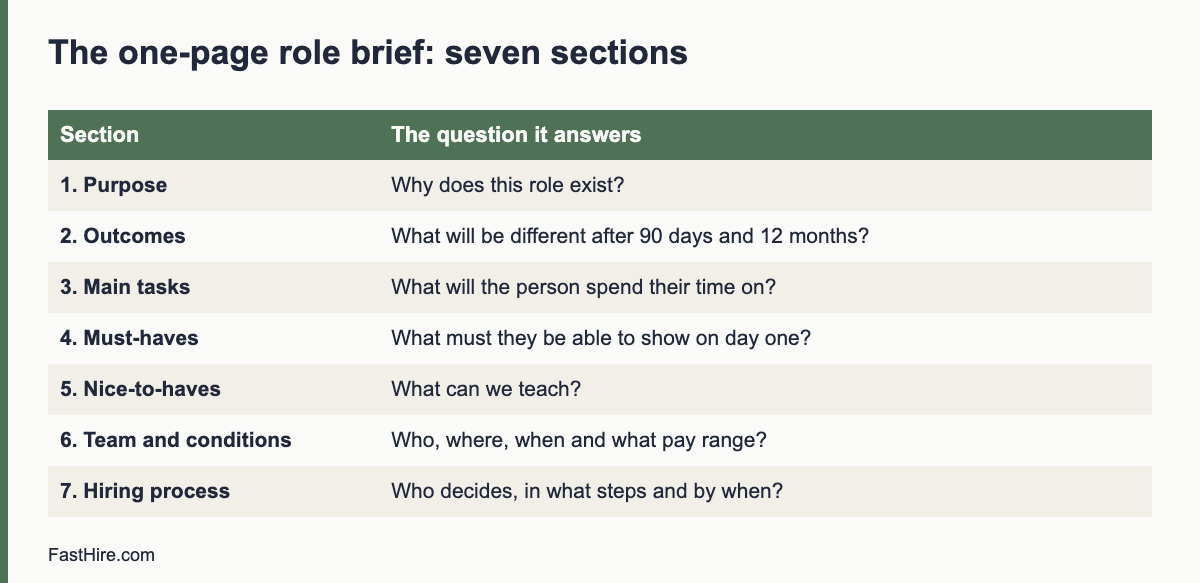
  • Reasonable adjustments in interviews: what hiring managers should do

    Reasonable adjustments in interviews: what hiring managers should do

    A reasonable adjustment, called a reasonable accommodation in the United States, is a change to the interview that lets a disabled candidate show their skills on equal terms. Offer changes before candidates ask, make asking easy, agree a practical option, keep the request confidential, and judge the answers by the same job criteria for everyone.

    Key takeaways

    • Offer adjustments in every invitation and name a contact who is not an interviewer.
    • Do not ask for medical proof at the interview stage unless the law and your policy allow it. Ask what would help.
    • Change how the candidate shows the skill, not what the job needs.
    • Keep the request confidential, outside the scorecard, and never use it as a reason to decline.
    • Rules differ. US: ADA. Great Britain: Equality Act 2010. EU: Employment Equality Directive and national law.
    x

    What the law requires, in outline

    RegionRule in outlineOfficial source
    United StatesThe Americans with Disabilities Act requires covered employers to provide reasonable accommodation to qualified applicants with disabilities in the application process, unless it causes undue hardship. Coverage depends on employer size, and state laws may add dutiesEEOC enforcement guidance on reasonable accommodation
    Great BritainThe Equality Act 2010 requires employers to make reasonable adjustments where a disabled person is at a substantial disadvantage, including in recruitment. Northern Ireland has separate lawGOV.UK: reasonable adjustments and Acas: recruitment
    European UnionThe Employment Equality Directive requires employers to take appropriate measures so that disabled people can access employment, unless this is a disproportionate burden. Member states set the detailDirective 2000/78/EC

    The tests differ in wording: “undue hardship” in the US, “reasonable” in Great Britain, and “disproportionate burden” in the EU. In every case the starting point is the same. Ask what the person needs, consider it in good faith and do not assume. Because the details vary by country and case, ask a specialist about any difficult request. This guide covers common practice.

    What counts as an adjustment

    An adjustment changes the process or the setting. It does not lower the standard for the job. The question is: can this person show that they can do the essential parts of the job, if the interview is arranged differently?

    Need (examples)Possible adjustmentWhy it works
    Hearing loss or deafnessSign language interpreter, live captions, written questions, a quiet room, face the candidate when speakingRemoves the barrier to hearing, not the content
    Low vision or blindnessLarge print or screen-reader friendly documents, questions read aloud, a guide to the roomSame information in another format
    Dyslexia or other reading differencesQuestions in advance, extra time to read, no unprepared reading aloudTests the skill, not the speed of reading
    Autism or sensory sensitivitiesClear structure in advance, literal questions, a calm room, breaks, no surprise changesReduces unneeded stress and unclear questions
    Anxiety or other mental health conditionsQuestions in advance, a longer break, a video or phone option, a support person for the visitLets the person show skills without avoidable stress
    Physical disability or limited mobilityStep-free access, an accessible toilet, seating, a ground-floor room, remote interview, parking close to the entranceRemoves a physical barrier
    Speech differenceMore time, patience, written answers or typing for part of the interviewContent matters, not speed of speech
    Chronic illness or fatigueShorter sessions, breaks, a flexible time of day, a remote formatFits the interview to the person’s energy
    ADHDWritten agenda, questions in advance, breaks, a task with a clear briefReduces the load of keeping the plan in mind
    Need for a personal aidPermission for a support person, assistive technology or an assistance animalLets the person use the tools they use at work

    This list gives examples only. People with the same label need different things. Ask the person.

    How to handle a request: six steps

    1. Thank the candidate and confirm that you will act. A short, warm reply tells them it was right to ask.
    2. Ask what would help. “What would make the interview work well for you?” is enough. Do not ask for a diagnosis.
    3. Agree on a change. Offer a practical option and ask if it works. If you cannot do exactly what they ask, propose an alternative and explain why.
    4. Confirm in writing. Repeat what you agreed, with the date and time, and tell the person who needs to know.
    5. Brief the interviewers. Say what is different, without saying why. They do not need to know the condition.
    6. Carry out the change, and check on the day. Ask at the start whether everything is as agreed.

    Wording you can use

    In the invitation:
    If you need any change to make the interview easier for you, for example extra time, a different format, a quiet room, a sign language interpreter or step-free access, please tell us at [email]. You do not need to explain why. We will reply within one working day.
    In a reply to a request:
    Hello [Name], thank you for letting us know. We can [change agreed]. Does that work for you? If you would like something different, please tell us. We will tell the interviewers what is different, but we will not share the reason.

    Keeping the process fair

    • Keep adjustment details out of scorecards. Do not record the condition. Record only the evidence of skills.
    • Share on a need-to-know basis. Interviewers need to know what to do, not why.
    • Do not compare answers to the pace or style of other candidates. Compare evidence against the job criteria.
    • Do not treat a request as a sign of risk. A person who asks for a change is giving you information to help them perform. It is not a reason to decline.
    • Keep records limited. Store the agreed change with the application for as long as the application is kept, then delete.

    Our guide on structured interviews explains how to ask the same job-related questions of every candidate. This makes adjustments easier to apply, because the questions and the scoring do not change. Only the way the answer is given changes.

    If a request is hard to meet

    Sometimes a request is difficult, for example a sign language interpreter at short notice, or a visit to a building without step-free access. Do not simply refuse. Consider alternatives and try to solve the problem together: change the date, move the interview to a different room or location, or hold it by video. Document what you offered. If you decide you cannot provide the adjustment, take advice before you tell the candidate, because a refusal can be unlawful in many places.

    Cost is rarely the main obstacle in interviews. Most useful changes are free or cheap: extra time, written questions, a quiet room, a different format. Governments in several countries also offer support schemes for adjustments. Look at the official pages for your country.

    Adjustments in tasks and tests

    Tests and tasks need the same care. A timed test can measure reading speed or typing speed rather than the skill in the job. Ask whether the speed is part of the job. If not, give extra time or a different format. The US Equal Employment Opportunity Commission explains how tests can screen out people with disabilities in its guidance on employment tests and selection procedures. Our guide on work sample tests shows how to design fair tasks.

    FastHire is being built to make early screening more open. It shows each job requirement next to the exact CV passage that supports it, so decisions rest on evidence of skills. FastHire is coming soon. It does not rank, score or reject candidates. People make every decision.

    Three fictional scenarios

    These cases are invented to show the reasoning. Real cases will differ, and you should take advice where the law applies.

    ScenarioWhat the manager doesWhat the manager avoids
    A candidate writes: “I find it hard to answer questions I have not seen. Could I have the topics in advance?” for an office coordinator role.Sends the topics and the structure, offers a written agenda, keeps the same questions and scoring for everyoneAsking about the reason, or marking the candidate down for needing the topics
    A candidate uses a wheelchair and the interview room is upstairs.Moves the interview to a ground-floor room, checks the route from the entrance, confirms the accessible toilet, tells the candidate the plan in writingOffering to carry the person, or suggesting that a video call would be easier without asking
    A candidate who is deaf asks for a sign language interpreter. The manager has two days.Contacts a booking service the same day, tells the candidate what is booked, offers a short delay if no interpreter is free, agrees to turn-taking so the interpreter can keep upCancelling because it is short notice, or speaking to the interpreter instead of the candidate

    Tricky moments, and what to say

    MomentSay thisNot this
    The candidate discloses a condition during the interview“Thank you for telling me. What would help us in this interview?”“Does that affect your work?”
    You need to change the plan on the day“We have a change. Would you like a short break, or shall we continue?”Carry on without telling the candidate
    A colleague asks why the interview is different“We agreed a change with the candidate. I cannot share details.”Explain the condition
    The candidate seems unwell“Would you like a break or a glass of water? We can reschedule if you prefer.”Assume they cannot do the job
    You cannot meet a request exactly“We cannot do X. Could we do Y instead? Would that work?”“That is not possible.”

    A pre-interview checklist for adjustments

    1. The invitation offers adjustments and names a contact.
    2. The contact replies within a stated time, and knows who to ask for help.
    3. The venue is accessible: step-free route, toilets, seating and signs.
    4. Video links work with common assistive tools, and an audio-only option exists.
    5. Written material is available in accessible formats on request.
    6. Interviewers have the same scorecard and know that nothing in the scorecard changes.
    7. Interviewers know the agreed change without knowing the reason.
    8. A break is built into long sessions for all candidates, so nobody has to ask.

    Building flexibility into the standard process helps everyone. Breaks, a written agenda and sent-in-advance topics are useful to many candidates who never ask. A process that already works for a wide range of people needs fewer individual changes and makes the ones that remain easier to handle.

    Finally, review what you learn. After each interview with an adjustment, ask the candidate, if they are willing, whether the change worked and what would work better next time. Record the answer in general terms, without personal details, and add useful points to your standard process. Over a year, these notes become a practical guide that is specific to your offices, your tools and your roles.

    Frequently asked questions

    Do I have to ask candidates if they have a disability?

    No. Do not ask about disability in general. Offer adjustments to everyone, and let candidates tell you what they need. In some places the law limits questions about health before an offer.

    What if a candidate does not tell me about a need and then does badly?

    You cannot adjust for a need you do not know about. That is why the offer should be clear in every invitation. Do not guess at conditions.

    Can I ask for evidence of a disability?

    Usually not at the interview stage. Ask what would help. If the request is unusual or costly, the law may allow limited questions or documents. Ask a specialist first.

    Is it unfair to the other candidates?

    No. Adjustments aim to remove a disadvantage so that everyone is assessed on the same criteria. They do not change the standard.

    Does the same duty apply to online tests and video interviews?

    Yes. Online tools and platforms are part of the process. Check that they work with screen readers and keyboards, and offer an alternative if they do not.

    Related guides

    This is general information, not legal advice.
  • Structured interviews: what they are and how to run one

    Structured interviews: what they are and how to run one

    A structured interview asks every candidate the same job-related questions in the same order and scores every answer on the same scale. The US Office of Personnel Management describes it this way: candidates get equal chances to share information, and the assessment is more consistent. To run one, write the questions from the role brief, define what a weak, fair and strong answer sounds like, score alone straight after the interview and compare scores before you discuss.

    Key takeaways

    • Take your questions from the must-haves and outcomes in the role brief, not from habit.
    • Ask every candidate the same core questions in the same order. Follow-up probes are fine.
    • Write rating anchors for each question before the first interview.
    • Each interviewer scores alone, in writing, before any discussion.
    • Decide using the scores and evidence. Do not let a general impression override them.
    x

    What a structured interview is, and what it is not

    In a structured interview the structure is part of the design. The questions are fixed, the scoring is fixed and the conditions are as equal as you can make them. It is not a script that forbids natural conversation. You can greet the candidate, explain the process and ask follow-up questions such as “What did you do next?” or “What was your part in that?”. What you cannot do is give one candidate easy questions and another hard ones, or score one on the answer and another on charm.

    The OPM page on structured interviews says that every candidate receives the same predetermined questions in the same order, and that all answers are scored with one rating scale and the same standards. It also says that this method can assess competencies that are hard to measure otherwise, such as interpersonal skills.

    Why use one

    • Fairness. The same questions and the same scale reduce the room for personal preference and unfair bias. They do not remove it, so you still need to be careful about notes and scoring.
    • Comparability. You can set two candidates side by side because they answered the same questions.
    • Evidence. Written scores and notes show why you chose someone. This helps if a candidate or a regulator asks you to explain.
    • Better questions. Writing anchors forces you to think about what good looks like.
    • Faster decisions. The debrief starts from scores and examples, not from a long argument about feelings.

    Six steps to build a structured interview

    Step 1: Start from the role brief

    List the outcomes and must-haves from your role brief. Pick the four to six that an interview can test better than a resume or CV. These are usually communication, problem solving, working with others, handling pressure and a few role-specific skills.

    Step 2: Write one question per area

    Use two question types.

    TypeFormExample
    BehaviouralAsks about the past“Tell me about a time you had to deliver a report with incomplete data. What did you do?”
    SituationalAsks about a realistic future case“A team lead asks for a report by noon, but one source is missing. What would you do first?”

    Behavioural questions work well for experienced candidates. Situational questions suit entry-level candidates who may not have the experience. Using one of each for important areas gives you more evidence. Avoid hypothetical questions that have nothing to do with the role, and avoid trick questions.

    Step 3: Define the rating scale and anchors

    Use a 1 to 5 scale, or a 1 to 4 scale if you want to avoid the middle score. For each question, write what a weak, an adequate and a strong answer contains. Base this on the work, not on how well someone speaks.

    ScoreWhat it means in generalExample anchor for “missing data”
    1No relevant example, or an answer that shows poor judgementIgnores the gap or hides it from the team lead
    2Some relevant action, but unclear or incompleteSends the report late without telling anyone
    3Clear example with a sensible action and a resultTells the lead about the gap, sends the report with a note on what is missing
    4Clear example, good judgement and awareness of impactFinds a second source, flags the risk, agrees a deadline for the missing part
    5Excellent example with a clear lesson that they applied againAs 4, and later set up a check to avoid the problem in future reports

    Step 4: Plan the format and the timing

    Allow 45 to 60 minutes for six to eight questions. Plan the order: warm-up, core questions, candidate questions and next steps. Decide who asks which question, who takes notes and who watches the time. Prepare the same introduction for each candidate.

    Step 5: Train the interviewers

    A short briefing of 30 minutes is enough. Cover how to ask the questions as written, how to probe without leading, how to write notes about what the candidate said or did, and what not to ask. Practise with a colleague on one question, and score it together to compare how each of you reads the anchors.

    Step 6: Score alone, then compare

    Each interviewer scores every question within 15 minutes of the interview, alone. Only then do you compare. This reduces the effect of the most senior or most talkative person on the panel. In the debrief, ask each person to give their scores and one piece of evidence per score. For a full guide, see our article on how to run a debrief meeting after interviews.

    A sample plan for a customer support team lead

    #AreaQuestionLook for
    1Handling pressureTell me about a busy period when you had more tickets than people. What did you do?Prioritisation, clear communication, protecting quality
    2CoachingDescribe a time you helped a colleague improve. What did you do and what changed?Specific actions, patience, a measurable change
    3FairnessTwo team members disagree about who takes the difficult customers. What do you do?Listens to both, uses a fair rule, follows up
    4Process thinkingWhat would you change first about how our team handles returns? Explain why.Evidence-based, practical, small first step
    5LearningTell me about a mistake you made at work and what you changed afterwards.Ownership, concrete change, no blame shifting
    6Role knowledgeYou see a rise in complaints about delivery times. What data would you look at?Relevant data, simple analysis, link to action

    Ask each candidate these six questions in this order. Allow two follow-up probes per question, from a fixed list: “What was your part?”, “What happened next?”, “What would you do differently?”.

    A scoring sheet you can copy

    Candidate: ______ Role: ______ Interviewer: ______ Date: ______

    Question 1: Evidence (what the candidate said or did): ______ Score (1-5): __
    Question 2: Evidence: ______ Score: __
    Question 3: Evidence: ______ Score: __
    Question 4: Evidence: ______ Score: __
    Question 5: Evidence: ______ Score: __
    Question 6: Evidence: ______ Score: __

    Must-haves seen or not seen in the interview: ______
    Open points to check (for example a reference): ______
    Total: __ Recommendation (move on / hold / decline): ______ Reason in one sentence: ______

    Keeping the interview fair

    • Do not ask about age, family plans, health, religion, nationality, sexual orientation or similar topics. The US Equal Employment Opportunity Commission explains these limits on its page about prohibited employment policies and practices.
    • Offer reasonable adjustments, such as extra time, a written copy of the questions or a different format. In Great Britain, the Acas page on recruitment explains the duty to make reasonable adjustments for disabled candidates.
    • Write notes about what the candidate said, not about how they look or sound. Words such as “nice”, “cultural fit” or “abrasive” should prompt you to find the underlying evidence.
    • Keep notes. Applicant data is personal data in the UK and the EU. The Information Commissioner’s Office explains how to handle it in its guidance on recruitment and selection.

    Common mistakes

    • Changing questions between candidates. If you must change a question, change it for everyone.
    • Scoring after the discussion. The group will anchor on the first opinion.
    • Skipping anchors. Without anchors, a “4” means different things to different people.
    • Too many questions. Eight is plenty. More questions mean thinner answers.
    • Letting the chat run. A friendly talk before the interview is fine, but do not use it as evidence.
    • Ignoring the must-haves. Interviews should add to the resume or CV evidence, not replace it.

    FastHire is being built to make the earlier step easier, by showing each job requirement next to the exact CV passage that supports it. The interview then focuses on what the CV cannot show. FastHire is coming soon. It does not rank, score or reject candidates. People make every decision, including every interview score.

    An opening and closing script

    Say the same words to every candidate. It sets expectations and treats people equally. Adapt this sample to your voice.

    Opening: “Thank you for coming. I am [name], [job title]. With me is [name], who will take notes. The interview takes about 45 minutes. We will ask the same set of questions to every candidate so that we can compare fairly. I may ask short follow-up questions. If you need a moment to think, take it. If you need anything adjusted, tell us at any time. You will have time at the end to ask your questions.”

    Closing: “Thank you. Is there anything about your experience that we did not ask about and that you would like us to know? What questions do you have for us? Here is what happens next: we will contact every candidate by [date].”

    Running it well on video or with a panel

    • Video. Test the link before the interview. Send the questions’ topics in advance if you have agreed to do so for all candidates. Allow for slow connections and do not penalise a pause.
    • Panel. Decide in advance who asks which question. Agree that notes are written, not summarised in your head, and that scoring is done alone.
    • Phone. Make sure the candidate can hear you clearly, and offer a call-back number in case the line drops.
    • In person. Use the same room set-up for each candidate where you can, and tell them about access, parking and the people they will meet.

    After five interviews: a short review of your own process

    A structured interview improves when you check it. After five interviews, compare notes across the panel and ask four questions. Did any question produce answers that all looked the same? Replace it. Did one question confuse several candidates? Reword it for later candidates only if you are early in the process, and note the change. Did interviewers use the anchors in the same way? If not, agree examples. Did any note refer to personal traits unrelated to the job? Ask the writer to restate it as evidence.

    If you notice a pattern that treats a group of candidates differently without a job-related reason, take it seriously and ask your HR contact or adviser for help. A fair process is not only good practice. It also protects the people you want to hire.

    Frequently asked questions

    What is a structured interview?

    An interview in which every candidate gets the same job-related questions in the same order, and every answer is scored on the same scale with written anchors.

    Can I ask follow-up questions?

    Yes. Use a short, fixed list of probes, such as “What was your part?” and “What happened next?”, so that candidates have equal chances to give detail.

    How many questions should I ask?

    Six to eight questions for a 45 to 60 minute interview. Choose areas that matter most for the role and that a resume or CV cannot show.

    Should I use a 1 to 5 or 1 to 4 scale?

    Either works. A 1 to 4 scale avoids the neutral middle. What matters is that every interviewer uses written anchors.

    Is a structured interview less friendly?

    It does not have to be. Welcome the candidate, explain the process and give them time to ask questions at the end. The structure applies to the assessed questions, not to your manner.

    Related guides

    This is general information, not legal advice.
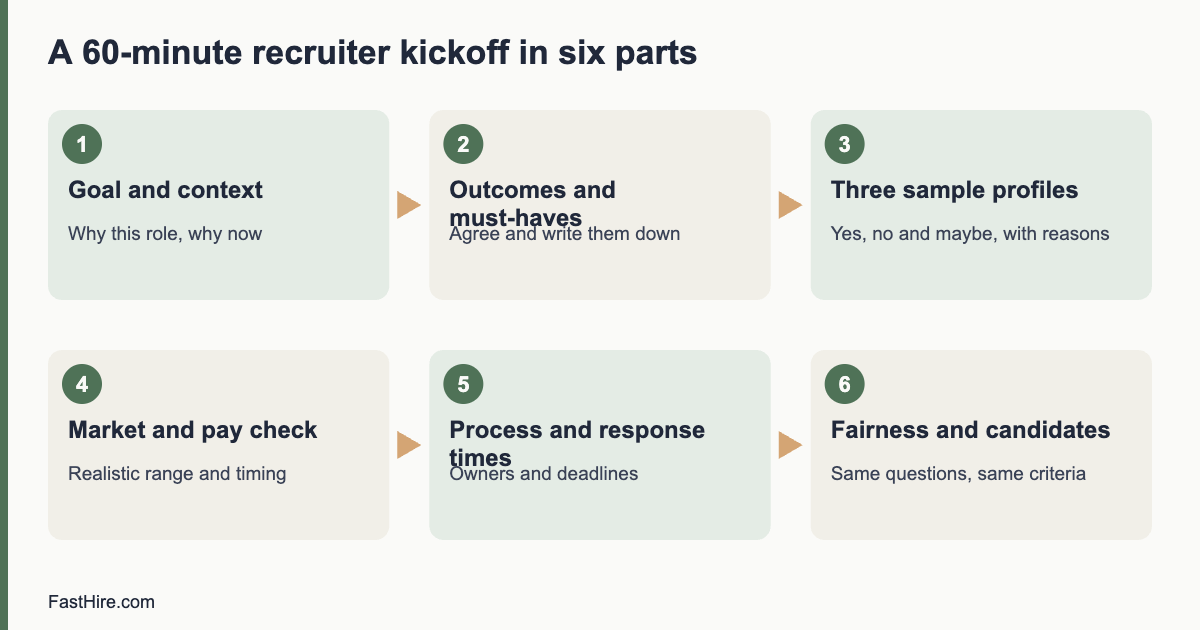
  • How to run a debrief meeting after interviews

    How to run a debrief meeting after interviews

    An interview debrief is a short meeting where interviewers share their scores and evidence, discuss differences and reach a hiring decision. To run one well, ask everyone to submit written scores before the meeting, speak in a fixed order with the most junior person first, discuss evidence rather than feelings, and record the decision and the reasons. Keep it to 30 minutes per finalist or less.

    Key takeaways

    • Collect written scores and notes before the meeting, so that no one is swayed by a senior voice.
    • Speak in a set order. Start with the least senior interviewer and end with the hiring manager.
    • Discuss evidence against the must-haves. Do not discuss “gut feel” without examples.
    • Resolve differences by returning to the notes or by adding one targeted check.
    • Write a short decision record: choice, reasons, risks and next steps.
    x

    Why debriefs go wrong

    In many hiring teams, the debrief is a free conversation. The loudest or most senior person speaks first, others agree, and a vague feeling like “I just liked her” becomes the decision. This is fast, but it hides the evidence, repeats the same biases and makes it hard to defend the decision. It also wastes the work that interviewers did in their interviews.

    A structured debrief fixes this. It takes the same time or less, and it gives you a record. If your interviews used a scorecard, the debrief is a short step from the scores. If they did not, start with our guides to structured interviews and the interview scorecard.

    Common problemWhat happensStructured fix
    Anchoring on the first speakerOthers adjust to the first viewCollect scores in writing before the meeting
    Senior voice dominatesJunior interviewers stay silentSpeak in order from the most junior
    Feelings in place of evidence“Good vibe” decidesAsk for an example for each score
    Recency effectThe last candidate is remembered bestUse notes and scores, not memory
    Hidden disagreementQuiet doubts do not surfaceAsk for the biggest concern from everyone
    No recordCannot explain the decision laterWrite a decision record

    Before the meeting: what each interviewer submits

    Ask each interviewer to submit three items within a set time after their interview, for example two hours, and before they speak to anyone else about the candidate.

    1. Scores for each must-have, on the agreed scale, such as 1 to 4.
    2. Evidence for each score: one or two facts or quotes from the interview.
    3. Overall recommendation: strong yes, yes, no or strong no, and the main reason.

    Use a shared form or a spreadsheet. A simple layout is one row per must-have and one column per interviewer. A facilitator hides the names until the meeting, or reveals them only after everyone has submitted. This protects independent judgement.

    The 30-minute agenda

    MinutesStepWhat happens
    0 to 3Set the frameThe facilitator restates the role, the must-haves and the rules of the meeting
    3 to 8Review the scoresEveryone looks at the grid. Mark the rows where scores differ by two points or more
    8 to 20Discuss differencesGo row by row through the differences. Each interviewer states the evidence for their score. Ask: “What did the candidate say or do that led to this score?”
    20 to 25Concerns and risksEach person names the biggest risk. Decide whether it can be reduced by onboarding or support
    25 to 28DecideCompare finalists on the grid. Name the first choice and a back-up. Check the decision against the must-haves
    28 to 30Next stepsAssign who calls the candidate, who checks references and who tells the others

    If you compare several finalists, run the same steps for each candidate before you compare them. Score first, compare later. Comparing too early can turn the debrief into a ranking contest where the best performer on a single day wins, instead of the person who best meets the criteria.

    Roles in the meeting

    RoleTask
    FacilitatorKeeps time, enforces the order, asks for evidence, keeps the group on the must-haves. This may be the recruiter or a neutral colleague, not the hiring manager if possible
    Hiring managerMakes the final decision after hearing the group; speaks last
    InterviewersShare scores and evidence; do not interrupt each other
    Note takerRecords the scores, the reasons and the decision

    In a small business you may be the only decision maker. Ask one trusted outsider to read your scorecards and ask you questions. Even 15 minutes with another person improves the quality of the decision.

    Rules for the discussion

    • Refer to the must-haves. If a point is not related to the role, it does not count.
    • Use examples, not labels. “She reduced late orders from ten to two a week” is evidence. “She seems senior” is not.
    • Do not mention protected traits such as age, sex, race, religion, disability, family plans or accent. If someone does, the facilitator interrupts the comment and returns to the criteria.
    • Do not use “culture fit” as a reason. Use specific behaviours the role needs.
    • Separate risks from deal breakers. A risk can be managed in onboarding. A deal breaker is a missing must-have.
    • Do not change the criteria during the meeting to favour a candidate.

    For more on reducing bias, see how to reduce bias in resume screening, which also applies to interview decisions. In the UK, Acas explains fair recruitment. In the US, the EEOC lists prohibited practices on its page about prohibited employment policies and practices.

    What to do when interviewers disagree

    SituationNext step
    Scores differ by one pointAccept the average, unless the evidence is weak
    Scores differ by two or more points on a must-haveEach side reads their evidence aloud. If the evidence conflicts, ask whether the questions were the same
    One interviewer has a strong concern others did not seeAsk what they saw. Decide if it needs a check, such as a reference or a short follow-up question
    Two finalists are very closeAdd one targeted check: a work sample, a reference call or a second conversation on one must-have
    The group is split on the final choiceReturn to the must-haves. If still split, the hiring manager decides and records the reasons

    Do not settle disagreements by voting alone. A vote hides the reasons. A short written reason for the final choice is more useful. For a deeper guide to deadlocks, see our upcoming article on how to decide when the team disagrees.

    A decision record template

    FieldEntry
    Role and date
    Finalists considered
    Decision
    Evidence for each must-have
    Risks and how to manage them
    Differences discussed and how they were resolved
    Reference checks needed
    Next steps and owner
    Date records will be deleted

    Keep the record secure. Share it only with people who need it. Delete it when your policy or the law requires. In the UK and EU, data protection rules apply to these notes. A candidate may ask to see data held about them. Write notes that you would be comfortable showing to the candidate.

    A worked example (fictional)

    This example is invented. A team hires a marketing coordinator. Three interviewers each score three finalists on four must-haves with a scale of 1 to 4.

    Must-haveInterviewer AInterviewer BInterviewer CNotes
    Writes clearly434All saw the sample email
    Plans campaigns243A asked about planning; B asked about a campaign. Questions differed
    Uses data333Agreed
    Works with others334Agreed

    The facilitator noticed the two-point gap on “plans campaigns”. She asked A and B what each had asked. A had asked a general question and had received a short answer. B had asked for an example, and had received a detailed one. The group agreed that B’s evidence was stronger. They asked A to re-score from the notes and the score became 3. The group chose the candidate and recorded the reason: strong writing and evidence of planning, with a risk on data tools that onboarding would cover.

    Remote debriefs

    • Collect scores in a shared form before the call.
    • Use video, so that the facilitator sees who wants to speak.
    • Use the chat to flag when someone wants to add a point.
    • Share the grid on screen.
    • Save the recording only if your policy allows. Written notes are enough.

    After the debrief

    1. Call the chosen candidate within one working day.
    2. Send reference requests or checks as agreed.
    3. Tell the other finalists the outcome and give brief feedback if you can. See our upcoming guide on giving fast feedback.
    4. Store the record.
    5. Review: what would make the next debrief faster?

    For a deeper view of the process before the debrief, see the recruiter kickoff meeting and behavioural interview questions. CIPD offers a recruitment factsheet on good practice.

    Questions the facilitator can use

    MomentQuestion
    A score has no evidenceWhat did the candidate say or do that led to this score?
    A strong opinion without a reasonWhich must-have does this relate to?
    Everyone agrees very fastWhat is the strongest argument against this choice?
    A vague concernWhat would we need to see to feel sure about this point?
    A comment about personalityCan you describe the behaviour you saw, and why it matters for this job?
    Pressure to decide quicklyWhich facts are still missing, and can we get them in one day?

    These questions work because they are neutral. They do not accuse anyone, and they bring the group back to the evidence. Print them for the facilitator and read them aloud when needed.

    Keep the debrief fair for candidates

    The debrief is the point where hidden bias often enters. Remind the group of three habits. First, compare candidates to the criteria, not to each other. Second, treat equal evidence equally, whatever the person’s background. Third, check whether you applied the same questions and the same time to each candidate. If one candidate got a longer interview or a friendlier setting, note it, and adjust the weight you give to the extra information.

    If you hold monitoring data about applicants and the law allows you to use it, review it after the decision, not during it. Do not use it to choose individuals. Use it to check whether your process has patterns that need review. Take advice if you are unsure.

    Metrics to review after three debriefs

    QuestionWhat it tells you
    How often did scores differ by two points or more?Whether the questions or scales need clearer wording
    How long did the meeting take?Whether the preparation works
    How often did the group change a score after discussion?Whether discussion adds value or only pressure
    Did the chosen candidate perform well at six months?Whether your criteria predict success
    Did any candidate complain about the process?Whether the experience needs a change

    Keep these notes together. After several hires you will see which must-haves and which questions help most. That evidence is more useful than any rule of thumb.

    Frequently asked questions

    Who should attend the debrief?

    Everyone who interviewed the candidate, the hiring manager and a facilitator. Keep the group small, five people or fewer if possible.

    Should we debrief right after each interview?

    Collect scores right after each interview. Hold the group debrief when all interviews for the role are done, or after each finalist if you must move fast.

    What if the hiring manager disagrees with the group?

    The hiring manager usually decides. They should write the reason in the decision record and explain it to the group.

    Is it fine to talk about “fit”?

    Only if you define it as specific behaviours the job needs and give examples. Avoid vague fit statements.

    How long should a debrief take?

    About 30 minutes per role if scores were submitted in advance. Add 10 minutes per extra finalist.

    Related guides

    This is general information, not legal advice.