
Under the Equality Act 2010, employers in Great Britain must make reasonable adjustments so that disabled applicants are not at a substantial disadvantage in recruitment. You also may not ask applicants about their health before offering work, except for limited purposes. In practice: invite requests, agree changes, keep details confidential, and judge everyone on the same job criteria.
Key takeaways
- The duty applies to recruitment as well as to employment. It is triggered when a disabled applicant would be at a substantial disadvantage.
- Before offering work, do not ask about health or disability, except for permitted purposes such as checking if a person can take part in an assessment.
- Adjustments can change a process, a physical feature or provide an auxiliary aid.
- The Access to Work scheme can help with support such as interpreters at interviews. Tell candidates about it where relevant.
- Northern Ireland has separate legislation. This guide covers Great Britain.
The legal duty, in plain language
The duty to make adjustments is in section 20 of the Equality Act 2010. It has three requirements. First, where a provision, criterion or practice puts a disabled person at a substantial disadvantage compared with non-disabled people, you must take reasonable steps to avoid the disadvantage. Second, where a physical feature has that effect, you must take reasonable steps to avoid it. Third, where a disabled person would be at a disadvantage without an auxiliary aid, you must take reasonable steps to provide the aid. The full Act is on legislation.gov.uk.
The duty applies to job applicants. A recruitment practice is a “provision, criterion or practice”. Examples: a requirement to complete an online test in 30 minutes, a rule that all interviews take place in person upstairs, or a form that can only be completed on one website. If a practice puts a disabled person at a substantial disadvantage, you consider what reasonable steps can remove it. “Substantial” means more than minor or trivial.
“Reasonable” depends on the facts: how effective the step would be, whether it is practicable, its cost, your resources and the support available. Many changes in recruitment are low cost. GOV.UK gives employers a short guide on reasonable adjustments for disabled workers, and Acas explains recruitment duties on its recruitment page.
Who is a disabled person?
Under the Act, a person has a disability if they have a physical or mental impairment that has a substantial and long-term adverse effect on their ability to carry out normal day-to-day activities. Long-term generally means that the effect has lasted or is likely to last at least 12 months. Conditions such as cancer, HIV and multiple sclerosis are covered from diagnosis. Read the definition on GOV.UK to see how it applies. Do not decide whether a person “counts” before you help. Focus on what they need in the process.
No health questions before an offer
Section 60 of the Equality Act says that an employer must not ask a job applicant about their health before offering work, or before placing them in a pool to be selected from later. The Act lists exceptions. They include asking whether the person will be able to take part in an assessment, such as an interview or a test, and whether reasonable adjustments are needed for it. They also include checking that the person can carry out a function that is intrinsic to the work, with adjustments, and monitoring diversity. Read the section for the full list, and ask a specialist if you are unsure.
| Allowed in the recruitment process | Not allowed before an offer |
|---|---|
| “Is there any adjustment we should make so you can take part in the interview or test?” | “Do you have any health conditions?” |
| “This job involves driving. Do you hold a valid licence?” | “How many days were you off sick in your last job?” |
| “Can you perform the main tasks in the job description, with adjustments if needed?” | A health questionnaire sent with the application form |
| An equal opportunities form that is voluntary, anonymous in the decision, and kept separate | Asking referees about the person’s sickness record |
| Asking about health after a conditional offer, as the Act allows | Rejecting a person because of an imagined future absence |
An employer can ask for health information after making an offer, but the usual rules on discrimination still apply. If you withdraw an offer for a reason linked to disability, take advice first.
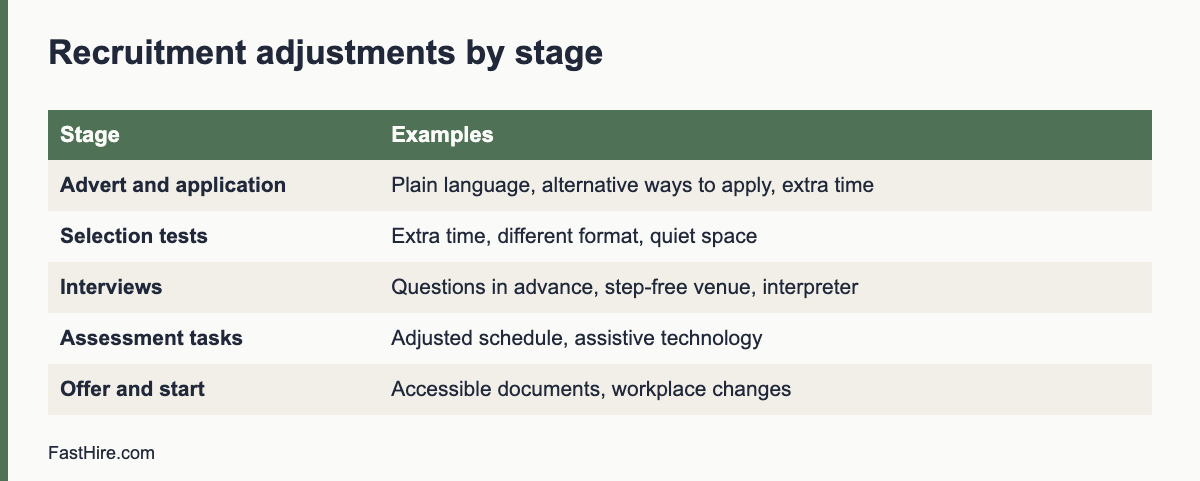
What adjustments look like in recruitment
| Stage | Possible adjustments |
|---|---|
| Advert and application | Plain language; accessible format; alternative ways to apply, such as phone or email; extra time for the form |
| Selection tests | Extra time; a different format; reader or scribe; screen-reader-compatible test; a quiet space |
| Interviews | Interview questions sent in advance; step-free venue; breaks; a video or phone interview; British Sign Language interpreter; a support person |
| Assessment centres and tasks | Adjusted schedule; a different task that tests the same skill; assistive technology |
| Offer and start | Accessible documents; changes to the workplace or equipment; a phased start |
Make it easy to ask. Add a line to every invitation. For example: “If you need any adjustment to take part, such as extra time, a different format or step-free access, please tell us at [email]. You do not need to explain why. We will reply within one working day.” Our guide for hiring managers on reasonable adjustments in interviews has wording and a six-step process.
Access to Work
Access to Work is a UK government scheme that can help disabled people with the extra costs of support at work, and it can cover support at job interviews. GOV.UK describes it on its page, Access to Work: get support if you have a disability or health condition. It mentions that deaf or hard-of-hearing applicants who need a BSL interpreter or lipspeaker, and people who need communication support, can get help for interviews. Rules and eligibility change, so read the page. Tell candidates that this scheme exists, but do not make them apply for it before you provide reasonable adjustments you can provide yourself.
Keeping the process fair
- Judge the same job criteria for everyone. An adjustment changes how a person shows a skill. It does not lower the standard.
- Keep details confidential. Tell interviewers what is different, not why.
- Record what you agreed. Keep a short note, and keep it away from the scorecard.
- Do not treat a request as a risk. Declining a candidate because they asked for an adjustment is likely to be unlawful.
- Use structured interviews. Same questions, same scoring. See structured interviews.
- Mind data protection. Health and disability information is special category data under UK GDPR. See GDPR for job applicants.
Common mistakes
| Mistake | Fix |
|---|---|
| Waiting for the candidate to disclose | Offer adjustments in every invitation |
| Asking for a medical certificate | Ask what would help. Do not ask for proof at this stage |
| Saying “we cannot do that” without looking for alternatives | Discuss other options and explain what you can do |
| Using an online test with no accessible version | Offer an alternative format, or choose an accessible tool |
| Sharing the condition with all interviewers | Share only the change, not the reason |
| Assuming the cost is too high | Check the real cost; consider support such as Access to Work |
FastHire is being built for fair, evidence-based screening. It shows each job requirement next to the exact CV passage that supports it, so decisions rest on skills. FastHire is coming soon. It does not rank, score or reject candidates. People make every decision.
A fictional case: an online test
This case is invented. A UK retailer uses a 20-minute online numeracy test for a stock controller role. A candidate with dyscalculia emails the contact in the invitation and asks whether the time can be extended.
| Question | Reasoning |
|---|---|
| Is there a provision, criterion or practice? | Yes. The practice is a timed online test for all candidates. |
| Is there a substantial disadvantage? | Likely. Timed numeracy tasks can disadvantage the candidate more than non-disabled candidates. |
| What would a reasonable step be? | Extra time, a calculator if the job allows it, or a different format. The employer checks what the job needs: stock controllers use calculators and systems every day. |
| Is the step practicable and low cost? | Yes. Most test platforms allow time changes. |
| What does the employer do? | Agrees extra time and allows a calculator, confirms in writing, tells the assessor only about the changed conditions, and marks against the same criteria. |
The key move is to ask what the test is for. If the job uses a calculator, a test that bans it measures something the job does not need. Adjusting the test makes it fairer for everyone, and it gives the employer a better picture of the skill it cares about.
Plan for common requests
Most requests fall into a few groups. Plan these in advance so that you can reply fast.
| Request type | Plan |
|---|---|
| More time in a test | Know which tools allow it and how long you can extend. Decide a standard extension and a route for longer ones |
| Questions in advance | Decide which questions you can send, and send the same kind to anyone who asks |
| Different format | Keep documents in plain text or accessible PDF; allow phone or video |
| Step-free access | Know the accessible rooms in each office and the route from the entrance |
| Interpreter or communication support | Keep contact details for booking services; tell candidates about Access to Work where it may apply |
| A support person or assistance animal | Set a simple rule to welcome them, and tell reception |
Write the plan in a short procedure and give it to everyone who schedules interviews. Review it each year with feedback from candidates who asked for adjustments, if they are willing to share it.
Public sector and large employers
Public bodies in Great Britain also have the public sector equality duty, which is separate from the duty to make adjustments. Large employers may also use voluntary schemes to show their commitment to disabled candidates. These schemes can help, but they do not replace the legal duties. Treat each request on its own facts.
What to do if a request is hard
Some requests take effort: a sign language interpreter booked at short notice, an interview in a building with no lift, or a test platform that cannot change its timing. Do not refuse by reflex. Try these steps in order: tell the candidate you are working on it, look for a different date or venue, look for another route such as a video interview, ask the candidate what would work for them, and check whether outside support is available. Record what you tried. If you conclude that a request is not reasonable, take advice before you reply, and offer the closest alternative you can.
Tell the candidate early. Waiting until the day before makes every option harder and leaves the candidate anxious. A frank message that says what you can do and when you will have an answer is always better than silence.
Frequently asked questions
Do small employers have to make reasonable adjustments?
The duty applies to employers of any size in Great Britain. What is reasonable depends on the employer’s resources.
Can I ask about health at the interview?
Not before offering work, except for the permitted purposes in section 60 of the Equality Act, such as asking about adjustments for the assessment.
What if a candidate does not tell me about their disability?
The duty to make adjustments generally applies where the employer knows, or could reasonably be expected to know, that a person is disabled and likely to be disadvantaged. Invite requests so that people can tell you.
Who pays for adjustments?
The employer pays for reasonable adjustments, and cannot pass the cost to the applicant. Schemes such as Access to Work may help with some support.
Does this apply in Northern Ireland?
Northern Ireland has its own disability discrimination law. Check the official guidance there.
Related guides
- Hiring guides for fair and compliant hiring
- UK Equality Act 2010 and recruitment
- Reasonable adjustments in interviews: what hiring managers should do
- The ADA and hiring: reasonable accommodation for applicants
- All hiring guides for employers
- Accessible job applications: a checklist for forms and websites
This is general information, not legal advice.