
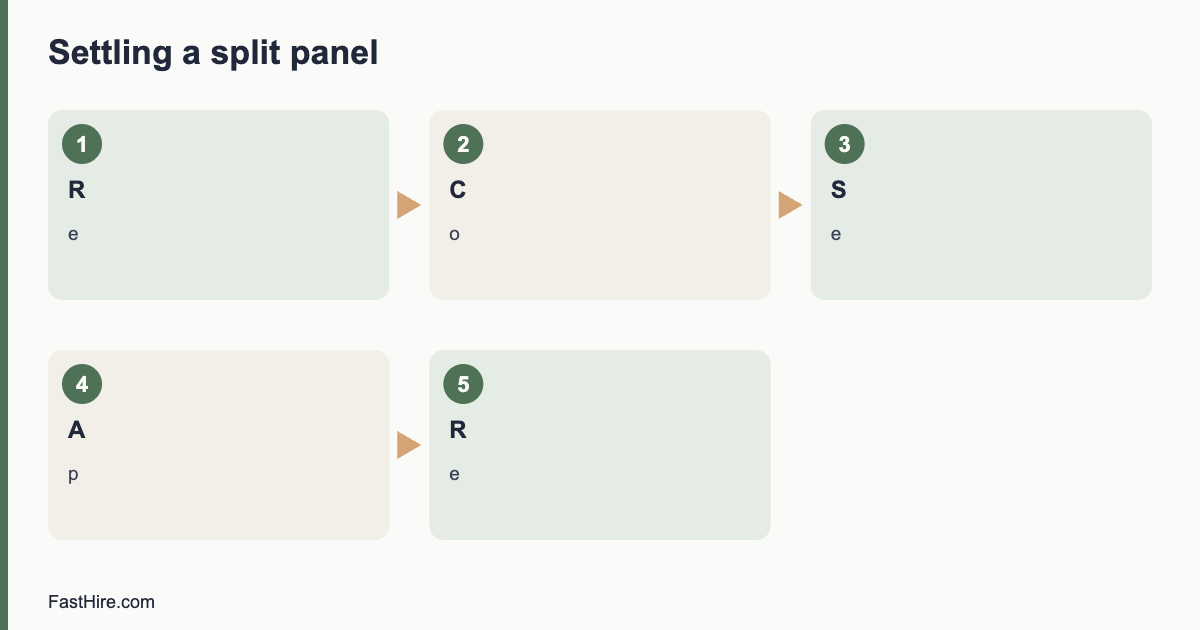
When interviewers disagree, return to the written requirements, compare the evidence for each one, and look for the exact point where scores differ. If the gap remains, gather more evidence with a work sample or reference check, then apply a tie-break rule agreed in advance. The hiring manager decides, and the reasons and any dissent are recorded.
Key takeaways
- Disagreement is normal and useful. It shows where the evidence is thin or unclear.
- Start with the requirements and the notes, not with opinions or the strongest voice.
- Seek more evidence when the disagreement is about a fact you can check.
- Agree a tie-break rule before the interviews: who decides and how.
- Record the decision, the reasons and any dissent, and give feedback to candidates.
Why panels disagree
Panels disagree for several reasons. Interviewers asked different questions and saw different parts of the candidate. They used different standards for a score. They weighed requirements differently. Some were swayed by the manner of the candidate and others by the content. A few disagreements are about the facts, and many are about the weight of the facts. If you can name the cause, you can solve it.
| Cause | Sign | Fix |
|---|---|---|
| Different evidence | Interviewers saw different questions | Use the same core questions for all, as in structured interviews |
| Different standards | One person scores 3 where another scores 1 for the same answer | Calibrate the scale with examples |
| Different weights | Agreement on facts, disagreement on importance | Set weights before the interviews |
| Style bias | Debate about manner and “feel” | Ask for evidence tied to a requirement |
| Group pressure | One senior voice sets the view | Score alone first, then discuss |
Step 1: collect scores alone before the debrief
The simplest way to reduce group pressure is to ask each interviewer to write scores and notes alone before the meeting. This gives you each person real view, not a view shaped by the first speaker. Use the same scorecard. See the interview scorecard guide and the debrief meeting guide.
Step 2: return to the requirements
Open the debrief by reading the requirements and weights. Then take them one at a time. For each, ask each interviewer for the evidence behind their score. This changes the talk from “I liked her” to “she gave an example of re-planning a late delivery”. Opinions without evidence carry little weight.
Step 3: find the point of difference
Look at the score grid. Where is the biggest gap? For each gap, ask: did you hear different answers, did you read the same answer differently, or do you weigh the requirement differently? Write the cause next to the gap. This quickly clarifies whether you need more evidence or a decision about priorities.
Step 4: gather more evidence when the gap is about facts
If the gap is about something you can check, check it. Options include:
- A short work sample on the point in dispute, scored by all. See work sample tests.
- A reference call with a question aimed at the doubt. See reference check questions.
- A short follow-up conversation with the candidate, with one structured question on the gap.
- A review of the original resume or CV for the specific claim.
Tell the candidate the reason for the extra step and the timing. Keep other finalists informed. Do not drag the process out for weeks. See how to keep your best candidate warm.
Step 5: apply a tie-break rule
Before interviews, agree how you will decide if the panel is split. Common rules are listed below. Choose one and write it in the plan.
| Rule | How it works | Best for | Watch out for |
|---|---|---|---|
| Hiring manager decides | The manager takes the panel input and decides | Most roles | The manager must show reasons tied to the requirements |
| Weighted score decides | The highest weighted total wins, subject to essential minimums | Roles with clear criteria | Scores can hide a serious gap on one item |
| Veto on essentials | Any panelist can block a candidate who fails an essential requirement, with evidence | Safety or trust roles | Vetoes need evidence, not a feeling |
| Senior sign-off | A more senior person reviews evidence and decides | Cross-team roles | Delay and extra bias if that person was not in the interviews |
Avoid majority votes unless they follow a review of the evidence. A vote can hide strong evidence from one person and weak evidence from the others.
Step 6: record the decision and the dissent
Write a short record: the decision, the three main reasons tied to the requirements, and any disagreement that remains, with the reasons. Recording dissent is not a sign of failure. It shows that you took the issue seriously, and it helps later, when you check how the new hire is doing against the doubts. After 90 days, review: were the doubts justified? What does it teach you about your questions and your scales?
What not to do
- Do not let the loudest or most senior voice settle the matter without evidence.
- Do not take a vote without looking at the evidence.
- Do not change the requirements or weights midway to favour a person.
- Do not hire the “compromise” candidate that no one rated highest on the essentials.
- Do not drag out the process while you hope the disagreement will disappear.
- Do not tell the candidate that the panel was split. Give clear, job-related feedback.
When the disagreement is about fairness
Sometimes one interviewer raises a concern about bias: a comment about age, a remark about accent, a view that a person will not fit. Take it seriously. Return to the requirements and the evidence, and set aside the remark. Note the concern and the response. If it is serious, involve HR. Fairness law applies, and a record that shows you took it seriously is important. See the EEOC, GOV.UK employing people and how to reduce interview bias.
Facilitating the meeting
- Share the grid and the notes in advance.
- State the aim: to decide on evidence.
- Take each requirement in turn.
- Ask quiet people first, and the senior person last.
- Summarise the point of agreement and the point of difference.
- Decide, or agree the next step and the date.
- Close with thanks, and send the record the same day.
Checklist
- Requirements and weights were agreed before interviews.
- Each interviewer scored alone with notes.
- The debrief started from the requirements.
- The cause of each gap was named.
- More evidence was gathered where facts were in dispute.
- A tie-break rule was applied as planned.
- The decision, reasons and dissent are recorded.
- Candidates receive clear, job-related feedback.
Worked example (fictional)
A panel of three interviews two finalists for a customer success lead. Two interviewers prefer Candidate A, who was lively and confident. One prefers Candidate B, who was quiet but gave detailed examples. The manager reads the requirements aloud and takes each in turn. On “handles escalations”, B scored 3 with a specific example, and A scored 1 with a general answer. On “builds relationships”, A scored 3. The weights set before the interviews give escalation handling the higher weight. The group agrees to ask both candidates for a short written reply to a realistic escalation scenario. B scores higher. The manager decides on B, records the reasons and the original disagreement, and thanks A with specific feedback and an invitation to apply for future roles.
Common disagreement patterns and how to answer them
“I just have a feeling about this person”
Feelings are information, but they are not evidence. Ask the person to turn the feeling into an observation: “What did you see or hear that led to it?” Often the answer is a real point, such as the candidate avoiding a question or giving a vague example. Sometimes it is style or similarity. If the point is real and relates to a requirement, test it with a follow-up question or a reference. If it is not, set it aside and say why.
“They are too junior” or “too senior”
Ask what requirement the person fails. If it is a skill, it can be scored. If it is a concern about pay, interest or growth, it can be asked about directly. Avoid using these words as stand-ins for age. Consider whether the level mismatch can be solved by changing the scope or the support.
“They would not fit the team”
Ask which behaviour would clash with a team standard. If you cannot name one, the concern is likely about similarity. See how to hire for culture without hiring clones.
“The other candidate is safer”
Safe choices can be right, but they should rest on evidence of results, not on familiarity. Ask what makes one safer, and whether the other has been tested by the same questions. If the choice is between a proven profile and a more varied one, the matrix in how to compare candidates with different backgrounds helps.
Disagreement between the manager and HR or the recruiter
Sometimes the split is not inside the panel but between the manager and the recruiter or HR. The recruiter may see a risk in the process, such as a missing check, an unequal question or an unexplained pay gap. The manager may see a strong candidate. Treat process concerns as serious. Fix the process point first, then return to the decision. Agree in advance who owns which part, as in how to work with HR on a hiring plan.
How to give feedback when the panel was split
Candidates do not need to know that the panel was split. Give them the main job-related points that decided the outcome. Say what was strong and what was missing against the requirements. Use the guidance in how to give useful feedback to rejected candidates. If the margin was narrow, say that the decision was close, and invite the person to apply again. Keep any internal comments about individuals out of the message.
Prevention: set up the panel so that disagreement is productive
Most hard disagreements can be eased before the first interview. Choose a small panel, usually two to four people, each with a clear reason to be there. Brief them on the requirements, the weights, the questions and the scoring scale. Hold a ten minute calibration before the first interview, using a sample answer, so that everyone scores in the same way. Agree the tie-break rule and say who decides. Book the debrief for the same day as the last interview, while memories are fresh. Ask everyone to write scores before they speak.
These steps cost little and change the quality of the talk. Instead of a long argument about impressions, you have a short, structured conversation about evidence. Panel members feel heard, because their scores and notes are on the table. The hiring manager feels more confident, because the decision rests on a record. Candidates are treated more fairly, because the same standards are used for all.
Review each decision after 90 days. If the new hire is doing well, note what the panel saw that predicted it. If not, note what was missed. Share the lessons with the panel. Over time, the group learns what good evidence looks like in your business, and disagreements become faster to settle and more likely to end in a good hire.
Keep the record of each split decision in one shared folder, so that new managers can read past examples and see how the evidence was weighed. Remove names where privacy requires it.
Frequently asked questions
What if the panel is split evenly?
Return to the requirements and weights, gather more evidence on the point of difference, and apply your tie-break rule. The hiring manager decides, with reasons recorded.
Should we vote?
Only after reviewing the evidence, and not as the sole method. A vote can hide strong evidence from a minority.
What if the hiring manager disagrees with the whole panel?
Ask for the evidence behind the view. If it is strong, consider more evidence or a second round. If not, follow the agreed rule and record the reasons.
Should I tell the candidate there was disagreement?
No. Give clear, job-related feedback without describing the internal debate.
Related guides
This is general information, not legal advice.