
A good interview plan maps each must-have for the role to one interview stage and one question or task, names who will assess it, and sets the scoring scale before you meet any candidate. For a new role, start with the outcomes the person must deliver, choose two to four stages, and make sure no must-have is tested twice or missed.
Key takeaways
- Start from the must-haves, not from a standard list of questions.
- Use a coverage matrix: each must-have appears in at least one stage and has a named assessor.
- Two to four stages are enough for most roles. Each stage must test something new.
- Brief interviewers, share the scorecard and agree the scale before the first interview.
- Plan the candidate experience: timing, format, adjustments and a clear next step at each stage.
Why plan for a new role
A new role has no history of what works. Interviewers often fall back on their favourite questions or on talk about personality. The result is an uneven process in which each candidate is judged on different things. A plan fixes this by linking every question to a requirement of the job. It also saves time, because you do not repeat topics or add stages that give no new information. If you have not yet written the role, begin with the one-page role brief and the guide to job descriptions for new roles.
The five-step planning method
| Step | Task | Output |
|---|---|---|
| 1 | List the must-haves and outcomes | Three to six items, each checkable |
| 2 | Choose assessment methods | One method per must-have |
| 3 | Group into stages | Two to four stages with time limits |
| 4 | Assign assessors and write questions | Names, questions and scoring guides |
| 5 | Plan logistics and communications | Schedule, invitations, adjustments, feedback dates |
Step 1: List the must-haves
Use the role brief. Write each must-have as a short statement that can be checked from evidence, for example “writes clear customer emails” or “plans work across several deadlines”. Avoid traits such as “driven” or “polished” unless you can define the behaviour.
Step 2: Choose a method for each must-have
| Method | Good for | Limits |
|---|---|---|
| CV or resume review | Basic experience, qualifications, tools | Self-reported; can hide skill that is not written |
| Phone or video screen | Motivation, availability, basic fit with must-haves | Short; use a script |
| Structured behavioural interview | Past examples of skills and behaviour | Depends on question quality and scoring. See behavioural questions |
| Situational question | How the person would handle a realistic problem | Answers can be idealised |
| Work sample or task | Direct evidence of a skill | Takes candidate time; keep it short and fair. Pay if it is long |
| Portfolio review | Creative and technical work | Check who did the work |
| Reference check | Confirm facts and working style | Limited detail; see references |
Choose the method that gives the best evidence for the least burden on the candidate. Using more than one method for the same must-have rarely adds value. A mix of methods across different must-haves is better.
Step 3: Group the methods into stages
Typical stages for a mid-level role are: (1) a short screen of 20 minutes, (2) a structured interview of 45 to 60 minutes, and (3) a work sample or a second interview with a future colleague. Senior roles may add a short presentation. Entry-level roles may need only two stages. Each stage should answer a new question. If you cannot say what a stage will tell you that you do not already know, remove it.
Step 4: Assign assessors and write questions
Pick interviewers who know the work. Give each person a clear area. Write the questions in advance and share them with the interviewers. Do not let each interviewer ask the same general questions. Write a scoring guide: what a 1, 2, 3 and 4 looks like for each question. Our interview scorecard template shows an example.
Step 5: Plan logistics and communication
Decide the dates, the format, the length, the room or link and who sends invitations. Offer adjustments. Plan feedback dates. See how to give fast interview feedback.
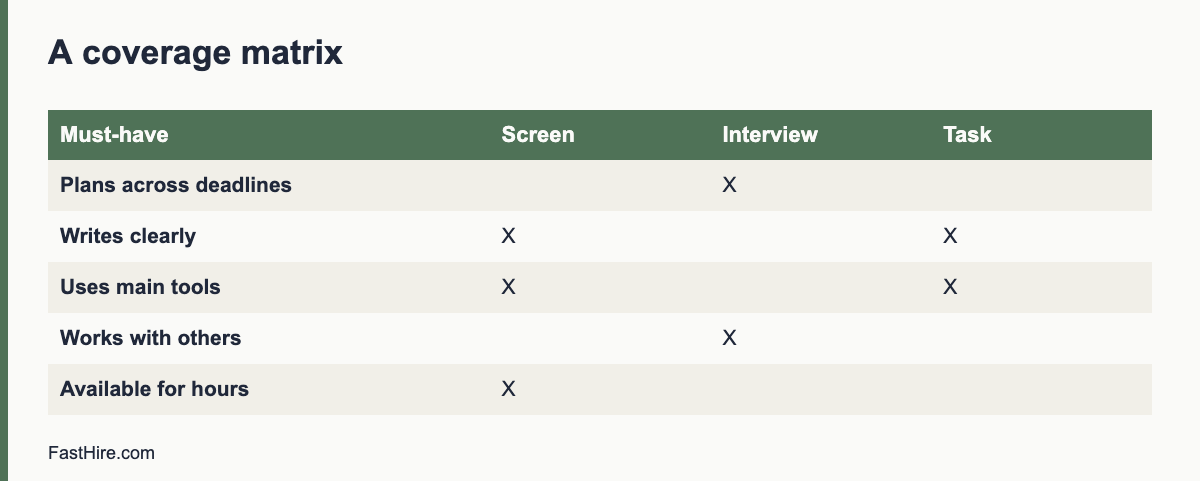
The coverage matrix
Copy this table into a spreadsheet and fill it in. Each row is a must-have. Each column is a stage. Put an X where the must-have is tested, and write the assessor.
| Must-have | Stage 1: 20-min screen | Stage 2: Structured interview | Stage 3: Work sample | Assessor |
|---|---|---|---|---|
| Plans work across deadlines | X | Hiring manager | ||
| Communicates clearly in writing | X (email sample) | X (short written task) | Recruiter, then manager | |
| Uses the main tools | X (quick check) | X | Team lead | |
| Works with others | X | Future colleague | ||
| Available for the hours | X | Recruiter |
If a row has no X, you will not learn about that must-have. If a row has three X marks, you may be over-testing it. Aim for one or two per must-have.
A worked example (fictional)
This example is invented. A mid-sized company creates a new role: a customer onboarding specialist. The hiring manager writes four must-haves. She builds this plan.
| Stage | Format | Time | Tests | Assessor |
|---|---|---|---|---|
| 1. Screen | Phone call with a script | 20 minutes | Availability, basic experience, written communication through a short email exercise sent in advance | Recruiter |
| 2. Interview | Structured behavioural interview, 6 questions | 50 minutes | Planning, working with customers, learning new tools | Hiring manager and a senior colleague |
| 3. Task | Draft a welcome email and a one-page onboarding plan for a made-up customer | 45 minutes, paid time or optional take-home with a clear limit | Written clarity and planning | Team lead |
| 4. Decision | Debrief | 30 minutes | All scores reviewed | Facilitator, then manager |
The plan has four steps but only three candidate-facing stages, and it takes about two hours of the candidate’s time. Each stage tests something new. The task uses a made-up case, not the company’s real data. The plan was shared with the candidate in the invitation, so there were no surprises.
Time limits and candidate effort
- Plan the total candidate time in hours. For most roles, three hours is a reasonable ceiling. For senior roles, it may be higher.
- Do not ask for unpaid work that looks like real work for your business. Use a made-up case. If the task is long, pay for it.
- Tell candidates the number of stages and the likely timeline in the job ad.
- Offer a choice of times, and an alternative format if needed.
- Remember that people who are working need slots outside office hours or by video.
Brief the interviewers
Hold a 20-minute briefing before the first interview. Cover:
- The role, the must-haves and the outcomes.
- The stage structure and each person’s area.
- The questions, in order, and the scoring guides.
- What not to ask. See our guide on what you can and cannot ask.
- How and when to submit scores and notes.
- How to describe the company and the role honestly.
Give new interviewers a chance to practise with a colleague. Even five minutes of practice improves note-taking and reduces nervous talking.
Plan for fairness and access
| Issue | What to plan |
|---|---|
| Adjustments | Offer in every invitation: more time, written questions in advance, a quiet room, step-free access, a different format. Respond quickly |
| Same questions | Use the same questions and time for every candidate, apart from adjustments |
| Diverse panel | Include people with different backgrounds where you can |
| Clear criteria | Share what you assess, in general terms, so candidates can prepare |
| Fair tasks | Test skills the job needs. Avoid tasks that favour people with free time or special tools |
| Records | Plan how you will store notes and for how long |
For the legal duties around adjustments, see Acas for the UK, the EEOC for the US and your national equality body in the EU. This is general information, not legal advice.
Checklist before you open the role
- Role brief and must-haves are final.
- Coverage matrix is complete.
- Questions and scoring guides are written.
- Interviewers are named, briefed and have calendar time.
- The task, if any, has been tested by a current employee.
- Invitation templates are ready, with an adjustment offer.
- Debrief date is booked.
- Feedback standard is agreed.
Question writing: from must-have to question
| Must-have | Draft question | Follow-ups | Scoring guide (1 to 4) |
|---|---|---|---|
| Plans work across deadlines | Tell me about a time you had several deadlines at once. How did you decide the order? | What did you drop or delay? What happened? | 1: no example. 2: general example, no method. 3: clear method, outcome stated. 4: clear method, strong outcome, learning applied later |
| Works with customers | Describe a customer problem you solved. What did you do yourself? | How did the customer respond? | 1: no example. 2: example, little personal action. 3: clear personal action and result. 4: strong result and improvement to the process |
| Learns new tools | Tell me about the last tool you had to learn quickly. How did you do it? | How long did it take to be productive? | 1: no example. 2: example, unclear method. 3: clear method, productive within a stated time. 4: also taught others or documented it |
Write the scoring guide before the first interview, and keep it fixed. If you change it, apply the change to every candidate. See behavioural interview questions for more examples.
Choosing the order of stages
Put the cheapest, most informative stage first. A short screen costs the candidate and you little time and removes clear mismatches on must-haves. Put the heaviest stage, such as a task or a panel, last, so that only finalists spend that effort. Use this order of effort: CV review, short call, structured interview, task or panel, references. If a must-have is a hard requirement such as a licence or the right to work in the country, check it early, in a way that you apply to all candidates.
Keeping the plan alive
After the first three interviews, check the plan against what you see. Ask: Did the questions produce usable evidence? Did interviewers use the scale in the same way? Did candidates understand the task? If a question produces the same answer from everyone, replace it. If interviewers differ widely on one must-have, clarify the scoring guide. Record any change and apply it to all candidates. At the end of the search, save the plan, the matrix and your notes. Next time you hire a similar role, you can start from the improved version and finish the plan in under an hour.
Tools you can use
You do not need special software to run a good plan. A shared spreadsheet holds the coverage matrix and the scores. A shared document holds the questions and the scoring guides. A calendar holds the schedule. If you use an applicant tracking system, check that it lets you attach scorecards and record dates. Whatever you use, keep the plan in one place that every interviewer can open, and keep it up to date, so that everyone works from the same version. When a person asks “what do we ask in stage two?”, the answer should be one click away.
Review the plan with one person who has not seen it before. Ask them to find a must-have with no question, or a question with no must-have. Fix both before you open the role.
Official sources for this topic: EEOC: employment tests and selection procedures, Acas: recruitment. These pages are maintained by the authorities and may change, so check them for the current text.
Frequently asked questions
How many stages should a hiring process have?
Use the fewest that test your must-haves. Two to four is typical. Each stage should give new information.
How many interviewers should I include?
Two to four people. More people add scheduling cost and rarely improve the decision.
Should every candidate do a work sample?
Only the finalists, if the task tests a must-have that other methods cannot. Keep it short, relevant and paid if long.
Can I change the plan during the process?
Only for clear reasons, such as a flawed question. Apply the change to all candidates, including those already seen, where practical.
What if I do not have time to plan?
Use the coverage matrix only. Even a 30-minute plan improves the quality of the process.
Related guides
- Hiring guides for hiring managers
- How to define a role before you hire: a one-page role brief
- Structured interviews: what they are and how to run one
- Interview scorecard template with a worked example
- All hiring guides for employers
- How many interview rounds are enough?
- How to assess skills with a work sample test
- Interview questions for managers: a bank for leadership hires
- How to prepare candidates for an interview
This is general information, not legal advice.