
Structured screening means judging every applicant against the same written, job-related criteria, and recording the evidence for each decision. You write the must-haves first, read every application for the same things, note the passage in the CV that supports each criterion and decide by a rule you set in advance. It is fairer because personal preference has less room, and it is easier to explain because the evidence is on paper.
Key takeaways
- Write the criteria before you read the first application, and apply them to everyone.
- Record evidence: the exact CV passage for each yes. No passage, no yes.
- Mark “unclear” separately from “no”, and ask a neutral question before you decide.
- Set the rule for choosing among qualified people in advance, and record it.
- People make the decision. Keep notes that you can explain to a candidate or a regulator.
What structured screening is
Screening is the step where you decide whom to take forward. It is often the least structured step in hiring, even in organisations that run structured interviews. A reviewer opens a CV, forms an impression in seconds and moves on. The impression may be influenced by a name, a photograph, a school, a gap in dates or the style of the layout. None of these show whether the person can do the job.
Structured screening replaces impression with a method. The method has four parts: criteria written in advance, a standard way of marking each criterion, a record of the evidence and a decision rule. The same idea sits behind structured interviews, which the US Office of Personnel Management describes as asking every candidate the same questions in the same order and scoring them on the same scale. See our guide to structured interviews. The principle is equal treatment on job-related grounds.
Why it supports fair hiring
- Equal treatment. Every applicant is read against the same list, so two similar CVs get the same outcome.
- Job relevance. If a criterion is not in the written list, it cannot decide the outcome. This keeps out proxies such as school names, employment gaps and age signals.
- Explainability. You can tell a candidate, a manager or a regulator which criterion was not met and where you looked.
- Consistency over time. Reviewers who are tired or rushed still follow the sheet.
- Better calibration. When two reviewers disagree, the sheet shows which criterion caused it, and you can fix the wording.
Structured screening does not guarantee fairness. Criteria can themselves be unfair, for example a requirement for a specific degree when the work does not need it. It is a tool that makes bias easier to see and correct.
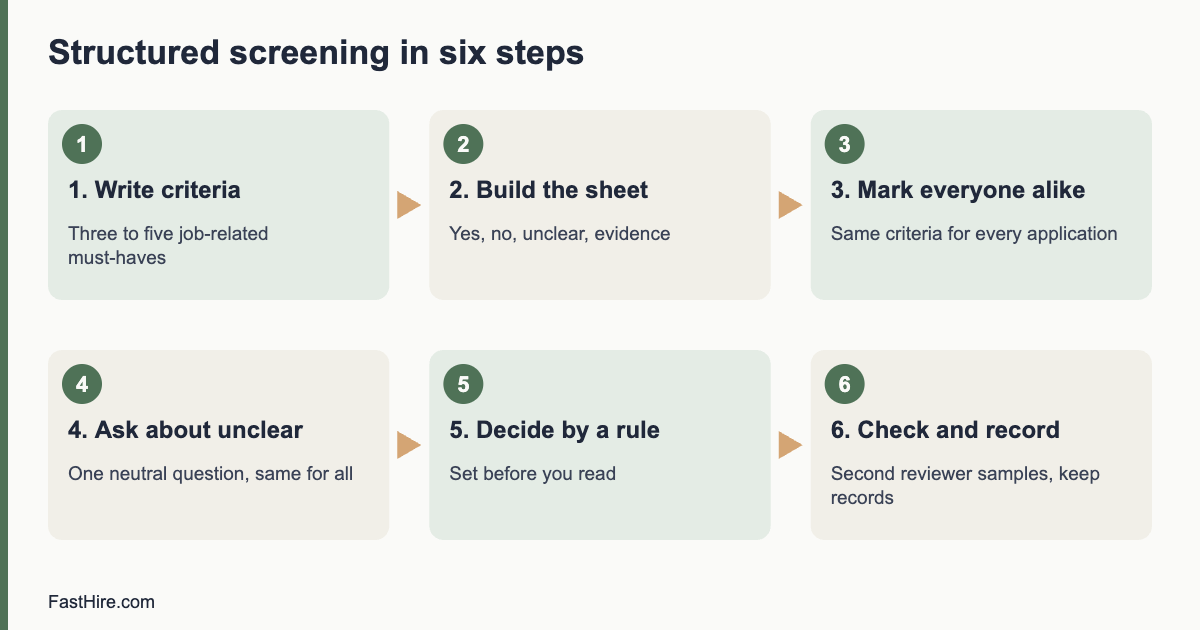
The six steps
Step 1: Write the criteria from the role
Use the role brief. Choose three to five must-haves that someone can verify on a resume or CV. Test each one with two questions: does the job really need this on day one, and could a person show it in more than one way? If the answer to the second is yes, write the alternatives, for example “two years of customer support work, paid or unpaid” instead of “two years in a call centre”.
Step 2: Build a screening sheet
| Column | Content |
|---|---|
| Application ID | A number for the first pass, if you can hide names |
| Criterion 1 to 5 | Yes, no or unclear |
| Evidence for each yes | The exact CV passage, copied or paraphrased |
| Question to ask (unclear) | One neutral question that would settle it |
| Reviewer and date | For traceability |
| Decision | Move forward, hold or decline |
| Reason | The criterion not met, if declined |
Step 3: Mark every application the same way
| Mark | Use it when | Do not use it when |
|---|---|---|
| Yes | The CV clearly shows the criterion, with a passage you can point to | You assume it from a job title or a company name |
| No | The CV clearly shows the criterion is missing, or the applicant says so | The CV is silent. Use unclear. |
| Unclear | The CV could support the criterion but does not say, or is ambiguous | You simply dislike the style of the CV |
Step 4: Ask before you decline on unclear
Send one short, neutral question to anyone with an unclear mark and no clear no. For example: “Your CV lists project work from 2022. Did it include managing a budget? A short reply is fine.” Give a date. Ask all unclear applicants the same question. This step often rescues strong candidates with short CVs.
Step 5: Decide by a rule
Write the decision rule before you screen. A common rule: invite everyone who has yes for every criterion. If you have more qualified people than you can interview, use a written, neutral tie-break, such as random selection among all who meet every criterion. Do not use hidden scores, impressions or the order in which you read applications.
Step 6: Check and record
Ask a second reviewer to check a sample, for example every tenth “no” decision. Keep the sheet. It is your record of job-related decisions. In the UK and the EU, the sheet is personal data about applicants, so protect it and delete it on schedule. The Information Commissioner’s Office explains the duties in its guidance on recruitment and selection.
An example: two similar CVs
This example is fictional. It shows how evidence changes the discussion. The role is Customer Support Assistant. The criteria are: one year of customer support work (paid, unpaid or volunteer), clear written English, comfort with new software.
| Criterion | Applicant A | Applicant B |
|---|---|---|
| One year of customer support work | Yes. “Support agent, Brightside Pets, 2022 to 2024” | Yes. “Volunteer helpline adviser, 18 months, evenings” |
| Clear written English | Yes. Cover note is clear and organised | Yes. Short, clear CV and cover note |
| Comfort with new software | Yes. “Introduced a ticket tool for a team of four” | Unclear. Lists “quick learner” with no example |
| Action | Invite | Ask one question: “Can you give an example of learning a new tool?” |
A reviewer who skimmed might have preferred A because of the paid job title. The sheet shows that B meets two criteria with evidence and has one open question. B gets the question, replies with a clear example and is invited. The structured sheet made the volunteer experience count as the criterion allowed. Note that the example is for illustration only.
What structured screening does not mean
- It does not mean rejecting people for one missing nice-to-have. Nice-to-haves are not criteria.
- It does not mean software decides. If you use software to find passages, a person still checks the evidence and decides.
- It does not mean ignoring context. If a CV shows the criterion in an unusual way, count it and write why.
- It does not mean you can skip legal rules. You must still avoid discrimination on protected grounds, make reasonable adjustments and protect data.
Legal anchors by region
Rules differ by country, so check the official sources for the places where you hire. In the US, the Equal Employment Opportunity Commission explains prohibited practices in selection on its page about prohibited employment policies and practices. In Great Britain, the Acas page on recruitment explains how the Equality Act applies, including to shortlisting. In the EU, equal treatment is set out in EU directives and national laws, and data protection rules apply to applicant data.
Common mistakes
- Writing criteria after seeing the applications.
- Using a vague criterion such as “strong communicator” that cannot be checked on a CV.
- Giving half marks. If you need a scale, use it in interviews. For screening, yes, no and unclear are enough.
- Not recording evidence. A tick with no passage cannot be reviewed.
- Changing the rule midway without telling everyone and re-applying it to all.
FastHire is being built around this method. It shows employers each job requirement next to the exact CV passage that supports it, and candidates check their fit before applying. FastHire is coming soon. It does not rank, score or reject candidates. People make every decision.
Turning vague requirements into checkable criteria
| Vague requirement | Why it fails | Checkable version |
|---|---|---|
| Excellent communication skills | Cannot be seen on a CV and invites bias towards accent and style | Writes clear emails or reports. Evidence: cover note, work samples or a short written task for all candidates |
| Degree in business | Excludes people who learned the skill another way | Can prepare budgets and forecasts. Evidence: work, study or volunteering that shows it |
| Native English speaker | Points to national origin and is not a skill level | English at the level needed to write customer replies. State the level |
| 5 years of experience | An arbitrary number that favours age | Has handled at least [number] customer cases a week in a past role, paid or unpaid |
| Team player | Vague and not verifiable on a CV | Has worked in a team on a shared outcome. Evidence: one example in the CV or answered question |
| Culture fit | Invites sameness and bias | Remove from screening. If values matter, define behaviours and test them in a structured interview |
| Recent graduate | Points to age | Early-career role, with up to [number] years of experience. Say what you will teach |
Notice what changed. Each checkable version names a task, a result or a way to show evidence. It also allows several ways to meet the criterion. This helps both fairness and quality, because the person who can do the work has more ways to show it.
A five-question fairness test for each criterion
- Is it job-related? Can you link it to a task or outcome in the role brief?
- Is it necessary on day one? If you could teach it in a few weeks, it is a nice-to-have.
- Is there more than one way to show it? If not, check whether the single way excludes people for reasons unrelated to the work.
- Could it work as a proxy for a protected trait? Age, sex, race, religion, disability, family status or nationality may be signalled by schools, years, names, languages or gaps. If yes, rewrite it as a task.
- Can you check it from the application? If not, test it later in a structured interview or work sample, for everyone.
If a criterion fails a question, rewrite it before you screen. If you must keep a requirement that affects some groups more than others, such as a licence required by law, note the reason in the role brief. We cover the legal ideas of disparate treatment and disparate impact in other guides in this section.
Handling special cases
| Situation | What to do |
|---|---|
| Career break | Do not treat the gap as a negative. Ask only about the criterion, for example the relevant skills used in the last role. |
| Qualifications from another country | Compare the skills, not the name of the qualification. If you need a formal equivalence, use the official recognition service in your country. |
| Non-linear career path | Count relevant work wherever it happened, including freelance, volunteer or family business work. |
| CV in a different format or language | Read for the criteria. Offer a translation or an alternative way to apply where the role needs it. |
| Applicant states a disability or a need for adjustment | Do not use it in the decision. Provide the adjustment and apply the same criteria. |
| Internal applicants | Use the same criteria and the same sheet. Avoid assuming that you already know them. |
Frequently asked questions
What is structured screening?
Judging every applicant against the same written, job-related criteria and recording the evidence for each decision, with a decision rule set in advance.
How is it different from reading CVs normally?
Normal reading relies on impressions. Structured screening uses written criteria, standard marks and recorded evidence, so that two reviewers can reach the same result.
What should I do about unclear applications?
Mark them unclear and send one short, neutral question to each, with a date for a reply. Decide after you receive the answers.
Can I use AI in structured screening?
Tools can help find passages, but a person should check the evidence and make the decision. Rules on automated decision making and on AI in hiring may apply in your country.
How long should I keep screening records?
Only as long as needed and according to the rules of your country. State the period in your applicant privacy notice.
Related guides
- Hiring guides for fair and compliant hiring
- Structured interviews: what they are and how to run one
- Screening at volume: a process for 500 applications
- How to screen applications quickly: a 20-minute method for small teams
- All hiring guides for employers
- How to reduce bias in resume screening: 15 practical steps
- How to write a screening call script
- Blind CV screening: does it work and how to do it
- Adverse impact and the four-fifths rule explained
- Disparate treatment vs disparate impact in hiring
- How to screen resumes against must-haves with evidence
- Age discrimination in hiring: wording, screening and examples
- How to write fair knock-out criteria
This is general information, not legal advice.