Category: Small businesses and founders

Practical guides for first hires, job ads and quick screening, written for teams without an HR department.

  • How to check the right to work: US, UK and EU basics

    How to check the right to work: US, UK and EU basics

    A right to work check is a simple step: before someone starts, you confirm that the law lets them work for you. The rules differ by country, so the right method in the US is not the right method in the UK or the EU. This guide gives the basics for each, a routine you can copy, and the errors small employers make most often.

    Key takeaways

    • Do the check for every new hire, in the same way, so no one is treated differently.
    • In the US, the employer completes Form I-9 for each new employee. In the UK, the employer checks and keeps a record. In the EU, national rules apply.
    • Check original documents, with the person in front of you or through the official route for your country.
    • Never ask for more documents than the rules require, and never choose documents for the person.
    • Diarise expiry dates and keep records for the period your national rules require.

    Why the check matters

    Employing someone who is not allowed to work can lead to fines and other penalties. Checking only some people, or asking some people for extra papers, can also be unlawful discrimination. The safest approach is one fixed routine that every new hire goes through.

    The check is not a hiring test. It happens after you decide to make an offer, not before. A person who looks or sounds foreign is not more likely to need a check, and every person you hire needs the same one.

    The general routine, in any country

    1. Make the offer conditional on the right to work check.
    2. Tell the person which documents are accepted, and let them choose which to show.
    3. Look at the original documents with the person present, or use the official online route where one exists.
    4. Check that the documents look genuine, that the photo and details match the person, and that the dates are valid.
    5. Record the result in the way your national rules require.
    6. Add any expiry or review date to your calendar.
    7. Store the record safely, and delete it when the retention period ends.
    x

    United States: Form I-9

    In the US, every employer must complete Form I-9 for each new employee. The employee fills in their section no later than their first day of work. The employer then examines documents that show identity and work authorisation, and completes the employer section within the time the form instructions give. The official source is the USCIS I-9 page, which links to the current form, the instructions and the list of acceptable documents.

    Key points for small US employers

    • The employee chooses which acceptable documents to show. You must not say which ones you want.
    • You examine the documents and record what you saw. You do not need to keep copies unless you do so for every employee.
    • Use the current version of the form. Older versions may not be accepted.
    • Some employers can use an electronic system, and some can use E-Verify. Check the USCIS page before choosing either route.
    • Keep each form for the period the instructions state, and store I-9 forms apart from personnel files so they are easy to produce.

    US errors to avoid

    • Asking for a particular document, such as a passport or a green card.
    • Filling in the form before the person has accepted the job.
    • Asking for documents from some people but not others.
    • Letting the employee complete the employer section.
    • Failing to follow up when work authorisation has an end date.

    United Kingdom: right to work checks

    In the UK, employers must check that a person has the right to work before they start. Doing the check correctly gives the employer a statutory excuse against a civil penalty if the person later turns out not to be allowed to work. The route depends on the person. Some people can be checked using original documents, and some can be checked online using a share code. The official guidance is on the GOV.UK right to work check page, and the wider employer overview is at GOV.UK employing people.

    Key points for small UK employers

    • Check before the person starts work. A check done after the start date does not give the same protection.
    • Use the route that fits the person. British and Irish citizens can show certain documents, and others may prove their status online.
    • Make and keep a copy of the evidence, with a note of the date you did the check.
    • Diarise any time limit, and repeat the check before it ends.
    • Keep the record for the whole time the person works for you, plus the period the guidance states afterwards.

    UK errors to avoid

    • Doing the check by video call or by looking at a photo sent by message, when the guidance requires a different method.
    • Keeping no record of the date of the check.
    • Missing a follow-up check when a visa or permission has an end date.
    • Asking only people with a foreign accent or name.
    • Using out-of-date guidance. Check the GOV.UK page each time you hire.

    European Union: national rules apply

    The EU does not have one single right to work check. Each member state sets its own rules for how an employer confirms a worker can work, what documents are accepted, what notifications are needed and what records are kept. EU citizens have a right to work in other member states, but the employer may still need to register or notify the worker in the way national law requires. Start with the Your Europe business pages on human resources, then check the page of the national authority in the country where the person will work.

    A simple approach for EU employers

    1. Identify the country where the work will be done.
    2. Find the national rule for checking identity and work authorisation, and for registering a new employee.
    3. Ask the person for the documents the national rule names, and record what you saw.
    4. For non-EU workers, check whether a work permit or residence permit is needed, and when it ends.
    5. Ask a local adviser if you are unsure. Rules for posted workers and remote workers can differ.

    If you are hiring someone who lives in another country, read how to hire in another country before you make an offer.

    Compare the three approaches

    QuestionUSUKEU
    Who does the check?EmployerEmployerEmployer, under national rules
    When?After acceptance, within the form timelineBefore the start dateBefore or at the start, per national rule
    Who chooses documents?The employeeThe employee, within the allowed listDepends on the country
    What do you keep?Form I-9Copy of evidence and date of checkDepends on the country
    Repeat checks?When authorisation endsWhen permission endsWhen a permit ends

    A copyable checklist

    • Offer letter says the job is conditional on a right to work check.
    • The same routine is used for every new hire.
    • The person is told which documents are accepted and is not told which to choose.
    • Documents are checked in person or through the official route.
    • The person has been compared with the photo and details on the document.
    • The date of the check and the name of the checker are recorded.
    • Expiry dates are added to the calendar with a reminder at least a month before.
    • Records are stored securely and deleted when the retention period ends.

    Candidates, privacy and fairness

    Right to work documents contain personal data, and in some cases special category data. Collect them only from the person you are hiring, not from every applicant. Tell them why you need them and how long you will keep them. The article on GDPR for job applicants explains how to write a clear notice.

    Do not ask about someone immigration status in the first interview or on the application form. Ask whether they are legally able to work in the country where the job is, in the way your national guidance allows, and leave detailed checks until after the offer.

    What to do when a document looks wrong

    If a document does not look genuine or does not match the person, do not accuse them. Stay calm, say that you cannot accept the document, and ask whether they have another acceptable one. Write down what you saw and what you said. In the UK and the US there are official routes for checking a case, and in the EU you can contact the national authority. Do not start work until the check is complete.

    Where this fits in your hiring process

    The right to work check is the last step before the first day, after the offer and the references. Put it in your timeline from the start. The first hire plan shows where it sits, and the offer letter template has a line for a conditional offer. Then plan the first 30 days so the person has a good start.

    A simple log you can copy

    NameStart dateCheck methodDate checkedChecked byExpiry or review date
    Example Person (fictional)1st of the monthOriginal documentsBefore startOwnerNone
    Example Person B (fictional)1st of the monthOnline share codeBefore startManagerDate on permission

    Special cases small employers meet

    Remote and hybrid workers

    If someone works from home in a different country from your office, the law of the country where they work usually decides which check applies. Do not assume the rules of your own country cover them. Before you make the offer, find the official guidance for the place where the work will be done, and ask a local adviser whether you must register as an employer there.

    Part-time, seasonal and short contracts

    The check is needed for every employee, however short the job. A student who works two weeks in the summer needs the same check as a full-time manager. Build the check into your seasonal hiring routine, and set aside time for it in the week before the start date so the first day is not delayed.

    Agency workers and contractors

    If you use an agency, the agency usually does the check for the workers it supplies, but your contract should say so in writing. If you engage a self-employed contractor, the rules can differ, and the label on the contract does not decide the matter. Read employee or contractor before you rely on a label.

    Students and people with limited permission

    Some visas allow only limited hours or only some types of work. Ask for the details of the permission, record any limit, and make sure the rota respects it. Write the limit in the log so the next manager sees it.

    Training the person who does the check

    Whoever does the check should be named, trained and consistent. Give them a one-page guide that lists the steps, the accepted documents and the official page for your country. Ask them to practise with a colleague before the first real check. If the checker is on leave when a new hire starts, name a backup so the check is never skipped.

    Review the process twice a year. Pick a few records at random and ask three questions: was the check done before the start date, is the record complete, and is any expiry date missing from the calendar. Fix gaps at once and note the change in your log.

    Five-minute self audit

    • Open your last five hire records. Is each check dated and signed?
    • Is there a diary entry for every document that expires?
    • Do you store the records in one place, with limited access?
    • Does your offer letter mention the check?
    • Does your job ad avoid asking for particular documents?

    Frequently asked questions

    Can I check right to work before making an offer?

    It is usually better to check after you decide to make an offer, and to apply the same step to every person you hire. Checking earlier can lead to unfair treatment of applicants.

    Do I need copies of documents?

    In the UK you need to keep a copy and record the date. In the US you complete Form I-9 and need not copy documents unless you do so for everyone. Other countries differ, so check the official page.

    What if the person has a time limit on their right to work?

    Add the end date to your calendar, remind the person in good time, and repeat the check before it ends according to your national rules.

    Can I use a service to do the checks for me?

    Yes, in some countries. You remain responsible for the result, so choose a provider who follows the official method.

    Related guides

    This is general information, not legal advice.

  • How to write a job ad that attracts the right applicants

    How to write a job ad that attracts the right applicants

    A good job ad tells a candidate what they will do, what you need, what you pay, where the work happens and how to apply. Write it in plain words, keep to a few checkable must-haves, show a pay range and describe your process. The ad is also your first screening tool: a clear ad brings fewer unsuitable applications and more people who can actually do the work.

    Key takeaways

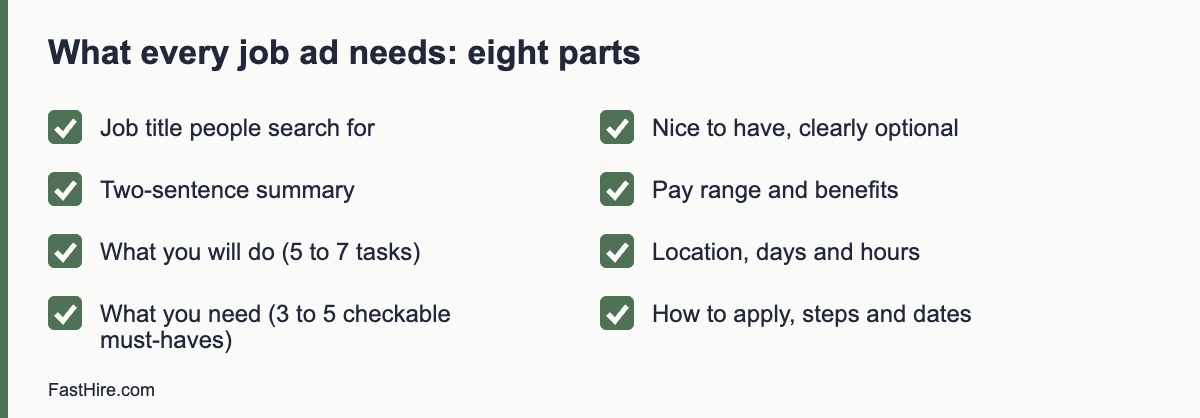
    • Use eight parts: title, summary, what you will do, what you need, nice to have, pay and benefits, location and hours, how to apply.
    • Limit must-haves to three to five things a person can check in their own CV.
    • Show a pay range. It saves time on both sides and, in some places, the law requires it.
    • Describe your process and dates so that candidates know what to expect.
    • Avoid wording that points to age, sex, race or other protected traits.
    x

    Why the job ad matters more than it seems

    Most hiring problems that look like “too many bad applicants” start in the ad. A vague ad attracts everyone and puts the whole filtering job on you. A precise ad lets candidates screen themselves. The best ads also respect the reader: they are short enough to read in two minutes, honest about the hard parts of the job and specific about what happens next.

    FastHire is being built on the same principle. Candidates check their fit against the requirements before they apply, and employers see each requirement next to the exact CV passage that supports it. FastHire is coming soon. It does not rank, score or reject candidates, and people make every decision. Whatever tools you use, the work starts with requirements that can be checked.

    The eight parts of a good job ad

    1. A job title people actually search for

    Use the common name of the role, such as “Bookkeeper”, “Customer Support Assistant” or “Electrician”. Avoid invented titles such as “Ninja” or “Guru”. Put the level in plain words when it matters, for example “Junior” or “Senior”. Add the location only if the role is tied to one place.

    2. A two-sentence summary

    Say who you are and why the role exists. Example: “We are a six-person online shop selling home goods. We need someone to keep our customers happy and our orders on time.” Candidates should know within ten seconds whether the ad is for them.

    3. What you will do

    List five to seven tasks, in order of time spent. Use verbs and objects: “answer customer emails within one working day”, “prepare weekly invoices”, “keep the stock list up to date”. Add one sentence about the hardest part of the job. It builds trust.

    4. What you need

    This is the must-have list. Keep it to three to five items, and write each so that a person can answer yes or no from their CV. Use “at least one year of customer support work, paid or unpaid” instead of “excellent communication skills”. If a requirement cannot be checked, leave it for the interview. See How to write job requirements candidates can actually check themselves against and Must-haves vs nice-to-haves for more.

    5. Nice to have

    Keep this short, and say clearly that people without these items are welcome to apply. Never screen out on a nice-to-have.

    6. Pay and benefits

    Show a pay range and the pay period, for example “per year” or “per hour”. List the benefits that matter to most applicants: holiday, pension or retirement plan, flexible hours and training. Do not list benefits you do not offer.

    Pay information is moving from good practice to legal duty in many places. Some US states have pay-range laws for job ads, and the EU has adopted Directive (EU) 2023/970 on pay transparency. Each EU member state must apply it in national law, so check the rules in the country where the person will work. Rules differ and change, so check your local law.

    7. Location, hours and flexibility

    Say where the work happens, how many days are on site, and what hours are expected. If a role is remote, say which countries or time zones you can hire in. If the schedule can be flexible, say so.

    8. How to apply and what happens next

    Give the closing date, the steps (for example: application, 15-minute call, one-hour interview, short work task), the time each step takes and when people will hear from you. Offer a contact for adjustments, such as a different format for the interview or the application. Ask for a resume or CV and, at most, one short written question.

    Before and after: the same role, two ads

    Here is a weak ad. It is typical of what small businesses post when they are in a hurry.

    Rockstar Customer Ninja Wanted!!

    We are a fast-growing, dynamic company looking for a young and energetic go-getter to join our family. Must be a native English speaker with excellent communication skills and a can-do attitude. Must be able to work under pressure and wear many hats. Competitive salary. Apply now!

    Now the same role, rewritten.

    Customer Support Assistant, Greenfield Home Goods

    We are a six-person online shop selling home goods in the UK and Ireland. We need someone to keep our customers happy and our orders on time.

    What you will do: answer customer emails and chats within one working day; process returns and refunds; keep our help pages up to date; tell us each month what customers ask about most. The hardest part of the job is the first week of December, when volume triples.

    What you need: at least one year of customer support work (paid, unpaid or volunteer); clear written English; comfort learning new software.

    Nice to have: experience with an online shop platform. If you do not have it, please still apply.

    Pay and benefits: [range] per year, 25 days of holiday plus public holidays, pension contribution, training budget.

    Where and when: Bristol office four days a week, one day from home. Monday to Friday, 9:00 to 17:30.

    How to apply: send your resume or CV and three lines on a time you solved a customer problem, by [date]. We will reply to every application by [date]. Steps: a 20-minute call, a one-hour interview and a short paid exercise. Tell us if you need any adjustment for any step.

    The second ad is longer, but it takes less time to read, because every line is useful. It removes the age and language references, lists checkable requirements and shows the pay range and the process.

    Words and phrases to avoid

    Instead ofWhy it causes troubleWrite
    Young and energeticPoints to ageAble to work at a steady pace in a busy shop
    Native English speakerPoints to national originFluent written and spoken English (state the level you need)
    Digital nativePoints to ageConfident with the tools we use, such as [tool names]
    Strong man or girl FridayPoints to sexOffice assistant
    Must be a team playerCannot be checkedHas worked in a team and can give one example
    Rockstar, ninja, guruUnclear and off-putting to manyUse the real job title
    Must work under pressureVague and can deter people with health conditionsHandles up to [number] customer queries a day

    The US Equal Employment Opportunity Commission states that job ads must not favour or discourage applicants because of protected traits. See its page on prohibited employment policies and practices. In Great Britain, the same principle comes from the Equality Act 2010. The Acas page on recruitment explains how employers should advertise and select fairly. In the EU, equal treatment rules are set in EU directives and national law, so check the law of the country where you hire.

    A job ad template you can copy

    [Job title]

    [Company name] is [one sentence about what you do and your size]. We need someone to [one sentence on why the role exists].

    What you will do
    – [Task 1]
    – [Task 2]
    – [Task 3]
    – [Task 4]
    – [Hardest part of the job]

    What you need
    – [Must-have 1, checkable]
    – [Must-have 2, checkable]
    – [Must-have 3, checkable]

    Nice to have
    – [Item]. You can still apply without it.

    Pay and benefits
    – [Pay range and period]
    – [Holiday, pension or retirement plan, other benefits]

    Where and when
    – [Location, days on site, hours]

    How to apply
    – Send [what you need] by [date].
    – Steps: [list steps and time for each].
    – You will hear from us by [date].
    – Tell us if you need any adjustment at [contact].

    Five checks before you publish

    1. Read it aloud. If you stumble, shorten the sentence.
    2. Check each requirement. Can a person confirm it from their resume or CV? If not, move it to the interview.
    3. Check the pay. Is a range shown? Does it match what you would offer an internal candidate?
    4. Ask a colleague who does not know the role. Can they say what the person will do after reading it?
    5. Look for protected traits. Search for words about age, sex, race, religion, disability, family status and nationality.

    Accessibility and data protection

    Make the ad easy to read: short paragraphs, simple headings and no text inside images. Offer an alternative way to apply, for example by email. Tell people how you will use their data. In the UK and the EU, you should give applicants a privacy notice. The UK Information Commissioner’s Office has detailed guidance on recruitment and selection.

    Where to post the ad

    Post the ad where your candidates already look: your own website, one or two job boards in your sector and country, and professional groups. Public employment services can help as well. Tell friends and customers to share the ad, and set a closing date so that you can screen in one batch. See our first hire plan for a step-by-step process and how to hire without an HR team for a record-keeping routine.

    Common mistakes in job ads

    • Copying a large company’s ad. It lists requirements for a different business.
    • Listing ten or more must-haves. Few people meet all of them, and good candidates talk themselves out of applying.
    • Hiding the pay. Candidates then guess, and many guess that it is low.
    • Using the ad as a sales brochure. Describe the work first and the perks second.
    • Leaving the process vague. People need to know how long to wait.

    A 20-minute exercise to improve any ad

    Take your current draft and do four things, in this order. First, delete every sentence that would be true of any company. Second, replace each vague trait with a task or an example. “Self-starter” becomes “plans your own week with a manager check-in on Mondays”. Third, add the pay range, the days on site and the dates of your process. Fourth, send it to one person who works in the role at another company and ask: “Would this make you apply, and is anything unclear?” Make the changes they suggest if they match the real job.

    This short loop usually shortens the ad, makes the requirements clearer and gives you a better first screen. It is also the best moment to check the must-haves against the role brief you wrote before advertising.

    Frequently asked questions

    How long should a job ad be?

    Aim for 300 to 500 words. That is long enough to cover the eight parts and short enough to read in two minutes.

    Should I include the salary in the ad?

    Yes, as a range with the pay period. It saves time, and some places already require it by law. Check the rules where the person will work.

    How many requirements should I list?

    Three to five must-haves. Put anything else in the nice-to-have list or leave it for the interview.

    Can I ask for a cover letter?

    You can, but it is a barrier for many people. Consider asking for three lines on a specific question instead.

    Is it legal to say “native speaker” in a job ad?

    It can point to national origin and lead to discrimination claims. State the language level you actually need instead.

    Related guides

    This is general information, not legal advice.
  • How to check references without breaking rules or trust

    How to check references without breaking rules or trust

    To check references fairly, ask the candidate for permission, contact only the referees they name, ask the same job-related questions of every referee, write down the answers, and use them to confirm what you learned in the interview. Do not use references to look for private information, and do not let one comment decide the outcome without a check.

    Key takeaways

    • Check references after you have chosen a preferred candidate, and before you make an unconditional offer.
    • Always ask for the candidate’s consent and tell them who you will contact.
    • Ask all referees the same questions, based on the must-haves of the role.
    • Treat the answers as one piece of evidence. Look for patterns, not a single remark.
    • Keep notes secure and share them only with people who decide. Delete them on schedule.
    x

    Why references are worth a short call

    References do three jobs. They confirm facts, such as the job title and dates. They give you a second view of how the person works. And they help you plan the first months, because a good referee can say what support the person needs. They are not a test of character, and they are not a reason to ask about private life. A short, structured call of 15 minutes is enough.

    References have limits. Many referees only confirm dates and title because of company policy or fear of legal risk. Others are friendly and say only good things. Treat the reference as a supporting signal, together with the interview scorecard and any work sample. Our article on the interview scorecard shows how to keep the main evidence in one place.

    The rules before you call

    RuleWhat it means in practice
    Get consentTell the candidate you will contact referees and ask for names and contact details. Do not contact the current employer without permission, because it can put the candidate’s job at risk
    Use named referees firstAsk for two or three people who worked with the candidate. A manager is best. Add a colleague or client if the candidate cannot name a manager
    Time the checkDo it after you have a preferred candidate, so that you ask for fewer people to spend time, and make any offer conditional on satisfactory references if needed
    Keep it job-relatedAsk about the work: tasks, results, reliability and teamwork. Do not ask about health, family, age or other protected traits
    Apply the same process to all finalistsSame questions, same steps, same notes
    Handle data lawfullyYou are collecting personal data. In the UK and EU, data protection law applies and the candidate may have the right to see what you hold. In the US, rules differ by state and by type of check

    For data protection basics, see the UK Information Commissioner’s Office pages on employment information. For the EU, the GDPR text sets the principles, and your national data protection authority gives local guidance. In the US, if you use an outside company to prepare a background report, the Federal Trade Commission explains your duties under the Fair Credit Reporting Act in its page Background Checks: What Employers Need to Know.

    Step-by-step process

    Step 1: Ask the candidate

    Send a short message after the final interview. Example: “We would like to take up two references before we make an offer. Could you send the name, role and contact details of two people who have managed you or worked closely with you, and tell us the best time to call? We will not contact your current employer without your permission.”

    Step 2: Send the referee a short note

    Contact the referee by email and offer a call or a short written form. Example: “[Candidate] has applied for a [role] at [business] and gave your name as a referee. May I ask you a few questions about their work with you? It will take about 15 minutes. Please tell me a time that suits you, or reply by email.”

    Step 3: Ask the same questions

    Open with the facts: dates, title, and the nature of the relationship. Then ask the job-related questions below. Write the answers as the person speaks.

    Step 4: Check and record

    After the call, write a three-line summary: what was confirmed, what was new and what was unclear. Mark each must-have as supported, not supported or no information. Store the notes with the candidate’s file.

    Step 5: Follow up on anything unclear

    If a comment worries you, give the candidate a chance to explain, using neutral words: “A referee mentioned that deadlines were sometimes difficult. Can you tell me more about that?” Then decide using all of the evidence.

    Question bank

    TopicQuestionWhy it helps
    FactsCan you confirm the dates of employment and the job title?Checks the CV
    RelationshipHow do you know the candidate, and for how long?Shows how well the referee knows the work
    TasksWhat were the main tasks and responsibilities?Checks fit with your tasks
    ResultsWhat did the candidate achieve that you remember best?Checks evidence of results
    ReliabilityHow did the candidate manage deadlines and attendance?Checks dependability. Ask in a neutral way. Do not ask about health or family
    TeamworkHow did the candidate work with others?Checks cooperation
    LearningHow did the candidate respond to feedback?Checks growth
    SupportWhat support helped the candidate do their best work?Helps you plan onboarding
    RehireWould you work with this person again, and in what kind of role?Gives an overall signal
    OpenIs there anything else I should know about the work?Allows extra context

    Keep a scale for your own use, for example 1 to 4, and define it in words. Do not read hints into short or cautious answers. Many referees give brief replies because of policy. If a referee will only confirm dates and title, accept this and rely on other evidence.

    Written or by phone?

    MethodStrengthsWeaknesses
    Phone callRicher detail, can ask follow-ups, hear toneNeeds scheduling; harder to record exactly
    Email or online formEasy for referees; written recordLess detail; referees may write general praise
    Short video callSimilar to phoneNeeds a time slot

    For a small business, a 15-minute call with a short form for the notes is usually best. Offer the referee a written option if they prefer. Always follow their wishes regarding how their words are recorded and shared.

    Red flags and green flags

    SignalHow to treat it
    Facts differ from the CV (dates, title)Ask the candidate to explain. Mistakes happen. Look for patterns
    The referee is a friend or relative posing as a managerAsk for another referee from a work setting
    The referee refuses to talkAccept. Rely on other evidence. This is common
    Several referees mention the same concernTake it seriously. Discuss it with the candidate
    All referees describe the same strengths as you saw in the interviewA good sign; confirm the evidence on the scorecard
    One referee is negative and others are positiveLook for context: different roles, different managers. Do not decide on one voice

    What not to do

    • Do not contact a current employer without permission.
    • Do not ask referees about protected traits or private life.
    • Do not use social media comments in place of a reference.
    • Do not share one referee’s words with the candidate in a way that reveals who said them, unless the referee agreed.
    • Do not delay the process for weeks. Candidates may accept other offers.
    • Do not make a final offer to someone you have not checked, when the role needs trust, for example handling money or working with vulnerable people. Follow the legal checks for such roles.

    Some roles need formal checks, such as right-to-work, criminal record or professional licence checks. These are different from references. Use the official guidance: in the UK, GOV.UK: checks employers can make on job applicants; in the US, the FTC page above; in the EU, your national rules. Do them only when the law allows and the role requires. See our first hire plan for the order of steps.

    A sample note sheet

    FieldEntry
    Candidate / role
    Referee name, role, relationship
    Date and method
    Facts confirmed (dates, title)
    Must-have 1: evidence
    Must-have 2: evidence
    Must-have 3: evidence
    Concerns raised
    Rehire answer
    Summary in three lines

    A worked example (fictional)

    This example is invented. A small design studio plans to hire a project coordinator. The preferred candidate gives two referees: a former manager and a client. The must-haves are “keeps projects on schedule”, “communicates clearly with clients” and “works well in a small team”.

    Must-haveWhat the manager said (summary)What the client said (summary)Result
    Keeps projects on scheduleDelivered eight projects in two years; one slipped by a week because a client changed the briefAlways sent early warning when dates movedSupported
    Communicates clearly with clientsWrote the weekly update that clients likedReplies were fast and clearSupported
    Works well in a small teamHelped train a new colleagueNo informationPartly supported
    ConcernNeeded support when handling several urgent tasks at onceNo concernDiscuss with candidate

    The studio then asked the candidate a neutral question: “Your former manager mentioned that urgent tasks were hard to handle at once. Can you tell me how you organise your work when everything arrives together?” The candidate described a daily list and a rule for escalating. The studio recorded the answer, noted the need for a clear priority system in onboarding, and made the offer. The reference check helped plan support, rather than only rule the person in or out.

    Message templates

    Reply to a referee who wants to give a written answer

    “Thank you. Please reply to these four questions: What were the main tasks? What results do you remember best? How did the person handle deadlines? Would you work with them again, and in what role? Your answers will be kept only for the hiring decision and shared with the people who decide.”

    Message to a candidate when a referee raises a concern

    “Thank you for the references. One of them mentioned [neutral description of the point, without naming the person]. I would like to hear your view. Can you tell me more about it?”

    Message to a candidate after a satisfactory check

    “The references we received support what we heard in your interview. We would like to make you an offer. I will send the details by [date].”

    Timeline for a quick check

    DayAction
    Day 1Final interview ends; send reference request to the candidate
    Day 2Candidate sends names; you contact referees
    Days 3 to 4Calls or written replies; write summaries
    Day 5Decide, call the candidate, send the offer or the outcome

    A five-day timeline respects the candidate’s time. If a referee is slow, tell the candidate and ask for a back-up referee. Do not leave a good candidate without news for a week.

    Frequently asked questions

    When should I check references?

    After you have a preferred candidate and before you make an unconditional offer. Tell the candidate in advance.

    Can I call the current employer?

    Only with the candidate’s permission. Contacting it without consent can put the person’s job at risk.

    How many references do I need?

    Two is enough for most small business roles. Add one more only if the first two leave key questions open.

    What if a former employer will only confirm dates?

    Accept this. Many employers have this policy. Use the interview, work sample and other referees for evidence.

    Do I need the candidate’s consent in every country?

    Consent or another lawful basis is needed under data protection law in the UK and EU. Even where it is not strictly required, asking is fair and respectful. Check local rules.

    Related guides

    This is general information, not legal advice.
  • How to make a job offer: a letter template and what to include

    How to make a job offer: a letter template and what to include

    A good job offer is clear, complete and honest. Call the candidate first, then send a written offer that states the job title, start date, pay, hours, place, any conditions, the deadline for a reply and who to contact. The written offer is not the same as the full employment contract, but it must match it, and it should never promise things you cannot deliver.

    Key takeaways

    • Phone the candidate first, then send the letter the same day.
    • Put the key terms in writing: title, pay, hours, place, start date, conditions and reply date.
    • State conditions clearly, such as references or right-to-work checks.
    • Give a fair time to decide, usually three to five working days.
    • Rules on written terms differ by country. Check the official page for your country before you send a contract.
    x

    The offer in three steps

    StepWhat you doWhy
    1. CallPhone the candidate, share the good news, give the main terms and the reply dateShows respect, answers first questions and lets you hear the reaction
    2. WriteSend the offer letter by email within a few hoursGives the candidate the terms in writing and avoids misunderstandings
    3. ContractSend the full employment contract or written terms of employment as the law requiresCovers all legal terms; the offer letter alone may not be enough

    Many small businesses skip step 3 or merge it with step 2. If you merge them, make sure the document includes everything the law requires in your country. Read the official guidance: in the UK, GOV.UK: employment contracts; in the US, there is no federal requirement for a written contract for most jobs but state rules and the Fair Labor Standards Act affect pay (see US Department of Labor: wages and the FLSA); in the EU, Directive (EU) 2019/1152 on transparent and predictable working conditions sets information duties, and each country applies them in its own way.

    What to include in the letter

    ItemDetails to stateNotes
    Job titleThe exact titleMatch the ad
    Start dateDate, or “to be agreed by [date]”Allow time for notice periods
    PayAmount, currency, period (hourly, weekly, yearly) and pay dateMatch the range in the ad, or explain any difference
    HoursHours per week, days, breaks, overtime rulesState flexible hours if they apply
    Place of workAddress or remote arrangementSay who pays for equipment
    Reporting lineName and title of the managerHelps the candidate picture the team
    Contract typePermanent, fixed term, part-time; end date if fixedUse the legal term for your country
    Probation or trial periodLength and rules, if usedSee local limits; in some places a probation period has legal rules
    BenefitsHoliday, pension or retirement, health, other benefitsDescribe only what you will provide
    ConditionsReferences, right to work, qualifications, background checks if the role requires themSay what happens if a condition is not met
    Reply dateA date and timeGive three to five working days
    ContactName, email, phoneOffer to answer questions

    Do not copy terms from a large company if you will not offer them. Avoid phrases like “competitive package” with no detail. If the pay depends on bonuses, state the bonus rules in plain words and say that they are not guaranteed unless they are.

    A template you can copy

    Replace the text in square brackets. Have a lawyer or advisor check the template once for your country.

    [Date]

    Dear [Name],

    Job offer: [Job title] at [Business name]

    We are pleased to offer you the position of [job title]. This letter sets out the main terms. We will send the full written terms of employment separately [or: they are attached].

    Start date: [date].
    Place of work: [address or remote details].
    Reporting to: [name and title].
    Hours: [hours per week and days].
    Pay: [amount] per [hour/month/year], paid [monthly/weekly] on [date].
    Contract: [permanent/fixed term until date], [full-time/part-time].
    Probation: [length and rules, or “none”].
    Holiday and other benefits: [summary].

    This offer depends on: [satisfactory references; proof of the right to work in [country]; any other condition].

    Please reply by [date and time] to confirm that you accept. If you have questions, please contact [name] at [email or phone]. We would be glad to talk.

    We were impressed by [one specific, honest reason from the interview] and we look forward to working with you.

    Yours sincerely,
    [Name, title]

    The phone call script

    1. Open with the news. “We would like to offer you the role of [title]. Congratulations.”
    2. State the main terms. Title, pay, hours, start date and conditions.
    3. Ask for first reactions. “How does that sound to you?”
    4. Answer questions honestly. If you do not know, say you will check and reply by a time.
    5. Give the timeline. “I will send the letter today. Please reply by [date].”
    6. End warmly. Thank them. Do not pressure them to decide on the call.

    Do not use tactics such as an “exploding offer” with an unreasonable deadline or a false statement that there are other candidates waiting. They damage trust, and they may push the person to a worse decision. A fair time to decide is part of a respectful offer.

    A worked example (fictional)

    ItemExample
    RoleOperations coordinator at a small online shop (invented)
    Pay24,000 per year, paid monthly, within the range in the ad
    Hours30 hours per week over four days
    Start date1 March, or earlier by agreement
    ConditionsTwo satisfactory references and proof of right to work
    Reply dateFriday at 5 p.m., four working days after the offer

    The founder called the candidate on Monday, sent the letter at noon, and sent the full written terms on Tuesday. The candidate asked two questions: whether the hours could be moved to another day, and whether there was a training budget. The founder answered both in writing the next morning. The candidate accepted on Thursday. The founder then told the other finalists the outcome the same day.

    Handling questions and negotiation

    Candidates often ask for a change in pay, hours, start date or benefits. Decide in advance what you can offer. Have a floor and a ceiling for pay, and a list of items that can change at low cost, for example start date, flexible hours, a review date for pay or a training budget. When you negotiate:

    • Treat all candidates alike. Unequal pay for the same work can create fairness and legal issues, and some places require pay equity.
    • Give reasons for what you cannot change.
    • Put every agreed change into the written terms.
    • Do not reduce an offer because the candidate asked a question.
    • If you cannot meet the request, say so with respect and ask whether the original offer still works.

    After the person accepts

    1. Send a thank-you message and confirm the start date.
    2. Tell the other finalists the outcome, with respect. A short message is enough.
    3. Close the job ad.
    4. Complete the required checks as the law requires, such as right-to-work checks.
    5. Prepare payroll, equipment, accounts and the first-week plan.
    6. Stay in touch before day one with a short message from the manager.

    The gap between acceptance and the first day is a risk period. A friendly message, a clear schedule and a named contact reduce the risk that the person changes their mind or arrives unprepared. See the first hire plan for the full order of steps.

    Mistakes to avoid

    MistakeWhy it hurtsFix
    Verbal offer onlyTerms are unclear; disputes laterAlways follow with writing
    Terms that differ from the adLose trust; may breach rules on pay informationExplain differences honestly before sending
    Vague conditionsThe candidate quits a job for an offer that then falls throughState conditions clearly
    A very short deadlinePressure; poor decisionsGive three to five working days
    No contractLegal risk in many countriesProvide written terms as the law requires
    Telling other finalists nothingDamages your reputationReply to everyone within a day or two

    Reply templates

    Acceptance confirmed

    Hello [Name],

    Thank you for accepting. We are glad you are joining us. Your start date is [date]. Before then, we will send you the full terms, the first-week schedule and details of who to meet on your first day. If you have any questions, please contact me at [email].

    Best wishes,
    [Name]

    Message to the other finalists

    Hello [Name],

    Thank you for your time and effort during our process. We have offered the role to another candidate. We valued your skills in [one specific point], and we would be glad to keep your details for future roles if you agree. We wish you every success.

    Best wishes,
    [Name]

    Check list before sending the offer

    • The terms match the job ad, or any difference is explained.
    • The pay is the same as you would offer another candidate with the same experience.
    • The conditions are listed, with a way to meet each one.
    • The reply date is realistic.
    • Someone else has read the letter for errors.
    • You have a plan for the full contract.

    Offers for different situations

    SituationWhat to addWhat to watch
    Part-time roleState the hours, the days and how changes are agreedPart-time staff usually have the same rights in proportion to hours. Check local rules
    Fixed-term roleState the end date and the reason, and say what happens at the endRules limit repeated fixed-term contracts in many countries
    Seasonal roleState the season dates, the shifts and how pay is calculatedMake sure holiday pay is handled as the law requires
    Remote roleState the country of work, equipment and costs, and the time zoneWorking from another country can change tax and legal duties. Take advice
    Commission or bonus payState the rules, the targets and the pay datesDo not describe a bonus as guaranteed unless it is
    RelocationState what you pay for and when the person must repay it, if at allPut repayment terms in the contract and keep them reasonable

    If you are offering a role to a person who currently lives in another country, the legal position can be complex. Our guide on hiring abroad will cover the basics. Until then, speak to an accountant who knows both countries before you make the offer.

    Keep the tone human

    An offer letter is also a first impression of how you manage. Use plain words. Thank the person for their time. Give one honest reason why you chose them, based on the evidence from the interview, not on personality. Avoid heavy legal language where you can. If the legal document is formal, add a short cover note in plain words that says what happens next. Candidates remember how they were treated at this point, and they tell others.

    Frequently asked questions

    Is an offer letter a contract?

    It can form part of a contract once accepted, depending on the country. Treat it as binding on you and make sure it matches the full terms.

    Do I need a written contract?

    Many countries require written terms or a statement of particulars for employees. Check the official page for your country, for example GOV.UK in the UK.

    How long should I give a candidate to decide?

    Three to five working days is typical. Allow more time for senior roles or for people who must give notice.

    Can I withdraw an offer?

    Only for fair reasons, such as a failed condition, and with care. Withdrawing without a valid reason can create legal risk. Take advice before you do it.

    Should I tell the candidate the pay range earlier?

    Yes. State a range in the ad where you can, and make the offer within the range, unless you explain a change.

    Related guides

    This is general information, not legal advice.

  • How to hire an assistant or office manager: role, ad and interview

    How to hire an assistant or office manager: role, ad and interview

    To hire an assistant or office manager, list the tasks you want to hand over, group them by skill, decide the hours and the level of trust, write a clear job description, advertise it with the pay range, and test the real skills with a short task such as a calendar puzzle, an email draft or a small spreadsheet. Keep the process fair, and plan the first month so that the person can take over tasks step by step.

    Key takeaways

    • Start with a task audit: write down everything you want to hand over and how long each task takes.
    • Choose between an assistant (supports you) and an office manager (runs the office). They are different jobs.
    • Test judgement and organisation with a short, realistic exercise.
    • Be clear about confidentiality, access to systems and data protection from the start.
    • Plan a staged handover: show, do together, then hand over with review.
    x

    Assistant or office manager?

    Titles in this area are used loosely. Before you write an ad, decide what you need. The two main roles are different, and so are the skills and the pay.

    AspectAssistant (executive or personal)Office manager
    Main focusSupports one person: calendar, email, travel, follow-upRuns the workplace: suppliers, equipment, health and safety, visitors, admin, sometimes HR support
    Key skillsDiscretion, written communication, calendar management, anticipationOrganisation, supplier management, budgets, practical problem solving, people skills
    Who they work withMostly youThe whole team, suppliers, visitors
    Typical riskBecomes a bottleneck for one person’s tasksRole grows into many unrelated jobs
    TestEmail, calendar and prioritisingSupplier plan, budget, handling an urgent issue

    If you need both, consider whether one person can do both at the start, or whether you should begin with one and add the other later. A role that mixes both can work in a very small company if you define priorities. See how to write a job description for a role that does not exist yet.

    Step 1: Run a task audit

    For one week, write down every task you do that someone else could do. Note the time each takes and how often. Then group the tasks.

    GroupExamplesHours per week (your estimate)
    Calendar and emailScheduling, filtering, drafting replies, reminders
    Travel and eventsBooking, itineraries, expenses
    Finance supportInvoices, receipts, expense forms, supplier payments (with access controls)
    OfficeSupplies, equipment, post, cleaning contracts, safety checks
    People supportOnboarding setup, contracts filing, holiday calendar
    Customer supportFirst reply, forms, bookings
    ProjectsResearch, document formatting, meeting notes

    Add the hours. If the total is below ten hours a week, consider a part-time role or a freelancer, and read employee or contractor. If it is above 30 hours, the job is full-time. Compare the cost with your own time using the cost worksheet.

    Step 2: Decide trust, access and data

    Assistants and office managers see sensitive information: emails, contracts, bank details and personal data. Decide before you hire what access the person will have, and put rules in writing.

    • Which accounts they can view or manage
    • Whether they can make payments, and what limits apply
    • How passwords and shared accounts are handled; use a password manager, not shared notes
    • What counts as confidential, and a confidentiality clause in the contract
    • Data protection duties. In the UK and EU, the person will handle personal data and needs training. See the ICO employment guidance
    • Checks you plan to make, where the law allows and the role needs it. Apply the same checks to every finalist

    Step 3: Write the job description and ad

    Use the seven-part method from the new-role guide: problem, outcomes, tasks, must-haves, nice-to-haves, context, unknowns. For an assistant, outcomes might be “calendar is up to date with no double bookings” and “email replies within one working day”. For an office manager, outcomes might be “supplier contracts reviewed each year” and “safety checks completed on time”. Choose three to five must-haves that you can check, such as “wrote business emails daily in the last role” or “managed supplier orders”. Avoid proxies such as years of experience that are not needed. See how to write a job ad that attracts the right applicants.

    Step 4: Screen and interview

    Must-haveQuestionWhat a strong answer shows
    OrganisationTell me how you plan a week with many changes. Give a real example.A method, tools, priorities
    Written communicationDescribe a difficult email you wrote on someone’s behalf.Clarity, tone, result
    DiscretionTell me about a time you handled confidential information. What did you do?Care, rules, judgement
    InitiativeTell me about something you improved in a past role without being asked.Action and result
    Working with a busy personHow do you work with someone who changes priorities often?Calm, questions, flexibility
    Practical problem solvingThe printer breaks before a client visit. What do you do?Steps, priorities, communication

    Use the same questions for every candidate and a simple scorecard. Learn the method in our guides on the first interview and the interview scorecard. Do not ask about family plans, health, age or other protected topics. See what you can and cannot ask.

    Step 5: Test the skills with a short task

    A 30 to 45 minute exercise gives strong evidence. Use made-up data and tell candidates the time limit.

    TaskWhat it testsScoring points
    Calendar puzzle: five meetings, three time zones, two conflicts. Find a schedule and write a short email to confirm.Planning, attention to detail, written clarityNo conflicts, correct time zones, clear email
    Inbox triage: ten fictional emails; mark the urgent ones, draft two replies, list questions for the manager.Priorities, judgement, toneRight order, polite and short replies, good questions
    Small spreadsheet: fix three errors in a fictional expense sheet and add a total.Accuracy, basic toolsErrors found, formulas correct
    Supplier choice: compare three fictional quotes and recommend one.Judgement, simple analysisClear comparison, assumptions stated

    Keep the task short, paid if long, and fair. See how to assess skills with a work sample test.

    Step 6: Check references and make the offer

    Ask referees about reliability, discretion, accuracy and how the person handled pressure. See how to check references. Then make the offer with clear hours, duties and confidentiality terms. See how to make a job offer.

    The first month: staged handover

    StageWhat happensYour role
    1. ShowExplain the task, why it matters and how you do itDemonstrate; give a checklist
    2. Do togetherThe person does it while you watchGive feedback
    3. Do with reviewThe person does it; you check the resultReview quickly
    4. OwnThe person owns the task; you check weeklyTrust and spot-check

    Write a short handbook as you go: where files are kept, who the key suppliers are, how you like emails written. The new person can update it, and it helps the next hire. See the first 30 days onboarding plan.

    Common mistakes

    MistakeEffectFix
    Hiring before the task auditRole does not match the needRun the audit first
    Giving full access on day oneRisk to data and moneyGrant access in stages with limits
    Treating the role as a junior role with senior dutiesLow pay, high responsibility, quick exitMatch pay to duties. Check the market
    No prioritiesPerson is pulled in many directionsAgree top three priorities each week
    Expecting the person to read your mindFrustrationShare preferences in a written guide
    Handing over everything at onceErrors and overloadStaged handover

    A worked example (fictional)

    This example is invented. A founder of a six-person design studio spends about 12 hours a week on admin: scheduling, invoices, supplies and client emails. She runs a task audit and decides to hire a part-time studio coordinator for 20 hours a week. She writes outcomes: invoices sent within two days of project milestones, calendar free of conflicts and a monthly supplier review. She uses a 40-minute inbox triage task and the same six interview questions. The chosen candidate shows careful planning and clear email style. In the first month the founder uses the four-stage handover. By week four the coordinator owns the calendar and invoices. The founder reviews invoices weekly for two months. After 90 days the founder has about 10 more hours a week for client work.

    Pay, hours and growth

    Pay for assistants and office managers varies widely by country, city and level of responsibility. Do not guess. Check current local sources such as national statistics or labour market information, and compare advertised pay for similar roles in your area. In the US, the Bureau of Labor Statistics publishes occupation data in its Occupational Outlook Handbook. In the UK and EU, check your national statistics office and the legal minimum pay on GOV.UK or the equivalent source. Set a range, write it in the ad where allowed or required, and offer within it.

    Be honest about growth. If the role can grow into a coordinator or operations role, say so, with the conditions. If it cannot, do not promise it. People stay when the work is clear, the pay is fair and they see a path to learn. A training budget or a named course can mean more than a vague promise.

    Part-time and shared options

    OptionFits whenWatch out for
    Part-time employeeYou need steady cover, 10 to 25 hours a weekSet clear hours and a backup for holidays
    Shared assistant between two foundersYou each need a few hoursAgree priorities and who decides conflicts; put it in writing
    Freelancer or virtual assistantTasks are separable and the person works with their own toolsCheck status rules and data protection. See employee or contractor
    Temporary coverA busy period or leave coverPlan the handover and keep access limited

    Whatever option you choose, write down the tasks, hours, confidentiality rules, review dates and the way you will give feedback. A short written agreement reduces most misunderstandings.

    How to review the role after three months

    1. Compare the task list with what the person actually does.
    2. Ask the person which tasks take the most time and which they would change.
    3. Review the outcomes: calendar conflicts, invoice timing, supplier issues, errors.
    4. Decide which tasks to add, move or remove.
    5. Update the job description and agree changes in writing.

    Roles like this grow quickly. A short review prevents drift and keeps both sides clear about what is expected.

    Finally, think about cover. If the person is ill or on holiday, who answers the calendar and the post? A shared checklist and a named backup keep the office running. Write the checklist while the person is new and fresh, because they notice steps that others have forgotten. Update it every quarter.

    Frequently asked questions

    What is the difference between an assistant and an office manager?

    An assistant supports one person or a small group with calendar, email and tasks. An office manager runs the workplace, including suppliers, equipment and administration.

    Should the role be full-time or part-time?

    Add up the task hours from your audit. Under about ten hours a week, consider part-time or a freelancer. Above 30 hours, plan a full-time role.

    How do I protect confidential data?

    Limit access by task, use a password manager, add a confidentiality clause, train the person on data protection and review access regularly.

    What test should I use?

    A short, realistic task such as inbox triage or a calendar puzzle, with a time limit and a scoring guide.

    Can I hire a virtual assistant?

    Yes. Check the status rules in employee or contractor, and set data protection terms with the provider.

    Related guides

    This is general information, not legal advice.
  • Where to post a job when you have no budget

    Where to post a job when you have no budget

    You can post a job for free on public job services, your own website, social networks, local community boards, schools and colleges, and through your network. Free channels cost time, not money, so pick three to five that match the role and track which ones bring suitable applicants. Use a clear ad, apply the same fair process to everyone, and do not rely on word of mouth alone.

    Key takeaways

    • Free channels cost your time. Choose by role type and location, not by habit.
    • Use three to five channels, not fifteen. Track the source of each applicant.
    • Government job services, your own careers page, local boards and schools are strong free options in many places.
    • Word of mouth is useful but can narrow your pool. Always add at least one open channel.
    • Write one clear ad and adapt the first lines for each channel.
    x

    Free channels and when to use them

    ChannelBest forEffortWatch out for
    Public employment services (for example the job service run by the government in your country)Local, entry-level, trades, part-time and shift rolesLowListings may need an account; check the posting rules
    Your own website or careers pageEvery role; builds a lasting sourceMedium at first, low afterNeeds traffic; link to it from other channels
    Your business social media profilesRoles where customers or fans may applyLowReach depends on your followers; be careful with ad wording
    Professional networks for individualsOffice, skilled and remote rolesMediumFree posts may be limited in number or reach
    Local community boards, shops and librariesLocal and part-time rolesLowShort reach; use a clear contact method
    Schools, colleges and universitiesEntry-level, apprentice, intern and seasonal rolesMediumFollow each institution’s rules for employers
    Industry associations and groupsSpecialist rolesMediumRead the group rules; do not spam
    Alumni and volunteer networksMission-led or specialist rolesMediumKeep the process open to all
    Your network and customersAny role, especially hard-to-fillLowCan narrow the pool; combine with open channels
    Your own email listAny role if you have a listLowOnly message people who agreed to receive email from you

    Job board names and free-posting rules change often, so check each site’s current terms before you spend time. In the US, the Department of Labor sponsors CareerOneStop, which lists American Job Centers that help employers find workers. In the EU, the EURES portal supports cross-border job search. In the UK, GOV.UK: employing people points to the official routes for employers.

    A five-step plan for a free posting week

    Step 1: Write one strong ad

    A clear ad saves you hours of screening. Use our guide to writing a job ad that attracts the right applicants. Include the job title, the main tasks, three to five must-haves, the pay range, the hours, the place and how to apply. Keep it under 500 words.

    Step 2: Pick the channels

    Choose by role. For a shift worker in a town, pick the public job service, local boards and your shop window. For a remote designer, pick your website, a professional network and one industry group. For a trainee, pick local schools and colleges. Keep the list short enough that you can answer every applicant.

    Step 3: Make one tracking link per channel

    Use a simple way to learn where people came from. The easiest way is a question on the application: “How did you hear about this job?” with a short list of options. Do not put personal data in a link. Plain text answers are fine.

    Step 4: Post on a weekday morning and set a closing date

    Post early in the week so that you can respond within a day or two. Set a closing date two to three weeks ahead and say it in the ad. A date helps candidates plan and helps you plan your own time.

    Step 5: Review after one week

    Count applicants by source and ask: how many met the must-haves? Drop the channels that bring many unsuitable applicants. Repeat the post on the channels that bring suitable ones. Use a screening method for small teams so that the review takes minutes.

    Templates you can copy

    Short post for social media

    “We are hiring a [job title] in [place]. You will [two main tasks]. Pay: [range]. Hours: [hours]. Closing date: [date]. Read the full details and apply here: [link]. Please share with anyone who may be interested.”

    Message to your network

    “Hello [name], we are hiring a [job title] at [business]. The role is [one sentence]. The details are here: [link]. If you know someone who may be a good match, please pass it on. We welcome all applicants and everyone will receive a reply.”

    Note for a school or college careers team

    “We are a small business in [place] and we have a [job title] role for [type of applicant]. It includes [training or support]. Could you share the details with students or graduates? Our contact is [name and email].”

    Keep the process fair

    Free channels can narrow your pool without you noticing. If you only post to your own friends and followers, you will meet people who look like your network. Add at least one public channel that anyone can see. Use the same ad, the same questions and the same screening sheet for all applicants, whatever the source. Do not use words in the ad or the post that point to age, sex, race or other protected traits, for example “young and energetic” or “native speaker” when fluent English is enough. If you need a language level, state it as a skill, such as “written English at a level for customer emails”.

    Respect candidates. Say how long you will take to reply, and then reply. Do not ask for payment from applicants. Do not ask for sensitive information such as bank details or identity numbers at the application stage. Scam postings make candidates wary, so keep your contact details and your company name clear.

    Measure what works

    Number to trackHow to countWhat to do with it
    Applicants per channelCount by the “how did you hear” answerKeep top channels
    Suitable applicants per channelCount those who meet the must-havesChoose by suitable, not by total
    Time to replyDays from application to first replyAim for two working days
    Hires per channelCount at the endPlan the next hire with these channels
    Hours you spentEstimate your timeCompare with a paid option

    After two or three hires, you will know which free channel serves each type of role. Keep a short list in a spreadsheet and reuse it. If free channels do not bring enough suitable people after two weeks, check the ad and the pay before you pay for promotion. See what to do when no one applies in our first hire plan. A low-cost paid option can still make sense when your time is the scarcer resource; the cost worksheet helps you compare.

    Match the channel to the role: three examples

    These examples are invented to show the thinking. They are not data from real businesses.

    Role (fictional)Channels chosenWhyFirst-week target
    Weekend shop assistant in a small townPublic job service, shop window sign, local community board, business social pageApplicants are local and look for nearby work. People walk past the window.Ten applicants, three who can work the shifts
    Remote bookkeeper, part-timeOwn careers page, a professional network post, one accounting association groupSkill is specialist and place does not matterEight applicants, three with the right software experience
    Summer trainee in a workshopTwo local colleges, public job service, parents’ groups through a school newsletterApplicants are young and local; schools reach themSix applicants, two who can start in June

    In each example, the owner picked channels that the likely applicant already uses. Ask yourself: where would a person who could do this job look first? Then post there.

    How to write the first lines for each channel

    Most readers see only the first two lines. Rewrite them for each channel and keep the rest the same.

    ChannelFirst lines should say
    Public job serviceTitle, place, hours and pay range
    Social mediaWhat the person will do and where, in one sentence, plus the link
    Professional networkThe outcome of the role and the team size
    Careers pageWhy the role exists and what success looks like
    School or collegeThe training or support you give and the start date
    Community boardTitle, hours, contact name and phone or email

    Keep the facts identical across channels. If the pay is stated on one and missing on another, candidates notice, and it creates doubt.

    Handling replies without losing a week

    Free channels can bring many replies at once. Set a routine so that none are lost.

    1. Use one email address or one form for all applications. Do not collect them in private messages on five platforms.
    2. Send an automatic or manual reply within two working days that confirms receipt and gives the closing date and the next step.
    3. Put each applicant in a spreadsheet with a date, the source and a status.
    4. Screen on a fixed day, for example the day after the closing date.
    5. Send a clear outcome to every applicant. A short message takes a minute and protects your reputation.

    A simple spreadsheet is enough at this stage. Our guide to a 20-minute screening method shows how to go from a pile to a shortlist without reading every application twice.

    Common mistakes with free posting

    • Posting once and waiting. Post, then share again after one week with a new first line.
    • Using a different ad on each channel. It creates confusion and uneven screening.
    • Posting without a closing date. You will not know when to start screening.
    • Ignoring replies. A slow reply loses good people to faster employers.
    • Using only your personal network. It is fast, but it narrows the pool.
    • Asking for payment or sensitive data. Applicants should never pay to apply or share bank details.

    Do the numbers before you pay for promotion

    If free channels bring few suitable people, test a paid option on one role only. Set a fixed cap before you start. Write down the fee, the expected number of suitable applicants and the date you will judge the result. After the closing date, divide the fee by the number of suitable applicants. Compare that figure with the value of your own hours. If a paid option saves you ten hours and costs less than ten hours of your time, it is a fair trade. If it brings the same people you already reach, do not repeat it.

    Keep a short record after each search: the channels you used, the number of suitable applicants from each, the hours you spent and the result. After three searches, this record is more useful than any general advice, because it describes your own market, your own roles and your own time. Share it with the next person who hires for you.

    Frequently asked questions

    Is it really free to post a job?

    Many public services, your own site and social profiles are free to use. Some job boards limit free posts or charge to promote them. Check each site’s terms.

    How many channels should I use?

    Three to five is a good range for a small team. More channels mean more replies to manage.

    Is word of mouth a fair way to hire?

    It is a useful source, but if it is your only source, it can limit who hears about the job. Add at least one public channel.

    How long should I leave the ad open?

    Two to three weeks is typical for a small business role. State a closing date in the ad.

    Do I need to pay to reach good candidates?

    Not always. Check your ad and pay first. If free channels fail, try one paid channel for one role and track the result.

    Related guides

    This is general information, not legal advice.
  • Part-time, seasonal or temporary staff: how to hire fast and fairly

    Part-time, seasonal or temporary staff: how to hire fast and fairly

    To hire part-time, seasonal or temporary staff fast and fairly, plan the dates and shifts first, post a short clear ad with pay and hours, use a quick two-step process (a short application and a 15-minute call or group session), check the right to work, give a written offer with end date and terms, and run a one-day induction. Apply the same fair rules to everyone, and know that part-time and fixed-term workers have legal protections.

    Key takeaways

    • Work out the number of hours and shifts you need, week by week, before you advertise.
    • Use a short process: a simple form, a short call or group session, and a same-week offer.
    • Part-time, fixed-term and agency workers have rights. Check the official rules for your country.
    • Check the right to work for every person you hire, in the same way.
    • Plan induction, safety training and a clear end-of-season message.
    x

    Which type of worker do you need?

    TypeMeaningCommon useWatch out for
    Part-time employeeWorks fewer hours than a full-time employee in the same businessRegular shifts, ongoing coverEqual treatment in proportion to hours in many countries
    Seasonal workerHired for a peak period, such as holidays or harvestRetail peaks, hospitality, farming, eventsFixed-term rules; holiday pay and end dates; some sectors have special permits
    Fixed-term employeeEmployed for a set period or for a specific taskMaternity cover, projects, seasonsLimits on repeated renewals in many countries
    Temporary agency workerSupplied by an agency to work for youShort-notice coverAgency worker rules; check who is the employer
    Casual or on-call workerCalled in as neededIrregular eventsRules on zero-hours or on-call contracts differ by country. Check them
    Student or young workerUnder 18 or in educationPart-time jobsSpecial limits on hours, tasks and pay in many countries

    Choose the type that fits the work. Do not label someone a contractor to avoid cost, because status depends on the facts. See employee or contractor.

    What the law says: pointers by region

    RegionTopicWhere to read
    United StatesWages, overtime and youth employment limits under the Fair Labor Standards Act; state laws can add moreUS Department of Labor: wages and the FLSA and fact sheets
    United KingdomRights of part-time workers, fixed-term employees and agency workers; National Minimum Wage and Living WageGOV.UK: part-time worker rights, fixed-term employees, agency workers and minimum wage rates
    European UnionEU directives on part-time work, fixed-term work and temporary agency work; each country applies them in its own lawDirective 97/81/EC, Directive 1999/70/EC, Directive 2008/104/EC

    The key idea in these rules is that part-time, fixed-term and agency workers should not be treated less favourably than comparable full-time or permanent workers without good reason. Details vary. Read the official pages before you set pay and terms. This is general information, not legal advice.
    Step 1: Plan the hours and shifts

    Create a simple demand plan. List each week of the season and the number of staff needed per shift. Add the minimum and the maximum. Then compute the total hours and the number of people. Compare with your budget. Use the cost worksheet for an hourly cost, including employer on-costs and holiday pay.

    WeekShifts per dayStaff per shiftHours per weekPeople needed (at 20 hours each)
    12321011
    22428014
    3 (peak)3552527
    42321011

    This table is a fictional example. The formula is shifts per day times staff per shift times hours per shift times days open. Write your own. Allow extra people for sickness and drop-outs, and decide how many reserves to keep.

    Step 2: Write a short, clear ad

    Short roles need short ads. Put the key facts at the top: role, place, dates, shift pattern, pay, and how to apply. Describe the tasks and any training you provide. State how long the application takes. Avoid words that signal age, sex or other protected traits. See how to write a job ad that attracts the right applicants and where to post a job when you have no budget. Good channels include public job services, local schools and colleges, community boards, and your own customers and followers.

    Seasonal sales assistant, [shop name], [town]
    Dates: [start] to [end]
    Shifts: [pattern], [hours per week]
    Pay: [rate] per hour plus [holiday pay as the law requires]
    Tasks: serve customers, restock shelves, use the till
    Training: paid first-day induction
    No previous experience needed. We welcome students, parents, retirees and career changers.
    To apply: send your name, phone number and the days you can work to [email] by [date]. It takes five minutes. Tell us if you need any adjustment to apply.

    Step 3: Use a quick, fair two-step process

    1. Short form or message. Ask for contact details, availability and one or two job-related questions, such as “Tell us about a time you worked with customers” or “What shifts can you work?”. Do not ask for a long CV for a simple role.
    2. Short call or group session. A 15-minute call, or a 45-minute group session where candidates do a short task and talk with the team. Use the same questions and a one-page scorecard. See how to run a first interview.

    For group sessions, give people clear instructions, offer adjustments, and observe job-related behaviours such as listening, following instructions and working with others. Do not score on style, accent or appearance. Keep a note of each person’s evidence.

    CriterionWhat countsScore 1 to 4
    AvailabilityCan work the needed shifts
    Reliability evidenceExamples of attendance or commitments
    Customer or team skillsExample of working with others
    Following instructionsCompleted a short task correctly
    Interest in the roleClear reasons that relate to the work

    Step 4: Check the right to work and make the offer

    Check the right to work for every person you hire, in the same way, as the law requires. Do not check only people who seem foreign. In the UK, see the GOV.UK right to work check guidance. In the US, employers complete Form I-9 for every new employee; see the US Citizenship and Immigration Services I-9 page. In the EU, rules differ by country, so see Your Europe and your national authority. Our upcoming guide on right-to-work checks gives an overview.

    Make a written offer with: role, start and end dates (or the way the end date is set), hours or shift pattern, pay and pay dates, holiday arrangements, notice and what happens at the end. Use the template in how to make a job offer. For young workers, check the rules on age, hours and tasks.

    Step 5: Induction in one day

    TimeTopic
    09:00Welcome, team, tour, schedule
    09:30Safety: exits, first aid, safe lifting, who to tell about problems
    10:30Tools: till, scanner, app or whatever the role uses
    11:30Customer and service standards, with two role-plays
    12:30Break
    13:00Shadow an experienced worker
    15:00Do tasks with supervision
    16:30Questions, next shifts, who to call if sick

    Give each person a one-page guide with the phone number to call, the dress code, break rules and the main tasks. Pair each new worker with a buddy for the first three shifts. See the onboarding plan for the longer version.

    Keep it fair

    • Use the same questions, the same criteria and the same time for all candidates.
    • Offer adjustments for the process and for the job.
    • Pay at least the legal minimum and pay for training time.
    • Give shifts fairly and give notice of schedule changes as the law requires.
    • Do not promise permanent jobs you cannot offer. If there is a chance of a longer contract, say what the conditions are.
    • Do not ask about family plans, health or other protected topics. See what you can and cannot ask.

    Finish the season well

    Tell staff the end date early. Thank them in person and in writing. Pay all wages and holiday pay due on time. Ask for feedback with two or three short questions. With consent, keep a list of people who would like to work next season. Delete the list on a schedule. A good end to the season makes it easier to hire next year. See how to build a talent pool with consent for the idea.

    A worked example (fictional)

    This example is invented. A garden centre needs 12 seasonal staff for eight weeks. The owner builds a demand plan, writes a short ad, posts it on the public job service, at local colleges and in the shop. She receives 60 replies in a week. She reads the short forms with a sheet and invites 30 to a group session on two evenings. A manager and a supervisor observe, using the scorecard. They offer 14 jobs (two reserves). She checks the right to work for all 14 in the same way, issues written offers with end dates and holds a one-day induction. Over the season she tracks sickness and schedule changes. At the end she thanks everyone, pays on time and asks eight people if she may contact them next year. All eight agree.

    How the demand plan works: the calculation

    The fictional table above assumes the shop is open seven days a week and each shift is five hours. Hours per week equal shifts per day times staff per shift times hours per shift times days open. In week 3: 3 shifts times 5 staff times 5 hours times 7 days equals 525 hours. Dividing by 20 hours per person gives 26.25, which you round up to 27 people. In practice you will not get a perfect fit, because people have different availability. Add a column for reserves and plan to over-recruit by a small number, then check actual drop-out against your plan after the first week.

    Handling schedules and short-notice changes

    Seasonal work often changes at short notice. Weather, sales and sickness all move the plan. Rules on notice of schedules and pay for cancelled shifts vary by place. Some US states and cities have predictive scheduling laws, and the UK and EU have rules on working time and on-call contracts. Check the official guidance for your location. As a good practice, publish schedules at least a week ahead, use a shared calendar or an app that everyone can see, and agree how swaps and cancellations work. Treat requests for time off for school, caring duties, religious observance and medical care fairly and consistently.

    SituationGood practice
    Shift swap requestAllow swaps between trained workers with manager approval within a set time
    SicknessGive a phone number and a clear rule on how to report; apply sick pay rules as the law requires
    Last-minute cancellation by youFollow the pay rules for your country; tell workers as early as you can
    Reduced hoursTalk to the person and record what you agreed
    Request for extra hoursOffer fairly, in order of need and fairness, not by favouritism

    Write the rules in one page and give it to every worker on day one. A clear page prevents most disputes. If a dispute arises, listen to the person, check the written terms and take advice if you are unsure.

    Frequently asked questions

    Do part-time workers have the same rights as full-time workers?

    In many countries they must not be treated less favourably without justification, in proportion to hours. Check the official rules for your country.

    Can I hire seasonal staff on short notice?

    Yes, with a quick process and a written offer. Do not skip right-to-work checks or safety training.

    Do I need to pay for training time?

    Generally yes, if it is part of the job. Check wage rules in your country.

    Can I use an agency?

    Yes. Agency workers have their own rules. Check who is responsible for pay, rights and checks.

    What if a seasonal worker wants a permanent job?

    Treat them as you would any internal applicant, using the same criteria. Do not promise a job you cannot offer.

    Related guides

    This is general information, not legal advice.
  • Employee or contractor? How to choose for your first role

    Employee or contractor? How to choose for your first role

    Choose an employee when you control how, when and where the work is done and the person works mainly for you. Choose a contractor when the person runs their own business, decides how to do the work, and delivers a defined result for a fee. The label in the contract does not decide it. The facts of the working relationship do, and the tests differ by country.

    Key takeaways

    • Employee or contractor is decided by the real working relationship, not by the name on the contract.
    • Control, independence, who bears financial risk and how long the work lasts are the main questions.
    • Wrong labels can lead to back taxes, penalties and claims. Check the official tests in your country.
    • A contractor suits a defined project. An employee suits ongoing work that you direct.
    • If you are unsure, ask an employment lawyer or accountant before the first day.
    x

    The core difference

    An employee works inside your business. You set the hours, the tools and the methods, you train the person, and the person usually works for you alone. In return, the employee gets protections: minimum pay, paid leave, notice rules, and in many countries protection from unfair dismissal. You pay employer taxes and contributions and often provide benefits.

    A contractor works as a separate business. The contractor decides how to do the job, uses their own tools, can work for other clients, can send a substitute in some cases, and carries financial risk. You pay an invoice. You usually do not pay employer taxes or benefits. The contractor handles their own taxes and insurance.

    QuestionPoints to employeePoints to contractor
    Who decides how the work is done?You doThe worker does
    Who sets the hours and the place?You doThe worker does, within a deadline
    Who provides tools and equipment?You doThe worker does
    Can the person work for other clients?Not freelyYes
    Is there a fixed pay each period?Yes, wage or salaryNo, invoice per job or per day
    Who bears the loss if the work goes wrong?You doThe worker does, in part
    Can the person send someone else in their place?NoOften yes
    How long does the relationship run?Open-endedA project or a set term
    Is the person part of your team structure?Yes, with a manager and a titleNo, a supplier outside the team

    No single row decides the question. Authorities look at the overall picture. If most rows point to the left column, treat the person as an employee.

    What the official sources say

    Each region has its own test. Read the official page, not a summary of a summary.

    RegionHow the test worksOfficial source
    United StatesFederal agencies use several tests. The IRS looks at behavioural control, financial control and the type of relationship. The Department of Labor uses an economic reality analysis for wage and overtime law. State tests can be stricter.IRS: independent contractor or employee and DOL: misclassification
    United KingdomThe law uses three groups: employee, worker and self-employed. The group depends on control, obligation to work and personal service.GOV.UK: employment status
    European UnionNational law decides. Tests and protections differ in each member state.Your Europe: hiring and managing staff, then your national authority

    In the UK there is a middle group called “worker”. Workers get some rights, such as the minimum wage and paid holiday, but not all employee rights. Check the GOV.UK page if your role does not fit neatly.

    A decision guide for your first role

    Step 1: Describe the work in one paragraph

    Write what the person will do, for how long, and who decides how. If your paragraph includes “will report to me every day”, “will use our systems”, or “will be available during our hours”, you are describing an employee.

    Step 2: Score the control questions

    Use the table above. Mark each row. Count how many point to each side. Keep this record. It shows you made a reasoned decision.

    Step 3: Check the length and type of the work

    A defined project with a start, an end and a clear deliverable fits a contractor. A role you will need for years, such as customer support or office management, fits an employee.

    Step 4: Price both options

    Use the cost worksheet for the employee. For the contractor, use the quoted fee and add any cost of your own time to manage the work. Compare the full costs, not the day rate against the salary.

    Step 5: Check the official test and confirm with an advisor

    Read the official page for your country. Then ask an accountant or employment lawyer to confirm. One hour of advice before you start is cheap compared with a dispute later.

    Examples (fictional)

    SituationLikely classificationWhy
    A founder needs a new website built in 8 weeks. The designer works from their own studio, sets their own hours and invoices at milestones.ContractorDefined project, own tools, own methods, own business
    A shop needs someone to answer customers every weekday, using the shop’s help desk, following the shop’s scripts, with a fixed weekly wage.EmployeeOngoing, directed work with fixed pay
    A start-up wants a bookkeeper for 4 hours a month who also serves other clients.ContractorSmall, independent service with other clients
    A company calls a person a “freelancer” but requires set hours, a company email address, and a manager to approve their work. They work for no one else.Likely employee, despite the labelControl and dependence point to employment

    These are examples to explain the method. They are not legal conclusions about any real situation.

    Risks of getting it wrong

    If an authority decides that a contractor is an employee, the employer may owe back taxes and contributions, pay for missed holiday, and face penalties. The person may also claim rights that apply to employees. In some countries the person who hired also faces fines. The risk is higher if the label was used to avoid costs. Treat the decision as a legal question, not a budget question.

    There are risks for the worker too. A contractor does not get paid holiday or sick pay in most countries and carries tax and insurance duties. A worker who accepts the wrong label may lose protections they would have had. Be clear and honest about the arrangement in your ad and in your talks with candidates. Do not describe a job as freelance to avoid costs if you will direct it like a normal job.

    How to write the ad for each type

    ItemEmployee adContractor ad
    TitleJob title and levelProject or service name
    PaySalary or wage range, hours, benefitsFee or day rate, project length, payment terms
    HoursWorking hours or shiftsDeadline and deliverables
    ToolsProvided by youProvided by the contractor, or stated in the brief
    Next stepApplication, interviews, offer letterProposal or portfolio review, statement of work

    For an employee role, use our guide on how to write a job ad that attracts the right applicants. For a contractor, write a short brief with the goal, the deliverable, the deadline, the review steps and the payment terms. Treat contractor applicants with the same fairness as employee applicants: use written criteria and evidence, and do not use protected traits to choose. Anti-discrimination law may apply to contractors in some places, so do not assume it does not.

    A contractor agreement checklist

    • Names and legal status of both parties
    • Scope of work and deliverables
    • Deadline and review steps
    • Fee, invoice dates and payment terms
    • Who owns the finished work and any intellectual property
    • Confidentiality terms
    • The contractor provides their own tools and decides how to work
    • The contractor is responsible for their own taxes and insurance
    • How either side ends the agreement
    • Which country’s law applies

    Have a lawyer review a template once. Then reuse it. A signed agreement helps, but it does not override the facts of the relationship.

    When you can change your mind

    Many businesses begin with a contractor and later hire the same person. This is normal when the work grows. Do it openly. End the contractor agreement, offer an employment contract, and set up payroll. Do not keep both arrangements running at once for the same work. If you begin as an employer and then want to move someone to a contractor model, take legal advice first, because this can be seen as an attempt to avoid employee rights.

    Red flags that a contractor is really an employee

    Review your arrangement every six months. These signs suggest the relationship has moved toward employment.

    Red flagWhat it suggestsWhat to do
    The person works set hours that you chooseYou control timeMove to a deadline-based model or hire as an employee
    You give daily instructions on how to do each taskYou control methodTreat as employee work
    The person uses your email address, title and equipmentThey are part of your teamReview the status; take advice
    The work has run for years with no end dateOngoing needConsider an employment contract
    The person has no other clientsDependence on youReview the status; take advice
    You pay a fixed monthly amount regardless of outputWage-like payMove to milestone or invoice pay, or hire as an employee

    One red flag alone does not prove anything. Several together are a signal to act. Document your review and the reasons for your decision.

    Questions to ask a possible contractor

    Use the same questions for every contractor you consider. This keeps the process fair and gives you evidence for your choice.

    1. Describe a similar project you delivered. What was the goal, your method and the result?
    2. Which tools and software will you use, and who pays for them?
    3. Who else do you work for, and how will you manage your time between clients?
    4. What is your fee, what does it cover, and what costs extra?
    5. How do you handle changes to the scope?
    6. Can you share a link or file that shows your work?
    7. What insurance do you hold?
    8. How do you prefer to report progress?

    Score the answers against a short written list, as you would for an employee. A simple guide is in our article on the interview scorecard. Ask each person the same questions, and write down the evidence for each answer.

    Switching from contractor to employee: a short plan

    1. Tell the contractor in writing that you plan to offer employment. Give a date.
    2. Agree a notice period on the contractor agreement.
    3. Prepare an offer letter and an employment contract. Take legal advice for the first one.
    4. Register as an employer and set up payroll before the first day.
    5. Check right-to-work rules for the person, as for any new employee.
    6. End the contractor agreement on the day the employment starts.
    7. Record the change and the reasons.

    This plan keeps the change clean and avoids a period in which the person is both. If the person was truly a contractor before, nothing was wrong. If the person worked like an employee for a long time, take advice about any past tax or pay duties.

    Frequently asked questions

    Can I just call someone a contractor to save money?

    No. The real working relationship decides, not the label. If the person works like an employee, authorities can treat them as one and charge back taxes and penalties.

    Is a part-time employee the same as a contractor?

    No. A part-time employee works fewer hours but is still an employee, with the same rights in proportion to hours. A contractor runs their own business.

    What is the difference between a worker and an employee in the UK?

    Workers have some rights, such as minimum wage and paid holiday, but fewer than employees. The GOV.UK employment status page explains the three groups.

    Do anti-discrimination rules apply to contractors?

    In many places the rules reach beyond employees. Do not assume contractors are outside the law. Check the rules for your country.

    Who should I ask if I am unsure?

    An employment lawyer or an accountant who knows your country. Bring your description of the work and the table from this guide.

    Related guides

    This is general information, not legal advice.
  • How to make your first hire: a step-by-step plan for founders

    How to make your first hire: a step-by-step plan for founders

    To make your first hire, start with the work, not the person. Write down what the role must achieve in 90 days, choose the right contract type, publish a clear job ad, compare every applicant against the same must-haves, interview with the same questions, and confirm the offer in writing. This guide walks through each step for founders in the US, the UK and the EU.

    Key takeaways

    • Define the outcomes first. A role you cannot describe in five sentences is not ready to advertise.
    • Decide employee, contractor or agency before you write the ad. The choice changes the law that applies.
    • Set three to five must-haves and judge every applicant against the same list.
    • Use the same interview questions for every candidate and write down evidence, not impressions.
    • Check right to work, give written terms and register as an employer before day one.
    x

    Step 1: Decide whether you really need to hire

    A first hire is a long commitment. Before you advertise, check that the work is regular, that it will not disappear in three months and that you can pay for it. Ask three questions.

    1. What outcome is missing today? Describe it as a result, for example “customer emails answered within one working day”, not as a job title.
    2. Could a tool, a process change or a short contract cover it? If yes, try that first.
    3. Can you pay the full cost for at least a year? Salary is only part of the cost. Add employer taxes, insurance, equipment, software and your own time to train the person.

    If the answers point to a permanent role, continue. If the need is short or uncertain, read the section on contractors below.

    Step 2: Define the role in one page

    Most weak hires start with a vague role. Write a one-page brief before you write any ad. It should contain four parts.

    • Purpose: one sentence on why the role exists.
    • Outcomes: three to five results the person should deliver in the first 90 days.
    • Tasks: the regular work, in order of time spent.
    • Working conditions: location, hours, pay range and who the person reports to.

    Here is a short before-and-after example for a small online shop.

    Weak versionStronger version
    Customer service star wantedAnswer customer emails and chats within one working day, resolve returns, and report the three most common complaints each month
    Must be a fast learner and a team playerMust have 1 year or more of customer support work, paid or unpaid, and be able to write clear replies in English
    Competitive salarySalary range: [your range] per year, 4 days in the office, 1 day remote

    The stronger version tells candidates what the job is. It also gives you something to check each application against. For more on separating essential skills from preferences, see Must-haves vs nice-to-haves: cutting your applicant pile without unfair filters and How to write job requirements candidates can actually check themselves against.

    Step 3: Choose the contract: employee, contractor or agency

    The contract type decides your legal duties, so decide before you advertise. The table gives a first view. It is not a test, because the rules differ by country and by the facts of each case.

    OptionBest whenMain risk
    EmployeeThe work is regular, you direct how and when it is done, and you want a long-term relationshipFull employer duties: payroll, insurance, notice and dismissal rules
    Independent contractor or freelancerThe work is a defined project and the person runs their own businessMisclassification: if the facts look like employment, authorities can treat the person as an employee
    Agency or temporary workerYou need short-term cover or a fast startHigher cost per hour and less control over who arrives

    Each country looks at the real working relationship, not the label in the contract. In the US, the Department of Labor explains how it tells employees from independent contractors in its guidance on misclassification. In the UK, GOV.UK sets out the main employment statuses: worker, employee and self-employed or contractor. In the EU, rules sit mainly at national level, so check the law of the country where the person will work.

    Step 4: Set the budget and the pay range

    Work out the full cost before you promise a number. Use a simple sheet with these lines: base pay, employer taxes and social contributions, pension or retirement contribution where required, insurance, equipment, software, recruitment costs and training time. Tax and contribution rates change, so take them from your tax authority for the current year.

    Set a pay range and show it in the ad. Some US states and some countries require pay information in job ads or on request, and more rules are coming in the EU. Publishing a range also saves time, because applicants who cannot accept it do not apply. Check the rules in the place where the person will work.

    Step 5: Write a clear job ad

    A good ad answers the questions a candidate has before they apply: what will I do, what do I need, what do I get, and how do I apply. Keep it under 500 words. Here is a short sample you can adapt.

    Customer Support Assistant, Greenfield Home Goods (small online shop, 6 people)

    What you will do: answer customer emails and chats within one working day, process returns, and tell us each month what customers ask about most.

    What you need: at least 1 year of customer support work (paid, unpaid or volunteer), clear written English, and comfort learning new software.

    Nice to have: experience with a shop platform.

    What we offer: [pay range] per year, 25 days of holiday, 4 days in our office and 1 day from home.

    How to apply: send your resume or CV and a few lines on a time you solved a customer problem. We reply to every application within 10 working days.

    Avoid wording that points to a protected group, such as “young and energetic” or “native speaker”. The US Equal Employment Opportunity Commission explains that job ads must not favour or discourage people because of protected traits, on its page about prohibited employment policies and practices. In the UK, Acas has practical advice on recruiting fairly, including advertising a job.

    Step 6: Find candidates

    You do not need a large budget. Start with channels where your kind of candidate already looks.

    • Your own website and social accounts. Ask friends and customers to share the ad.
    • One or two job boards that fit your sector and country.
    • Public employment services. In the UK, Jobcentre Plus help for recruiters is listed on the GOV.UK recruiting and hiring page.
    • Referrals. They are quick, but they tend to bring people who look like your current team, so also advertise openly.

    Tell people when the ad closes and when they will hear from you. A closing date lets you screen in one batch, which is faster than reading each application on the day it arrives.

    Step 7: Screen applications in one batch

    Screening means comparing each application with your must-haves. It does not mean looking for reasons to reject. Use a simple three-column sheet: the must-have, what the resume or CV shows, and a yes, no or unclear.

    1. Read each application once against the must-haves only. Mark each as yes, no or unclear.
    2. Note the line in the CV that supports each yes. If you cannot point to a line, mark it unclear.
    3. Invite everyone with all yes marks. For unclear marks, send one short question by email.
    4. Keep the sheet. It is your record of why you made each decision.

    Do not reject people for things that are not requirements, such as a gap in work history, an unusual career path or a degree you listed only as “nice to have”. FastHire is being built around this idea: show each requirement next to the exact CV passage that supports it, so a person can check the evidence quickly. FastHire is coming soon. It does not rank, score or reject candidates. People make every decision.

    Step 8: Interview with the same questions for everyone

    A structured interview means each candidate gets the same questions in the same order, and you score the answers against the same scale. It is fairer and easier to compare than a free conversation. Prepare six to eight questions tied to the outcomes in your brief. A sample set:

    • Tell me about a time you had to learn a new tool quickly. What did you do first?
    • Describe a customer or colleague who was unhappy. What did you say and what happened?
    • How do you decide what to do first when three tasks are urgent?
    • What would you want to know in your first week?
    • Give an example of a mistake you made at work. What did you change afterwards?

    Score each answer from 1 to 4 using notes you write straight after the interview: what the person said they did, not how they made you feel. Do not ask about age, family plans, health, religion or similar topics. If a candidate raises a health need or a disability, ask only what adjustment would help them do the interview or the job.

    Step 9: Check references and right to work

    Ask permission before you contact a referee. Ask each referee the same questions, for example: “What was this person responsible for? How did they handle pressure? Would you work with them again?”

    Right to work checks are a legal duty in every country, and the method differs.

    • US: complete Form I-9 for every new employee. The IRS page on hiring employees covers Form I-9 and the Form W-4.
    • UK: check the applicant’s right to work before they start, following the steps in the GOV.UK guide: an online share code or original documents, with copies and the date of the check kept.
    • EU: rules are national. Check with the labour ministry or employer authority in the country of employment.

    Step 10: Make the offer and set up the legal basics

    Make the offer by phone first, then confirm it in writing. Include the job title, start date, pay, working hours, location, notice period and any probation period. Give a date by which you need an answer.

    Then complete the basic setup for your country.

    CountryWhat to do before or on day one
    USGet an Employer Identification Number if you do not have one, collect the Form W-4 and complete Form I-9. See the SBA guide to hiring and managing employees. Check your state for extra rules, such as new-hire reporting and workers’ compensation insurance.
    UKRegister as an employer with HMRC before the first payday, using the GOV.UK registration page. Give a written statement of employment particulars. The core statement is due on the first day and the wider statement within two months, according to GOV.UK. Arrange employers’ liability insurance.
    EUGive the employee written information about the main terms of work. Directive (EU) 2019/1152 sets minimum rules on transparent and predictable working conditions, and each member state applies it through national law. Register the employee with the national tax and social security bodies.

    Step 11: Plan the first 30 days

    The start of the job is where a good hire is made or lost. Prepare before day one: equipment, accounts, a named buddy and a plan for week one. A simple structure works.

    • Day one: welcome, tools, introductions and the one-page brief.
    • Week one: shadow the work, finish a first small task and hold a short end-of-week check-in.
    • Day 30: review against the outcomes in the brief. Agree what to do in the next 60 days.

    Use the brief you wrote in step 2. If you wrote clear outcomes, the review is a conversation, not a guess.

    Common mistakes in a first hire

    • Hiring someone like yourself. Choose for the work that is missing, not for a similar personality.
    • Making the ad a wish list. A long list of requirements discourages good applicants and makes screening harder.
    • Skipping written notes. Memory is unreliable, especially after five interviews.
    • Waiting for the perfect candidate. A candidate who meets all the must-haves is a strong candidate.
    • Ignoring local law. The rules about contracts, probation and notice differ by country and even by state.

    A simple timeline

    For a small team, plan roughly three to six weeks from advertising to offer if you move steadily. That is two weeks to advertise and collect applications, one week to screen, one to two weeks to interview, and a few days for references and the offer. The notice period of the person you choose may add more weeks before they start. Your market and the role will change these numbers, so treat them as a planning aid and not a benchmark.

    Frequently asked questions

    How long does it take to make a first hire?

    Plan for several weeks from the ad to the offer, and add the notice period of the person you choose. A closing date and batch screening shorten the process more than posting in more places.

    Should my first hire be an employee or a contractor?

    Choose an employee when the work is regular and you direct how it is done. Choose a contractor for a defined project where the person runs their own business. Classification depends on the real relationship, so check your country’s rules.

    Do I need an HR person to make a first hire?

    No. You need a clear role, a fair and consistent process and the legal basics for your country. Written notes and the same questions for every candidate give you most of what an HR team would add.

    What should I include in a first job ad?

    Include what the person will do, the must-haves, the pay range, the location and working pattern, and how and when to apply. Leave out wording that points to age, sex, race or other protected traits.

    Can I use AI tools to screen applicants?

    Some tools help you read applications faster. The decision should stay with a person, and local rules may apply, so check the law where you hire.

    Related guides

    This is general information, not legal advice.
  • How to run a first interview for a small business: questions and scorecard

    How to run a first interview for a small business: questions and scorecard

    To run a first interview for a small business, prepare six to eight questions tied to the must-haves of the role, ask every candidate the same questions in the same order, take notes, and score each answer on a simple scale straight after the interview. Keep it to 30 to 45 minutes, leave time for the candidate’s questions, and explain what happens next.

    Key takeaways

    • Prepare before the interview: the must-haves, six to eight questions, a scorecard and a note sheet.
    • Ask every candidate the same core questions. Add follow-ups only to get more detail.
    • Ask for real examples of past work, and for how the person would handle a realistic task.
    • Score right after the interview, from your notes, before you compare with anyone.
    • Never ask about protected traits such as age, family plans, health, religion or origin.
    x

    Why a first interview needs a plan

    In a small business the owner often interviews alone and on instinct. The conversation feels friendly, but different candidates get different questions, and the person you like most often wins. A plan fixes that. It does not make the interview cold. It lets you listen, because you do not need to invent the next question.

    Research on selection methods generally finds that structured interviews predict job performance better than unstructured ones. For a short, plain explanation, see our guide on structured interviews.

    The 40-minute agenda

    MinutesPartWhat you do
    0 to 5WelcomeGreet the person, explain the agenda and the time, offer water, say that you will take notes
    5 to 10Business and roleDescribe the business, the role and the team in two minutes. Ask if anything is unclear
    10 to 30Core questionsAsk six to eight prepared questions. Use the same order for everyone
    30 to 35Candidate questionsInvite questions and answer honestly
    35 to 40CloseExplain the next steps, the date you will reply and thank the person

    If the candidate needs a longer time or a different format, for example because of a disability, make the change. See the Acas page on recruitment for UK guidance on fair processes, and the EEOC small business resource centre for US basics.

    The question bank

    Choose six to eight questions from this list. Match them to the must-haves in your role brief. Each question asks for evidence from real experience or a realistic task.

    AreaQuestionWhat to listen for
    MotivationWhy are you interested in this role at our business?Specific reasons linked to the work, not general praise
    ExperienceTell me about the most relevant work you have done for this role. What did you do yourself?Clear personal contribution, tasks and results
    Problem solvingDescribe a problem at work that you solved. What was the situation, what did you do and what happened?A real situation, steps, result and learning
    CommunicationTell me about a time you had to explain something difficult to a customer or colleague.Clarity, listening, a good outcome
    ReliabilityDescribe a time you had to meet a tight deadline. How did you plan it?Planning, priorities, honest about problems
    TeamworkTell me about a time you disagreed with a colleague. How did it end?Respect, facts, a resolution
    LearningWhat is something new you learned in the last year? How did you learn it?Curiosity and method
    Role-specific taskHere is a realistic example: [short case]. What would you do first, and why?Sensible steps, questions asked, good judgement
    Practical fitThese are the hours and the place. Do they work for you?A direct answer. Do not ask why not.

    For more questions and a scoring guide, see our article on behavioural interview questions.

    The scorecard

    Create a table with the must-haves in rows and a 1 to 4 scale. Define each level in words before you interview anyone. Fill it in right after the interview.

    ScoreMeaningExample for “communicates clearly in writing”
    1No evidence or poor evidenceCould not give an example; answer unclear
    2Some evidence, with gapsGave a general example with little detail
    3Good evidenceClear example, relevant to the role, with a result
    4Strong evidenceClear example, strong result, shows skill beyond the need of the role

    Add a column for notes with the exact words or facts that led to the score. At the end, add the scores and read the notes. Do not use the total as the decision. Use it as a prompt for your discussion and make a clear, reasoned choice. A fuller version with a worked example is in our interview scorecard template.

    How to take notes

    • Write facts and phrases, not opinions. “Reduced late orders from ten per week to two” is a fact. “Seems great” is an opinion.
    • Use a sheet with a box per question. Do not write on the CV only.
    • Tell the candidate that you will take notes, and why.
    • Do not note protected traits or comments on appearance. If the candidate mentions something personal, do not use it in your decision.
    • Keep notes for the period allowed by the rules in your country, and store them securely.

    Questions you must not ask

    Do not ask about age, date of birth, marital status, children or plans for children, pregnancy, health or disability history, religion, ethnic origin, nationality of birth, sexual orientation or political views. These can lead to discrimination claims, and they do not tell you if the person can do the job. If you need to know whether a person can do a task, ask whether they can do the task with or without reasonable adjustments, and describe the task. If you need to check the right to work, do so as the law requires for every person you plan to hire, not only for those who seem foreign to you. Our upcoming guide to what you can and cannot ask will cover the US, UK and EU rules in detail. For basics, read the Acas recruitment page and the EEOC page on prohibited practices.

    After the interview

    1. Score within 15 minutes, while your memory is fresh.
    2. Write the three strongest points and the biggest doubt for each candidate.
    3. Wait until all first interviews are done before you compare. This reduces the effect of the first and last candidate.
    4. Choose the top two or three for a second step, such as a short task or a second conversation.
    5. Send every candidate an outcome by the date you promised.

    Common mistakes

    MistakeResultFix
    Talking for 25 minutes about your businessYou learn little about the candidateLimit your talk to 5 minutes
    Different questions for each personYou cannot compareUse a fixed list
    Asking hypothetical “what would you do” onlyPeople give ideal answersMix with past examples
    Scoring after all interviewsMemory blends the candidatesScore at once
    Choosing the person you would enjoy a coffee withSimilarity biasUse the scorecard as evidence
    No next-step messageCandidates lose trustPromise a date and keep it

    If you also use a short test task, read our upcoming guide on work trials and test tasks to keep them fair and paid where required. For the whole process, our first hire plan shows where the interview fits.

    A worked example of scoring (fictional)

    This example is invented. A small online shop interviews for an operations coordinator. The must-have being scored is “clear written communication”. The question is: “Tell me about a message you wrote to explain a problem to a customer or colleague.”

    Candidate answer (summary)ScoreReason noted
    “I write good emails.” No example when asked a follow-up.1No evidence. The follow-up did not produce a case
    “I once told a customer their parcel was late. I said sorry and sent a new date.” No detail on the result.2Some evidence; no information on how the customer responded or what the person learned
    “A courier lost 40 parcels in a week. I wrote one message to all affected customers with the new dates and a refund option. Only two complained and I replied to both the same day.”3Clear situation, action and result. Relevant to the role
    “I created a template for delay messages that the whole team now uses, and I track replies. Complaints about delays fell after we started using it.”4Strong evidence; the person improved the process and measured the result

    Notice that the score depends on evidence, not on style. A shy candidate with a clear example should score higher than a fluent talker with none. This is one reason a scorecard is fairer than a general impression.

    A short script for the start and the end

    Opening

    “Thank you for coming. This is a 40-minute conversation. First I will tell you about the business and the role. Then I will ask some questions, and the same questions go to every candidate. I will take notes so that I do not miss anything. You can ask your questions at the end. If you need a pause or anything changed, please tell me.”

    Closing

    “Thank you. We are talking to several people this week. I will contact everyone by [date] with a clear answer. If anything changes on your side, such as another offer, please tell me so that I can plan. Do you have any last question?”

    A clear closing respects the candidate’s time. It also gives you a deadline that you must keep.

    If you interview online

    • Send the link, the time zone and the name of the interviewer in advance.
    • Use the same platform and the same length for everyone.
    • Tell the candidate what to do if the connection fails, for example a phone number to call.
    • Do not judge the background, the room or the camera quality. They say nothing about the skill.
    • Allow captions or other adjustments if the candidate asks.

    Adjustments for fairness

    Offer all candidates the chance to ask for changes before the interview. For example: “If you need any adjustment, such as more time, written questions in advance, or a different format, please tell us and we will arrange it.” In the UK, employers must consider reasonable adjustments for disabled applicants. In the US, the Americans with Disabilities Act covers reasonable accommodation for qualified applicants at employers of the required size. Rules differ in each EU country. Check your local rules, and remember that this is general information, not legal advice.
    Prepare yourself: a 10-minute checklist

    • Re-read the role brief and the must-haves.
    • Print or open the CV and mark two things you want to ask about.
    • Print the question list and the scorecard.
    • Block 15 minutes after the interview for scoring.
    • Silence your phone and close other windows.
    • Prepare answers to likely candidate questions: pay range, hours, team, growth, process and timeline.

    Candidates often ask about pay, the first month, how success is measured and why the role is open. Have honest answers ready. If you do not know, say so and say when you will find out. Candidates trust honest answers more than polished ones.

    Frequently asked questions

    How long should a first interview be?

    30 to 45 minutes is enough for most small business roles. Add time for the candidate’s questions.

    How many questions should I ask?

    Six to eight core questions plus follow-ups. More than that leaves little time to listen.

    Should I interview by video or in person?

    Either works if you use the same format for everyone. Offer an alternative if a candidate needs one.

    Can I ask the same questions as another interviewer?

    Yes. When several people interview, use the same question set and compare notes afterwards.

    What if the candidate talks too little?

    Ask a follow-up: “Can you tell me more about what you did yourself?” or “What happened next?” Give a few seconds of silence.

    Related guides

    This is general information, not legal advice.