
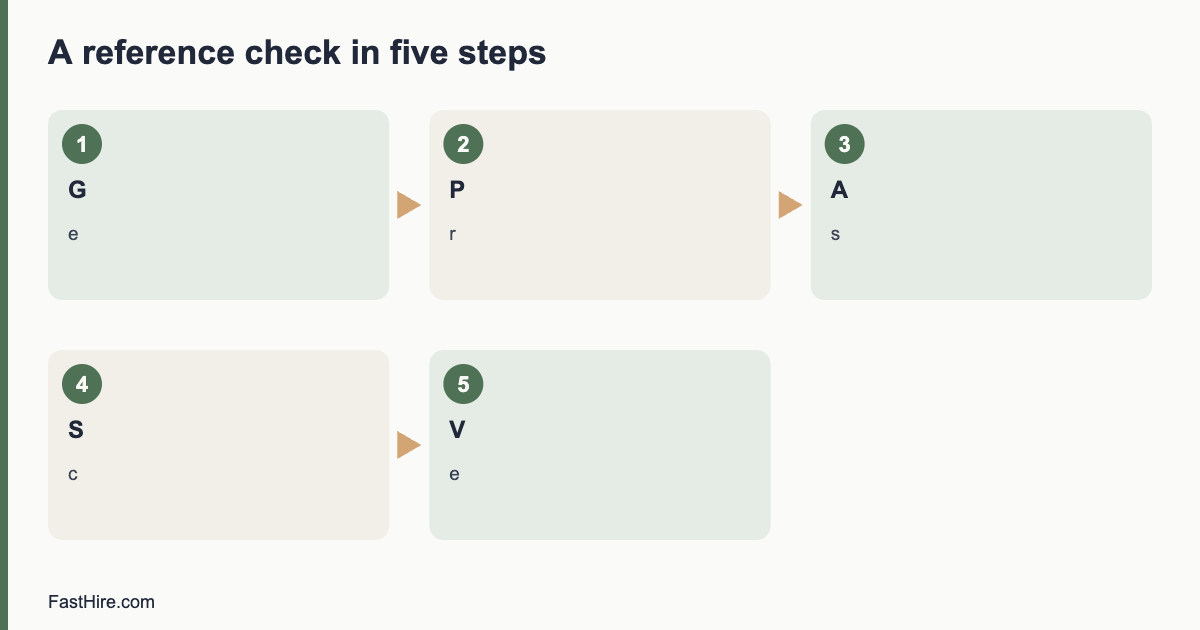
A good reference check tests what you still do not know after the interview. Get the candidate consent, prepare questions from the job requirements, ask the same questions of every referee, score the answers on a fixed scale, and follow up on anything unclear. This guide gives you a question bank, a scoring sheet and rules for staying fair and lawful.
Key takeaways
- Ask for consent first, and use only the referees the candidate names, unless they agree to more.
- Base questions on the requirements, and ask the same core questions for every candidate.
- Ask for facts and examples, not opinions about personality or private life.
- Do not ask about health, disability, family, pregnancy, religion or other protected topics.
- Write down what the referee said, score it, and keep the record for the right time.
What a reference can and cannot tell you
A reference tells you how someone worked for another person. It can confirm facts such as dates and role, show what the person did well, and flag concerns about reliability or conduct. It cannot tell you everything. Referees are chosen by the candidate, and some are cautious or brief because of company policy. Treat a reference as one source among several, alongside interviews, work samples and your scorecard.
For a shorter guide aimed at small businesses, see how to check references. This article goes deeper for hiring managers who want a structured routine.
Before the call
- Check your policy and the law. Many places allow references with consent. See the ICO guidance on recruitment and selection for the UK, and GDPR for job applicants for the EU and UK.
- Ask the candidate for two or three referees and explain the questions you will ask. Ask which referee knows their recent work best.
- Ask permission before you contact a current employer, and respect a request to wait until after the offer.
- Choose a time and a method that suit the referee: a short call is better than an email.
- Prepare four to eight questions from the requirements, and a scoring sheet.
Make the reference a condition of the offer where that is fair and clear, and say so in the offer letter. See the offer letter template.
The opening of the call
Introduce yourself, say why you are calling, and confirm the referee relationship with the candidate. Explain that you will ask the same questions for every candidate, that the candidate gave permission, and that you will keep notes. Ask how long they worked together and in what roles. Then move to the questions. Say thank you at the end and ask if there is anything else you should know that is relevant to the role.
Question bank
Facts and role
- What was the person job title and main duties?
- How long did they work for you, and what were the dates?
- Who did they report to, and did they manage anyone?
- What was the scope of their work, such as the size of the team, budget or customers?
Performance and results
- What were the main results this person achieved? Can you give an example?
- How did their work compare with what the role required?
- How did they handle deadlines and changing priorities?
- What would you say was the quality of their work, and how did you know?
Working with others
- How did this person work with colleagues and customers?
- Can you give an example of how they handled a disagreement or a difficult situation?
- How did they respond to feedback?
- Did they help others learn or succeed?
Reliability and conduct
- How reliable was the person in attendance and meeting commitments?
- Were there any conduct or performance concerns that you formally recorded? What was the outcome? (Only ask what is fair and lawful in your country.)
- Would you rehire this person, and in what kind of role?
Match to this role
- We need someone who can [requirement]. Can you tell me about a time the person did that?
- What kind of support or manager style helps this person do their best work?
- Is there anything about this person approach that we should plan for in the first months?
Questions to avoid
| Avoid | Why | Ask instead |
|---|---|---|
| Was the person often sick? | Health information is private and may be protected | How reliable was the person in meeting commitments? |
| Do they have young children? | Family status is not job-related | Not asked |
| How old are they? | Age is protected | Not asked |
| What religion or background do they have? | Protected | Not asked |
| Did they ever claim a benefit or take sick leave? | Private and possibly protected | Not asked |
| Would you describe them as a team player? | Vague opinion | Give me an example of how they worked with the team |
See interview questions you cannot ask. The same limits apply to reference calls.
Scoring the answers
Use a short scale for each requirement you tested.
| Score | Meaning |
|---|---|
| 0 | Concern about this requirement, with an example |
| 1 | No evidence, or vague answer |
| 2 | Clear positive evidence with an example |
| 3 | Strong positive evidence with scope, result and enthusiasm |
Write the key phrases the referee used, not your interpretation. Note the date, the time and the name and role of the referee. Share the summary with the panel as one input to the decision.
Reading between the lines
Some references are short because the referee is limited by policy to dates and title. This is not a bad sign on its own. Others are warm but vague. Others hint at a problem without saying it. Do not guess at the meaning of silence or tone. Ask a clear follow-up: “Can you give me an example?” or “Is there anything about this person approach that would affect their work in the role we described?” If a worry remains, ask the candidate for another referee, or ask the candidate to talk it through. Give them a fair chance to respond to any serious concern before you decide.
Fairness and legal points
- Apply the same process to all finalists.
- Do not use a reference to learn about protected traits.
- Treat a negative reference as information to verify, not as proof. Give the candidate a chance to respond to a serious concern.
- Keep notes factual and available if the candidate asks for their data, where the law allows.
- Keep the records for the right time and delete them after. See how long to keep rejected applicant data.
- Check local rules on references: in the US see EEOC, in the UK see GOV.UK employing people.
When a referee will not speak
Some companies forbid references beyond dates. Ask what they can confirm, and record it. Then use other sources: another referee, a client, a colleague who worked closely with the person, or a work sample. Do not penalise the candidate for a policy of their old employer.
Written references and online reference tools
Email or form-based references are easier to schedule but give less detail. If you use them, send the same questions to every referee and ask for specific examples. If you use a tool, check how it handles data, and offer a human option. Never treat a tool score as a decision. People should read the answers and decide.
Checklist
- The candidate has agreed to the check and named referees.
- Questions come from the requirements and are the same for all finalists.
- Questions on protected topics are excluded.
- Answers are written down and scored.
- Any concern is verified, and the candidate gets a fair chance to respond.
- The record is stored securely and deleted on time.
Worked example (fictional)
A hiring manager needs a project coordinator. She asks the candidate for two referees and permission to call. She prepares six questions tied to the requirements: planning, supplier work, working with the team, reliability, handling changes and results. On the call, the referee gives a clear example of how the candidate rescued a late delivery by re-planning with the supplier. On reliability, the referee is brief. The manager asks for an example, and the referee describes one missed deadline that the candidate reported early and fixed. The manager scores planning at 3 and reliability at 2, records the notes and shares the summary with the panel. The candidate receives an offer, conditional on the right to work check.
How to run the call well
The best reference calls feel like a conversation, not an interrogation. Start with a few easy fact questions to build rapport. Use the question bank in order, but follow the referee lead when they offer a useful example. Ask “what happened next?” and “what did the person do?” to draw out details. Take notes as you go, and read back key points to check that you heard them right. Keep the call to about fifteen or twenty minutes, and thank the referee for their time.
Listen for specifics. A strong reference includes a concrete example, a result and a sense of how the person worked with others. A weak reference stays general: “great person, very nice”. If you hear only general praise, ask for one example. If the referee cannot give one, record that as no evidence, not as a concern.
Checking facts that matter
Some facts can be checked from a reliable source, and some must be: a licence or a certificate required by law, a professional registration, or a qualification that the job truly needs. Ask the candidate for proof, or check with the issuing body, as the law allows. Do this for every candidate for the same role. Do not check facts that the role does not need. Keep proof of what you checked. See criminal record checks in hiring for rules on checks of that kind, which differ from references.
Timing in the hiring process
Take references late, for finalists only, so that you do not burden referees or alarm candidates who are still in their current job. A common sequence is: interviews, decision in principle, references, conditional offer, other checks, final offer. If you need to speak to a current employer before the offer, get the candidate clear consent first. Keep the other finalists informed about timing, as in how to keep your best candidate warm.
What to do with the information
- Add the scored summary to the candidate file with the interview scores.
- Use it to confirm or question the interview evidence, not to start a new line of judgement.
- If the reference raises a new concern, discuss it with HR and ask the candidate to respond.
- Use useful reference comments to plan onboarding, such as support needs or working style, if the candidate agrees.
- Do not share the details of what a referee said with anyone who does not need them.
Reference scoring sheet you can copy
| Requirement tested | Question asked | Referee answer (key words) | Score 0-3 |
|---|---|---|---|
| Planning | Give an example of how they planned a project | ||
| Working with others | How did they handle a disagreement? | ||
| Reliability | How reliable were they in meeting commitments? | ||
| Results | What was their main result, and how did you measure it? | ||
| Would rehire? | Would you rehire them, and in what role? |
Fill in the sheet during the call and finish it within an hour while the details are fresh. Add a short overall note about anything that needs checking, and flag it to HR if there is a concern. If you use the same sheet for every finalist, you get a clear, fair record that you can compare, and a simple way to explain your decision later. Review the sheet once a year: remove questions that never give useful answers and add questions that reflect what you learned from recent hires. Over time, your reference check becomes shorter, sharper and more useful.
Frequently asked questions
Do I need the candidate permission to call a referee?
In many places you should have it, and you must follow data protection rules. Ask first, and respect requests about current employers.
How many references should I take?
Two or three are usual. Choose referees who know the recent work. One strong, detailed reference is better than three vague ones.
What if a reference is negative?
Check the facts, ask for examples, and give the candidate a chance to respond. Do not decide on one opinion.
Can I call people the candidate did not name?
Only if the candidate agrees, and local law allows it. Contacting unnamed people can breach trust and data rules.
Related guides
This is general information, not legal advice.