
To manage hiring across the US, UK and EU, build one core process and add a short local layer for each country. The core covers requirements, structured interviews, scoring and records. The local layer covers discrimination rules, applicant data, right to work, pay information and contracts. Check each local layer with a qualified adviser. This guide shows how.
Key takeaways
- One core process, many local layers: the same scorecard and questions everywhere, with local rules added on top.
- Rules differ most on discrimination detail, applicant data, right to work, pay information and notice.
- Applicant data may need a lawful basis, a notice and a safe transfer route across borders.
- Write down, for each country, who owns the local check and when it is done.
- Use official sources, and ask a local adviser to confirm before you launch in a new country.
Why a global process is not enough
A recruiter who works across countries soon finds that a process that works in one place fails in another. A background check allowed in the US may be restricted in the UK or EU. A question that is routine in one country may be unlawful in another. A candidate right to see their data in the EU may call for a response time that your US team does not know about. Without a local layer, small differences cause big problems.
Step 1: build the core process
The core is everything you can do the same in every country. Use it as your standard.
- A role brief with checkable requirements. See how to write checkable job requirements.
- A scorecard with a fixed scale, and structured interviews. See structured interviews.
- A shortlist review with evidence. See shortlist review with hiring managers.
- Candidate communication standards. See candidate experience checklist.
- Record keeping and fair feedback. See feedback to rejected candidates.
Step 2: list the local layers
| Topic | US | UK | EU |
|---|---|---|---|
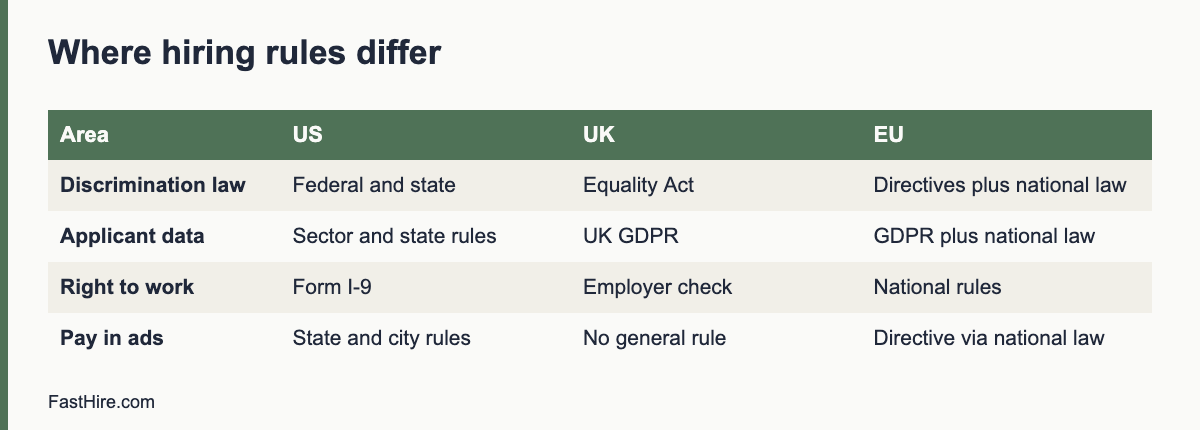
| Discrimination law | Title VII, ADA, ADEA and state laws; see EEOC | Equality Act 2010; see GOV.UK | Directives applied through national law; see EUR-Lex |
| Applicant data | Varies by state; some state laws cover applicants | UK GDPR and Data Protection Act; see ICO | GDPR plus national law; see EDPB |
| Right to work | Form I-9 | Check before the start date | National rules |
| Pay information | State and city rules on ranges | No general rule | Pay transparency directive via national law |
| Criminal records | State fair chance laws; FCRA for third-party reports | Rehabilitation of Offenders Act; DBS | Strict data rules; national law |
| Automated tools | Local rules, such as NYC Local Law 144 | UK GDPR rules on automated decisions | GDPR Article 22; EU AI Act |
Each of these has a guide on this blog: fair practice on criminal records, how to check the right to work, salary in job ads, NYC Local Law 144, GDPR Article 22 and the EU AI Act and hiring tools.
Step 3: handle applicant data across borders
If you collect data in one country and use it in another, data protection rules apply. Under GDPR and UK GDPR, transfers of personal data outside the EU or the UK need a lawful transfer route, such as an adequacy decision or approved clauses. Check what applies to your set-up. Tell candidates where their data goes and who sees it. Limit access to the people who need it. Keep one record of processing for recruitment. See GDPR for job applicants and the applicant privacy notice template.
Some US states give job applicants privacy rights. Ask your adviser which apply to you. If your system holds applicant data of EU or UK residents, treat it under GDPR rules, even if your company is based in the US.
Step 4: assign owners
| Task | Owner | When |
|---|---|---|
| Confirm the local rule for each topic above | Local HR or adviser | Before the role opens |
| Review the ad for local wording and pay rules | Recruiter and local HR | Before posting |
| Adjust interview questions and process | Recruiter and hiring manager | Before interviews |
| Right to work and other checks | Local HR | After the offer |
| Applicant data notice and retention | Data protection lead | Before collecting data |
| Contract and notice terms | Local HR or adviser | Before the offer |
Step 5: adapt the process country by country
United States
Expect a mix of federal and state rules. Check state and city laws on pay information, criminal history, and automated tools. Make sure your ads and questions avoid protected topics. Hiring is often fast, and at-will employment shapes contract terms. See probation periods for how this differs from the UK and EU.
United Kingdom
Check the right to work before the start date and keep the record. Follow the Equality Act on adjustments and discrimination. Pay information is not required in every ad, but equal pay rules apply. Written terms of employment are expected. Use GOV.UK as your starting point.
European Union
Each member state has its own rules on contracts, notice, probation, data, and records. Works councils or employee representatives may need to be involved in some countries. Language, form and documents differ. Use the Your Europe pages on human resources as a starting point, then speak to a local adviser for the country where the person will work.
Step 6: use plain language and local norms
Resume and CV norms differ by country. In the US, a resume leaves out personal details such as a photo and date of birth. In parts of Europe, those are common. Treat them as signals to set aside during screening, and see what to look for on a resume or CV. Use plain English, and translate the ad and the key messages when the language of the work is not English. Test translations with a native speaker.
Step 7: keep records in one place, with local labels
Keep one tracker with the same columns for each country, and add a local column for the extra checks. Record the date, the owner and the result for each. This gives you a clear view of where each hire stands, and a single audit trail. Store records in the region your policy allows, and delete them on schedule. See how long to keep rejected applicant data.
Common mistakes
- Applying US rules everywhere, or the reverse.
- Collecting data without a notice or a lawful basis.
- Using the same pay and benefits wording in every country.
- Running a criminal record check that is not allowed.
- Forgetting right to work checks for remote hires.
- Not telling a hiring manager about local differences, so they ask unlawful questions.
- Assuming that a tool is lawful everywhere.
Working with local advisers
Choose an adviser in each country where you hire regularly: an employment lawyer, a payroll provider or a local HR consultant. Ask for a short guide on the local rules for hiring, contracts, notice, probation and data. Keep it with your process documents. Review it each year. Ask the adviser to check any new tool or process before you roll it out. This costs little compared with an error in a new country.
Checklist
- One core process with scorecards and structured interviews.
- A local layer for each country, confirmed by an adviser.
- Owners named for each local task.
- Applicant data notice, transfer route and retention set.
- Ads and questions checked for local rules.
- Right to work and other checks planned after the offer.
- Records kept in one tracker with local columns.
- The process reviewed every year.
Worked example (fictional)
A software company based in the US plans to hire engineers in the UK and Germany. The recruiter keeps the core process: the same role brief, scorecard and structured interview. She lists the local layers in a table and asks a UK employment adviser and a German adviser to confirm them. She changes the application form to avoid asking for a photo or date of birth, adds a privacy notice that names the data controller and the transfer route, and sets right to work checks after the offer. She plans the UK start date after the check, and checks German notice terms with the local adviser. The process works, and she reuses the table for the next country.
Choosing tools for a multi-country process
Your applicant tracking system, scheduling tool and assessment tools may store data in one region and serve users in many. Before you choose or change a tool, ask the supplier where data is stored, how transfers are handled, what access controls exist, how long data is kept, and how it supports deletion and access requests. Ask whether the tool supports multiple languages and local forms. Ask whether it uses any automated decision-making that could trigger extra rules, and whether a person can review every output. Our guide to choosing recruiting software and the ATS compliance checklist cover the details.
Communicating with candidates in different time zones and languages
Candidates in other regions need clear timing. Write the time zone with every date. Offer interview slots in the candidate daytime where you can, and rotate the inconvenient hours rather than placing them always on one side. Reply within a working day in the candidate local time when possible. If the work language differs from the candidate first language, say what level is needed and test it in a way that matches the real tasks. Provide key documents, such as the privacy notice, in the local language if the law requires it or if it helps understanding.
Public holidays, notice periods and start dates
Calendars and norms vary. Public holidays differ between countries and even regions. Notice periods in the UK and parts of the EU can be longer than in the US, so a start date may be months away. Build this into your plan. Ask candidates about their notice period early, and check whether it is set by law, contract or custom. Do not promise a start date before you know. See how long hiring takes for planning stages.
Measuring a multi-country process fairly
Track the same measures in every country: time to fill, drop-out by stage, offer acceptance and candidate feedback. Compare, but do not copy targets from one country to another without checking local market conditions. Where the law allows, track outcomes by group in each country, and review any gaps. In places where collecting such data is restricted, use other checks, such as audits of question lists and scorecards. Report results to leaders in a simple table, and agree on actions for each country.
A starter plan for the first 30 days in a new country
- Week 1: name an adviser and an internal owner for the country. List the topics in the local layer table and mark what is confirmed.
- Week 2: adapt the ad, form, questions and privacy notice. Check them against the local rules with the adviser.
- Week 3: set up the tracker, the right to work step and the contract template. Brief hiring managers on what they may and may not ask.
- Week 4: run the first role as a pilot. Review what slowed it down, what the adviser changed and what candidates said. Update the table and the checklist.
After the pilot, write a one-page country note that any recruiter can follow. Keep it short, keep it dated, and link to the official sources you used. When rules change, update the note, and tell the team. A small, well-kept set of country notes is more useful than a large policy that no one reads, and it gives your business a safe, fair way to grow into new markets while keeping the candidate experience consistent and respectful everywhere you hire.
Frequently asked questions
Can I use the same interview questions in every country?
The core questions about skills can be the same. Check each country for questions on protected topics, and avoid them everywhere.
Does GDPR apply to a US company hiring in the EU?
It can, if you handle personal data of people in the EU in connection with offering them jobs or monitoring them. Take advice for your case.
Do I need a local entity to hire in another country?
Sometimes. Other options include an employer of record or a contractor, if the law allows it. Take local advice.
Who should check the local rules?
A qualified adviser in each country. Use official sources to prepare and to check their advice.
Related guides
This is general information, not legal advice.