
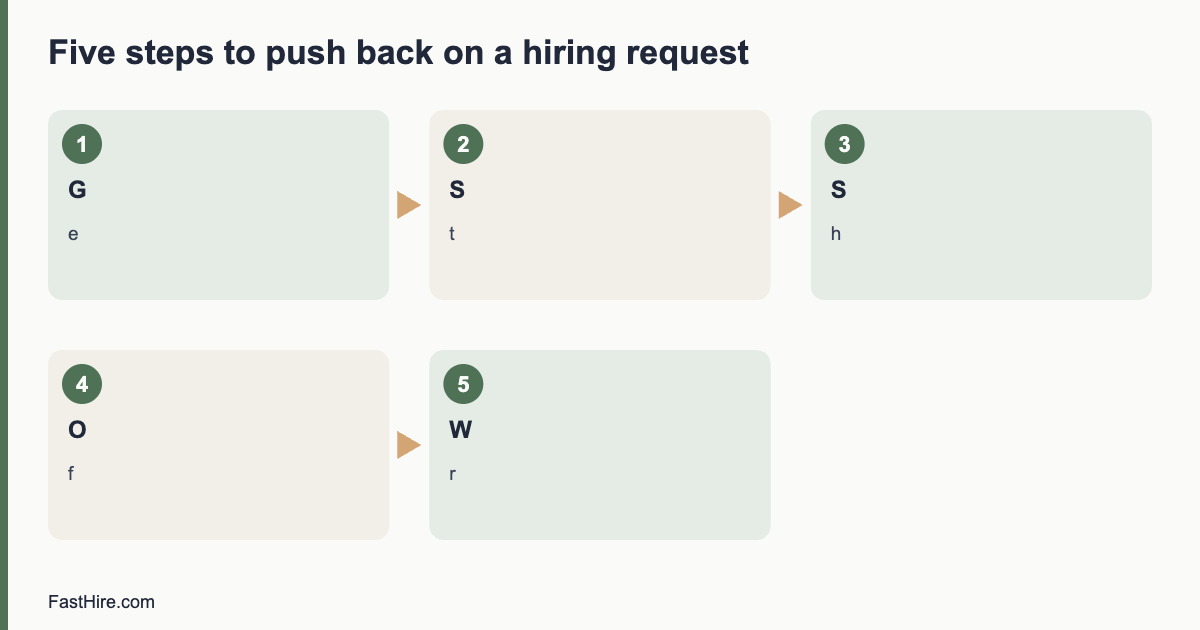
To push back on an unrealistic hiring request, do not say no. Show the evidence, ask what outcome the manager needs, offer two or three options with trade-offs, and agree one change with a date. Use your own numbers, real adverts and candidate feedback, and keep the tone calm and practical.
Key takeaways
- Most unrealistic requests come from habit, pressure or a missing picture of the market, not from bad intent.
- Bring evidence: your own pipeline numbers, current adverts, pay data from official sources and candidate comments.
- Ask about the outcome behind the request before you discuss the request itself.
- Offer options with trade-offs, such as a wider requirement, a higher pay range or a longer timeline.
- Write down the agreement and review it on a set date.
What “unrealistic” usually means
| Request | What lies behind it | Typical effect |
|---|---|---|
| A very long list of must-haves | Fear of a bad hire; a list built from several people’s wishes | A tiny pool; good people screened out for reasons that do not affect the work |
| A pay range below the market | Budget limits; the pay of the previous employee | Few applicants; declined offers |
| A start date in two weeks | Urgent gap in the team | Candidates with notice periods cannot start; you lose strong people |
| “Only people from top companies” | A belief that prestige signals quality | Narrow pool and possible unfair filtering |
| “Do not interview anyone before you have 50 CVs” | A wish to compare many people | Delay; strong candidates accept other offers |
| “We need a unicorn who does three jobs” | Budget for one role, work for three | A role no one can do, and burnout for the person hired |
| “Reject anyone with a gap in their CV” | A shortcut to reduce risk | Unfair filtering of carers, people with health issues and others |
Notice that each request has a reason you can discuss. The aim is not to win an argument. It is to help the manager reach the outcome they want.
Step 1: Get the facts ready
A pushback with facts is a conversation. A pushback with opinion is a dispute. Collect four types of evidence before the meeting.
- Your own pipeline data. Applicants per role, stage conversion, time to hire and offer acceptance from similar searches. See eight recruitment numbers worth tracking. If the numbers are thin, say so.
- Live market examples. Five to ten current adverts for similar roles. Note the requirements, the pay shown and the location rules. Do not name competitors in anything you publish, but for an internal discussion the examples help.
- Official labour and pay data. In the US, the Bureau of Labor Statistics publishes the Occupational Outlook Handbook with pay and demand notes by occupation. In the UK, GOV.UK publishes National Minimum Wage rates as a pay floor, not a market rate. In the EU, EURES gives labour market information by country. Use these as context, not as proof of any single salary.
- Candidate voice. Comments from declined offers, withdrawn candidates and interview feedback. A line such as “the pay was below other offers” is more convincing than your opinion.
Our guide to reading market data before you open a role, when it is published, will go deeper on this step.
Step 2: Start with the outcome
Open the conversation with a question about the goal. People defend a request when you attack it, but they will explain a goal.
“I want to help you fill this role well. Can I check what you need this person to achieve in the first six months? Then I will show you what I see in the market, and we can decide together how to get there.”
After the manager answers, repeat the goal in your own words, and ask if you have it right. Now the discussion is about how to reach the goal, and the original request becomes one option among several.
Step 3: Show the evidence, calmly
Share one or two facts at a time, in a simple form. A small table is better than a long deck. Here is a fictional example of how to present a requirements problem.
| Requirement | Candidates meeting it (from 120 applicants) | Notes |
|---|---|---|
| Degree in the exact field | 14 | Many strong candidates trained on the job |
| Five years in the exact title | 9 | Several have equal experience under other titles |
| Both of the above and agency experience | 2 | Only two are available this month |
The numbers above are invented to show the format. In a real discussion, use your own records. The aim is to let the manager see that each added requirement removes most of the pool. Then ask: “Which of these three is essential on day one?”
Step 4: Offer options, not objections
Give two or three clear choices with trade-offs. The manager keeps control of the decision, and you show that you have a plan.
| Option | What changes | Trade-off |
|---|---|---|
| A. Keep the requirements, raise the pay range | Better chance of attracting the few matching people | Higher cost; budget approval needed |
| B. Keep the pay range, relax two requirements and train | Larger pool; some training needed | Slower start to full performance |
| C. Keep both, extend the timeline | Same pool, more time to find people | The gap stays open longer; interim cover needed |
| D. Split the role | Two roles with clearer scopes | Two hires; more cost in total |
If the manager chooses A or C, ask for a sign-off from the person who controls the budget or the deadline, so the decision does not fall back on you later.
Step 5: Write the agreement
After the meeting, send a short note: “We agreed to change X to Y, review progress on [date], and use [metric] to decide whether to adjust again.” Keep it neutral. This protects both of you from misremembering. If the situation changes, you can point to what was agreed.
Scripts for common situations
| Situation | Try saying |
|---|---|
| The list is too long | “If we could only keep three of these, which three would you keep? Which others could the person learn in three months?” |
| The pay is below the market | “The five adverts I found for similar roles offer more. Candidates compare offers. What flexibility do we have, on pay or on other parts of the package?” |
| The timeline is too short | “Candidates who are working need time to give notice. If we start on [date], the earliest realistic start is after the notice period. Do you want to plan interim cover?” |
| Only top companies | “What does experience at those companies show that we need? Can we write the skill itself, so we can also see it in people from other places?” |
| Reject people with a gap in their CV | “A gap alone does not show whether someone can do the job. We risk unfair filtering. Can we check the same skills for everyone?” |
| The manager wants to bypass the process | “I want to keep it fair for all candidates and fast for you. What is the part you find slow? Can we change that part?” |
When the manager still says no
Sometimes the answer stays the same. You have three honest choices. You can run the search as asked and track the results, sharing them at an agreed date. You can escalate calmly to your own manager or HR partner, with a short summary of the facts and the options offered. Or you can decline a request that is unlawful, such as a requirement based on a protected trait. In that last case you do not negotiate. Explain the rule, point to official guidance, and offer a lawful alternative. For example, the Equal Employment Opportunity Commission lists prohibited practices on its page on prohibited employment policies and practices, and Acas explains the position in Great Britain on its recruitment page.
Keep a record of your advice and the decision. This is not to blame anyone. It helps the team learn when it reviews results.
Build trust so that pushback gets easier
- Deliver on small promises. Send the first shortlist on the date you promised.
- Share wins. When a changed requirement leads to a good hire, say so, with the manager as the author of the decision.
- Share the numbers regularly. A short monthly update makes your data part of the normal conversation.
- Invite their view. Ask what you could do better. A manager who feels heard hears you more easily.
- Use calibration. Compare sample CVs together, as in our guide on intake meetings.
FastHire is being built to make this kind of discussion factual. It shows each job requirement next to the exact CV passage that supports it, so you can see how a requirement affects the pool. FastHire is coming soon. It does not rank, score or reject candidates. People make every decision.
A one-page pushback brief
Before a hard conversation, fill in this page. It takes 15 minutes and keeps you calm and specific.
| Line | Your entry |
|---|---|
| The request, in the manager’s words | Write it exactly |
| The goal behind it (best guess, to confirm) | What outcome do they need? |
| Two facts that bear on it | From your data, adverts or official sources |
| The effect on the pool, fairness or time | Numbers if you have them, otherwise a clear description |
| Two or three options with trade-offs | Use the table above |
| The change you will ask for | One change, with a date |
| What you will do if the answer is no | Run as asked, track, review, escalate |
Tone: three habits that help
- Use “we”. “How can we reach the goal?” is better than “You are wrong”.
- Slow down. Pause before you reply to a strong statement. Repeat back what you heard.
- Keep it short. Give one fact, one question and one option at a time. Long lists feel like a lecture.
Remember that the manager is under pressure too. They may have a team that is stretched, a deadline from their own boss or a budget that was cut. If you start with that picture, your tone will be kinder, and the manager will be more likely to listen.
Following up after a change
Once the manager agrees to a change, follow up on the date you set. Bring the same type of evidence you used before: how many applicants, how many passed each stage, how long it took. If the change helped, say so and thank the manager. If it did not, ask what the data suggests and agree the next step. Keep a short log of each agreement and its result. After a few searches, you will have a record that shows which changes worked in your company. That record is the most persuasive argument you can bring to the next manager.
Share what you learn with other recruiters. A shared document of past pushbacks, with the facts and the result, lets new team members start from experience instead of from zero. Remove names before you share it so that managers are not singled out.
Frequently asked questions
Is it my job to challenge a hiring manager?
Yes, in a constructive way. A recruiter’s value includes honest advice on the market, the process and the law. The manager makes the hiring decision, and you help them see the options.
What if I have no data because the role is new?
Use market examples, official data and your experience from similar roles. State that the evidence is limited and propose a short review after a fixed number of weeks.
How do I respond to “just do what I asked”?
Confirm that you will run the search as agreed, state your concern in one sentence, and agree a date and a metric to review. Then do the work well.
Should I put pushback in writing?
Yes, in a short, neutral summary after a conversation. Avoid blaming language.
Can I refuse a requirement that looks discriminatory?
Yes, and you should. Explain the risk, share the official guidance and offer a lawful way to meet the goal. Tell your HR partner if the manager insists.
Related guides
- Hiring guides for recruiters and HR teams
- How to run an intake meeting with a hiring manager
- Recruitment metrics: eight numbers worth tracking
- Must-haves vs nice-to-haves
- All hiring guides for employers
- How to read market data before you open a role
- How to run a calibrated shortlist review with hiring managers
This is general information, not legal advice.