
A bad hire costs more than the salary you paid. You also pay for recruitment time, training, errors, lost customers, extra work for colleagues and the cost of hiring again. There is no single trusted figure that fits every business, so the useful step is to estimate your own cost with a simple worksheet and then reduce the risk with a fair, evidence-based process.
Key takeaways
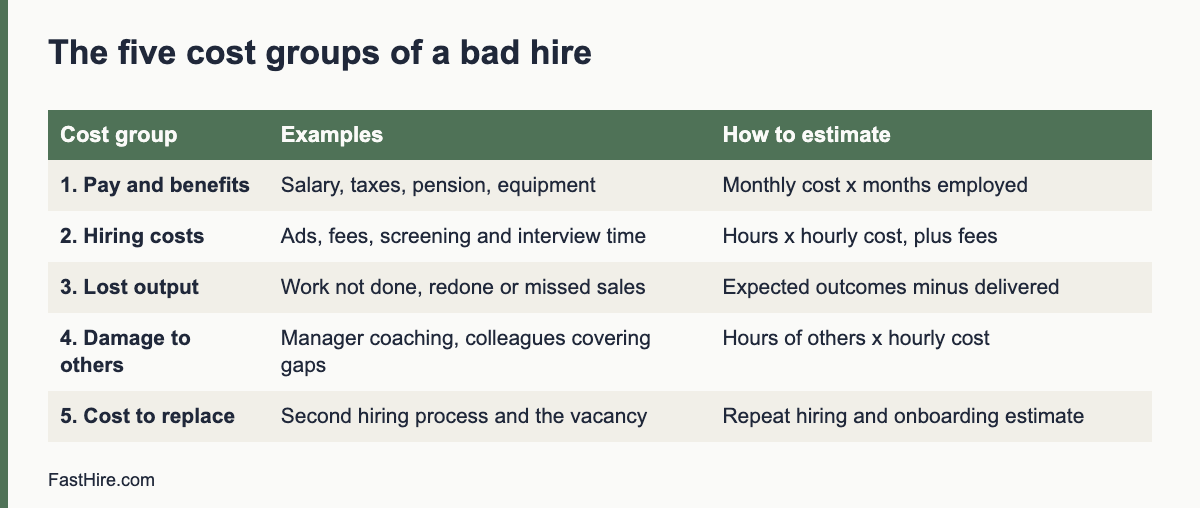
- Count five cost groups: pay and benefits, hiring costs, lost output, damage to others and the cost to replace.
- Use your own numbers. Averages from other firms rarely fit a small business, and many published figures have no clear source.
- Most mis-hires start before the interview: a vague role, an unclear must-have list or a rushed process.
- Ten controls lower the risk: a written brief, checkable must-haves, structured interviews, work samples, references, a clear offer, onboarding, early check-ins, fair probation use and prompt action.
- Fairness is part of risk control. A decision based on evidence is easier to defend and more often right.
What “bad hire” means
A bad hire is a person who does not meet the main outcomes of the role after a fair chance. Sometimes the person lacks a skill. Sometimes the role was never clear, the manager gave little support or the person and the business did not suit each other. All three produce the same cost, so it helps to ask early: was this a person problem, a role problem or a management problem? The answer decides what to fix.
Be careful with the label. A person who struggles in the first weeks is not a bad hire yet. Most people need time and support. Treat “bad hire” as a conclusion you reach after clear goals, honest feedback and enough time, not as a first reaction.
The five groups of cost
| Cost group | Examples | How to estimate it |
|---|---|---|
| 1. Pay and benefits | Salary, employer taxes and social contributions, pension or retirement contributions, insurance, equipment and software for the months the person worked | Monthly cost of the person multiplied by months employed |
| 2. Hiring costs | Job ads, agency fees, your time and your colleagues’ time to screen and interview, background checks | Hours spent multiplied by an hourly cost, plus fees |
| 3. Lost output | Work that was not done, done wrongly or redone; missed sales; delayed projects | Value of the outcomes expected minus what was delivered |
| 4. Damage to others | Manager time spent coaching, colleagues covering gaps, customer complaints, a drop in team morale | Hours of other people’s time multiplied by their hourly cost, plus any lost revenue |
| 5. Cost to replace | A second hiring process, a gap with no one in the role, onboarding and training the next person | Repeat the hiring and onboarding estimate, plus the vacancy period |
Group 3 and group 4 are the hardest to measure and often the largest. You can still estimate them with honest ranges, for example “two hours a week of manager time for twelve weeks”.
A worksheet you can copy
Open a spreadsheet and fill in these lines. Use your own figures. The example below is arithmetic to show how the sheet works, not a benchmark or a statistic.
| Line | Your figure | Example (hypothetical) |
|---|---|---|
| A. Monthly cost of the employee (pay, taxes, benefits, equipment) | [you fill in] | 3,500 per month |
| B. Months employed | [you fill in] | 4 months |
| C. Hiring cost the first time (hours x hourly cost + fees) | [you fill in] | 1,200 |
| D. Manager and colleague time lost (hours x hourly cost) | [you fill in] | 60 hours x 30 = 1,800 |
| E. Value of lost or redone work and lost sales | [you fill in] | 1,500 |
| F. Cost of the second hiring process and the vacancy | [you fill in] | 1,400 |
| Total = A x B + C + D + E + F | [you fill in] | 14,000 + 1,200 + 1,800 + 1,500 + 1,400 = 19,900 |
When you do this for a real case, you usually find that the salary is less than half of the total. Use the total to decide how much time and money it is worth spending on a better hiring process. If one mis-hire costs more than a small business earns in a month, a few extra hours on a role brief and structured interviews are a bargain.
Where mis-hires really start
Look back at your last difficult hire. In most cases, the problem began in one of these places.
- An unclear role. If you cannot say what the person must achieve in 90 days, you cannot judge a candidate or a new hire.
- A wish list instead of must-haves. Long lists make you hire for charm or for the one flashy item.
- An unstructured interview. A friendly conversation tests rapport, not skill.
- No evidence. Decisions by feeling cannot be checked, repeated or defended.
- Rushing. Urgency pushes teams to settle for the first acceptable candidate.
- Weak onboarding. A good hire can fail because nobody explained what good looks like.
Ten controls that lower the risk
- Write a one-page role brief with outcomes for the first 90 days. See our first hire plan for the format.
- Set three to five checkable must-haves and keep them fixed. See must-haves vs nice-to-haves.
- Advertise clearly, with pay, location and process, so that people can screen themselves. See how to write a job ad.
- Screen on evidence. Note the CV line that supports each must-have. See how to screen applications quickly.
- Use a structured interview. The same questions, the same order and a scoring scale for every candidate.
- Add a work sample for roles where you can test the real task in 30 to 60 minutes. Pay candidates for tasks longer than an hour.
- Check references with the same questions for each referee, after you ask permission.
- Make a clear written offer with the terms, so that nobody starts with different expectations.
- Onboard on purpose. Give a 30-day plan, a buddy and a check-in each week.
- Act early. If the first 30 days show a gap, say so, offer help and write down the plan. Do not wait for month six.
Early warning signs, and what to do
Most mismatches show up in the first month, but they only matter if you notice them. Watch for these signals and respond in a fair, documented way.
| Signal | First response |
|---|---|
| The person misses the first small deliverables | Check that the goals were clear and the tools worked. Agree a short, specific target for the next week. |
| The person asks few questions or hides problems | Ask for a short daily update for two weeks. Explain that questions are expected. |
| Colleagues report friction | Listen to both sides. Look for facts, such as missed handovers, not for personality labels. |
| The person says the job is not what they expected | Compare the job as advertised with the job as done. If the ad was inaccurate, fix the ad and the role. |
Write notes after each conversation. If you later need to end the employment, the notes show what you said and when. Rules for notice, probation and dismissal differ by country and change over time. In the US, the Department of Labor describes federal rules on termination, and state law adds more. In the UK, GOV.UK explains dismissal rights, and Acas offers guidance for employers. In the EU, rules are mainly national. Ask an employment adviser before you dismiss anyone.
Probation and trial periods: use them well
A probation or trial period is a useful check, but it is not a safety net for a weak process. Rules differ widely. Some countries set a legal maximum, some do not use the concept at all, and employment protections may still apply during probation. Write the terms in the contract, set review dates (for example at 30, 60 and 90 days) and give honest feedback at each one. Our guide to the probation period in each country will cover this in more detail.
The fairness side of risk
A hiring process that follows written criteria is also a fairer process. Decisions based on evidence are easier to explain, and you reduce the risk of a discrimination claim. In the US, the Equal Employment Opportunity Commission lists the main rules on its page about prohibited employment policies and practices. In Great Britain, the Acas page on recruitment explains the duty not to discriminate when choosing who to hire.
FastHire is being built around the same idea: show each job requirement next to the exact CV passage that supports it, so that people decide on evidence. FastHire is coming soon. It does not rank, score or reject candidates. People make every decision.
A short post-mortem after a mis-hire
If a hire does not work out, write a one-page review within a week. Answer five questions: What did we need? What did the ad and the interviews say we were getting? What did we see in the first 30 days? Which step in the process could have shown the gap earlier? What will we change in the next hire? Share it with the people who took part. The aim is to improve the process, not to blame a person. One honest review is worth more than any benchmark.
A 30-day check-in script that catches problems early
A short, structured conversation at 30 days is the cheapest control on this list. Block 45 minutes and use the same outline for every new hire. Share the questions a day earlier so that the person can think.
- What has gone well so far? Let the person speak first. Note specific examples.
- Which outcomes from the role brief are on track, and which are not? Go through the three to five outcomes one by one. Use facts, such as deliverables and dates.
- What has been harder than expected? Listen for gaps in tools, training or information that you can fix.
- What do you need from me? Offer support before you give criticism.
- What will we both do in the next 30 days? Write down two or three clear actions with dates.
Then give your own feedback in the same order. A useful sentence has three parts: what you saw, why it matters and what you want to see next. For example: “The weekly report was two days late both times. The team plans its Monday around it. Please send it by Friday noon from now on, and tell me on Thursday if you are at risk.”
Write a five-line summary after the meeting and send it to the person. If the 60-day check shows no progress on the same point, you have a record that you were clear and fair, and the person has had a real chance. If the person grows, you have also learned something about how to onboard the next hire.
Decision table: stay, support or exit
| What you see at 30 to 90 days | Likely cause | Next step |
|---|---|---|
| Good outcomes, slow start | Normal learning curve | Keep the plan and review again in 30 days |
| Mixed outcomes, willing and open to feedback | Gaps in training or unclear goals | Add training, clarify goals, check again in two weeks |
| Missed outcomes and no change after clear feedback | Skill or fit mismatch | Take advice on the legal steps in your country, then decide |
| Conduct problems such as dishonesty or harassment | Conduct, not performance | Follow your policy and the law at once, and take advice |
Use the table as a thinking aid, not a rule. Each case has its own facts, and local employment law may limit what you can do and how fast.
Frequently asked questions
How much does a bad hire cost?
It depends on the role, the pay and how long the problem lasts. Use the worksheet above to estimate your own figure. Be careful with published averages that do not name their source.
Is a bad hire always the candidate’s fault?
No. Unclear roles, poor onboarding and weak management cause many failures. Ask what you could have done differently before you decide.
How can I reduce the risk of a bad hire without spending much?
Write the role brief, set checkable must-haves, ask the same questions of every candidate and check references. These steps cost hours, not money.
Should I fire quickly if I realise it is a mistake?
Act early, but fairly. Give clear feedback and a short chance to improve, write down what you say and follow the legal rules for your country.
Do work samples help?
They can, because they test the real task. Keep them short, relevant and accessible, and pay for longer tasks.
Related guides
- Hiring guides for small businesses and founders
- How to make your first hire: a step-by-step plan for founders
- How to screen applications quickly: a 20-minute method for small teams
- How to write a job ad that attracts the right applicants
- All hiring guides for employers
- How much does it cost to hire an employee? A cost worksheet
- Do you need a probation period? How it works in each country
This is general information, not legal advice.