
Read a resume or CV against your written must-haves, not against a general impression. For each must-have, look for evidence: a task, a result, a tool, a qualification, a period of time. Note questions to ask at interview, and score every candidate the same way. This guide shows what to look for, what to ignore and how to avoid common traps.
Key takeaways
- Start from your must-haves. Without them, you will judge by style and instinct.
- Look for evidence, not labels. “Led a team” is a label. “Led a team of four to deliver X by Y” is evidence.
- Judge the quality of examples: scope, role, result, and how recent.
- Treat gaps, job changes and unusual paths as questions to ask, not as faults.
- Ignore signs that do not predict work: name, photo, age, address, school prestige, and font.
Before you open the first resume or CV
Decide what you are looking for. Write the must-haves and the nice-to-haves, as explained in must-haves vs nice-to-haves and how to write checkable job requirements. A good must-have can be checked on a document. “Has used a spreadsheet to build a monthly report” can be checked. “Passionate about data” cannot.
Set up a simple sheet: one row per candidate, one column per must-have, and a column for notes and interview questions. If you also work with a recruiter, share the sheet. For volume, see how to screen applications quickly.
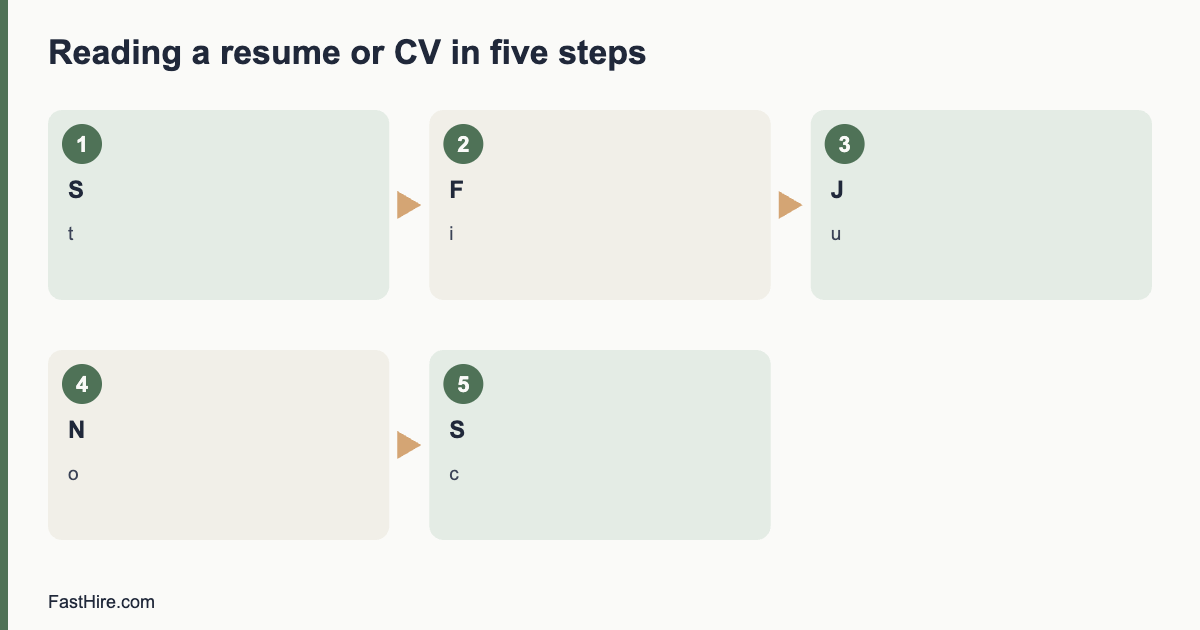
Step 1: match each must-have to evidence
Go through the document with one must-have at a time. Highlight the text that supports it, and write a short note. If you cannot find evidence, mark it as not shown. This is different from not met: the person may have the skill but not have written it down. You can ask at the interview or in a short screening call.
| Must-have | Evidence to look for | Note |
|---|---|---|
| Managed a budget | A budget amount or scope, what it covered, any result | Ask about the largest item |
| Used a specific tool | Tool name, what it was used for, how often | Ask for a task example |
| Worked with customers | Role, type of customers, volume, outcome | Ask about a hard case |
| Held a licence or qualification | Name, issuing body, status | Check the original if it is a legal need |
| Led or trained others | Number of people, outcome | Ask how they handled a problem |
Our guide on screening resumes with must-haves and evidence goes deeper on this step, and shows how FastHire is designed to place each requirement next to the exact passage that supports it, so you see the evidence at once. FastHire is coming soon, and people make every decision.
Step 2: judge the quality of the evidence
Not all evidence has equal weight. Ask four questions about each example.
- Scope: how big was the task, team, budget or customer base?
- Role: did the person do it, lead it or only help?
- Result: what changed because of the work? Is there a measure?
- Recency: when did they do it, and are the tools or rules still the same?
A short, concrete example beats a long, vague one. “Cut the time to close the month from six days to four by changing the order of tasks” says more than “improved processes”. Be careful, though: people who are not used to writing about themselves may under-describe their work. Ask a question before you reject.
Step 3: read for patterns, not single lines
Look at the whole document. Does the person show steady growth in responsibility? Do they learn new tools? Do they stay long enough to see results of their work? These are useful signals, but they are not rules. A person who moved often may have worked on contracts. A person who stayed long may have had many roles inside one company.
Signs that are worth a question
- A skill is listed but no job mentions using it.
- A title is senior but the described tasks are junior, or the reverse.
- Dates that do not add up.
- A big claim with no scope.
- Very generic text that could fit any job.
Each of these is a prompt for a question, not proof of a problem. Use a short screening call or interview question to check.
What not to read into a resume or CV
Some features feel important but do not predict work, and some can cause unfair treatment. Set them aside.
| Feature | Why to set it aside |
|---|---|
| Name, photo, address | Can reveal sex, ethnicity, age or background, and are not job-related |
| Age or graduation year | Age discrimination law can apply |
| Marital status, children | Not job-related, and can lead to unfair assumptions |
| Gaps in work history | Common and often for good reasons. Ask about them neutrally if it matters, or not at all |
| School name or brand | Weak link to ability, and can favour people with more money or connections |
| Design, fonts, layout | Tell you about the writer tools, not the work |
| Spelling errors | Matter only if accuracy in writing is a real requirement. Consider the writer first language and any disability such as dyslexia |
The law differs by country, but the principle is shared. In the US, the EEOC lists prohibited practices. In the UK, see GOV.UK employing people and the Equality Act guidance. In the EU, see the equal treatment guide. For ideas on reducing bias in the screening step, read how to reduce bias in resume screening.
Step 4: prepare interview questions from what you saw
The resume or CV is a list of claims. The interview tests them. For each finalist, write two or three questions that come from the document.
- “You list a budget of X. What did it cover, and what was your part?”
- “The role description mentions a tool. Show me how you used it in one real task.”
- “There is a gap between these two jobs. Is there anything you want to tell me about that period?” Ask only if the gap matters for the job, and only in a neutral way.
Then use a structured interview, as in how to run structured interviews, so each person answers the same core questions.
Step 5: score and compare
Use a simple scale, such as zero for no evidence, one for weak, two for clear and three for strong. Score each must-have, add notes, and set a threshold for moving to the next stage. Keep the scale the same for all candidates. Where possible, ask a second person to score a sample, and compare. If your scores differ widely, talk about why and adjust the criteria.
| Score | Meaning | Example |
|---|---|---|
| 0 | No evidence on the document | No mention of the tool |
| 1 | Weak or vague | Lists the tool with no detail |
| 2 | Clear evidence | Used the tool for a named task |
| 3 | Strong evidence | Used the tool for a task with scope and a result |
Do not add up scores blindly. The total is a guide. Look at must-haves one by one, and discuss close cases. People decide, not the sheet.
Using tools and AI for screening
If a tool helps you read resumes or CVs, keep a person in charge. Check what the tool does, what data it uses, and whether it can explain its output. Some places have rules for automated hiring tools, such as New York City Local Law 144 and GDPR Article 22. FastHire is coming soon and is designed to show evidence, not to rank or reject people.
A one-page checklist
- Must-haves and nice-to-haves are written before screening.
- One sheet is used for all candidates.
- Evidence is noted for every must-have, with its source on the document.
- Questions are noted for each gap or unclear claim.
- Name, photo, age and similar details are set aside.
- A second person checks a sample of scores.
- Reasons for each decision are written in terms of the requirements.
Common mistakes
- Reading for style, so good writers win over good workers.
- Rejecting on one weak line when the rest is strong.
- Over-valuing brand-name employers and schools.
- Changing the criteria after you see the candidates.
- Making a decision in the first 10 seconds and then looking for reasons.
- Keeping no record of why you rejected a person.
Worked example (fictional)
A hiring manager needs an operations coordinator. The must-haves are: schedules for a team of ten, uses a spreadsheet for weekly reports, and deals with suppliers. Candidate A writes “excellent organiser” and lists two job titles. Candidate B writes “planned weekly rotas for nine staff, built a stock report in a spreadsheet each Friday, and agreed delivery dates with four suppliers”. The manager scores A at one on each, because no evidence is shown, and B at two or three. She still invites A to a short call, because the document might hide good experience. In the call, A gives clear examples, and moves on. The sheet shows how each decision was reached.
Reading resumes or CVs for different kinds of role
Early career candidates
People with little work history show their skills through study projects, volunteering, part-time work and personal projects. Look for the same evidence: what they did, how big it was, and what resulted. Do not penalise a lack of years of experience if the must-haves do not require it.
Career changers
A person moving from another field may have strong transferable skills, such as planning, writing, handling customers or analysing data. Map each must-have to the closest example, even if the job title differs. Ask how they learned the missing parts and how fast they can close the gap.
Senior candidates
For senior roles, look for scope, decisions and results over time. Ask about the biggest decision and what they would change. Be wary of credit for team results without a clear description of the personal role.
Technical roles
A list of tools tells you little by itself. Look for what was built or fixed, with what constraints, and for whom. A short work sample can check the skill more fairly than a long list of keywords. See work sample tests.
How to handle documents in different formats and countries
Resume and CV formats differ by country. In the US, a resume is usually one or two pages and leaves out personal details. In the UK and much of Europe, a CV can be longer and may include more background. In some countries, photos and dates of birth are common on a CV, even though they are not job-related. Treat them in the same way: set them aside. If you receive a document from another country, adjust your expectations on format, and focus on content.
Make it easy for all candidates to apply. If someone cannot send a standard document, offer another route. Our guide to accessible job applications gives ideas.
Keeping records of your screening
Keep your sheet, your notes and the reasons for each decision. If a candidate asks why they were not selected, or if a regulator asks about your process, you can show that you used job-related criteria. Keep the records for the period that applies in your country, then delete them. The article on how long to keep rejected applicant data explains this in more detail.
Frequently asked questions
How long should I spend on each resume or CV?
Enough to check each must-have against the evidence. With a clear sheet, this can take a few minutes. Longer reading is for finalists.
Should I reject a resume or CV with spelling mistakes?
Only if accurate writing is a real requirement of the job. Even then, consider that the person may write in a second language or have a condition such as dyslexia.
How should I treat a gap in employment?
Do not assume the worst. Ask a neutral question only if the dates matter for the job. Many people have gaps for care, study, health, redundancy or travel.
Is it fair to use a score?
Yes, if the criteria are job-related, applied equally and checked. A score supports a decision made by people. It does not replace it.
Related guides
This is general information, not legal advice.