
To interview for potential, define what potential means for the role in observable terms, such as learning speed, problem solving, adaptability and motivation. Then collect evidence with past examples of learning something new, a short learning exercise and a plan for support. Score on a written scale, and do not let “potential” replace the must-haves or become a label for people who look like you.
Key takeaways
- Potential is not a feeling. Define it as behaviours you can observe: how the person learns, solves new problems and adapts.
- Ask for examples of learning something hard, and run a short learning exercise where the candidate learns a task and applies it.
- Keep a small set of true must-haves. Potential can replace experience only for skills that can be learned in your timeframe.
- Guard against bias: “potential” is often given to people who resemble the manager.
- Plan the support: training, a buddy, clear goals and regular feedback.
What potential means, and what it does not
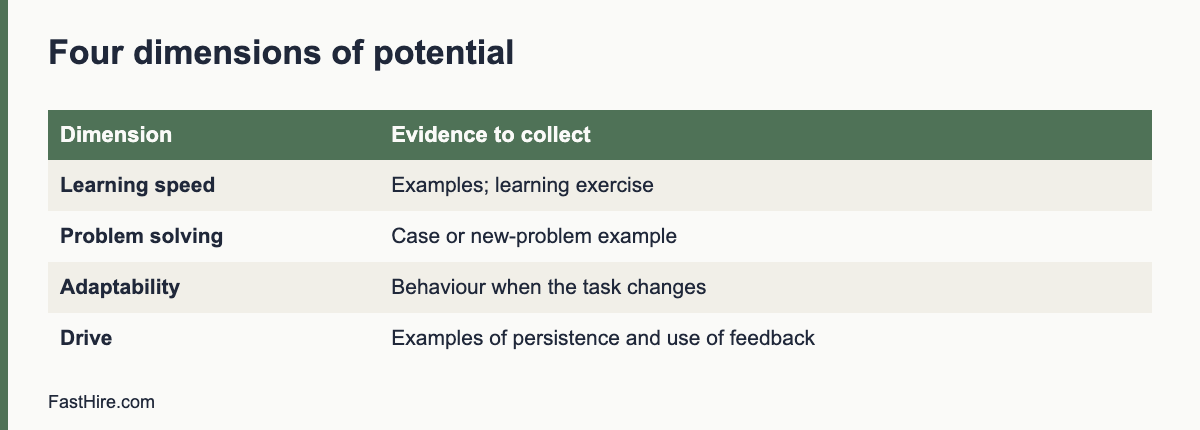
Employers often say they hire for potential. The phrase is vague. It can mean learning ability, ambition, a good attitude or simply “I like this person”. To make it useful, translate it into behaviours that you can check. For many roles, these four are a practical starting point:
| Dimension | What it looks like | Evidence you can collect |
|---|---|---|
| Learning speed | Picks up new tools, rules or domains quickly and applies them | Examples of learning a new area; a short learning exercise |
| Problem solving | Breaks down unfamiliar problems, asks useful questions, tests ideas | A case or scenario; examples of solving a new problem |
| Adaptability | Changes approach when facts change; handles uncertainty | Examples of changing plans; behaviour when the task changes during an exercise |
| Drive and persistence | Keeps going through difficulty and seeks feedback | Examples of long projects; how the person responded to failure |
Potential is not a replacement for evidence. It is a different type of evidence. It also does not mean youth. Many experienced people change fields and learn fast. Link back to your role brief and decide what the person must be able to do on day one and what they can learn in three to six months.
Decide which requirements can be learned
Use a simple split. For each requirement in the role brief, ask: Can a capable person learn this within our onboarding time, with the support we can give? If yes, it can be a learnable item. If no, it is a day-one must-have.
| Requirement (fictional example for a junior analyst) | Day-one must-have or learnable? | Reason |
|---|---|---|
| Basic spreadsheet use | Day-one must-have | Needed for the first task, and easy to test |
| Our specific reporting tool | Learnable | Training takes about two weeks |
| Clear written English | Day-one must-have | Reports go to clients from week two |
| Knowledge of our industry | Learnable | Reading and mentoring can cover it in three months |
| Statistics at graduate level | Day-one must-have for this role | The first project uses it |
Be honest with yourself. If you list 12 learnable items, the person will need a lot of support, and you must plan time for it. See must-haves vs nice-to-haves.
Interview questions that show potential
| Dimension | Question | Follow-ups | What a strong answer shows |
|---|---|---|---|
| Learning speed | Tell me about the hardest thing you learned in the last two years. How did you go about it? | How long did it take? How did you know you were improving? | A method (practice, feedback, resources), time scale and result |
| Learning speed | Tell me about a time you started a job or project where you had little experience. How did you get up to speed? | What helped? What would you do differently? | Active steps, asking for help, applying quickly |
| Problem solving | Describe a problem you had never seen before. What did you do first? | What did you check? What did you learn? | Structure, questions, testing ideas |
| Adaptability | Tell me about a time a plan changed at short notice. | How did you respond? What happened? | Calm, flexible, clear thinking |
| Drive | Tell me about something you stuck with despite setbacks. | What kept you going? What did you change? | Persistence with reflection |
| Feedback | Tell me about useful feedback you received. What did you do with it? | What changed? | Openness and action |
| Transferable skills | What skills from your previous work would help in this role? Give an example. | How would you apply them here? | Clear links between past and new tasks |
Use the same questions for all candidates and a scoring guide. See behavioural interview questions. Do not ask about age, family or health, even to judge “energy” or “commitment”. See what you can and cannot ask.
A learning exercise
A learning exercise shows how a person learns now, which is stronger than a story about the past. It takes 30 to 45 minutes. It has four parts.
- Teach. Give the candidate a short guide, a data set or a mini-lesson on something new to them (for example a simple rule set or a small tool). Allow 10 to 15 minutes to read it.
- Apply. Give a task that uses what they read. For example, apply the rules to five cases.
- Change. Mid-task, add a new fact or rule and see how they adjust.
- Reflect. Ask: What was easy? What was hard? What would you ask if you could?
| Criterion | Score 1 | Score 3 | Score 4 |
|---|---|---|---|
| Understanding the new material | Misreads the main rule | Applies the main rule correctly | Applies it and spots an edge case |
| Applying it | Many errors | Few errors | No errors; checks own work |
| Adapting to change | Ignores the change | Adjusts after prompting | Adjusts at once and explains |
| Asking questions | No questions | Relevant questions | Questions that improve the approach |
Use made-up material and tell candidates that you are not testing prior knowledge. Offer adjustments, extra time or alternative formats. Keep the exercise to the time stated. See how to assess skills with a work sample test for fairness and pay rules.
Guard against bias in “potential”
Potential is a judgement about the future, and judgements about the future are easily shaped by bias. Managers often see potential in people who resemble themselves: same school, same background, same style. Others may be judged on their “experience” and not on their capacity. Use these controls:
- Define potential in writing before the interviews.
- Use evidence, not labels. Write what the person said or did that shows the dimension.
- Use the same questions and the same exercise for everyone.
- Do not use age, years of experience as a proxy, or “energy” as a signal. Age discrimination law applies in many places. See Acas, the EEOC and the EU directives.
- Include a second reviewer on a sample of scores.
- Check the results by stage, where lawful, for patterns.
See also how to reduce bias in resume screening and the UK Equality Act guide. This is general information, not legal advice.
A scorecard for potential
| Dimension | Evidence from interview | Evidence from exercise | Score (1 to 4) | Support needed |
|---|---|---|---|---|
| Learning speed | ||||
| Problem solving | ||||
| Adaptability | ||||
| Drive |
Combine this with the scores for your day-one must-haves. Do not allow a high potential score to cover a missing must-have. Do not allow a low potential score to hide strong day-one evidence. In the debrief, discuss each dimension and make the final decision using both sets of scores. See how to run a debrief meeting.
Plan the support before you hire
| Support | Detail |
|---|---|
| Learning plan | A 90-day plan with milestones, reading, courses and tasks |
| Buddy or mentor | A named person who answers questions weekly |
| Clear goals | Three to five outcomes for each month |
| Regular feedback | Weekly 30-minute meeting in the first quarter |
| Review | A 30, 60 and 90-day review; adjust the plan |
| Budget | Time and money for training |
If you cannot provide this support, reduce the number of learnable items or hire for more experience. Hiring for potential without support is not a strategy, it is a gamble that transfers risk to the new person. See the onboarding plan for a template.
A worked example (fictional)
This example is invented. A team hires a junior data analyst. The must-haves are spreadsheet skills and clear writing. The learnable items are the company’s reporting tool and the sector. Four finalists take a 40-minute learning exercise: they read a one-page guide to a simple pricing rule, apply it to five orders, then get a new discount rule and apply it to three more. Candidate A, a recent graduate, applies the rule carefully and asks two good questions. Candidate B, a career changer from retail, makes two errors in the first part, then corrects them and applies the new rule correctly. Candidate C, who has similar experience to the team, applies the rules quickly but does not check the new rule. The panel scores learning speed as 3, 3 and 2, and adaptability as 3, 4 and 2. The panel also checks must-haves: all have them. They choose between A and B on the interview scores and references, and make a plan for B’s support, because B had the stronger adaptability score and the interview evidence of learning a new field. They record the reasons.
What to say to candidates about the exercise
Hello [Name],
The next step is a 40-minute exercise. You will read a short guide on something that may be new to you, apply it to a few cases and then adapt when we add a new rule. We are not testing prior knowledge. We want to see how you learn and solve problems. You may take notes and ask questions. If you need extra time, a different format or any other adjustment, please tell us and we will arrange it.
Best wishes,
[Name]
A clear explanation lowers stress and gives a fairer picture of how people work. Candidates who know what to expect perform closer to their ability.
Evaluating career changers and returners
Potential is often most visible in people who have changed field, returned after a break, or learned on their own. Their CVs may not match the usual pattern. Look for transferable skills and the way they learned. For a career gap, ask neutral questions about what the person did and learned, not why they left. Do not assume anything about the reason. See our guide on reading career gaps and short stints fairly. Be careful not to treat people with a different background as a risk by default. Test their evidence with the same standards as others.
Check the outcome after hire
Track whether people hired for potential succeed. Set a simple check at 90 days and six months: did they reach the learning goals, how did the manager rate their results, and what support did they need? Compare with other hires. If the ratings are lower, review the support plan, the exercise and the must-have list before you conclude anything about potential itself. If ratings are strong, record what worked and reuse it. Over a few hires, you will see which of your questions and exercises relate to later performance, and you can drop the rest.
Official sources for this topic: EEOC: employment tests and selection procedures, Acas: recruitment. These pages are maintained by the authorities and may change, so check them for the current text.
Frequently asked questions
What does “hire for potential” mean?
It means choosing a person based on their ability to learn and grow into the role, not only on current skills. Define it in behaviours you can observe.
How do I assess potential in an interview?
Ask for examples of learning something hard, use a learning exercise, and score the evidence on a written scale.
Is potential just another word for age?
It should not be. Using age or years of experience as a proxy can be discriminatory. Focus on learning behaviour.
Can potential replace experience?
Only for skills that can be learned within your onboarding time. Keep real day-one must-haves.
What support does a high-potential hire need?
A learning plan, a mentor, clear goals, regular feedback and reviews.
Related guides
- Hiring guides for hiring managers
- Behavioural interview questions with a scoring guide
- Must-haves vs nice-to-haves
- How to assess skills with a work sample test
- All hiring guides for employers
- How to decide whether to promote internally or hire externally
This is general information, not legal advice.