

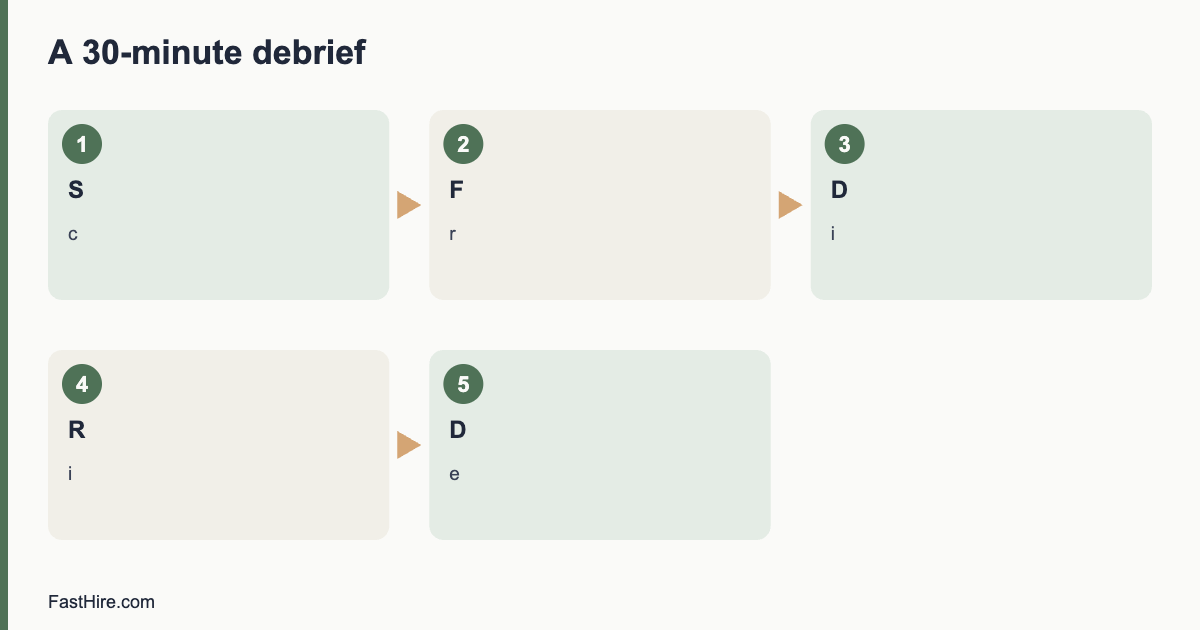
An interview debrief is a short meeting where interviewers share their scores and evidence, discuss differences and reach a hiring decision. To run one well, ask everyone to submit written scores before the meeting, speak in a fixed order with the most junior person first, discuss evidence rather than feelings, and record the decision and the reasons. Keep it to 30 minutes per finalist or less.
Key takeaways
- Collect written scores and notes before the meeting, so that no one is swayed by a senior voice.
- Speak in a set order. Start with the least senior interviewer and end with the hiring manager.
- Discuss evidence against the must-haves. Do not discuss “gut feel” without examples.
- Resolve differences by returning to the notes or by adding one targeted check.
- Write a short decision record: choice, reasons, risks and next steps.
Why debriefs go wrong
In many hiring teams, the debrief is a free conversation. The loudest or most senior person speaks first, others agree, and a vague feeling like “I just liked her” becomes the decision. This is fast, but it hides the evidence, repeats the same biases and makes it hard to defend the decision. It also wastes the work that interviewers did in their interviews.
A structured debrief fixes this. It takes the same time or less, and it gives you a record. If your interviews used a scorecard, the debrief is a short step from the scores. If they did not, start with our guides to structured interviews and the interview scorecard.
| Common problem | What happens | Structured fix |
|---|---|---|
| Anchoring on the first speaker | Others adjust to the first view | Collect scores in writing before the meeting |
| Senior voice dominates | Junior interviewers stay silent | Speak in order from the most junior |
| Feelings in place of evidence | “Good vibe” decides | Ask for an example for each score |
| Recency effect | The last candidate is remembered best | Use notes and scores, not memory |
| Hidden disagreement | Quiet doubts do not surface | Ask for the biggest concern from everyone |
| No record | Cannot explain the decision later | Write a decision record |
Before the meeting: what each interviewer submits
Ask each interviewer to submit three items within a set time after their interview, for example two hours, and before they speak to anyone else about the candidate.
- Scores for each must-have, on the agreed scale, such as 1 to 4.
- Evidence for each score: one or two facts or quotes from the interview.
- Overall recommendation: strong yes, yes, no or strong no, and the main reason.
Use a shared form or a spreadsheet. A simple layout is one row per must-have and one column per interviewer. A facilitator hides the names until the meeting, or reveals them only after everyone has submitted. This protects independent judgement.
The 30-minute agenda
| Minutes | Step | What happens |
|---|---|---|
| 0 to 3 | Set the frame | The facilitator restates the role, the must-haves and the rules of the meeting |
| 3 to 8 | Review the scores | Everyone looks at the grid. Mark the rows where scores differ by two points or more |
| 8 to 20 | Discuss differences | Go row by row through the differences. Each interviewer states the evidence for their score. Ask: “What did the candidate say or do that led to this score?” |
| 20 to 25 | Concerns and risks | Each person names the biggest risk. Decide whether it can be reduced by onboarding or support |
| 25 to 28 | Decide | Compare finalists on the grid. Name the first choice and a back-up. Check the decision against the must-haves |
| 28 to 30 | Next steps | Assign who calls the candidate, who checks references and who tells the others |
If you compare several finalists, run the same steps for each candidate before you compare them. Score first, compare later. Comparing too early can turn the debrief into a ranking contest where the best performer on a single day wins, instead of the person who best meets the criteria.
Roles in the meeting
| Role | Task |
|---|---|
| Facilitator | Keeps time, enforces the order, asks for evidence, keeps the group on the must-haves. This may be the recruiter or a neutral colleague, not the hiring manager if possible |
| Hiring manager | Makes the final decision after hearing the group; speaks last |
| Interviewers | Share scores and evidence; do not interrupt each other |
| Note taker | Records the scores, the reasons and the decision |
In a small business you may be the only decision maker. Ask one trusted outsider to read your scorecards and ask you questions. Even 15 minutes with another person improves the quality of the decision.
Rules for the discussion
- Refer to the must-haves. If a point is not related to the role, it does not count.
- Use examples, not labels. “She reduced late orders from ten to two a week” is evidence. “She seems senior” is not.
- Do not mention protected traits such as age, sex, race, religion, disability, family plans or accent. If someone does, the facilitator interrupts the comment and returns to the criteria.
- Do not use “culture fit” as a reason. Use specific behaviours the role needs.
- Separate risks from deal breakers. A risk can be managed in onboarding. A deal breaker is a missing must-have.
- Do not change the criteria during the meeting to favour a candidate.
For more on reducing bias, see how to reduce bias in resume screening, which also applies to interview decisions. In the UK, Acas explains fair recruitment. In the US, the EEOC lists prohibited practices on its page about prohibited employment policies and practices.
What to do when interviewers disagree
| Situation | Next step |
|---|---|
| Scores differ by one point | Accept the average, unless the evidence is weak |
| Scores differ by two or more points on a must-have | Each side reads their evidence aloud. If the evidence conflicts, ask whether the questions were the same |
| One interviewer has a strong concern others did not see | Ask what they saw. Decide if it needs a check, such as a reference or a short follow-up question |
| Two finalists are very close | Add one targeted check: a work sample, a reference call or a second conversation on one must-have |
| The group is split on the final choice | Return to the must-haves. If still split, the hiring manager decides and records the reasons |
Do not settle disagreements by voting alone. A vote hides the reasons. A short written reason for the final choice is more useful. For a deeper guide to deadlocks, see our upcoming article on how to decide when the team disagrees.
A decision record template
| Field | Entry |
|---|---|
| Role and date | |
| Finalists considered | |
| Decision | |
| Evidence for each must-have | |
| Risks and how to manage them | |
| Differences discussed and how they were resolved | |
| Reference checks needed | |
| Next steps and owner | |
| Date records will be deleted |
Keep the record secure. Share it only with people who need it. Delete it when your policy or the law requires. In the UK and EU, data protection rules apply to these notes. A candidate may ask to see data held about them. Write notes that you would be comfortable showing to the candidate.
A worked example (fictional)
This example is invented. A team hires a marketing coordinator. Three interviewers each score three finalists on four must-haves with a scale of 1 to 4.
| Must-have | Interviewer A | Interviewer B | Interviewer C | Notes |
|---|---|---|---|---|
| Writes clearly | 4 | 3 | 4 | All saw the sample email |
| Plans campaigns | 2 | 4 | 3 | A asked about planning; B asked about a campaign. Questions differed |
| Uses data | 3 | 3 | 3 | Agreed |
| Works with others | 3 | 3 | 4 | Agreed |
The facilitator noticed the two-point gap on “plans campaigns”. She asked A and B what each had asked. A had asked a general question and had received a short answer. B had asked for an example, and had received a detailed one. The group agreed that B’s evidence was stronger. They asked A to re-score from the notes and the score became 3. The group chose the candidate and recorded the reason: strong writing and evidence of planning, with a risk on data tools that onboarding would cover.
Remote debriefs
- Collect scores in a shared form before the call.
- Use video, so that the facilitator sees who wants to speak.
- Use the chat to flag when someone wants to add a point.
- Share the grid on screen.
- Save the recording only if your policy allows. Written notes are enough.
After the debrief
- Call the chosen candidate within one working day.
- Send reference requests or checks as agreed.
- Tell the other finalists the outcome and give brief feedback if you can. See our upcoming guide on giving fast feedback.
- Store the record.
- Review: what would make the next debrief faster?
For a deeper view of the process before the debrief, see the recruiter kickoff meeting and behavioural interview questions. CIPD offers a recruitment factsheet on good practice.
Questions the facilitator can use
| Moment | Question |
|---|---|
| A score has no evidence | What did the candidate say or do that led to this score? |
| A strong opinion without a reason | Which must-have does this relate to? |
| Everyone agrees very fast | What is the strongest argument against this choice? |
| A vague concern | What would we need to see to feel sure about this point? |
| A comment about personality | Can you describe the behaviour you saw, and why it matters for this job? |
| Pressure to decide quickly | Which facts are still missing, and can we get them in one day? |
These questions work because they are neutral. They do not accuse anyone, and they bring the group back to the evidence. Print them for the facilitator and read them aloud when needed.
Keep the debrief fair for candidates
The debrief is the point where hidden bias often enters. Remind the group of three habits. First, compare candidates to the criteria, not to each other. Second, treat equal evidence equally, whatever the person’s background. Third, check whether you applied the same questions and the same time to each candidate. If one candidate got a longer interview or a friendlier setting, note it, and adjust the weight you give to the extra information.
If you hold monitoring data about applicants and the law allows you to use it, review it after the decision, not during it. Do not use it to choose individuals. Use it to check whether your process has patterns that need review. Take advice if you are unsure.
Metrics to review after three debriefs
| Question | What it tells you |
|---|---|
| How often did scores differ by two points or more? | Whether the questions or scales need clearer wording |
| How long did the meeting take? | Whether the preparation works |
| How often did the group change a score after discussion? | Whether discussion adds value or only pressure |
| Did the chosen candidate perform well at six months? | Whether your criteria predict success |
| Did any candidate complain about the process? | Whether the experience needs a change |
Keep these notes together. After several hires you will see which must-haves and which questions help most. That evidence is more useful than any rule of thumb.
Frequently asked questions
Who should attend the debrief?
Everyone who interviewed the candidate, the hiring manager and a facilitator. Keep the group small, five people or fewer if possible.
Should we debrief right after each interview?
Collect scores right after each interview. Hold the group debrief when all interviews for the role are done, or after each finalist if you must move fast.
What if the hiring manager disagrees with the group?
The hiring manager usually decides. They should write the reason in the decision record and explain it to the group.
Is it fine to talk about “fit”?
Only if you define it as specific behaviours the job needs and give examples. Avoid vague fit statements.
How long should a debrief take?
About 30 minutes per role if scores were submitted in advance. Add 10 minutes per extra finalist.
Related guides
- Hiring guides for hiring managers
- Structured interviews: what they are and how to run one
- Interview scorecard template with a worked example
- Behavioural interview questions with a scoring guide
- All hiring guides for employers
- How to give fast interview feedback without cutting corners
- How to write a good interview plan for a new role
- How to avoid bias in interviews: 12 practical controls
- How to take interview notes that help you decide
- How to compare candidates with different backgrounds
- How to make a hiring decision when the team disagrees
This is general information, not legal advice.