

To close a candidate honestly, call them with the offer, tell them the decision first, explain the terms plainly, ask what concerns they have, answer truthfully, agree a clear date for their reply, and follow up in writing. Do not use pressure, invented deadlines or promises you cannot keep. Candidates who say yes with full information stay longer.
Key takeaways
- Prepare the pay, the extras, your limits and the answers to likely questions before you call.
- Lead with the decision, then the main terms. Keep the call calm and direct.
- Ask open questions about concerns and listen. Answer honestly, including about weak points.
- Give a fair deadline and send the written offer the same day.
- No pressure tactics: no fake rivals, no short fuses, no promises beyond what you can deliver.
What closing means, and what it does not
In sales language, closing is about pushing for a yes. In hiring, closing means helping a person make a good decision with full information. You want them to join, but you also want them to stay, and a person who feels pressured or misled is less likely to do either. An honest offer conversation is clear, warm and fair. It gives the candidate what they need to decide and respects their right to say no.
Step 1: prepare before you call
- Pay: the offer inside your range. See how to set a fair salary.
- Extras: bonus, holiday, flexibility, training, review date. Only list what you can deliver.
- Limits: the most you can offer, the latest start date, and what you can and cannot change.
- Approvals: confirm that you have the authority to make the offer.
- Candidate profile: what they said they care about, from the interviews. Use their words.
- Likely concerns: pay, commute, growth, team, manager, workload. Prepare honest answers.
- Documents: the written offer, ready to send. See offer letter template.
- Conditions: references, right to work and any other checks. See how to check the right to work.
Check the fairness of your offer against others in the team who do similar work. If the offer differs, be ready to explain the job-related reason. See pay transparency in hiring.
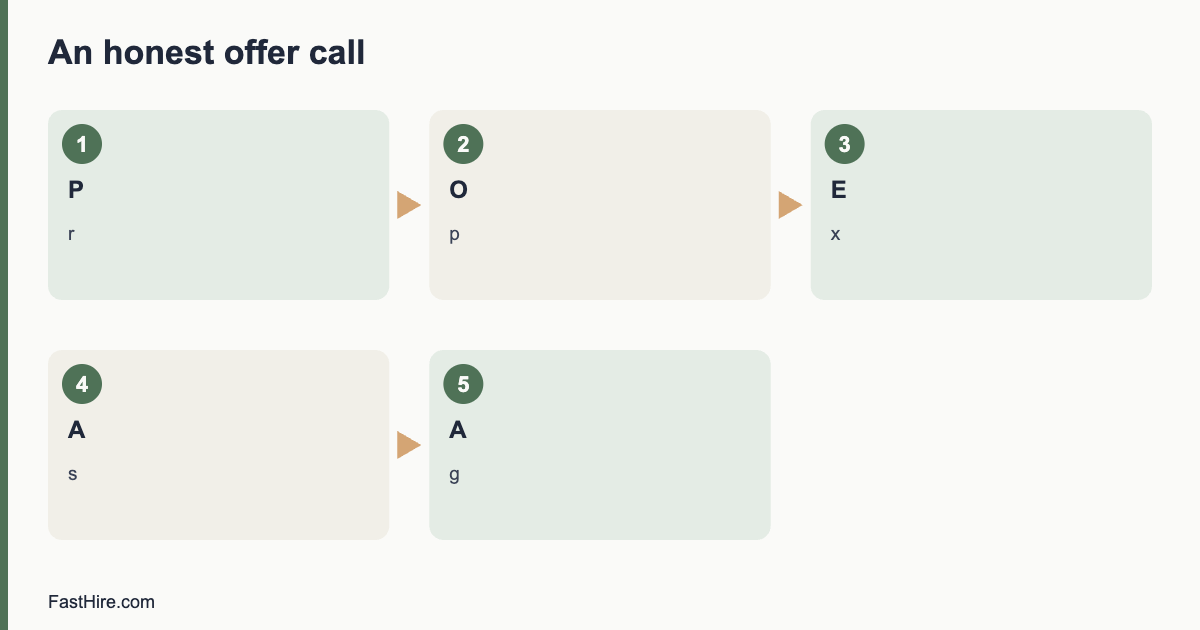
Step 2: the call script
- Greeting and good news: “Hello [name], thank you for taking my call. I am pleased to say that we would like to offer you the [role].”
- Why them: one or two true points from the interviews. “Your examples of [skill] stood out.”
- Main terms: pay, start date, hours, place, key conditions. Keep it short.
- Pause: “How does that sound?” Let them respond.
- Ask: “Is there anything that would make this a clear yes for you, or anything you are unsure about?” Listen.
- Answer honestly. If you do not know, say so and promise a time to reply.
- Timeline: “Could you let me know by [date]? I will send the written offer today.”
- Close warmly: “I would be delighted to have you join us. Please call me with any question.”
Step 3: handle common concerns honestly
| Concern | Honest approach | Avoid |
|---|---|---|
| Pay is lower than hoped | Explain the range and how you set it. Say what can move and what cannot. Offer a review date only if you will hold it. | Promising a raise that is not agreed |
| Growth path unclear | Describe the real routes and timing. Say what you do not know. | Inventing titles |
| Workload or hours | Give the real picture, including peak periods. | Saying “it is fine” if it is not |
| Manager style | Offer a conversation with the manager and a future colleague. | Speaking badly of anyone |
| Another offer | Ask the date and what matters. Do what you can within your limits. | Pressure or false rivals |
| Commute or flexibility | Say what is possible now and what is not. Put any agreement in writing. | Making verbal promises |
If the candidate raises a counter-offer from their employer, see how to handle a counter-offer.
Step 4: pay conversation
Speak about pay clearly. State the number and what it covers. Explain how it relates to the range and to their skills. If the candidate asks for more, ask what they base the request on. If you can move inside your range for a job-related reason, do so and say why. If you cannot, say so plainly and offer other value if you honestly can. Do not hint that more may come later unless it is planned. Keep records of the final number and the reasons.
Do not ask about past pay where the law bars it, and do not let past pay set the offer. Use the job and the range. See salary in job ads for related rules.
Step 5: set a fair timeline
Give enough time to decide. A few days is usual, and more for a big move. Say the date, and why. If the candidate asks for more time, consider it if you can, and agree a new date. If you have a hard limit, explain it and let the candidate choose. Do not invent a deadline to push them. Keep your other finalists informed honestly, as in how to keep your best candidate warm.
Step 6: confirm in writing
Send the written offer the same day, with the key terms: role, start date, pay, hours, place, probation, notice and conditions. Make sure it matches what you said. Add a line inviting questions. Read the probation period guide to check how to describe probation terms by country.
What not to do
- Do not use fake urgency, such as “another candidate is waiting”, unless it is true and relevant.
- Do not promise a promotion, bonus or remote days that you cannot guarantee.
- Do not criticise the current employer or the candidate other options.
- Do not ask about protected topics, such as plans for children, to judge commitment.
- Do not announce the hire to others before the candidate accepts.
- Do not make the candidate feel guilty for asking questions.
Legal and fairness points
- Offers should be based on job-related factors. Equal pay rules apply in the US, UK and EU. See the EEOC equal pay page and GOV.UK employing people.
- Make sure verbal and written terms match. A verbal promise can create obligations.
- Keep the candidate data private and use it only for hiring. See GDPR for job applicants.
- Right to work checks and other conditions should apply to every hire in the same way.
If the candidate says no
Thank them for their time and their honesty. Ask, without pressure, what made the difference. The answer is useful for your next offer. Keep the door open: “If things change, I would be glad to hear from you.” Then move to your second choice without delay, honestly and respectfully. Record the reason for the decline to improve your pay range, your timeline or your pitch next time.
If the candidate says yes
- Thank them and confirm the next steps and dates.
- Send the written offer if you have not already.
- Plan contact during the notice period so the person feels welcome.
- Prepare the first day and the first weeks, using the 30-60-90 day plan guide and first 30 days guide.
- Tell the other finalists kindly. See how to turn down a candidate kindly.
Worked example (fictional)
A hiring manager prepares an offer for a senior analyst. She sets the pay inside the range, lists the extras she can deliver (a learning budget and a review at six months), and writes her limit. On the call she says, “We would like to offer you the role. Your example of rebuilding the forecast model stood out.” She lists the pay, the start date and the conditions, and asks, “What would make this a clear yes?” The candidate says that the commute is long. The manager explains that two days from home are possible now, and that more would need the team agreement, so she cannot promise it. The candidate asks for a few days. The manager agrees a date, sends the written offer that day, and the candidate accepts with two days to spare.
Tone: how to sound like a person, not a script
A script helps you cover the points, but the call should sound like you. Use plain words, short sentences and a warm voice. Smile when you speak; people can hear it. Pause after you give the good news and let the candidate react. If they sound unsure, say so kindly: “I hear some hesitation. What is on your mind?” Then listen without rushing to answer. If you disagree with a point, say so respectfully and give your reason. A calm, honest voice builds more trust than a polished pitch.
Take notes during the call. Afterwards, send a short message that repeats the main terms and the date for the reply. This avoids misunderstanding, and it helps the candidate think. If they ask questions later, answer within a day.
Sell the job truthfully
Candidates want to know why this job and this team. Prepare three true points: what the work is, what the person will learn or achieve, and what is good about the team or the way it works. Use examples from your own team: a recent project, a way of working, a person who grew in the role. Include one honest challenge, such as a busy season or a tool that is being replaced. Candidates remember honesty, and it shows that you trust them with the truth.
Closing a candidate who is passive or quiet
Some candidates give little away. They may be cautious, shy or deciding alone. Do not read silence as a no. Ask a few open questions: “What would you like to know about the first weeks?” “Who else would you like to speak to before you decide?” Offer a second conversation with a future colleague. Give them time. Check in at the agreed date with a short message. If you hear nothing by then, call once and then close politely with a final date.
Closing across borders and time zones
If the candidate lives in another country, the offer needs more care. Contracts, tax, notice and right to work rules differ. Make sure the terms match local law, and say who will explain them. Read how to hire in another country before you call. Choose a time that suits the candidate, write dates with the time zone, and offer a video call rather than a long audio call if that helps.
Review your closing after each hire
After the candidate accepts or declines, take ten minutes to review. Note how long the offer took from decision to call, what concerns came up, what you said, what the candidate chose and why. Ask newly hired people, after a month, what helped them say yes and what they wish they had known. Ask people who declined, kindly, what made the difference. Put the answers in a simple log. After a few hires, you will see patterns: perhaps pay is rarely the issue but flexibility is, or perhaps speed matters most. Use the patterns to improve your offers, your timelines and your conversations. This turns each close into a lesson for the next, and over time raises your acceptance rate without any need for pressure.
Share what you learn with other managers, and keep a shared set of honest answers to the common questions: pay, growth, hours, remote days, training. A shared set avoids contradictions between managers and makes it easier for HR to check that every candidate hears the same truth. Update the set each year or when policies change, and remove any answer that is no longer accurate.
Frequently asked questions
Is it okay to sell the job to a candidate?
Yes, if you are honest. Describe the real strengths and the real challenges. Do not exaggerate or promise what you cannot deliver.
How long should I give a candidate to decide?
A few days is common, and more for a large move. Agree a date and keep to it. Avoid invented deadlines.
Should I call or send an email first?
Call first for the human touch, then send the written offer the same day.
What if the candidate asks for more pay?
Check your range and fairness to others. If you can move for a job-related reason, do so. If not, explain and offer other value if you honestly can.
Related guides
This is general information, not legal advice.